This roadmap is designed for a fresher—someone with curiosity, strategic thinking, and a desire to shape products that users love. You will learn Agile methodologies, data analytics, roadmapping, and product strategy through a structured path that mirrors how successful product managers actually work in 2026. The goal is to transform you from someone who "has ideas" into a professional who can validate problems, prioritize solutions, align stakeholders, and drive product success. This path prepares you for entry-level roles like Associate Product Manager (APM), Junior Product Manager, or Product Analyst in a market where product management is becoming one of the most exciting and impactful career paths .
🗺️ Phase 1: The Mindset Shift – What Product Management Really Is (Weeks 1-2)
Before you learn any framework or tool, understand that product management is not about being the "CEO of the product." It is about creating value for users and the business by solving real problems. Unlike project managers who focus on execution timelines, product managers focus on the "why" and "what"—why are we building this, and what problem does it solve?
What a Product Manager Actually Does
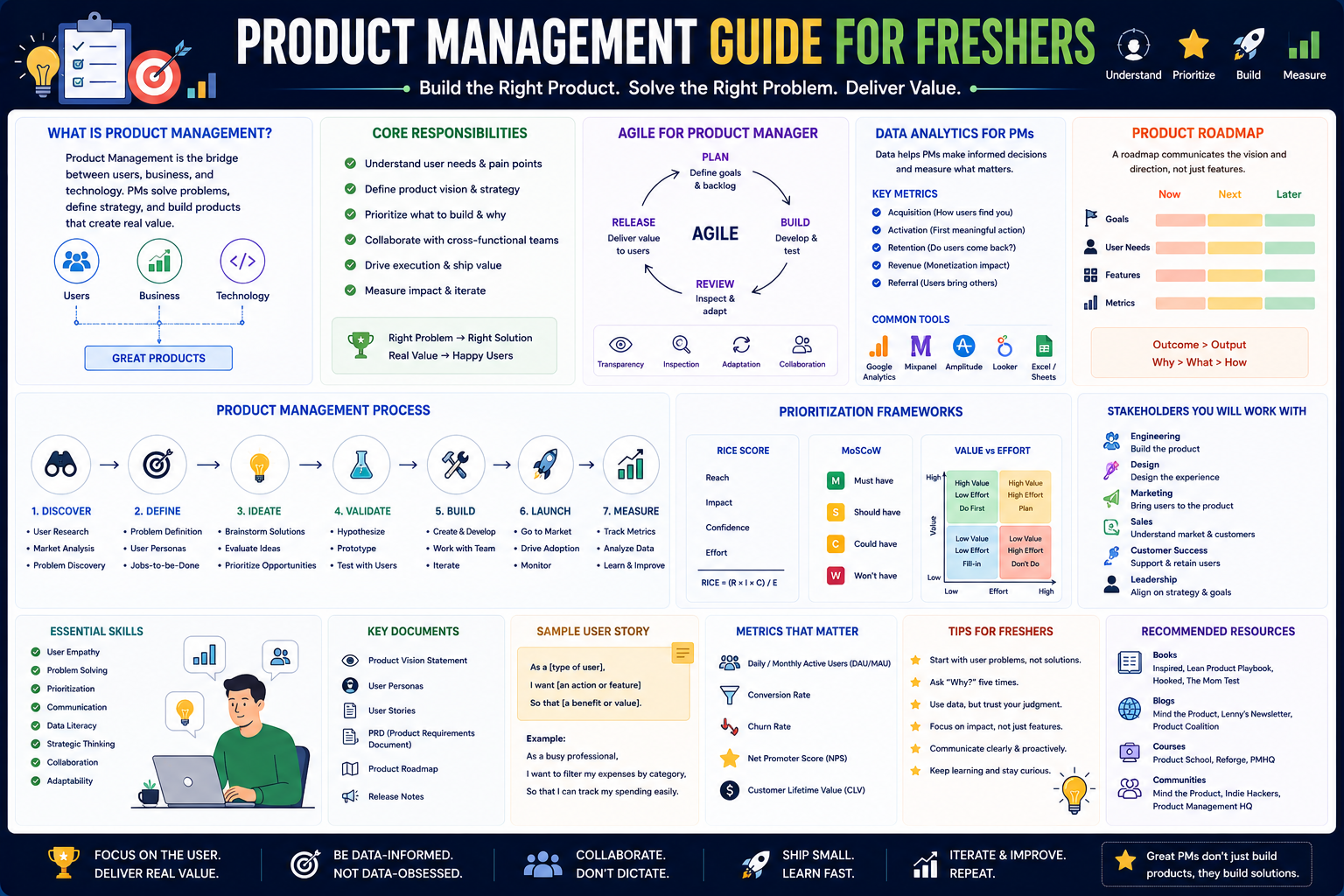
Think of a Product Manager as the person who keeps everyone aligned toward building something people actually want . The core responsibilities include:
- Product Vision & Strategy: Creating the big-picture plan—where the product should go and how it gets there
- Market Research & User Discovery: Talking to customers, analyzing competitors, figuring out what problems are worth solving
- Roadmapping & Prioritization: Deciding what features matter most and making tough calls about trade-offs
- Stakeholder Management: Working with engineers, designers, marketers, executives, and customers to keep everyone aligned
- Launch & Post-Launch Analysis: Tracking performance, gathering feedback, and figuring out what to improve next
The 2026 Product Management Landscape
Product management now combines business strategy, AI tools, analytics, and leadership skills . Specialization paths include:
- Technical PM: Works on complex tech products, close collaboration with engineering on APIs and system architecture
- Growth PM: Focuses on user acquisition, engagement, and retention metrics
- Data Product Manager: Leverages analytics and AI to drive product decisions
- Platform PM: Builds products that other products are built on top of
- Consumer PM: Works on apps that regular people use daily (social media, food delivery, entertainment)
- B2B Product Manager: Creates products for businesses, solving serious operational problems
Prerequisite Check
You need curiosity, analytical thinking, and a willingness to learn. No prior product experience required. A free Google account will give you access to Coursera audit options.
Practice Goal for Phase 1: Pick an app you use daily. Write down three things you would improve and why. Then ask yourself: "What problem would this solve for users? What evidence do I have that this is a real problem?" This is your first product thinking exercise.
Free Resources for Phase 1:
- Free Product Map (Interactive Guide) – The biggest free interactive guide for everything related to Product Management, organizing all topics and skills from initial idea to market success. Sections include business models, product-market fit, MVP, market segmentation, OKRs, user research, KPIs, agile methods, and soft skills. You can start based on your level (Beginner–Intermediate–Expert) and build a personalized learning plan. Each section includes links to books, courses, templates, and ready-to-use work examples .
- GUVI Product Manager Roadmap 2026 – A comprehensive guide breaking down everything you need to know about becoming a PM, including what PMs actually do, skills you need, exact steps to follow, and how to land your first PM role .
📊 Phase 2: Product Fundamentals & Market Research (Weeks 3-6)
Before you can build anything, you must understand the market and the user. This phase is about learning before building.
Core Concepts to Master
Product Lifecycle: Products go through stages—introduction, growth, maturity, and decline. Understanding this helps you make different decisions at different stages .
MVP vs. Full Product: MVP (Minimum Viable Product) means building the simplest version that still solves the core problem. Launch it, get feedback, then improve. This is far better than building a perfect product that nobody wants.
Market Analysis: Understand your industry, spot trends, and know what's happening in the market. Study what competitors are doing—not to copy them, but to understand where opportunities exist .
Product Positioning: Figure out how to present your product so it stands out. Why should someone choose your product over 50 others?
User Personas: Create fictional characters representing your typical users. This helps everyone understand who you're building for .
Customer Journey Mapping: Map every step a user takes when interacting with your product. Where do they get stuck? Where do they bounce? This helps you find problems to fix.
User Interviews: Talking to real users is one of the most valuable skills. You learn what they struggle with, what they love, and what features would actually help them .
Practice Goal: Choose a product category you care about (e.g., food delivery, fitness tracking, productivity apps). Conduct "research" by talking to 5 people about their experiences with existing products. Create 2 user personas and map one user journey. Identify 3 opportunities for improvement.
Free Resources for Phase 2:
- Free Product Map (Market Research & UX Section) – Includes all research steps and guidance on creating strong user experiences, with frameworks for market segmentation and user research .
- GitHub Product Development Guides – Battle-tested product development guides covering user research methodologies, customer journey mapping, survey design and analysis, and customer feedback systems .
- Harvard Online Course (Free Audit) – "Integrative Frameworks: Product Management (Module 1)" covers product discovery, user research, uncovering real problems, and validating opportunities .
🗺️ Phase 3: Product Strategy & Roadmapping (Weeks 7-10)
This is where you learn to translate vision into actionable plans. Good strategy makes prioritization obvious.
Core Concepts to Master
Vision, OKRs, and KPIs: Your vision is your north star. OKRs (Objectives and Key Results) help you set measurable goals. KPIs (Key Performance Indicators) help you track success . The Free Product Map includes dedicated sections on writing and organizing OKRs simply .
Prioritization Frameworks: These help you decide what to build first :
- RICE: Scores features based on Reach, Impact, Confidence, and Effort
- MoSCoW: Categorizes features as Must-have, Should-have, Could-have, or Won't-have
- Kano Model: Helps understand which features delight users versus just satisfy them
Roadmap Creation: A roadmap shows your plan visually—what you're building, when, and why. Good roadmaps get everyone excited and aligned .
Product Strategy Micro-Certification (Free): Product School offers a completely free Product Strategy Micro-Certification covering market analysis, customer analytics, product vision and mission, roadmaps, OKRs, prioritization, and stakeholder alignment communication. Includes simple hands-on exercises and industry examples .
Practice Goal: Define a product vision for a hypothetical product (e.g., "a task management app for students"). Write 3 OKRs that support that vision. Create a roadmap for the next 3 months. Use RICE to prioritize 5 potential features.
Free Resources for Phase 3:
- Product School Free Micro-Certifications – Five completely free micro-certifications including Product Strategy (market analysis, product vision, roadmaps, OKRs) and Product Roadmapping (clear data-informed prioritization, roadmap types, integrating roadmaps into process and culture) .
- Free Product Map (Strategy & Roadmapping) – Includes clear sections for product strategy and roadmapping with concise explanations and ready-to-use frameworks .
- Coursera Product Management Course (Free Audit) – Includes practical applications of roadmapping, metrics, and analytics to guide product strategies. Features a real-world example of a product roadmap in Jira .
⚡ Phase 4: Agile & Product Development Process (Weeks 11-14)
Agile is how modern product teams work. You don't need to be a certified Scrum Master, but you must understand the rhythms and rituals.
Core Concepts to Master
Agile Fundamentals: Learn the history, principles, and values of Agile. Understand the differences between Scrum (works in fixed time periods called sprints, usually 2 weeks) and Kanban (more continuous flow) .
Sprint Planning: Where the team decides what to build in the next sprint. You'll discuss user stories, estimate effort, and commit to what's achievable .
Backlog Grooming: Your backlog is your to-do list of features and fixes. Grooming means keeping it organized and prioritized so the team always knows what's next .
Writing User Stories: Describe features from the user's perspective using the format: "As a [user type], I want to [action] so that [benefit]." Good user stories help developers understand the "why" behind what they're building .
Key Agile Tools: JIRA for tracking work, Confluence for documentation, and Trello for simpler visual organization .
Practice Goal: Write 5 user stories for a feature you imagine (e.g., "dark mode" or "push notifications"). Create a backlog with those stories. Simulate a sprint planning session—which stories would you commit to for a 2-week sprint?
Free Resources for Phase 4:
- Free Product Map (Agile & Lean Section) – Covers modern management methods and process simplification, including Agile principles .
- Coursera Digital Product Management Specialization (Free Audit) – From University of Virginia, courses include "Agile Meets Design Thinking," "Hypothesis-Driven Development," "Agile Analytics," and "Managing an Agile Team" .
- GitHub Product Development Guides – Covers agile methodologies, product development frameworks, and MVP development strategies .
📈 Phase 5: Data Analytics for Product Managers (Weeks 15-18)
You cannot manage what you cannot measure. Data analytics is how you validate decisions and prove impact.
Core Concepts to Master
Product Metrics Fundamentals: Understand the difference between vanity metrics (page views, downloads) and actionable metrics (retention, conversion, engagement). Learn acquisition metrics (where users come from), retention metrics (do they come back?), and behavioral metrics (what do they do?) .
A/B Testing: Experimental design principles for testing hypotheses. Learn how to set up experiments, interpret statistical significance, and use testing frameworks. The GitHub Product Development Guides include comprehensive A/B testing frameworks and experimentation methodology .
Analytics Tools: Learn the basics of Google Analytics (tracks website traffic and user behavior), Mixpanel/Amplitude (focus on user actions and conversion funnels) .
Product Analytics Micro-Certification (Free): Product School's free Product Analytics certification covers building and analyzing behavioral metrics, acquisition and retention metrics, and experiments .
Practice Goal: Define 5 key metrics for a product you use daily. How would you measure user engagement? Retention? Success? Design a simple A/B test for one feature change.
Free Resources for Phase 5:
- Product School Free Product Analytics Micro-Certification – Covers building and analyzing your own behavioral metrics, acquisition and retention metrics, and experiments .
- Free Product Map (KPIs & Analytics Section) – Tools to measure results and analyze performance professionally .
- GitHub Product Development Guides – Comprehensive A/B testing frameworks, statistical analysis and interpretation, product analytics implementation, and conversion optimization strategies .
🎓 Phase 6: Certifications & Portfolio Building (Weeks 19-22)
While hands-on experience is most valuable, certifications help you structure learning and stand out to recruiters. Free options build strong fundamentals, while paid certifications provide industry-recognized credentials .
Free Certification Options
Product School Free Micro-Certifications (5 total) – Completely free certifications covering:
- Product Strategy (market analysis, product vision, OKRs, stakeholder alignment)
- Product Roadmapping (data-informed prioritization, roadmap types)
- Product Analytics (behavioral metrics, experiments)
- Product-Led Growth (acquisition, conversion, retention metrics)
- Product Launches (positioning, pricing, go-to-market plans)
Google Project Management Certificate (Coursera Free Audit) – While focused on project management, this covers many foundational skills valuable for product managers including stakeholder management and execution frameworks. You can audit the full program for free.
Paid Certification Options (Consider After Free Content)
Google Product Management Certificate (Coursera) – One of the best beginner-friendly programs for learning product strategy and project workflows .
Udacity Product Manager Nanodegree – Offers hands-on projects, AI-focused lessons, and practical portfolio building .
Product School's PM Certification – Highly valued for live mentorship, real-world case studies, and strong hiring networks .
Building Your PM Portfolio
You don't need professional experience to demonstrate product thinking. Your portfolio should include:
- Product Teardowns: Analyze existing products, identify strengths/weaknesses, propose improvements with rationale
- Case Studies: Document a hypothetical product from problem discovery to launch strategy, including user research, personas, journey maps, prioritization, and roadmap
- A/B Test Design: Propose an experiment for a real product, including hypothesis, success metrics, and interpretation plan
Practice Goal: Create a product teardown of an app you use frequently. Write a 2-page case study including user personas, journey map, 3 prioritized recommendations with RICE scores, and a sample roadmap.
📚 Consolidated Resource Toolkit
Completely Free, Comprehensive Resources
Free Product Map (Interactive Guide) – The largest free interactive guide for everything related to Product Management. Organizes all topics and skills from initial idea to market success. Start based on your level (Beginner–Intermediate–Expert) and build a personalized learning plan. Sections include business models, product-market fit, MVP, market segmentation, OKRs, user research, design/UX, marketing, KPIs, agile methods, and soft skills. Each section contains concise explanations, ready-to-use frameworks, and links to books, courses, templates, and practical exercises .
Product School Free Micro-Certifications (5 certifications) – Completely free micro-certifications covering Product Strategy, Product Roadmapping, Product Analytics, Product-Led Growth, and Product Launches. Each includes video lessons, hands-on exercises, industry examples, and a shareable certificate .
GUVI Product Manager Roadmap 2026 – Comprehensive 7-step roadmap from beginner to industry-ready PM covering product fundamentals, market research, product strategy, agile development, technical knowledge, hands-on experience, and job preparation. Includes salary data for Indian market (₹10-18 lakhs for freshers) .
Harvard Online Course (Free Audit) – "Integrative Frameworks: Product Management (Module 1)" covering product discovery, user research, product strategy and roadmapping, product metrics and analytics, and career growth in product management. Offered through Harvard Graduate School of Design .
Coursera Digital Product Management Specialization (Free Audit) – From University of Virginia, covering digital product management, agile meets design thinking, hypothesis-driven development, agile analytics, and managing an agile team .
GitHub Product Development Guides – Battle-tested product development guides covering product development frameworks (10x methodology), UX design process, A/B testing frameworks, customer feedback systems, product analytics, and feature prioritization frameworks .
Practice Tools & Platforms
JIRA / Trello / Confluence – Free tiers available for practicing backlog management, sprint tracking, and documentation.
Figma (Free Tier) – For understanding design workflows and reviewing prototypes.
Google Analytics Demo Account – Free access to a real Google Analytics property for practicing data analysis.
AI Tools for Product Managers
AI for Product Requirements: Tools that turn product requirements into prototypes and production-ready solutions. The Tubi APM program specifically mentions leveraging cutting-edge AI tools to accelerate product development .
AI-Assisted Analytics: Modern product analytics platforms increasingly include AI features for insight generation and anomaly detection.
💼 Career Application & Next Steps
Product management is a high-growth field. In India, freshers/APMs typically earn ₹10-18 lakhs per year . In the US, APM programs offer competitive compensation with structured career development. According to GUVI's roadmap, "Product management is lowkey becoming one of the most exciting career paths in 2026" .
1. The Fresher Entry Point
Associate Product Manager (APM) – Entry-level rotational programs designed for early-career professionals. You'll rotate through multiple product teams, gaining experience in product strategy, user experience, and data-driven decision-making. Work with engineers, designers, and business stakeholders to define product roadmaps, prioritize features, and drive execution. Ideal for individuals with strong analytical mindset and passion for building technology .
Junior Product Manager – Focuses on specific features or smaller products within a larger portfolio. You'll conduct user research, write user stories, manage backlogs, and support senior PMs.
Product Analyst – Data-focused entry point. You'll analyze user behavior, generate insights, and help inform product decisions. Many PMs transition from analytics roles.
Industries actively hiring include technology (FAANG, startups, SaaS), fintech (banking, investment apps), e-commerce (shopping and delivery), healthcare (patient portals, telemedicine), and consulting (client product work).
2. APM Programs: Your Fastest Path In
Associate Product Manager programs are structured apprenticeships designed specifically for early-career professionals. The Tubi APM program (San Francisco) offers rotations across three product teams, mentorship, executive exposure, and training sessions. Eligibility includes Bachelor's or Master's degree in Sciences, Mathematics, Business, Engineering, or related field, up to three years of combined professional experience including internships, and strong analytical and problem-solving skills .
How APM programs work: You'll rotate through multiple product domains, gaining strategic experience across different business areas. Work with engineering, design, and business teams to define and build impactful products. Conduct user research, competitive analysis, and generate data-driven insights. Manage the end-to-end product lifecycle from ideation to launch. By the end, you transition into a non-rotational full-time product management role .
Companies offering APM programs: Google (APM), Microsoft (Program Manager), Meta (Rotational Product Manager), Tubi (Builder's Program), and numerous startups and mid-sized companies.
3. Build Your PM Portfolio
You don't need professional experience. Build these three portfolio projects to demonstrate product thinking:
Project 1 (Product Teardown):
- What: Choose a product you use daily (Spotify, Instagram, Uber). Analyze its user experience, feature set, and business model. Interview 3-5 users about pain points. Create user personas and journey maps. Propose 3 specific improvements with prioritization rationale (RICE scores). Include a sample roadmap.
- Why: Demonstrates user empathy, analytical thinking, and structured problem-solving.
Project 2 (Hypothetical Product Launch):
- What: Design a product from scratch to solve a problem you've experienced (e.g., "meal planning for busy professionals"). Conduct "customer discovery" with 5 potential users. Define product vision, success metrics (KPIs), and an MVP scope. Create a 3-month roadmap with prioritized features. Write user stories for the first sprint.
- Why: Shows end-to-end product thinking from problem discovery to execution planning.
Project 3 (A/B Test Design):
- What: Choose a live product with a clear conversion funnel (e.g., checkout flow, sign-up form). Design an A/B test to improve a specific metric (e.g., completion rate). State your hypothesis, define success metrics, calculate sample size needed, and explain how you would interpret results.
- Why: Data-driven decision-making is a critical PM skill that distinguishes you from "idea people."
4. Certifications That Matter
While not required, certifications validate your knowledge and help your resume get noticed:
- Product School Micro-Certifications (Free) – Great for demonstrating foundational knowledge on LinkedIn
- Google Product Management Certificate (Paid) – Recognized by employers, includes practical projects
- Coursera Digital Product Management Specialization (Free Audit) – From University of Virginia; the certificate is paid but knowledge is free
5. The Interview Question You Will Be Asked
Question: "How would you improve the user experience of a food delivery app's checkout flow?"
Your Answer: *"I would start with user research, not features. I would interview 5-7 users who abandoned checkout in the last week to understand their specific friction points. I would analyze data to see where drop-offs occur—is it at the cart page, payment screen, or order confirmation?*
Based on that research, I would create a hypothesis: 'Users abandon checkout because estimated delivery times are unclear and surprise fees appear late.' I would prioritize solutions using RICE—maybe adding real-time delivery estimates early in the flow (high impact, moderate effort) versus rebuilding the entire payment system (high effort, lower incremental impact).
*I would design an MVP solution: add delivery time estimates on the restaurant page and consolidate all fees before the final checkout step. I would A/B test this with 10% of users, tracking completion rate as the primary metric. If successful, I would roll it out fully and then iterate based on post-launch feedback and data.*
Throughout, I would collaborate with design (for clear fee presentation), engineering (for technical feasibility), and marketing (for communicating the change to users)."
This answer demonstrates user empathy, data thinking, prioritization frameworks, collaboration awareness, and iterative development—exactly what hiring managers seek.
6. Sample Resume Entry
text
Associate Product Manager (Project-Based) | Portfolio

• Conducted user research for hypothetical meal planning app, interviewing 8 potential users and synthesizing findings into 3 user personas and journey maps
• Prioritized feature roadmap using RICE framework, balancing user needs with technical feasibility
• Created 3-month product roadmap with OKRs and success metrics (KPIs) for each milestone
• Wrote 15+ user stories following "As a user, I want... so that..." format
• Designed A/B testing framework for checkout flow optimization, including hypothesis, success metrics, and sample size calculation
• Completed Product School Micro-Certifications in Product Strategy, Roadmapping, and Analytics
🎯 Your Next Steps for This Week
Do not try to learn all frameworks and tools at once. Build momentum with small wins.
Step 1: Access the Free Product Map (Day 1)
Visit the link in the LinkedIn post and register with your name and email. Explore the interactive guide. Choose "Beginner" level and see your personalized learning plan.
Step 2: Take Your First Micro-Certification (Week 1)
Start with Product School's free Product Strategy Micro-Certification. It covers fundamentals and takes approximately 2-4 hours. Complete it and add the certificate to your LinkedIn .
Step 3: Read the GUVI PM Roadmap (Week 1)
Read the complete GUVI Product Manager Roadmap 2026 to understand the full landscape and timeline .
Step 4: Conduct Your First User Interview (Week 2)
Talk to 3 people about a product they use. Ask open-ended questions: "What frustrates you? What would you change?" Take notes. You just did user research.
Step 5: Write Your First User Story (Week 2)
Write 3 user stories in the standard format. Share them with a friend or online community for feedback.
Step 6: Join the Product Community
Follow product leaders on LinkedIn. Join r/ProductManagement on Reddit. The product community is collaborative—ask questions, share learnings, and learn from others' experiences.
The moment you successfully articulate why a feature matters to users and the business—not just what it does—you will understand the heart of product management. Product management is about asking "why" until you find the real problem. Start asking today.




 Group / 1: 1 Sessions