This roadmap is designed for a fresher—someone with strong organizational skills, the ability to bring order to chaos, and a desire to lead teams to successful outcomes. You will learn Agile, Scrum, JIRA, and Asana through a structured path that mirrors how professional project managers actually work in 2026. The goal is to transform you from someone who "takes notes in meetings" into a professional who can plan, track, and deliver complex projects with confidence. This path prepares you for entry-level roles like Junior Project Manager, Project Coordinator, Scrum Master Assistant, or Junior Agile Project Manager in a market where demand for skilled project managers continues to outpace supply.
🗺️ Phase 1: The Mindset Shift – What Project Management Really Means in 2026 (Weeks 1-2)
Before you learn any framework or tool, understand that project management is not about micromanaging tasks or policing deadlines. It is about creating clarity, removing obstacles, and enabling teams to do their best work . Research shows that nearly 60% of enterprise-level tech companies have adopted hybrid project models to maintain innovation without compromising standards.
What a Project Manager Actually Does
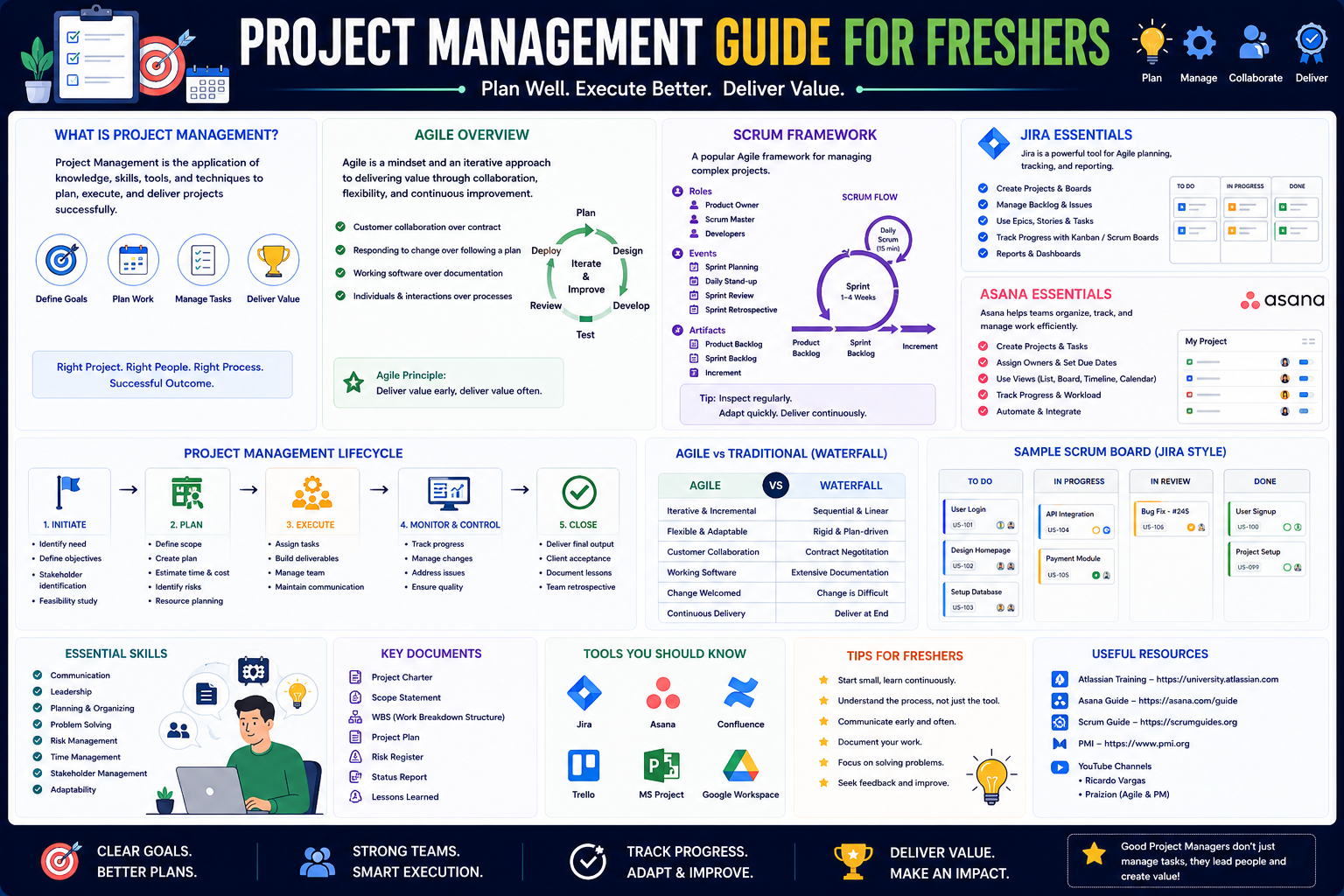
A Project Manager is the person who ensures projects are completed on time, within scope, and on budget while keeping everyone aligned and motivated. Unlike a Product Manager who focuses on the "why" (what product to build), you focus on the "how" (how to build it efficiently). The core responsibilities include:
- Initiating: Defining the project's purpose, goals, scope, stakeholders, and success criteria
- Planning: Creating the roadmap, work breakdown structure, timeline, budget, and resource allocation
- Executing: Coordinating the team's daily work, facilitating communication, and managing quality
- Monitoring & Controlling: Tracking progress against the plan, managing risks and changes, and reporting status
- Closing: Delivering the final product, documenting lessons learned, and celebrating the team's success
The 2026 Project Management Landscape
In 2026, the most successful Project Managers blend multiple methodologies rather than picking one rigid framework . Nearly 60% of enterprise-level tech companies have adopted hybrid project models, combining Agile's flexibility for software development with Waterfall's structure for regulated or hardware components.
Key Methodologies You'll Master:
- Agile: An iterative approach that breaks work into small, user-focused increments called sprints
- Scrum: A structured framework under the Agile umbrella with defined roles (Product Owner, Scrum Master, Development Team) and ceremonies (daily stand-ups, sprint planning, sprint reviews, retrospectives)
- Kanban: A visual workflow system that limits work-in-progress (WIP) to improve focus and throughput
- Waterfall and Hybrid: Sequential, phase-based planning (requirements → design → implementation → testing → deployment), often blended with Agile elements for modern delivery
Prerequisite Check
You need strong communication skills, basic familiarity with spreadsheets (Excel or Google Sheets), and a desire to learn. No prior project management experience is required. Create free accounts for Jira (Atlassian offers a free tier) and Asana.
Practice Goal for Phase 1: Think of a recent group project (school, work, or personal event like a party). Write down what went well, what went wrong, and what you would do differently as the project manager. This is your first "lessons learned" exercise.
Free Resources for Phase 1:
- Coursera – Project Phases and Methods (Free Audit): An introductory module covering the five project process groups (Initiation, Planning, Execution, Monitoring, Closing) and explaining core Scrum roles .
- Emeritus Project Management Guide 2026: Free in-depth blog post comparing Agile, Scrum, Kanban, Waterfall, and Hybrid methodologies, with tool recommendations .
- IBM Project Manager Professional Certificate (Free Audit): No prior degree or experience required. Start with core project management fundamentals—planning, tracking, stakeholder communication, and risk management .
📋 Phase 2: Agile & Scrum Mastery – The Foundations of Modern Delivery (Weeks 3-6)
Agile and Scrum are the dominant frameworks for software and IT project management. You don't need to become a certified Scrum Master immediately, but you must understand the roles, ceremonies, and artifacts inside out.
Core Concepts to Master
The Scrum Framework:
Scrum works in fixed-length iterations called sprints (usually 1-4 weeks). Each sprint produces a potentially shippable product increment .
The Three Core Roles:
- Product Owner: Defines what features to build and in what order, maintaining the product backlog and representing the customer's voice
- Scrum Master: Your primary role as an aspiring PM. You facilitate ceremonies, remove impediments, coach the team on Agile practices, and protect the team from external distractions
- Development Team: Self-organizing cross-functional members who build the product
The Five Scrum Ceremonies:
- Sprint Planning: The team decides what work to commit to in the upcoming sprint
- Daily Stand-up (Daily Scrum): A 15-minute sync where each team member answers: What did I do yesterday? What will I do today? Any blockers?
- Sprint Review: Demonstrate completed work to stakeholders and gather feedback
- Sprint Retrospective: The team reflects on what went well, what went wrong, and what to improve next sprint
- Backlog Refinement (Grooming): Ongoing process of adding detail, estimates, and order to backlog items
Scrum Artifacts:
- Product Backlog: Prioritized list of all desired features and fixes
- Sprint Backlog: Subset of product backlog items selected for the current sprint
- Increment: The sum of all completed backlog items at the end of a sprint
User Stories: Write requirements from the user's perspective: "As a [user type], I want to [action] so that [benefit]." Good user stories include acceptance criteria defining "done."
WIP Limits (Work-in-Progress Limits): A Kanban concept that limits how many tasks can be in progress simultaneously, reducing context switching and improving flow .
Practice Goal: Write 5 user stories for a hypothetical feature (e.g., "dark mode" or "password reset"). Create a product backlog with 20 items and prioritize them using MoSCoW (Must-have, Should-have, Could-have, Won't-have). Simulate a sprint planning session and commit to 5 stories for a 2-week sprint.
Free Resources for Phase 2:
- Coursera (Scrum Roles Module - Free Audit): Explains Product Owner, Scrum Master, and Development Team roles with real-world case studies from Spotify and Netflix .
- Coursera (WIP Limits Module - Free Audit): Teaches how to set WIP limits to create a "pull system" where new tasks start only when capacity is available .
- IBM IT Scrum Master Professional Certificate (Free Audit): Learn adaptive planning, iterative development, continuous improvement, and prepare for the CSM certification exam .
- Microsoft Learn – Scrum Assistant AI Agent (Free Documentation): Understand how AI can support scrum ceremonies, backlog management, and Agile best practices .
🛠️ Phase 3: Tools Deep Dive – JIRA & Asana Mastery (Weeks 7-12)
Theory is useless without execution. JIRA and Asana are the two most dominant project management tools in 2026, and employers expect hands-on proficiency .
JIRA (For Agile/Engineering Teams)
JIRA is the industry standard for software development teams, designed around Agile concepts like sprints, backlogs, and issues .
Core JIRA Concepts You'll Master:
- Projects and Issues: Different issue types (Epics → Stories → Sub-tasks, plus Bugs)
- Sprints: Creating, starting, and closing sprint cycles
- Backlog Management: Prioritizing, estimating (story points), and refining backlog items
- Boards: Scrum boards (sprint-focused) vs. Kanban boards (continuous flow)
- Dashboards and Filters: Creating custom views and saved filters for reporting
- Automation Rules: Conditional logic to automatically escalate tasks, assign issues, or notify stakeholders
Practice Goal: Create a free Jira Cloud account. Build a project for a "Mobile App Launch." Create an Epic called "User Authentication." Add 5 Stories under it. Run a 30-day simulated sprint, moving issues from To Do → In Progress → Done.
Free Resources for JIRA:
- Coursera (Jira Automation Module - Free Audit): Learn to build simple automation rules in Jira using conditional logic to automate escalation and notification .
- Pluralsight – Jira for Project Management Skill Path (Free Trial): Hands-on courses specifically for Jira fundamentals and configuration .
Asana (For Cross-Functional Collaboration)
While Jira excels for engineering, Asana shines for cross-functional collaboration involving marketing, sales, design, and leadership. Asana provides clearer timeline views and portfolio management that non-technical stakeholders prefer .
Core Asana Concepts You'll Master:
- Projects, Tasks, and Subtasks: Hierarchical work breakdown
- Sections and Columns: Organizing work by status (Backlog → In Progress → Review → Done)
- Timeline (Gantt View): Visualizing dependencies and schedules
- Portfolios: Rolling up multiple projects for executive reporting
- Goals: Connecting project tasks to strategic OKRs
- Custom Templates: Reusable workflows for recurring project types
- Asana-Jira Integration: Understanding how to sync tasks between engineering (Jira) and business teams (Asana) using two-way sync
Practice Goal: In Asana, build a "Product Marketing Launch" project. Set up Timeline view showing design → development → marketing dependencies. Create a Portfolio tracking 3 projects simultaneously.
Free Resources for Asana:
- Coursera – Asana & Jira Integration (Free Audit): Learn to configure two-way sync between Asana and Jira, map fields/statuses, and monitor sync errors .
- Pluralsight – Asana Fundamentals Skill Path (Free Trial): Step-by-step Asana training from basic to advanced .
The Asana + Jira Dual-Layer Strategy (High-Value Skill)
In many organizations, Jira serves as the engineering execution layer (sprints, backlogs, issues), while Asana serves as the cross-functional collaboration and management visualization layer (milestones, portfolios, stakeholder updates) . When you can design a workflow where:
- Jira tasks sync to Asana for visibility
- Executives see portfolio views in Asana
- Engineers stay in their familiar Jira environment
you become incredibly valuable as a Project Manager who bridges technical and business teams.
🤖 Phase 4: AI Tools for Project Managers – The 2026 Force Multiplier (Weeks 13-14)
AI is not replacing Project Managers. It is automating the repetitive work—status reports, meeting notes, backlog refinement, risk identification—so you can focus on leadership and problem-solving.
AI for Agile and Scrum
In 2026, Project Managers use AI assistants to:
- Generate and refine product goals using natural language prompts
- Create and manage product backlogs in Jira with AI assistance
- Support sprint planning and capacity decisions by analyzing historical velocity
- Summarize meeting insights and automatically update Jira and Confluence
Practice Goal: Use ChatGPT or a similar LLM to generate a 2-week sprint plan for a "Customer Support Dashboard" project. Ask it to identify potential risks. Use its output as a starting point, then refine manually based on your judgment. Document what the AI did well and where you needed to override it.
Free Resources for Phase 4:
- Packt – AI Project Management Skills (2-hour course, 2026 edition): Learn prompt engineering basics for Scrum Masters, using ChatGPT and Jira to refine product goals, generate backlogs, and support sprint planning .
- Microsoft Learn – Scrum Assistant Agent Template (Free): Understand how to build AI agents that provide real-time guidance on scrum ceremonies and Agile best practices .
📚 Phase 5: Certifications & Portfolio Building (Weeks 15-16)
While hands-on experience is the best teacher, certifications validate your knowledge for employers and help you pass resume screening filters.
Entry-Level Certification Path
IBM Project Manager Professional Certificate – No prior degree or project management experience required. In just 3 months, you will master project planning, tracking, reporting, and Agile expertise, plus prepare for the CAPM (Certified Associate in Project Management) exam with a practice test. This certificate is ideal for natural organizers and strong communicators stepping into their first PM role .
IBM IT Project Manager Professional Certificate – Focuses on IT-specific project management, software development lifecycle, DevOps, and cloud computing. In 4 months, you'll build a portfolio of real-world projects and gain skills for the CSM (Certified Scrum Master), PMI-ACP, and PMI-DASM certifications .
Pluralsight – Project Management Tools Skill Path – 7 hours of hands-on video training across Jira, Asana, Monday.com, Smartsheet, Wrike, and Basecamp. Free trial available .
Building Your PM Portfolio
You don't need professional experience to demonstrate project management thinking. Your portfolio should include:
- Project Plan Document: For a hypothetical or real project (e.g., "Organizing a Charity 5K Run"), include project charter, work breakdown structure, timeline (Gantt view), budget estimate, risk register with mitigation strategies, and stakeholder communication plan.
- Jira Project Screenshots: Portfolio of your Jira project setup—backlog, active sprint board, burndown chart, and dashboard showing team velocity.
- Asana Timeline & Portfolio: Screenshots of your Asana timeline showing dependency management and your portfolio view tracking multiple projects against milestones.
- Sample User Stories & Acceptance Criteria: 10 well-written user stories for a software feature with clear acceptance criteria and story point estimates.
Practice Goal: Create a complete project plan for a real small project (e.g., planning a friend's wedding, organizing a community event, or launching a personal blog). Use a free tool like GanttProject or even Google Sheets. This becomes your portfolio centerpiece.
📚 Consolidated Resource Toolkit
Completely Free, Comprehensive Resources
Coursera – Project Phases and Methods (Free Audit) – Foundational long course covering: five project process groups with example activities, core Scrum roles (Product Owner, Scrum Master, Development Team), WIP limits for workflow management, and timeline analysis for dependency bottlenecks .
Coursera – Asana & Jira Integration (Free Audit) – Learn to configure two-way sync between Asana and Jira via Unito, map fields/users/statuses accurately, monitor sync errors, and document fixes for integration health .
IBM Project Manager Professional Certificate (Free Audit) – Project planning, tracking, reporting, stakeholder communication, and risk management. 3 months, no experience required, includes CAPM exam practice test .
IBM IT Project Manager Professional Certificate (Free Audit) – IT fundamentals, software development lifecycle, DevOps, Agile project management. 4 months, builds portfolio and prepares for CSM, PMI-ACP, and PMI-DASM exams .
IBM IT Scrum Master Professional Certificate (Free Audit) – Adaptive planning, iterative development, continuous improvement, and early customer delivery. Designed to prepare for Scrum Alliance CSM certification .
Packt – AI Project Management Skills (2026 Edition) – 2-hour course covering prompt engineering basics, refining product goals with ChatGPT, generating backlogs in Jira, AI support for sprint planning, and meeting insights into Jira/Confluence .
Microsoft Learn – Scrum Assistant Agent Template – Build agents supporting scrum masters with real-time guidance on ceremonies, backlog management, and Agile best practices .
Emeritus Project Management Guide 2026 – Free in-depth article comparing Agile, Scrum, Kanban, Waterfall, and Hybrid methodologies, with tool recommendations for Jira, Asana, ClickUp, and Monday.com .
Free Tool Accounts
Jira Free Tier – 10 users, unlimited projects, 2GB storage, includes Scrum and Kanban boards, backlog, and basic reporting.
Asana Free Tier – Unlimited tasks, projects, messages, and activity log. Up to 10 teammates, includes list view, board view, and calendar view.
Pluralsight Free Trial (10 days) – 7-hour skill path on Project Management Tools including Jira, Asana, Monday.com, and Smartsheet .
AI-Assisted Learning Tools
ChatGPT / Claude as a PM Tutor – Practice writing user stories, generating risk registers, or simulating sprint planning scenarios. Ask for feedback on your project plans.
Scrum Assistant AI Agents – Build and use agents that analyze sprint reports and retrospective notes to offer data-driven recommendations for team performance improvement .
💼 Career Application & Next Steps
Project management is a high-growth field. According to the U.S. Bureau of Labor Statistics, employment of computer and information systems managers (including Scrum Masters) is projected to grow 16% from 2021 to 2031, much faster than average. Scrum Masters earn an average annual salary of 100,000+intheU.S.,whileITProjectManagersearnanaverageof
100,000+intheU.S.,whileITProjectManagersearnanaverageof126,091, with top professionals making up to $248,952 . Employers posted over 266,000 project management job openings in 2022 alone, with 25% of all IT job descriptions requiring project management skills .
1. The Fresher Entry Point
Project Coordinator / Junior Project Manager – Supports senior PMs by scheduling meetings, tracking action items, updating project plans, and managing documentation. Ideal entry point for strong organizers with basic methodology knowledge.
Scrum Master Assistant / Junior Scrum Master – Facilitates daily stand-ups, helps maintain the backlog, removes minor impediments, and learns Agile coaching from senior Scrum Masters.
Project Analyst – Focuses on data collection, report generation, budget tracking, and risk monitoring. Perfect entry point for analytical thinkers.
Industries actively hiring include technology (SaaS, software development, FAANG), financial services (banking, insurance, fintech), healthcare (hospital systems, telemedicine), consulting (client delivery), and e-commerce (retail, logistics).
2. Career Progression Paths
From Project Coordinator to Project Manager: Lay the foundation with core project management skills, then move into full responsibility for mid-sized projects.
From Project Manager to IT Project Manager: Learn essential project management, then specialize in leading complex IT initiatives in Agile-driven environments that power digital transformation .
From IT Scrum Master to Program Manager: Start by mastering Agile team leadership, then transition into roles where you drive organizational strategy, manage cross-functional teams, and influence critical business decisions .
3. Build Your Portfolio (Three Essential Projects)
Project 1 (Project Plan Document):
- What: Create a complete project plan for a hypothetical software launch. Include project charter (goals, scope, stakeholders, success criteria), work breakdown structure (20-30 tasks), Gantt chart timeline showing dependencies, risk register (10 risks with mitigation strategies), and stakeholder communication plan (matrix of who gets what update when).
- Why: This single document demonstrates you understand the full project lifecycle—from initiation to closure—and can organize complex information clearly.
Project 2 (Jira Project Setup & Simulation):
- What: In a free Jira Cloud account, create a project for a "Mobile Banking App" 3-month release. Set up Scrum board with Epics (Authentication, Transfers, Notifications). Create 15 user stories with story point estimates (1, 2, 3, 5, 8). Run a simulated 2-week sprint: move issues across columns, track burndown, generate a velocity report. Take screenshots of your board, backlog, and reports.
- The Narrative: "I configured a complete Agile project in Jira, demonstrating understanding of epics, user stories, story points, sprint planning, and burndown tracking."
- Why: Jira proficiency is listed in 60%+ of project management job descriptions. This proves hands-on capability.
Project 3 (Asana Cross-Functional Portfolio):
- What: Build an Asana portfolio tracking 3 interdependent projects: "Marketing Campaign," "Product Launch," and "Sales Enablement." Create Timeline views showing dependencies across projects (e.g., "Sales training depends on Product Launch completion"). Add Portfolio dashboard presenting milestone status and risk flags to executive stakeholders.
- The Narrative: "I designed a cross-functional project portfolio in Asana, enabling leadership visibility across marketing, product, and sales teams—a skill directly applicable to hybrid engineering-business environments."
- Why: Cross-functional coordination is where junior PMs often struggle. This project proves you can think beyond a single team.
4. The Interview Question You Will Be Asked
Question: "Your development team is consistently missing sprint commitments by 30%. As Scrum Master, what would you do?"
Your Answer: *"First, I would avoid blaming the team. Missing commitments is typically a process or estimation issue, not a performance issue. I would start with data: look at our velocity trend over the last 4-5 sprints to see if we are consistently over-committing by the same margin. If velocity is stable but we always commit to 50 story points and deliver 35, the fix is simple—commit to 35 next sprint.*
But I would dig deeper. In the next retrospective, I would facilitate an anonymous team survey asking: 'Are stories being split small enough?' 'Are dependencies known at sprint planning?' 'Is scope creeping during the sprint?'
*If the issue is unclear requirements, I would coach the Product Owner on writing better acceptance criteria and involve developers earlier in backlog refinement. If the issue is hidden dependencies, I would introduce a 'dependency board' visible during daily stand-up. If the issue is poor task breakdown, I would run a 'story splitting workshop' to teach the team how to break large stories (13+ points) into smaller, more predictable pieces (3-5 points). Finally, I would check for external interruptions—are other stakeholders pulling the team off sprint work? If so, I would create a 'buffer lane' on the board for unplanned work and track its impact on sprint commitments to make the cost visible to management.*
The key is transparency and continuous improvement, not pressure. A good Scrum Master helps the team feel safe enough to say 'we over-committed' before the sprint ends, not after."
This answer demonstrates data analysis, facilitation skills, coaching ability, and psychological safety awareness—exactly what hiring managers seek in junior Scrum Masters.
5. Sample Resume Entry
text
Junior Project Manager (Project-Based) | Portfolio

• Created complete project plan for hypothetical software launch including charter, WBS (30 tasks), Gantt timeline, risk register with 10 mitigation strategies, and stakeholder communication matrix
• Configured Agile Jira project for 3-month release cycle, managing 15+ user stories with story point estimates, sprint planning, and burndown tracking
• Built Asana portfolio tracking 3 interdependent projects with Timeline dependency views and executive milestone reporting
• Completed IBM IT Project Manager Professional Certificate (4 months), preparing for CAPM and CSM certifications
• Authored 20+ user stories with acceptance criteria following "As a user, I want... so that..." format
🎯 Your Next Steps for This Week
Do not try to learn Agile, Jira, Asana, and AI simultaneously. Build momentum with small wins.
Step 1: Set Up Your Free Tool Accounts (Day 1)
Create a free Jira Cloud account (Atlassian). Create a free Asana account. Install the Asana and Jira mobile apps. You now have $200+/month worth of professional tools at zero cost.
Step 2: Audit the IBM Project Manager Certificate (Week 1)
Go to IBM's Skills Network catalog and enroll in the free audit of the Project Manager Professional Certificate. Complete the first module on project initiation and charter creation .
Step 3: Take the Coursera Project Phases Module (Week 1-2)
Complete the "PM Phases: Initiate, Plan, and Execute" module from Coursera (free audit). Create your first Project Charter and practice phase-gate criteria .
Step 4: Build Your First Jira Project (Week 2)
Follow the Atlassian tutorial to create a Scrum project. Add 5 sample tasks. Run your first simulated sprint. Take a screenshot of your board.
Step 5: Build Your First Asana Timeline (Week 2)
Create a project in Asana with 15 tasks. Switch to Timeline view. Add dependencies (Task B cannot start until Task A finishes). Add milestones. Export the timeline image.
Step 6: Join the Project Management Community
Follow Project Management Institute (PMI) and Scrum Alliance on LinkedIn. Join r/projectmanagement on Reddit. The community is generous with advice for beginners asking thoughtful questions.
The moment you successfully guide a small team (even friends or classmates) through a 2-week "sprint" and deliver something tangible, you will understand that project management is not about control—it is about clarity, communication, and removing obstacles. You have the roadmap. Start leading today.




 Group / 1: 1 Sessions