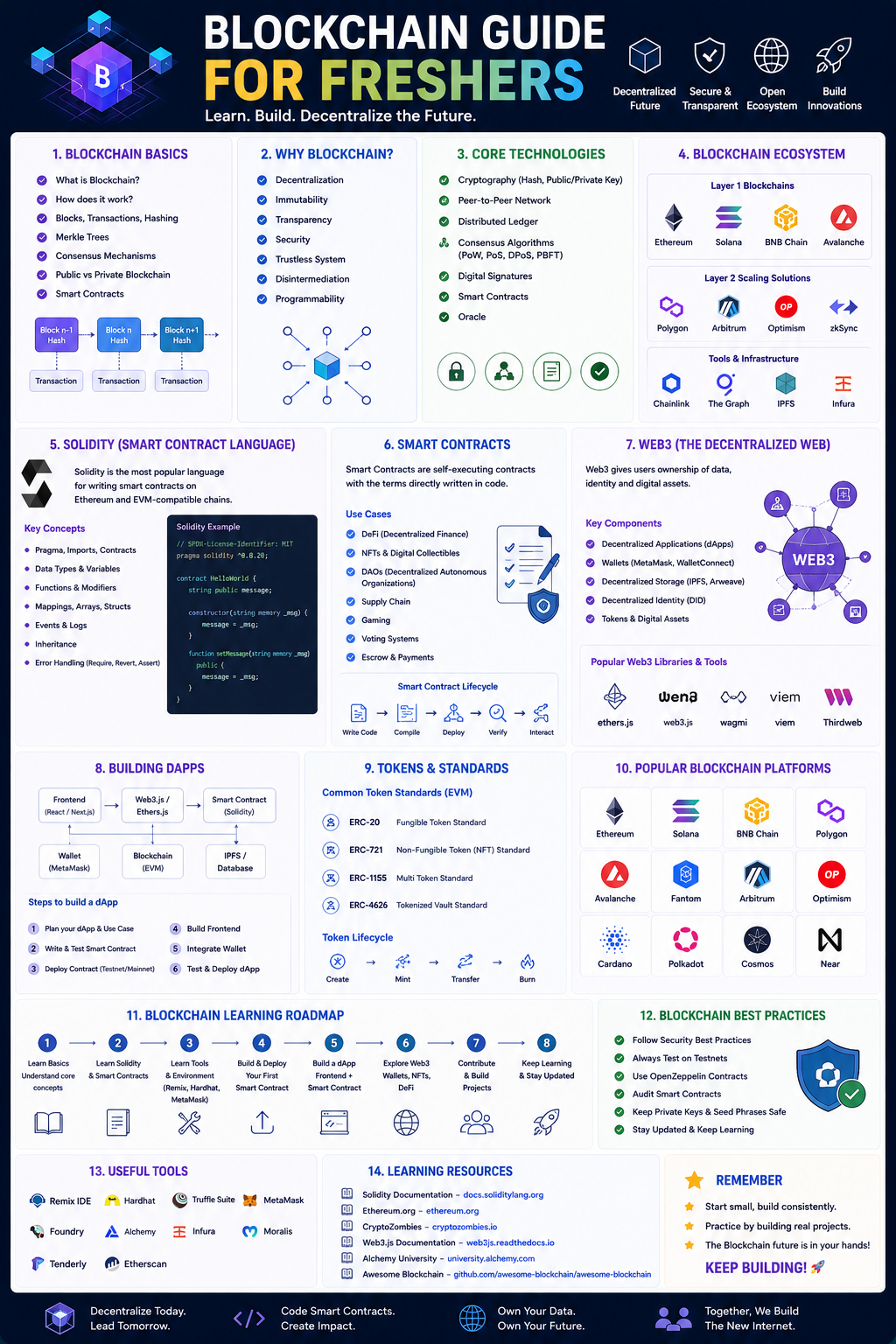
This roadmap is designed for a fresher—someone with curiosity about decentralized technology and a desire to build applications that operate without central authority. You will learn Solidity, Smart Contracts, and Web3 by following a structured path that mirrors how professional blockchain developers actually build in 2026. The goal is to transform you from someone who "knows what Bitcoin is" into a developer who can write, deploy, and test smart contracts, and build frontend applications that interact with them. This path prepares you for entry-level roles like Junior Blockchain Developer, Smart Contract Developer, or Web3 Frontend Engineer in a market where blockchain job postings grew approximately 45% in 2025, with over 460 full-time positions posted in January 2026 alone .
The blockchain space is rapidly maturing. Entry-level blockchain developers now earn an average of 100,000+peryear,withthetop10
100,000+peryear,withthetop10213,000, even for developers with 0-1 years of blockchain-specific experience . The demand is real, the compensation is competitive, and the barrier to entry is lower than you might expect—especially with the abundance of free, high-quality educational resources available today .
🗺️ Phase 1: The Mindset Shift – What Blockchain Development Really Means (Weeks 1-2)
Before writing your first smart contract, understand that blockchain development is fundamentally different from traditional web development. You are not building on a server you control—you are deploying code to a decentralized network where execution costs money (gas fees), data is immutable once written, and you cannot easily change deployed contracts.
What a Blockchain Developer Actually Does
Blockchain developers build decentralized applications (dApps) that run on networks like Ethereum, Polygon, or Base. Your core responsibilities include :
- Writing Smart Contracts: Self-executing code that runs on the blockchain, handling everything from token transfers to decentralized voting systems
- Developing dApp Frontends: Building web interfaces that connect to smart contracts using libraries like ethers.js or web3.js
- Testing and Security Auditing: Ensuring contracts are free from vulnerabilities before deployment (critical, as exploits can cost millions)
- Deploying to Networks: Publishing contracts to testnets (like Sepolia or Goerli) and eventually mainnet
Core Concepts to Master First
Before touching Solidity, understand these foundational ideas :
- Decentralization and Blockchain Basics: What is a block? How do nodes maintain consensus? Why is blockchain "trustless"?
- Cryptography Fundamentals: Hashing (SHA-256, Keccak-256), public/private key pairs, and digital signatures
- Wallets and Transactions: How MetaMask works, what gas fees are, and why transaction confirmation takes time
- EVM (Ethereum Virtual Machine): The runtime environment where all smart contracts execute—understanding this helps you write more efficient code
Practice Goal for Phase 1: Write a one-page explanation of how a blockchain transaction moves from a user's wallet to being included in a block. Identify every step and the cryptographic mechanisms that secure it.
Free Resources for Phase 1:
- Ethereum.org Education Resources: The official Ethereum community site offers comprehensive learning materials, documentation, and tutorials for builders at every level
- Cyfrin Updraft Blockchain Basics: Their free curriculum starts with fundamentals before moving to smart contract development. Over 200,000 students are learning through this platform
- GUVI Blockchain Developer Roadmap: A complete step-by-step guide from beginner to job-ready, breaking learning into simple stages
📝 Phase 2: Solidity Fundamentals – The Language of Smart Contracts (Weeks 3-8)
Solidity is the most in-demand blockchain programming language, and mastering it is your primary goal . This phase focuses on learning Solidity syntax and core patterns through intensive practice.
Getting Started with Solidity
Before diving into complex projects, set up your development environment :
- Remix IDE: Browser-based IDE perfect for beginners. No installation required—start coding immediately
- Hardhat: Professional development environment for compiling, testing, and deploying contracts
- MetaMask: Browser wallet for interacting with testnets and local networks
Beginner Solidity Projects (Weeks 3-5)
Start with the fundamentals. Work through these projects sequentially :
Basic Concepts (Projects 1-15):
- Hello World Smart Contract
- Basic Counter (Increment/Decrement)
- Store and Retrieve a Number/String
- Create and Use Structs (e.g., Person Info)
- Simple Mapping of ID to Names
- Array of Structs
Control Flow and Functions (Projects 16-30):
- Implement If-Else Logic
- Create Modifiers for Access Control
- Payable Functions (receive and send Ether)
- Emit Events and listen for them
- Simple Voting Contract
Security and Access Control (Projects 31-45):
- Restrict functions to contract owner using
msg.sender - Time locks using
block.timestamp - Import OpenZeppelin and use Ownable pattern
- Simulate a bank deposit/withdrawal system
Intermediate Solidity (Weeks 6-8)
Move to more complex patterns and real-world applications :
Data Structures and Patterns (Projects 46-75):
- Save and retrieve data from mappings
- Use Keccak256 hashing
- Custom errors and revert statements
- Contract inheritance
- Gas optimization techniques (struct vs. mapping comparison)
- Simple contract pause/unpause functionality
Practical Applications (Projects 76-100):
- Smart contract-based Todo List
- Unique user registration system
- Split payment contract
- Contract factory pattern
- Basic signature verification
Practice Goal: Complete at least 30 of the 100 beginner Solidity projects, deploying each to a local Hardhat network or Remix VM. For each contract, write a brief explanation of what it does, what gas costs you observed, and any security considerations.
Free Resources for Phase 2:
- Cyfrin Updraft Solidity Courses: Over 100+ hours of hands-on courses covering everything from basics to advanced smart contract development, completely free. Includes industry-recognized Cyfrin Updraft Certifications
- Base-Learn GitHub Repository: A comprehensive Hardhat-based development environment with 13+ educational Solidity contracts covering basic math, control structures, inheritance, ERC20 tokens, ERC721 NFTs, and weighted voting mechanisms. Includes a React frontend for Web3 wallet integration
- 100 Beginner Solidity Projects GitHub: A collection of 100 beginner-friendly Ethereum projects to help new developers learn Solidity through hands-on practice. Perfect for starting your Web3 journey
🛠️ Phase 3: Development Tools & Testing (Weeks 9-12)
Writing contracts is only half the job. Professional developers use robust tooling for testing, deployment, and frontend integration.
Essential Development Tools
Hardhat is the industry standard for Ethereum development :
- Compilation:
npx hardhat compile - Testing:
npx hardhat test (write tests in JavaScript/TypeScript) - Deployment: Scripts using Hardhat Ignition or custom deploy scripts
- Local network:
npx hardhat node for a local blockchain
Testing Best Practices:
- Write unit tests for every contract function
- Test edge cases (overflow, underflow, unauthorized access)
- Use Hardhat's console.log for debugging
- Measure gas usage with
hardhat-gas-reporter
Frontend Integration with Web3 Libraries :
- ethers.js: The most popular library for interacting with Ethereum
- wagmi: React hooks for Ethereum that simplify wallet connection and contract calls
- RainbowKit: Beautiful wallet connection UI that supports MetaMask, WalletConnect, and more
Building Your First Full dApp
Follow the Web3 Bank Demo project structure :
- Smart Contract Layer (
bank-contract/):
- Write Bank.sol with deposit, withdraw, and transfer functions
- Write deployment scripts
- Write comprehensive tests
- Frontend Layer (
bank-client/):
- React application with wallet connection
- Contract ABI integration
- Read contract state (balance, user info)
- Write transactions (deposit, withdraw)
- Local Development Workflow:
- Start local Hardhat node
- Deploy contracts to local network
- Connect MetaMask to local network (Chain ID: 31337)
- Import test accounts using the mnemonic
- Run frontend and interact with your deployed contracts
Practice Goal: Build a complete dApp with at least one smart contract and a React frontend. Your dApp should allow users to connect their wallet, read data from the contract, and write transactions. Deploy to a testnet (Sepolia or Goerli) and share the live link.
Free Resources for Phase 3:
- Web3 Bank Demo GitHub: A complete application demonstrating a bank smart contract with deposit, withdrawal, and transfer functionalities using Solidity, Hardhat, web3.js/Ethers.js, and React. Includes full setup instructions and troubleshooting guidance
- Base-Learn Frontend Integration: The Base-Learn repository includes a modern React frontend with Tailwind CSS, RainbowKit for wallet connection, and ethers.js/wagmi for blockchain interactions
- Hedera Counter DApp GitHub: A comprehensive educational project showing smart contract development, React/Next.js frontend, wallet integration, and real-time contract state monitoring
🚀 Phase 4: Tokens, NFTs, and Real-World Projects (Weeks 13-18)
Now you build projects that demonstrate real value to employers. Focus on creating deployable, functional applications.
Token Standards
ERC-20 (Fungible Tokens) : The standard for cryptocurrencies and utility tokens :
- Implement totalSupply, balanceOf, transfer, approve, transferFrom
- Understand allowance patterns and infinite approval risks
- Explore mintable, burnable, and pausable extensions
ERC-721 (Non-Fungible Tokens) : The standard for unique digital assets :
- Implement tokenURI for metadata
- Understand safeTransferFrom and approvals
- Explore enumerable extensions for collection browsing
Portfolio Projects
Complete these three projects to demonstrate your capabilities :
Project 1: Custom Token with Utility
- Create your own ERC-20 token with a unique utility (governance, staking, or rewards)
- Deploy to a testnet
- Build a simple claim interface for users to mint tokens
- Document the tokenomics and security measures
Project 2: NFT Collection
- Deploy an ERC-721 collection with 10+ unique token URIs (using IPFS or Arweave for metadata)
- Implement a mint function with allowlist (merkle tree)
- Build a gallery frontend showing all tokens owned by the connected wallet
- Submit to an NFT marketplace (testnet) to demonstrate compatibility
Project 3: DeFi or DAO Application (Capstone)
- DeFi Option: Build a simple decentralized exchange or lending pool (following Uniswap V2 patterns)
- DAO Option: Create a governance token and voting contract where token holders can propose and vote on changes
- Include time-locks, quorum requirements, and proposal execution
- Build a complete frontend for interacting with all functions
Practice Goal: Complete all three portfolio projects. Deploy each to a public testnet (Sepolia or Polygon Mumbai). Create a GitHub repository for each with comprehensive README documentation.
Free Resources for Phase 4:
- Base-Learn Token Examples: The repository includes UnburnableToken (ERC-20), HaikuNFT (ERC-721), and WeightedVoting contracts ready for deployment and study
- 100 Projects Collection: The intermediate and advanced projects in this collection include token contracts, DeFi primitives, and DAO examples
- Cyfrin Updraft DeFi and NFT Courses: Advanced courses covering Curve Cryptoswap and Uniswap V3 mechanics, teaching concentrated liquidity and AMM mathematics
🔒 Phase 5: Smart Contract Security – The Most Valuable Skill (Weeks 19-20)
Smart contract security is the single highest-compensated specialization in blockchain. The cost of getting security wrong in web3 is immediate and public—millions can be lost in minutes . Learning security fundamentals from the start sets you apart.
Common Vulnerabilities
Master the OWASP Top 10 for Smart Contracts :
- Reentrancy: The DAO hack that led to Ethereum fork. Use Checks-Effects-Interactions pattern or reentrancy guards
- Access Control: Unprotected functions that should be onlyOwner
- Arithmetic Over/Underflow: Use SafeMath (Solidity 0.8+ has built-in checks)
- Front-Running: Understanding mempool and transaction ordering
- Denial of Service (DoS): Block gas limits and unbounded loops
- Oracle Manipulation: Dependence on external price feeds
Security Tools and Practices
- Slither: Static analyzer for finding vulnerabilities
- Mythril: Symbolic execution tool for security checking
- Foundry: Fast, portable testing framework that's gaining popularity
- Audit Readiness: Writing code that is easy to audit (clear comments, modular design, comprehensive tests)
Practice Goal: Take one of your earlier contracts. Run it through Slither. Fix every warning. Write a "Security Considerations" section for your README documenting potential attack vectors and how you mitigated them.
Free Resources for Phase 5:
- Cyfrin Updraft Security+ Certification: The Smart Contract Security+ Certification program validates ability to audit and secure smart contracts, covering common vulnerabilities, formal verification, attack vectors, and auditing methodologies
- SSCD+ Certification: The premier certification for Solidity developers, validating security expertise and industry best practices. Recognized by leading protocols and university organizations
🤖 Phase 6: Emerging Trends – AI-Assisted Blockchain Development (Weeks 21-22)
In 2026, approximately 14% of web3 job descriptions now mention AI capabilities, up from 2% just a few years ago . Understanding AI-assisted development workflows is becoming essential.
AI Tools for Blockchain Developers
- AI Vibe-Coding: Building applications through natural language prompting, rapid iteration, and AI-assisted workflows. The Belgrade University Blockchain Bootcamp now features an "AI Vibe-coding" track specifically for this skill
- Smart Contract Generation: Using AI to generate boilerplate smart contracts (verify every line—AI can hallucinate)
- Test Generation: AI can generate comprehensive test cases from contract specifications
- Audit Assistance: AI tools can suggest potential vulnerabilities and security improvements
AI + Blockchain: The Emerging Frontier
On-chain AI agents are becoming a real product category. Developers who understand both domains are in a unique position :
- Autonomous AI agents that transact on blockchain
- Decentralized inference networks
- Verifiable AI outputs on-chain
Practice Goal: Use a free LLM (ChatGPT or Claude) to generate a simple ERC-20 contract. Review every line. Ask the AI to explain functions you don't understand. Then manually add a security feature (like a cooldown period for transfers). Document what the AI did well and where its output was problematic.
Free Resources for Phase 6:
- AI Vibe-coding Bootcamp (Free): The Blockchain Laboratory at FON University offers a free AI Vibe-coding course teaching AI-native application development, prompt engineering, and rapid prototyping. Open to students worldwide with no prior knowledge required
- AI + Blockchain Market Reports: Industry analysis showing the growing intersection between these fields—learn what talent is in demand
📚 Consolidated Resource Toolkit
Completely Free, Comprehensive Educational Platforms
Cyfrin Updraft is the leading blockchain development and smart contract security education platform, offering over 100+ hours of hands-on courses completely free. Designed and taught by industry-leading educators, the platform provides high-quality content covering Solidity, Vyper, DeFi, and smart contract security. The platform has educated millions of developers globally and offers industry-recognized Cyfrin Updraft Certifications. Key courses include the Full Stack Development Course (React, Next.js, ethers.js, wagmi), DeFi Deep Dives (Curve Cryptoswap, Uniswap V3), and the Smart Contract Security+ Certification program. The platform also features live cohort learning models with mentors and AI-driven support .
GUVI Blockchain Developer Roadmap 2026 provides a complete step-by-step guide from beginner to job-ready, breaking learning into four levels: Beginner (fundamentals and cryptography), Intermediate (smart contracts and development tools), Advanced (scalability and security), and Practical (real-world projects). The roadmap is beginner-friendly and estimates 3-6 months to become interview-ready with consistent practice .
Ethereum.org Education Resources is the official community-curated collection of learning materials, documentation, and tutorials. It includes links to Cyfrin Updraft and other verified educational platforms .
Free Hands-On Learning Resources
Base-Learn GitHub Repository is a comprehensive Hardhat-based development environment for building and deploying smart contracts on Base blockchain. It includes 13+ educational Solidity contracts (BasicMath, ControlStructures, Inheritance, UnburnableToken, HaikuNFT, WeightedVoting), deployment scripts, test files, and a modern React frontend with Tailwind CSS and Web3 wallet integration. Perfect for understanding real project structure .
100 Beginner Solidity Projects GitHub offers a collection of 100 beginner-friendly Ethereum projects organized by difficulty: Basic Smart Contract Fundamentals (1-15), Contract Logic and Control Flow (16-30), Security and Access Control (31-45), Data Storage (46-60), and Practical Applications (76-100). Each project includes clear objectives and can be completed in Remix or Hardhat .
Web3 Bank Demo GitHub demonstrates a complete dApp with bank smart contract (deposit, withdrawal, transfer), Hardhat configuration, tests, and React frontend with wallet integration. Full setup instructions included .
Hedera Counter DApp GitHub is a comprehensive educational project showing smart contract development (Solidity), frontend integration (React/Next.js, TypeScript, Tailwind), wallet connection (HashPack), and real-time contract state monitoring. Excellent documentation for blockchain beginners .
Belgrade University Blockchain Bootcamp 2026 is a free bootcamp with two tracks: Solidity Blockchain Development (fundamentals, NFTs, dApps) and AI Vibe-coding (AI-native development, prompt engineering). Open to students worldwide, no prior knowledge required. Offers mentorship, certificates, and recorded materials .
Certifications and Career Validation
Cyfrin Updraft Certifications include the SSCD+ Certification (premier certification for Solidity developers, recognized by industry protocols and universities), Vyper+ Certification (specialized for Vyper development), and Smart Contract Security+ Certification (security-focused for auditing). These certifications provide standardized validation of expertise .
Official Pathway (India) through NQR includes structured learning modules covering Blockchain Fundamentals, Smart Contracts, Solidity, and Hyperledger with mini-project requirements .
AI-Assisted Learning Tools and Guidance
AI Vibe-coding Training is available through the Belgrade University Bootcamp and teaches modern AI-native approaches to digital product development where applications are designed and built through natural language prompting and AI-assisted workflows .
Market Intelligence: 14% of web3 job descriptions now mention AI capabilities. Blockchain job postings grew 45% in 2025. Entry-level salaries average 100K+withtop10 100K+withtop10213K+ .
💼 Career Application & Next Steps
The blockchain job market is growing rapidly. Companies are hungry for developers who can build secure smart contracts and decentralized applications. Over 460 full-time web3 positions were posted in January 2026 alone . The key is building a portfolio that demonstrates real capability.
1. The Fresher Entry Point
Junior Smart Contract Developer focuses on writing and testing Solidity contracts, often for DeFi protocols or NFT projects. Requires strong Solidity fundamentals, understanding of ERC standards, and basic security awareness .
Web3 Frontend Engineer builds interfaces that connect to smart contracts using ethers.js, wagmi, and RainbowKit. Requires React experience plus Web3 library knowledge .
Blockchain Quality Engineer ensures quality across blockchain development including automation frameworks, manual testing, and dashboards. Requires understanding of blockchain testing patterns and gas optimization .
Industries actively hiring include DeFi protocols (lending, exchanges, stablecoins), NFT and gaming platforms, infrastructure (RPC nodes, indexing), enterprise blockchain (supply chain, identity), and traditional finance (institutional DeFi).
2. The Career Progression Path
0-1 year – Junior Blockchain Developer
- Focus: Simple contract deployment, dApp frontends, testnet projects
1-3 years – Smart Contract Developer
- Focus: Complex protocol development, security patterns, mainnet deployment
3-5 years – Senior Blockchain Engineer
- Focus: Protocol architecture, team leadership, audit participation
5+ years – Blockchain Architect / Security Researcher
- Focus: System design, zero-knowledge proofs, novel consensus mechanisms
3. Build Your Portfolio (Three Essential Projects)
Project 1 (ERC-20 Token with Utility):
- What: Deploy a custom token with a unique feature (time-locked transfers, reward mechanism, or governance). Deploy to Sepolia testnet. Write comprehensive tests (coverage >80%). Document security considerations and gas costs.
- Why: Demonstrates understanding of token standards, testing, and real deployment workflows.
Project 2 (Full-Stack dApp):
- What: Create a complete application with a smart contract (e.g., decentralized task manager, prediction market, or charity donation platform) and React/Next.js frontend. Include wallet connection, transaction history, and real-time updates. Deploy the contract to testnet and frontend to Vercel.
- Why: Employers want developers who can build complete products, not just write contracts. This shows end-to-end capability.
Project 3 (Audit-Ready Contract with Security Report):
- What: Write a moderately complex contract (e.g., a staking pool or simple AMM). Run Slither and fix all issues. Document every vulnerability you considered and how you mitigated it. Write a "Security Review" section for your README.
- Why: Security is the most valuable skill. This project proves you take it seriously.
How to Document Your Portfolio: Create a GitHub repository for each project with comprehensive README including: project overview and problem statement, architecture diagram, technologies used, setup instructions (local deployment), deployed addresses (testnet), frontend demo link (if applicable), test coverage report, security review, and gas optimization notes.
4. The Interview Question You Will Be Asked
Question: "What are the most common security vulnerabilities in smart contracts, and how would you prevent them?"
Your Answer: *"The most critical vulnerability is reentrancy, where an external contract calls back into your function before state updates complete. The 2016 DAO hack exploited this, losing $60M. Prevention: use checks-effects-interactions pattern (update state before external calls), or use OpenZeppelin's ReentrancyGuard modifier.*
Second is access control—functions that should be onlyOwner but are unprotected. I always use OpenZeppelin's Ownable contract and add onlyOwner modifiers to administrative functions.
*Third is arithmetic issues. Solidity 0.8+ has built-in overflow checks, but for earlier versions I use SafeMath. Even with 0.8+, I still validate inputs for unexpected values.*
Fourth is front-running, where attackers see pending transactions and submit their own with higher gas. For auctions or liquidation mechanisms, I use commit-reveal schemes or implement minimum time delays.
I also watch for DoS through unbounded loops—always iterate over arrays of unknown length carefully, and consider pagination patterns for on-chain data.
Finally, I never trust external data without validation. Oracle manipulation is common in DeFi. I would use multiple oracle sources, time-weighted average prices, or circuit breakers for extreme deviations.
For every contract I write, I run static analyzers like Slither, write comprehensive tests including edge cases, and document the threat model in my README. Security is not optional in blockchain—the cost of failure is immediate and public."
Why This Works: You named specific vulnerabilities, referenced historical exploits, demonstrated knowledge of prevention patterns (checks-effects-interactions, OpenZeppelin), and mentioned the security tools and practices you actually use.
5. Sample Resume Entry (No Experience Version)
text
Junior Blockchain Developer | Portfolio

TECHNICAL SKILLS
- Languages: Solidity, JavaScript/TypeScript
- Frameworks: Hardhat, Foundry (basic)
- Web3: ethers.js, wagmi, RainbowKit
- Frontend: React, Next.js, Tailwind CSS
- Tools: Remix, MetaMask, Git

PROJECTS

ERC-20 Governance Token (Sepolia Testnet)
- Deployed custom ERC-20 token with voting-weight calculation and time-locked transfers
- Wrote 25+ unit tests achieving 92% coverage
- Documented security considerations including reentrancy prevention and access control
- Contract address: 0x... (available in README)

Full-Stack Decentralized Task Manager
- Built smart contract for task creation, assignment, and completion rewards
- Developed React frontend with wallet connection (RainbowKit) and real-time task updates
- Deployed contract to Sepolia testnet, frontend to Vercel
- Live demo: [link]

CERTIFICATIONS (In Progress)
- Cyfrin Updraft SSCD+ Certification
- Smart Contract Security+ Certification

EDUCATION
- Self-directed blockchain development (6 months, 30+ completed projects)
- Cyfrin Updraft Solidity Course (100+ hours)
- Bachelor's in Computer Science (or relevant coursework)
🎯 Your Next Steps for This Week
Do not try to learn Solidity, Hardhat, React, and security simultaneously. Build momentum with small, achievable wins.
Week 1: Set Up Your Environment and Learn Fundamentals
- Install Node.js (v16+), Git, and MetaMask
- Create a GitHub account for portfolio hosting
- Complete Cyfrin Updraft's Blockchain Basics module (free)
- Read the GUVI Blockchain Developer Roadmap for a complete overview
Week 2-3: Write Your First Contracts
- Open Remix IDE (no installation required)
- Complete projects 1-15 from the 100 Beginner Solidity Projects collection
- Deploy each contract to Remix VM and test functions
Week 4-5: Professional Development Environment
- Install Hardhat locally; follow the Base-Learn setup instructions
- Clone the Web3 Bank Demo and get it running locally
- Understand the project structure: contracts/, test/, frontend/
- Write your first Hardhat test
Week 6-8: Build Your First Complete dApp
- Create your own token contract (ERC-20 or ERC-721)
- Use Base-Learn's React frontend template for wallet connection
- Deploy to Sepolia testnet (testnet ETH free from faucets)
- Share your live dApp link
Week 9-10: Security Fundamentals
- Run Slither on your contracts
- Fix every finding
- Write a security review document for your README
Month 3-6: Portfolio Projects
- Build the three portfolio projects described above
- Document thoroughly
- Start applying for entry-level roles
The moment you deploy your first smart contract to a testnet and see a transaction confirmed—knowing that your code is now running on a global, decentralized network—you will understand why this field is so exciting. Blockchain development is not just a career; it is participation in a new paradigm for trust and coordination on the internet. You have the roadmap. Start building today.




 Group / 1: 1 Sessions