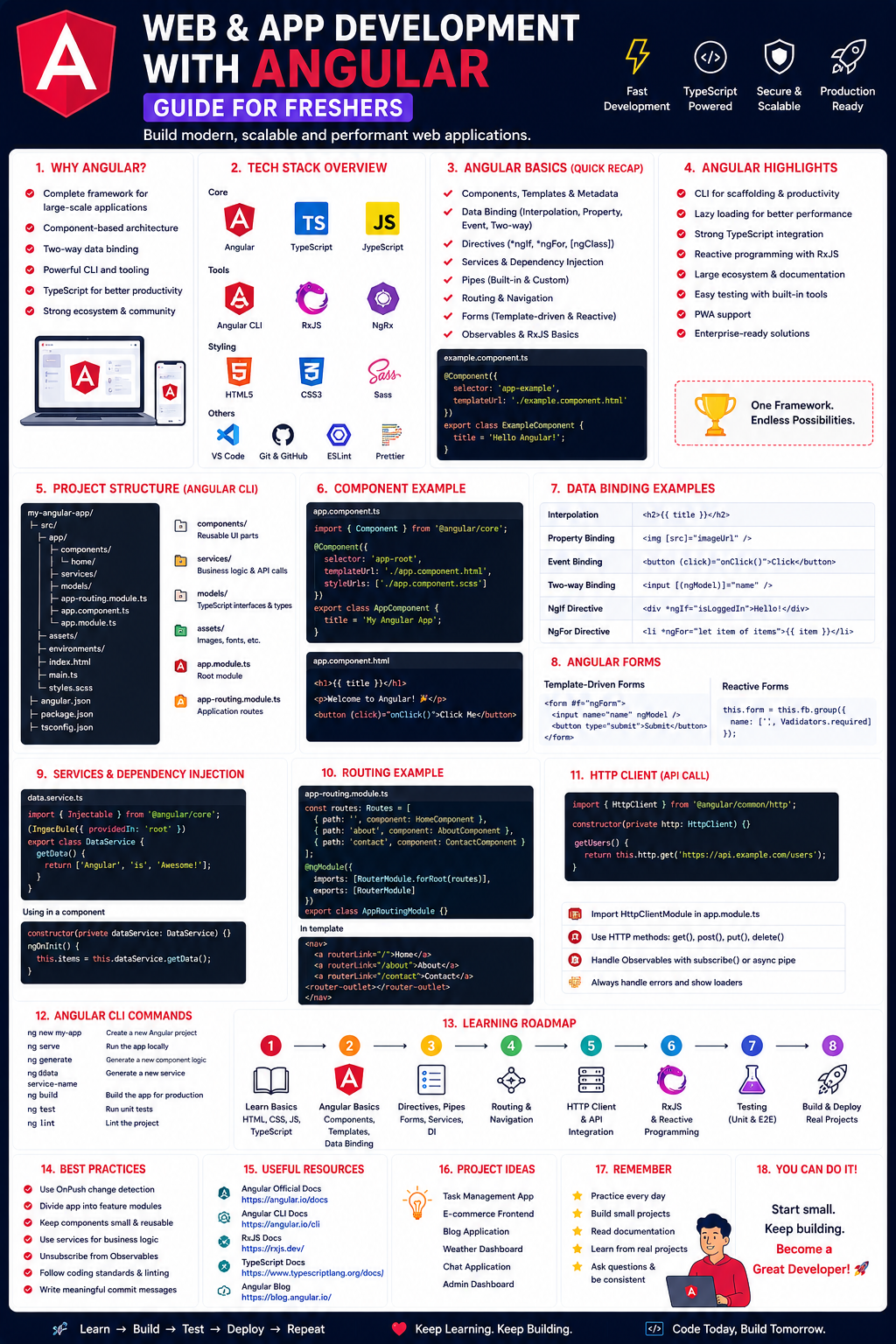
🗺️ A Complete Angular Roadmap for Freshers
This roadmap is your structured, no-nonsense guide to becoming a job-ready Angular Developer in 2026. If you've been overwhelmed by random tutorials, this path will give you clarity on what to learn, when to learn it, and why it matters for your career.
Angular is a TypeScript-based framework for building dynamic single-page applications. It is widely used in enterprise development for its scalability and robust architecture . Companies like Google, Microsoft Office 365, Deutsche Bank, and Samsung use Angular for large-scale applications .
The Bottom Line: In 2026, Angular offers a premium career path with strong job security. While React has more total jobs, Angular developers often command a $10,000+ salary premium due to the smaller talent pool and high enterprise demand .
📌 Your Angular Tech Stack at a Glance
Before we start the weekly breakdown, here is the exact stack that employers are looking for right now:
CategoryTechnologyCore FrameworkAngular (latest version)LanguageTypeScript (required, not optional)Reactive ProgrammingRxJS (Observables)State ManagementServices with DI / NgRx / SignalsUI ComponentsAngular Material / Ignite UITestingVitest, Playwright, Karma, JasmineToolsAngular CLI, VS Code, GitAI-Assisted DevGitHub Copilot, Cursor, Ignite UI CLI MCP
📚 Phase 1: The Unskippable Foundation (Weeks 1-4)
Goal: Build a rock-solid foundation in JavaScript and TypeScript. Do not skip this phase.
Week 1-2: Modern JavaScript (ES6+)
Angular is built on JavaScript. You cannot learn Angular without mastering these concepts first :
Essential JavaScript Concepts:
let and const declarations (avoid var)- Arrow functions and lexical
this binding - Template literals for string interpolation
- Destructuring (objects & arrays) – used constantly in Angular
- Spread/Rest operators – for copying arrays/objects
- Array methods:
.map(), .filter(), .reduce() – fundamental for data transformation - Asynchronous JavaScript: Promises,
async/await - ES Modules (
import/export syntax)
Practice Goal: Build a small project using only vanilla JS (e.g., a weather dashboard using the Fetch API, or a todo list with localStorage).
Week 3-4: TypeScript Fundamentals
TypeScript is required for Angular. You cannot use Angular without it .
Essential TypeScript Concepts:
- Basic types:
string, number, boolean, array, tuple - Interfaces and custom types
- Classes and inheritance
- Generics (basic understanding)
- Decorators (crucial for Angular components)
- Access modifiers:
public, private, protected
Practice Goal: Convert your vanilla JS project from Week 2 into TypeScript. Add interfaces for your data models.
Free Resources for Phase 1
- Simplilearn's Free Angular Course: 3 hours of self-paced video covering components, services, routing, and forms – no prerequisites required .
- TypeScript Official Documentation: The free, canonical guide to TypeScript.
- Online JavaScript Courses: Use free coupons on platforms like Udemy (look for "Full-Stack Development for Beginner" with promo codes).
🟢 Phase 2: Angular Core Concepts (Weeks 5-9)
Goal: Master the building blocks of every Angular application.
Week 5: Development Environment & CLI
Setup Steps:
- Install Node.js (version 18 or higher)
- Install Angular CLI globally:
npm install -g @angular/cli - Install VS Code with Angular Language Service extension
- Create your first project:
ng new my-first-app --routing
Key CLI Commands to Master:
- ng new – Create a new project
- ng generate component <name> – Generate a component
- ng generate service <name> – Generate a service
- ng serve – Start the development server
- ng build --prod – Build the project for production
- ng test – Run unit tests
Week 6: Components & Templates
Components are the fundamental building blocks of Angular applications .
Core Concepts:
- Component decorator (
@Component) - Templates and inline styles
- Data binding: interpolation (
{{ }}), property binding ([property]), event binding ((event)) - Two-way binding with
[(ngModel)] @Input() and @Output() decorators for component communication- Lifecycle hooks:
ngOnInit, ngOnChanges, ngOnDestroy
Week 7: Directives & Pipes
Directives:
- Structural directives:
*ngIf, *ngFor, *ngSwitch - Attribute directives:
[ngClass], [ngStyle] - Creating custom directives
Pipes:
- Built-in pipes:
date, currency, uppercase, lowercase, json - Creating custom pipes with
@Pipe - Parameterizing pipes
Week 8: Services & Dependency Injection
Services provide centralized data and functionality. Dependency Injection (DI) is Angular's powerful system for providing services to components .
Core Concepts:
- Creating injectable services with
@Injectable - Registering providers at component or module level
- Understanding hierarchical injectors
- Using services for data sharing between components
Week 9: Modules & Routing
Modules (@NgModule):
- Root module (
AppModule) bootstraps the application - Feature modules organize related components
- Shared modules for reusable components/directives
- Lazy loading for performance
Routing:
- Configuring routes with Angular Router
- RouterLink for navigation
- Route parameters and query parameters
- Route guards (canActivate, canDeactivate)
- Lazy loading routes
Practice Project for Phase 2
Build a "Task Manager" application with:
- Component-based UI (task list, task detail, add task form)
- Services to manage task data (CRUD operations)
- Routing between task list and task detail views
- Pipes to format dates and filter tasks by status
- Directives for conditional styling
Free Resources for Phase 2:
- Angular Official Documentation (angular.dev): The free, canonical guide maintained by the Angular team. Essential reading .
- Simplilearn Free Angular Course: Covers components, services, forms, routing, and dependency injection .
- Angular Academy App (iOS): AI-powered mobile learning with built-in code editor, smart code assistance, and AI chatbot support. Free tier available, subscription for premium features .
⚡ Phase 3: Reactive Programming with RxJS (Weeks 10-12)
Goal: Master Angular's reactive programming model. RxJS is a core part of Angular, especially for handling asynchronous operations like HTTP requests .
Core RxJS Concepts
- Observables: The foundation – streams of data over time
- Operators:
map, filter, tap, catchError, switchMap, mergeMap - Subjects:
Subject, BehaviorSubject, ReplaySubject - Common patterns:
of(), from(), interval() - Angular HTTP client with Observables
Practice
Convert your Task Manager to use:
- RxJS operators for data transformation
- Subjects for inter-component communication
- HTTP client with Observables (if connecting to a backend)
Free Resources for Phase 3
- RxJS Official Documentation: free, comprehensive operator reference.
- Angular HTTP Client Guide: free documentation on making API calls with Observables.
📝 Phase 4: Forms in Angular (Weeks 13-14)
Goal: Build complex, validated forms for real-world applications.
Template-Driven Forms
- Using
ngModel with two-way binding - Form validation with built-in validators
- Tracking form state (
touched, dirty, valid) - Displaying error messages
Reactive Forms (The Angular Way)
FormGroup, FormControl, FormArray- Reactive form validation
- Custom validators
- Dynamic forms
- Async validators
Practice
Build a "User Registration" form with:
- Reactive Forms approach
- Custom validator for password matching
- Async validator for username availability (simulate API call)
- Proper error messaging and styling
Free Resources for Phase 4:
- Angular Forms Guide (angular.dev): Free official documentation covering both template-driven and reactive forms.
- Simplilearn Angular Course (Forms Module): Free video content on Angular Forms .
🏗️ Phase 5: State Management (Weeks 15-16)
Goal: Manage application state at scale.
Option 1: Services with BehaviorSubjects (Built-in, Simpler)
For many applications, Angular's built-in services with BehaviorSubject from RxJS provide sufficient state management without additional libraries .
Option 2: NgRx (Redux Pattern for Enterprise)
NgRx provides a Redux-inspired state management solution for complex applications with multiple data sources and requirements for time-travel debugging .
Core NgRx Concepts:
- Store – single source of truth
- Actions – describe state changes
- Reducers – pure functions implementing actions
- Effects – handle side effects (API calls)
- Selectors – query state efficiently
Option 3: Signals (The Future)
Introduced in Angular 16+ and stabilized in Angular 19, Signals are Angular's new reactive primitive that simplifies state management .
Practice: Choose Signals as your focus – they represent the future of Angular state management and are simpler to learn than NgRx for beginners.
Free Resources for Phase 5:
- Angular Signals Guide (angular.dev): Free official documentation on Signals.
- Angular Blog: Free updates on new features and best practices.
🎨 Phase 6: UI & Testing (Weeks 17-18)
Angular Material (UI Components)
Angular Material provides production-ready UI components following Google's Material Design .
Key Components:
- Form controls: input, select, checkbox, datepicker
- Navigation: toolbar, menu, sidenav, tabs
- Data display: table, card, list, paginator
- Feedback: dialog, snackbar, tooltip
Testing Angular Applications
Testing Types :
- Unit tests: Test components, services, pipes in isolation
- Integration tests: Test component interactions
- End-to-end (e2e) tests: Test complete user flows
Tools:
- Jasmine/Karma (traditional)
- Vitest + Playwright (modern alternative – used by Ignite UI)
Practice: Write unit tests for your Task Manager components and services.
Free Resources for Phase 6:
- Angular Material Documentation: Free, comprehensive component guides.
- Angular Testing Guide (angular.dev): Free official testing documentation.
🚀 Phase 7: Performance & Deployment (Weeks 19-20)
Goal: Get your application production-ready.
Performance Optimization
- Ahead-of-Time (AOT) compilation
- Lazy loading modules
- Change detection strategy (
OnPush) - TrackBy function in
*ngFor - Code splitting and bundle optimization
Deployment
- Build for production:
ng build --prod - Deploy to hosting platforms (Vercel, Netlify, Firebase, AWS)
- Environment configuration (development vs. production)
Practice
Deploy your Task Manager application to Vercel or Netlify. Test it from your phone.
Free Resources for Phase 7:
- Angular Deployment Guide (angular.dev): Free official deployment documentation.
- Vercel/Netlify Documentation: Free guides for deploying Angular apps.
🤖 Phase 8: AI-Assisted Angular Development (Ongoing)
In 2026, AI tools are transforming how Angular developers work. Use them to accelerate your learning and productivity, not to replace your thinking.
AI Coding Assistants
- GitHub Copilot: Code completions and generation in VS Code
- Cursor: AI-powered IDE with advanced features
- Windsurf: Context-aware AI assistance
New: Ignite UI CLI MCP Server
The Ignite UI CLI now includes a built-in MCP (Model Context Protocol) server that exposes Angular documentation and API references to AI clients like VS Code with Copilot, Cursor, and Claude Desktop .
Features:
- Generate from Image skills: Drop a design image into an AI client, and it generates a working Angular UI with appropriate components and theming
- Components and API search: AI can search Angular docs and suggest implementations
- Pre-wired agent configs: Every new scaffold includes
AGENTS.md, CLAUDE.md, and pre-configured MCP settings
New Angular 19 Template Features
The latest Angular templates (Angular 21.2) now include:
- Signal-based components:
viewChild() replaces @ViewChild, output() replaces @Output - Modern control flow:
@if, @for, @switch replace *ngIf, *ngFor, *ngSwitch - Standalone-only architecture (no NgModules required)
- Injection function for cleaner DI
Practice: Use an AI assistant to generate a new Angular component. Review every line of generated code. Ask the AI to explain concepts you don't understand. Never deploy AI-generated code without understanding it.
📊 Angular Developer Salaries 2026
Based on market data:
United States (USD/year)
- Entry (0-2 yrs): Range 70K–70K–95K — Average $82K
- Mid (2-5 yrs): Range 95K–95K–135K — Average $115K
- Senior (5-8 yrs): Range 130K–130K–175K — Average $152K
- Lead/Architect (8+ yrs): Range 165K–165K–220K+ — Average $190K
India (INR/year)
- Fresher (0-1 yr): Range ₹4L–₹8L — Average ₹6L
- Junior (1-3 yrs): Range ₹7L–₹14L — Average ₹10L
- Mid (3-5 yrs): Range ₹14L–₹25L — Average ₹18L
- Senior (5+ yrs): Range ₹24L–₹45L+ — Average ₹32L
Key Insight: Angular developers command a premium because the talent pool is smaller relative to enterprise demand. Financial services and large corporations heavily use Angular .
💼 Career Application & Next Steps
🗂️ Your Job-Ready Portfolio (Build These 3 Projects)
Project 1 – Task Manager (The Foundation)
Build a complete task management app with components, services, routing, and forms. Host it on Vercel. This demonstrates core Angular competency.
Project 2 – E-commerce Product Dashboard (Intermediate)
Build an admin dashboard with product listing, filtering, sorting, pagination, and CRUD operations. Use Angular Material for UI and NgRx for state management.
Project 3 – Full-Stack Angular + .NET App (Enterprise-Ready)
Combine Angular with an ASP.NET Core backend . Build a complete business application (e.g., customer management system) with authentication, authorization, and data persistence.
📝 Sample Resume Entry
text
Junior Angular Developer | Project Portfolio

TECHNICAL SKILLS
- Angular (latest), TypeScript, RxJS, NgRx, Angular Material
- Angular CLI, Git, VS Code
- Testing: Jasmine, Karma
- Deployment: Vercel, Netlify

PROJECTS

Task Manager Application (Angular)
- Built component-based task management app with services for data persistence
- Implemented routing for navigation and reactive forms for task creation
- Deployed to Vercel with 95+ Lighthouse performance score

E-commerce Admin Dashboard
- Created product dashboard with sorting, filtering, and pagination
- Used Angular Material UI components and NgRx for state management
- Wrote unit tests achieving 85% code coverage

CERTIFICATIONS (In Progress)
- Simplilearn Angular Free Course – Completion Certificate
- Angular Official Documentation – Self-study

EDUCATION
- Self-directed Angular training (4+ months, 3 complete portfolio projects)
- JavaScript/TypeScript fundamentals (certificate)
🎤 The Interview Question You Will Be Asked
"Why would you choose Angular over React for a client project?"
Your Answer: "It depends on the project requirements. For an enterprise application with a large team, multiple modules, and long-term maintenance needs, Angular is the better choice. Angular provides everything out of the box – routing, forms, HTTP client, dependency injection, and testing utilities – so the team doesn't waste time debating architecture decisions. This consistency is valuable when onboarding new developers.
*Angular's use of TypeScript (required, not optional) and its opinionated structure also makes code more predictable and maintainable at scale. For startups where speed-to-market is critical, the larger React ecosystem might be better. But for banking, insurance, or any large-scale application with a 5+ year lifecycle, Angular's structure, tooling, and enterprise support make it the superior choice."*
This answer demonstrates you understand the trade-offs and can make architectural decisions based on business needs.
🎯 Your Next Steps for This Week
Do not try to learn everything at once. Consistency over intensity.
Step 1: Set up your environment (Day 1)
- Install Node.js, VS Code, and Angular CLI
- Create your first project:
ng new my-first-app --routing - Run
ng serve and see "Welcome to Angular"
Step 2: Complete Simplilearn's Free Angular Course (Week 1-2)
- 3 hours of self-paced video
- Covers components, services, forms, and routing
Step 3: Read the official Angular Tutorial (Week 2-3)
- Go through angular.dev tutorials
- Build the "Tour of Heroes" sample application
Step 4: Build your first independent project (Week 3-4)
- The Task Manager from Phase 2
- Deploy it and share the link
Step 5: Join the Angular community
- Follow the Angular blog
- Join r/Angular on Reddit
- Connect with Angular developers on LinkedIn
The journey of a thousand components begins with ng new. You have everything you need to start – free resources, a clear roadmap, and a growing ecosystem. The Angular community is welcoming, and the enterprise demand is real. Start building today.




 Group / 1: 1 Sessions