PHP Web Development Roadmap (Laravel/Symfony) for Freshers
Here's a complete, structured roadmap for becoming a PHP backend developer in 2026, covering everything from fundamentals to job readiness, with free and paid resources, AI tool integration, and career guidance.
Part 1: Foundational Skills (Before Frameworks)
Before touching Laravel or Symfony, you need solid PHP fundamentals. These are non-negotiable for interviews and real work.
Core Topics to Master:
- PHP syntax: variables, loops, conditionals, arrays, functions
- Superglobals (
$_GET, $_POST, $_SESSION, $_SERVER) - Form handling and file uploads
- Object-Oriented Programming (classes, inheritance, traits, visibility)
- Error handling (try-catch, custom error handlers)
- Sessions and cookies
- Working with MySQL using PDO and MySQLi
- Basic security: SQL injection prevention, XSS, CSRF, password hashing
- Composer (dependency manager)
- Git version control
- Linux basics (file permissions, cron jobs, SSH)
Free Resources:
- PHP Manual – The official documentation is excellent and beginner-friendly
- PHP Course on W3Schools – Quick, interactive examples
- freeCodeCamp's PHP Tutorial – 4+ hour video on YouTube
- Laracasts "PHP for Beginners" – Free series, highly recommended even if you don't use Laravel yet
Paid Resources:
- PHP: Getting Started (Pluralsight) – $29/month or use free trial. Covers installation, forms, MySQL, authentication
- PHP for Beginners (Udemy) – Edwin Diaz or Edwin Diaz, ~$15 on sale
- Zend PHP Certification Study Guide – For those serious about fundamentals
Practice Platforms:
- Exercism PHP Track – Mentored coding challenges
- HackerRank PHP – Syntax and algorithmic problems
- LeetCode Easy – Use PHP for array/string problems
- Build small scripts: contact form handler, file uploader, simple login system
Time estimate: 3-4 weeks (10-12 hrs/week)
Part 2: Choose Your Framework Path
The PHP landscape offers three distinct flavors. Your choice should depend on your career goals.
Path A: Laravel – The "Developer Happiness" Framework
Best for: Startups, SaaS products, rapid development, most job openings (80% of new projects)
Why Laravel
- Unmatched developer experience – things "just work"
- Massive ecosystem: Forge (deployment), Vapor (serverless), Nova (admin panels), Horizon (queues), Reverb (WebSockets)
- Largest community = most tutorials, packages, and job postings
- Shortest learning curve among full-featured frameworks
When NOT to choose Laravel:
- Ultra-high-concurrency APIs (sub-300 RPS ceiling with PHP-FPM)
- 5+ year enterprise systems where Symfony's strictness is better
- Pure admin/ERP systems (ThinkPHP 8 is faster for that niche)
Path B: Symfony – The Enterprise Bedrock
Best for: Large corporations, long-term projects (5-10 years), complex business logic, API-first architectures
Why Symfony
- Explicit configuration = less "magic" = easier to debug at scale
- Component-based architecture (HTTP, Console, Routing components are gold standards)
- Full PSR compliance for interoperability
- Forces SOLID principles and good architecture
- Powers Drupal, Magento, and Laravel's core components
When NOT to choose Symfony:
- You need to ship something in 2 weeks
- Your team is small and prefers rapid iteration
- You're a solo developer building a simple MVP
Path C (Optional): Doppar – The Performance-Focused Newcomer
Best for: High-load APIs, real-time WebSocket applications, sub-50ms response requirements
Why consider Doppar:
- Lightweight core, intelligently memoizes repeated executions
- Native Airbend WebSocket component (no external Pusher needed)
- Daemon-mode scheduler for sub-minute tasks
Caveat: Smaller ecosystem – you may need to write integrations yourself. Only choose this after learning Laravel or Symfony.
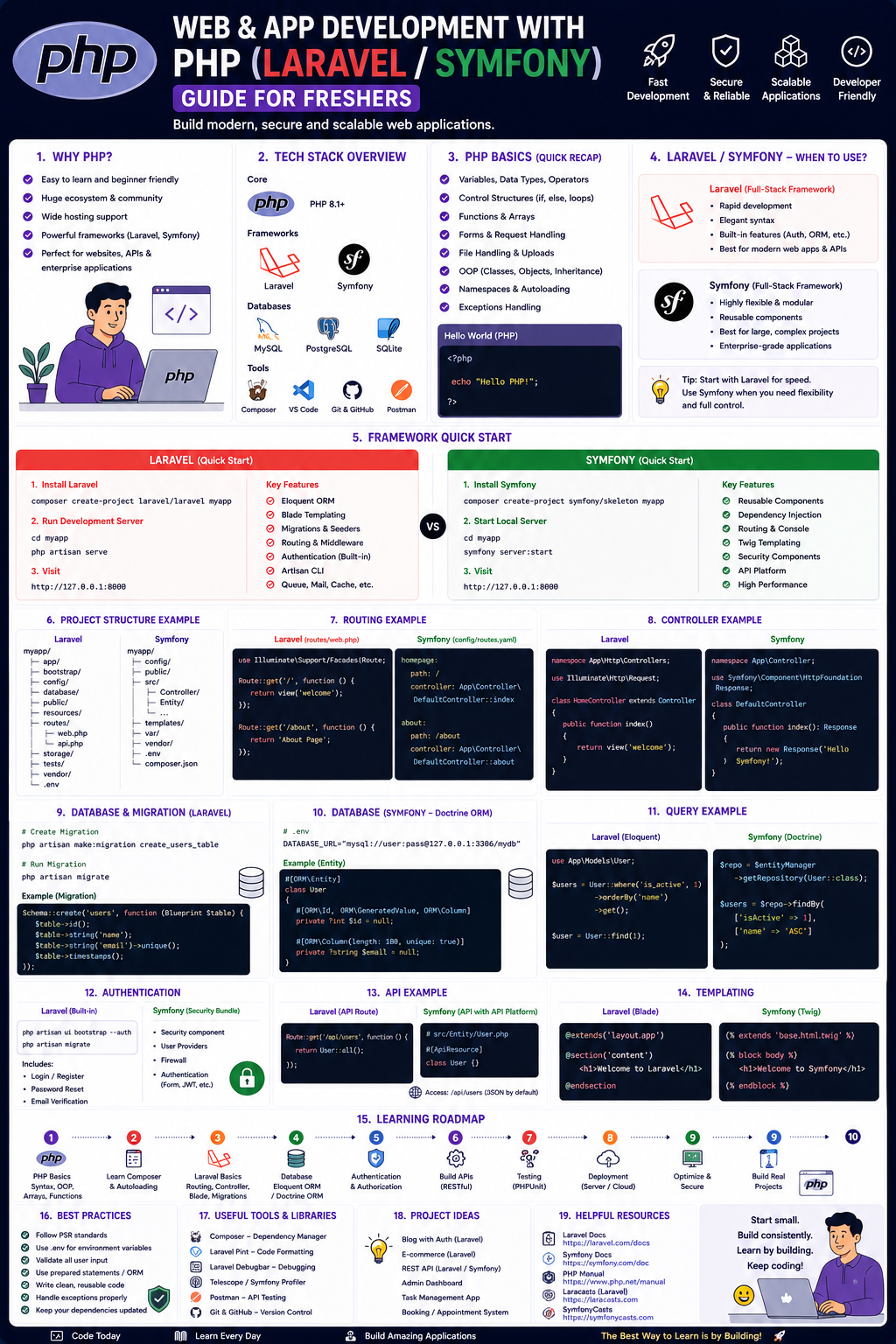
Part 3: Learning Laravel (Recommended for Freshers)
Since most PHP jobs require Laravel, this should be your primary focus.
Free Resources:
Laracasts "Laravel 11 From Scratch" – Free. The gold standard – Jeffrey Way teaches everything.
Laravel Daily YouTube – 400+ free videos on specific features.
Official Laravel Bootcamp – Interactive, builds a real app.
Laravel News – Weekly articles and package updates.
Laravel Documentation – Exceptionally well-written documentation.
Paid Resources:
- Laracasts – $15/month, worth every penny. Includes Vue, Livewire, Testing courses
- Laravel: Up & Running (book) – Matt Stauffer, ~$40
- From Apprentice to Artisan (ebook) – Free but donation-requested, by Taylor Otwell
Key Laravel Concepts to Master:
- Routing (web + API)
- Eloquent ORM and relationships (watch for N+1 problem!)
- Blade templating
- Middleware
- Authentication + Authorization (Gates, Policies)
- Queues and Jobs
- Events and Listeners
- Testing with PHPUnit/Pest
- Artisan CLI
- Service Container & Facades (understand what they really do)
Common Beginner Pitfalls (from experience):
php artisan serve is only for development – FPM mode behaves differently- Config caching – After changing
.env or config files, run php artisan config:clear or you'll waste hours debugging - Eloquent N+1 queries – Use
with() for eager loading, or toBase()->get() for read-heavy lists
Sample Laravel Projects to Build:
- Blog with comments – Learn relationships, authentication, pagination
- Task manager with teams – Many-to-many relationships, policies
- Job board – Search, filtering, file uploads, email notifications
- API for a mobile app – Passport/Sanctum, API resources, rate limiting
Part 4: Learning Symfony (After Laravel, for Career Flexibility)
Once you're comfortable with Laravel, learn Symfony to open enterprise doors.
Free Resources:
- Symfony Casts – Free "Symfony 7" track (limited but excellent)
- Official Symfony Tutorial (The Fast Track) – Free book, builds a real project
- Symfony Documentation – Extremely thorough
- Code with Symfony YouTube
Paid Resources:
- Symfony Casts – $15/month, more comprehensive than free tier
- Mastering Symfony (Udemy) – ~$15
- Symfony 5: The Fast Track (book) – ~$20
Key Symfony Concepts:
- Dependency Injection (central to Symfony)
- Doctrine ORM (similar to Eloquent but different philosophy)
- EventDispatcher for decoupled events
- Security component (authentication + authorization)
- Form component (powerful but complex)
- Validator component
- Serializer for APIs
- Workflow component for state machines
Symfony vs Laravel Mindset Shift:
- Laravel = convention over configuration (things are named correctly and "just work")
- Symfony = explicit over implicit (you configure everything, but nothing is hidden)
Part 5: Essential Backend Skills (After Frameworks)
Don't stop at "knowing Laravel." These skills differentiate juniors from mid-level.
Databases
- Skills to Learn: MySQL indexing, EXPLAIN queries, PostgreSQL, Redis
- Free Resources: MySQL Official Docs, Redis University
APIs
- Skills to Learn: REST design, GraphQL basics, OpenAPI/Swagger
- Free Resources: Stoplight.io tutorials
Queues
- Skills to Learn: Redis, RabbitMQ, Laravel Horizon
- Free Resources: Laracasts "Queues" series
Caching
- Skills to Learn: Redis, Memcached, HTTP caching
- Free Resources: Redis official docs
Testing
- Skills to Learn: PHPUnit, Pest, TDD workflow
- Free Resources: Free PestPHP tutorial
Deployment
- Skills to Learn: Docker basics, Forge, Envoyer, GitHub Actions
- Free Resources: Docker's Getting Started
Web Servers
- Skills to Learn: Nginx vs Apache, PHP-FPM configuration
- Free Resources: DigitalOcean tutorials
Part 6: Using AI Tools Effectively
AI can accelerate learning when used correctly. The Laravel ecosystem has unique AI advantages.
Laravel-Specific AI Tools:
- Laravel Skills Directory – An open directory of reusable AI agent skills for Laravel/PHP. Works with Claude Code, Cursor, Windsurf, Copilot. Skills cover Laravel conventions, Eloquent optimization, TDD workflows, API design. Install with
npx skills add <owner/repo> - PhpStorm 2026.1 MCP Tools – PhpStorm now includes MCP server tools for AI agents to access inspections, quick-fixes, and structural search. Claude Code plugin provides context-aware Laravel skills.
General AI Tools for PHP Developers:
GitHub Copilot – Best for code completion and suggestions. Free for students, otherwise $10 per month.
Claude Code (Anthropic) – Best for complex refactoring and understanding legacy code. Paid usage.
ChatGPT / Claude Web – Best for explaining error messages and generating boilerplate code. Free tier available.
Cursor IDE – AI-powered editor with PHP support. Free tier.
PhpStorm AI Assistant – JetBrains' built-in AI (Junie CLI in beta). Subscription required.
How to Use AI Without Hurting Your Learning:
DO use AI for:
- Explaining an error message you don't understand
- Generating repetitive boilerplate (migrations, tests, CRUD controllers)
- Suggesting improvements to your code
- Writing documentation comments
DON'T use AI for:
- Copy-pasting entire features you don't understand
- Skipping the "why" behind a solution
- Completing take-home assignments (employers will ask you to explain)
Prompt example for learning:
"I'm building a Laravel API for a job board. I have a Job model and want to add filtering by category and location. Show me how to implement this using query scopes, but explain each step so I understand Eloquent better."
Part 7: Portfolio Projects to Land a Job
Build these in order of increasing complexity. Host all on Render, DigitalOcean ($6/mo), or Laravel Forge.
For Laravel (Your Main Focus):
- Task Management System (1 week)
- User auth, create/assign tasks, due dates, priorities
- Deploy on Render
- Job Board with Company Profiles (2 weeks)
- Job posts, search/filters, resume uploads, email alerts
- Add Laravel Scout for full-text search
- Queue email notifications
- E-commerce API (3 weeks)
- Products, carts, orders, payment integration (Stripe sandbox)
- REST API with versioning
- API documentation with Scribe or Swagger
- Real-time Chat Dashboard (2 weeks)
- Use Laravel Reverb (first-party WebSockets)
- Vue or React frontend (or just Inertia.js)
- Demonstrated real-time skills are rare for juniors
For Symfony (To Stand Out):
- Admin Dashboard with CRUD – Using EasyAdmin or Sonata
- API Platform Project – Build a REST API with automatic OpenAPI docs
GitHub README Must-Haves:
- Live demo link (or video screencast)
- ER diagram of database schema
- API endpoints table (for API projects)
- Setup instructions (git clone, composer install, etc.)
- What you learned – employers love this
Part 8: Career Application & Next Steps
Entry-Level Job Titles:
- Junior PHP Developer
- Backend Developer (PHP/Laravel)
- Laravel Developer
- Full Stack PHP Developer (with Vue/React)
- WordPress/PHP Developer (if you want CMS work)
Job Boards for PHP Freshers:
LaraJobs – Best for Laravel-specific jobs and global remote positions.
Symfony Jobs – Best for enterprise roles using Symfony.
Wellfound (formerly AngelList) – Best for startup PHP roles.
Internshala – Best for Indian internships and entry-level positions.
LinkedIn (filter by "Entry Level" + "PHP") – Best for corporate roles.
Upwork – Best for small gigs and portfolio building.
Salary Expectations (India, 2026):
- Fresher (0-1 year): ₹3-6 LPA
- Junior (1-3 years): ₹6-12 LPA
- Mid-level (3-5 years): ₹12-20 LPA
- Senior (5+ years): ₹20-35 LPA+
*Note: A developer reporting 3 LPA as a fresher aimed to reach 10+ LPA by mastering DSA, system design, and architecture alongside PHP.*
How to Write Your Resume (Fresher):
Bad:
"Built a blog using Laravel following a YouTube tutorial."
Good:
"Developed a job board platform handling 500+ job listings. Implemented full-text search with Laravel Scout, reduced query time by 60% with eager loading, and deployed on DigitalOcean with automated backups."
Interview Preparation for PHP Roles:
Core PHP Questions (Expect these):
- Difference between
== and === - How sessions work vs. JWT for APIs
- Explain SQL injection and how to prevent it (prepared statements)
- What are traits? When to use them?
- Array functions:
array_map, array_filter, array_reduce
Laravel-Specific:
- What's the service container? How does dependency injection work?
- Explain Eloquent relationships (hasMany, belongsToMany)
- How do you avoid N+1 problems?
- What are facades? When should you avoid them?
- How does Laravel's queue system work?
System Design (Junior Level):
- Design a URL shortener like bit.ly
- Design a simple chat application architecture
DSA (For product companies):
- 30-50 LeetCode easy/medium problems in PHP or any language
Certifications (Nice-to-Have, Not Required):
- Zend PHP Certification – Recognized globally, ~$200
- Laravel Certified Developer – Official exam, validates framework skills
- PHP Institute – Entry-level and professional tracks
Part 9: Sample 6-Month Training Plan
Month 1: PHP fundamentals + MySQL + Git
- Weekly Hours: 12–15
- Deliverable: CLI todo app + simple CRUD site
Month 2: Laravel basics (routes, Blade, Eloquent)
- Weekly Hours: 10–12
- Deliverable: Blog system with comments
Month 3: Laravel advanced (auth, queues, testing)
- Weekly Hours: 10–12
- Deliverable: Job board with email alerts
Month 4: API development + deployment
- Weekly Hours: 8–10
- Deliverable: REST API with authentication
Month 5: Symfony basics (or deepen Laravel + Docker)
- Weekly Hours: 10–12
- Deliverable: Admin dashboard (EasyAdmin)
Month 6: Portfolio refinement + interview prep
- Weekly Hours: 15
- Deliverable: 3 polished projects on GitHub
Part 10: Red Flags & How to Avoid Them
Don't:
- Learn WordPress first – it teaches bad habits and limits career growth
- Ignore OOP fundamentals – framework "magic" won't save you in interviews
- Skip testing – junior roles that demand "immediate impact" still value test coverage
- Compare yourself to 10-year veterans on X (Twitter) – most are selling courses
Do:
- Read other people's code on GitHub (look at popular Laravel packages)
- Contribute to open source (even just fixing a typo in docs counts)
- Attend local PHP user groups or online meetups
- Build one project that actually solves a problem you have
The PHP ecosystem in 2026 is healthier than ever. Laravel dominates the job market, Symfony powers enterprise systems, and new tools like Doppar push performance boundaries . Start with Laravel, build real projects, learn Symfony later for career flexibility, and use AI tools to accelerate (not replace) your learning.




 Group / 1: 1 Sessions