AI-Powered Performance Creative (Video/AR) Training Roadmap
This roadmap is designed for creative professionals who want to master the intersection of video production, advertising platforms, and performance marketing. The role of the "Performance Creative" has emerged as one of the most in-demand positions in growth marketing—blending creative instinct with analytical rigor to produce ads that don't just look good but actually convert .
Understanding the Performance Creative Role
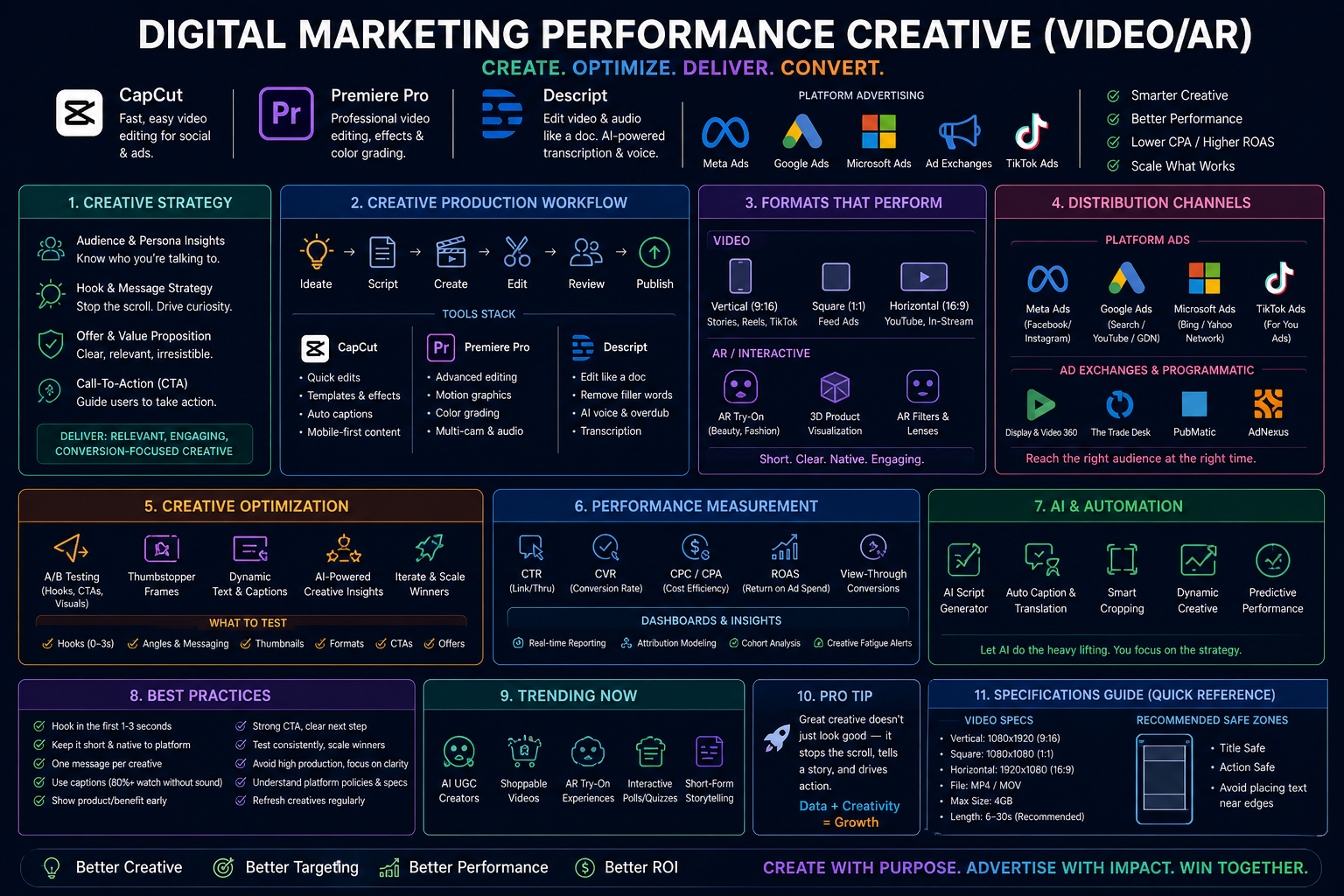
Before diving into tools, understand what "Performance Creative" means. Unlike traditional brand creative roles where success is measured by aesthetics or brand sentiment, Performance Creatives are judged on concrete metrics: ROAS (Return on Ad Spend), CTR (Click-Through Rate), CVR (Conversion Rate), CAC (Customer Acquisition Cost), and testing velocity .
The job posting from Linktree captures this perfectly: "You won't be here to feed a content calendar or execute pre-written briefs. You'll lead with insight—using performance data, audience understanding, and sharp judgment to decide what we should make next, and translate that into ads that convert" .
This role sits at the intersection of copywriting, video production, data analysis, and platform expertise. Large tech companies like Adobe and major advertisers are actively hiring for these roles, but the supply of qualified talent hasn't caught up with demand .
The 16-Week Performance Creative Roadmap
Phase 1: Weeks 1-4 – Foundations of Performance Creative
What to focus on
Start by understanding the core philosophy of performance creative. Traditional creative asks "does this look good?" Performance creative asks "will this drive a click, a conversion, or a sale?" The entire mindset shifts from aesthetic approval to hypothesis testing .
You need to understand the advertising ecosystem. Meta (Facebook/Instagram), TikTok, YouTube, and Google Ads each have different creative requirements, audience behaviors, and algorithm preferences. A creative that crushes on TikTok may flop on Facebook—not because it's bad, but because the platforms reward different retention patterns.
Key platforms to learn
Google Ads and Microsoft Ads remain foundational for search-based performance marketing. Ad exchanges (programmatic advertising) matter for display and video across the open web. For a performance creative role, you need to understand how creatives perform differently across each channel's auction and delivery systems.
Practical application
Set up test accounts on Meta Ads Manager, TikTok Ads Manager, and Google Ads. Don't run paid campaigns yet—just familiarize yourself with the creative specifications, ad formats, and reporting dashboards. Download the creative guidelines for each platform and create a cheat sheet of format requirements (aspect ratios, maximum lengths, text limits).
Free resources
Meta Blueprint – Facebook's free certification platform covers ad formats, creative best practices, and campaign setup. The "Creative Strategies" learning path is directly relevant.
Google Skillshop – Free training covering Google Ads, YouTube advertising, and creative best practices. The "Video Advertising" certification path is particularly valuable.
TikTok Creative Center – Free resource showing top-performing ads across categories, plus creative tools and best practices.
Microsoft Advertising Learning Lab – Free interactive training covering search and audience ads.
Ad Exchanges basics – Programmatic advertising fundamentals are covered free through Google's "Display & Video 360" training and industry blogs like AdExchanger.
Paid resources
Coursera "Meta Social Media Marketing Professional Certificate" – Subscription-based, 7-course series covering ads manager, creative strategy, and analytics. Free audit option available.
Udemy "Facebook Ads & Facebook Marketing Mastery 2026" – Typically $20-50, comprehensive coverage of creative testing and optimization.
Trade Desk Edge Academy – Free certification for programmatic advertising fundamentals, essential if you plan to work with ad exchanges directly.
Phase 2: Weeks 5-8 – Mastering Video Editing Tools
What to focus on
In 2026, AI has dramatically changed video production economics. According to industry testing, AI video tools have reduced average production costs by 91%, from around 4,500perminutewithtraditionalproductiontoroughly
4,500perminutewithtraditionalproductiontoroughly400 per minute . Monthly active users across AI video platforms reached 124 million in January 2026, and 73% of Fortune 500 companies have integrated AI video tools into their workflows .
However, different tools serve different purposes. You need proficiency in multiple tools based on your use case.
CapCut (Free)
CapCut offers the most powerful free video editor available. Auto captions, text-to-speech, AI background removal, script-to-video generation, and 1080p export are all available at zero cost . The TikTok integration (both owned by ByteDance) makes it the default editor for short-form social content. The AI Clipper feature turns long videos into short clips automatically, and Smart Auto-Reframe keeps subjects centered when switching aspect ratios.
For beginners who want polished content without a steep learning curve, CapCut gets you there fastest. The free tier handles 80% of casual editing needs .
Premiere Pro (Industry Standard)
Adobe Premiere Pro remains the industry standard for professional editing. Adobe is layering AI on top of the most capable editing timeline available . Key AI features include Generative Extend (adds AI-generated frames to extend clips), AI Object Masking (tracks moving objects up to 20x faster than manual masking), and Dubbing and Lip Sync (translates dialogue while preserving the original voice and matching lip movements).
The barrier is the steep learning curve and expensive subscription (22.99/monthannualor
22.99/monthannualor34.49/month monthly). For professional work, the depth and ecosystem integration are unmatched. For social media content, CapCut and alternatives handle casual editing at a fraction of the cost .
Descript (Talking-Head Specialization)
Descript pioneered editing video by editing a transcript. Delet a word from the transcript, and the corresponding video segment is cut. It's as intuitive as editing a Google Doc . Key AI features include filler word removal (detects and strips "ums," "uhs," and "likes"), Eye Contact AI (adjusts pupils so you appear to look at the camera even when reading notes), Studio Sound (removes background noise), and Overdub (clones your voice for voiceover).
The limitation: text-based editing works best for talking-head and dialogue-heavy content. Cinematic editing and B-roll-heavy projects don't benefit from the transcript-first approach .
Other tools to consider
- Runway – Best for AI video generation (text-to-video, image-to-video) at $12-76/month
- Filmora – Sweet spot between CapCut and Premiere Pro at $49.99/year
- Opus Clip – Long-form to short-form repurposing with AI Virality Score
- Topaz Video AI – Best for upscaling and enhancing footage quality
Hands-on practice
Edit three short videos using each tool. First, edit a talking-head video using Descript's transcript-based workflow. Second, edit a fast-paced social media clip using CapCut's templates and auto-captions. Third, edit a more complex multi-layer video using Premiere Pro's timeline and AI masking features. Compare the time spent and output quality.
Free resources
CapCut Academy – Built-in tutorials and YouTube channel covering all features.
Adobe Premiere Pro User Guide – Complete free documentation with tutorials.
Descript Help Center – Free tutorials covering every feature.
YouTube – Countless free tutorials from creators like Justin Odisho, Premier Gal, and CapCut Tutorials.
Paid resources
LinkedIn Learning "Premiere Pro 2026 Essential Training" – 30/monthsubscription,comprehensivevideocourse.∗∗Udemy"CapCutCompleteCourse"∗∗–Typically
30/monthsubscription,comprehensivevideocourse.∗∗Udemy"CapCutCompleteCourse"∗∗–Typically20-50, covers everything from basics to advanced effects.
Descript's own training – Included with paid plans, covers team workflows and advanced features.
Phase 3: Weeks 9-12 – Ad Platforms, UGC, and Creative Testing
What to focus on
This phase bridges production skills with performance marketing. You need to understand how Meta, TikTok, YouTube, and Google algorithms behave—and how creative influences delivery, targeting, and in-platform performance .
UGC (User-Generated Content) mastery
Performance creative roles consistently emphasize UGC expertise . Authentic, creator-led content often outperforms polished studio productions. You need to learn how to source, brief, and manage UGC creators, plus how to produce UGC-style content yourself when speed matters .
The GrowthAssistant job description specifies: "Hands-on creative production. Produce static ads, short-form videos, UGC-style content, and simple motion edits yourself" . You're not just briefing others—you're expected to execute.
Ad copy and hooks
At your core, you're a copywriter. Successful performance creatives know how to sell, which angles convert, how to shift audience beliefs, and how to calibrate messaging across sophistication levels—from problem-unaware to ready-to-buy .
The Thrillophilia job posting emphasizes: "If you think in data, hooks, angles, hypotheses and experiments, keep reading" .
Creative testing frameworks
The most valuable skill is building a systematic testing engine. This means:
- Turn growth targets into creative hypotheses
- Run weekly testing that ships new concepts without fail
- Scale winners, kill losers, codify learnings
- Build a library of creative frameworks that makes the entire organization smarter
Practical application
Run a creative test cycle. Start with one product/service. Write 5 different hook variations. Produce 3 video variations (different angles, different hooks, different lengths). Run them as a split test on one platform with a small budget. Analyze the results: which hook had the highest hook rate? Which angle drove the lowest CPA? Document your learnings.
Free resources
Meta Creative Hub – Free tool for previewing and testing creatives across placements before launch.
TikTok Creative Challenge – Free learning resource with top-performing ad examples and breakdowns.
Google Ads Creative Studio – Free preview and testing environment.
UGC creator communities – Free to join platforms like Billo, Trend, and Insense (though payments to creators cost money).
Paid resources
Ad creatives databases – Tools like Motion (49/month),CreativeOS(
49/month),CreativeOS(39/month), or Foreplay (29/month)provideswipefiles,breakdowns,andcreativetestinginsights.∗∗UGCplatforms∗∗–Billo,Trend,Insense(
29/month)provideswipefiles,breakdowns,andcreativetestinginsights.∗∗UGCplatforms∗∗–Billo,Trend,Insense(50-500 per video) connect you with creators for authentic content.
Testing platforms – Creative testing tools like Smartly.io, Madgicx, or Revealbot ($100-500/month) automate creative testing across platforms.
Phase 4: Weeks 13-16 – Analytics, AR, and Career Integration
What to focus on
Performance creative requires living in dashboards. You need to interpret metrics like CTR (Click-Through Rate), CVR (Conversion Rate), hook rate, hold rate, thumb-stop rate, and CPA . You're not just producing creatives—you're analyzing what works and iterating based on real data.
AR (Augmented Reality) for advertising
AR advertising is growing rapidly, particularly on Meta and TikTok platforms. Both offer AR effect creation tools for branded filters, try-on experiences, and interactive ads. While advanced AR development requires technical skills, understanding the creative possibilities and how to brief AR developers is valuable for performance creative roles.
Attribution and funnel thinking
You need to diagnose friction points across the entire acquisition journey, from the first ad impression to the final conversion . This means understanding tracking, pixels, events, and conversion paths—not just the creative itself.
AI tools for workflow acceleration
Performance creative roles increasingly expect AI fluency. The Linktree job description states: "Comfortable using AI tools to move faster, generate variation, and extend your creative output—without losing quality or judgment" .
AI accelerates tasks like:
- Generating headline and hook variations
- Auto-captioning and subtitling
- Background removal and audio cleanup
- Creating multiple aspect ratios from one master
- Transcribing interviews for highlight extraction
Practical application
Build a complete creative testing dashboard. Set up tracking for your test campaigns. Export performance data. Create a simple spreadsheet or Notion database that tracks: creative ID, platform, hook, angle, CTR, CVR, CPA, and testing notes. After 4 weeks of testing, you should have a clear picture of what works for your product/category.
Free resources
Meta Ads Reporting – Built-in dashboards and custom report builder, free with ad account.
Google Looker Studio – Free for connecting and visualizing ad platform data.
AR creation tools – Meta Spark AR free for creating basic branded filters; TikTok Effect House free for AR effects.
Analytics academies – Google Analytics Academy (free), Meta Blueprint Analytics courses (free).
Paid resources
Attribution platforms – Tools like Triple Whale (100−500/month)orNorthbeamforadvancedattribution.∗∗Creativeanalytics∗∗–ToolslikeMotion(
100−500/month)orNorthbeamforadvancedattribution.∗∗Creativeanalytics∗∗–ToolslikeMotion(49/month) or Daasity for creative performance analysis.
AR advanced training – Coursera "AR for Marketing" specialization (subscription), LinkedIn Learning AR courses ($30/month).
Portfolio Projects That Get You Hired
Your marketing degree taught you that portfolios matter more than resumes. Build these three artifacts during your training.
Project One: The Complete Creative Test Cycle
Choose a real product (could be a friend's small business, a dropshipping product, or even a mock brand with real ad spend). Run a structured creative test over 4 weeks. Document everything: your hypothesis, the 5-10 creatives you produced, the testing framework, the performance data, and your learnings. Present as a one-page case study with clear metrics (CTR lifts, CPA improvements).
The Thrillophilia job posting explicitly wants: "A portfolio that highlights impact, not aesthetics (CTR lifts, CAC drops, format wins)" .
Project Two: The UGC Library
Produce or commission 5-10 UGC-style videos for a specific brand/product. Include different hooks, angles, and formats. Document the briefs you provided to creators. Show the before/after feedback process. This proves you can source and direct creator content at scale.
Project Three: The Multi-Platform Adaptation
Take one piece of content (one video, one message) and adapt it for Meta feed, Meta stories, TikTok, and YouTube Shorts. Show each version with platform-specific hooks and editing styles. Demonstrate you understand what each platform rewards.
Project Four: The AR Interactive Ad (Advanced)
Create a simple AR filter using Meta Spark AR or TikTok Effect House that could be used in a brand campaign. Even a basic face filter or try-on effect shows you understand the AR advertising opportunity.
Career Application
Job Titles to Target
Performance Creative Strategist – The most common title across job postings. You'll own creative strategy, testing roadmaps, and production across paid channels .
Performance Creative Head – A leadership title at companies like Thrillophilia, owning creative direction, team management, and testing velocity for D2C/e-commerce brands .
Creative Strategist, Growth – Equivalent title emphasizing the growth marketing integration. Linktree's version of this role requires "copywriter at your core" and deep platform fluency .
Growth Creative Lead – Another variant emphasizing the direct connection to growth metrics.
Required Skills Based on Real Job Postings
Based on analysis of active job postings, employers expect :
- Hands-on production: You can personally produce high-performing ads, not just brief or review them
- Copywriting expertise: You know how to write hooks, angles, and CTAs that convert
- Platform fluency: Deep understanding of Meta, TikTok, YouTube, and Google creative best practices
- Analytical instincts: You know how to read performance data and turn it into better creative
- Testing mindset: You design experiments, read results, and codify learnings into repeatable frameworks
- UGC experience: You've sourced, briefed, or produced creator-led content
- AI comfort: You use AI tools to move faster without losing quality
Salary Expectations
Based on job postings, performance creative roles command significant premiums over traditional creative positions. The GrowthAssistant role lists compensation up to Php120,000 (Philippines-based, remote) . US-based roles typically range from $80,000-150,000 depending on experience and company stage. Head of Performance Creative roles at growth-stage companies command higher ranges with equity components.
Certifications That Matter
Meta Certified Creative Strategy Professional – Validates you understand Meta's creative best practices and testing frameworks.
Google Ads Creative Certification – Covers video ad best practices, asset optimization, and creative measurement.
TikTok Creative Certification – Demonstrates you understand short-form video creative for TikTok's unique algorithm.
HubSpot Video Marketing Certification – Free, covers video strategy and measurement basics.
Trade Desk Edge Academy – Free certification for programmatic advertising, valuable if working with ad exchanges directly.
The Job Search Strategy
Your portfolio is everything. Create a dedicated website or Notion page showcasing your case studies. Each case study should clearly show: the hypothesis, the creatives you produced, the testing framework, the performance data, and your learnings .
Network on LinkedIn with the title "Performance Creative Strategist" in your headline. Share your testing learnings as posts. Engage with growth marketing communities like Demand Curve, GrowthHackers, and the Facebook Ad Buyers group.
Apply to roles at growth-stage companies (Series A-C) where creative testing velocity matters most. Enterprise roles exist but often require agency or in-house experience first.
Immediate Next Steps for the Next 7 Days
Day One: Set up free accounts on CapCut, Descript free tier, Canva, and Meta Ads Manager. Just get familiar with the interfaces.
Day Two: Watch a "CapCut in 20 minutes" tutorial on YouTube. Edit your first 15-second clip end-to-end—cutting, captions, music, export.
Day Three: Sign up for Meta Blueprint and start the "Creative Strategies" learning path (free, 2-3 hours).
Day Four: Choose a product (real or mock) you'll use for your portfolio projects. Define your testing hypothesis: "I believe [hook type X] will outperform [hook type Y] on [platform] because [reason]."
Day Five: Write 10 hook variations for your chosen product. Film or source 3 pieces of UGC-style content. Edit them in CapCut.
Day Six: Create your portfolio structure—a website, Notion page, or Google Drive folder where you'll document your case studies.
Day Seven: Join the Performance Creative community on Reddit (r/performancecreative, r/ads), LinkedIn groups, or the Demand Curve Slack. Introduce yourself as a practitioner transitioning into the field.
The Long Game
Performance creative is one of the fastest-growing specializations in marketing. The shift from brand creative to performance creative reflects a broader industry trend toward accountability and measurement. Every dollar spent on advertising can now be tracked, and creative is the single biggest variable in campaign performance.
Your hands-on production skills (CapCut, Premiere Pro, Descript) give you an edge over strategists who can only brief others. Your ad platform knowledge (Meta, TikTok, Google) makes you operational, not just creative. Your testing mindset and analytics comfort make you a growth partner, not just an asset producer.
The job postings are clear: the market needs people who can think in hypotheses, produce great creative, and measure what works . Companies like Linktree, Thrillophilia, and countless others are actively hiring—but they're looking for portfolios, not just resumes .
Start your week one actions today. Build your first case study this month. Ship your first creative test next month. The window for establishing yourself as a performance creative is wide open, and the professionals who act now will own this emerging discipline.
Design/Video portfolio




 Group / 1: 1 Sessions