AI-Powered RevOps & Revenue Architecture Training Roadmap (Salesforce, HubSpot, Tableau, Salesforce CPQ, Clari)
This roadmap is designed for sales and operations professionals who want to master Revenue Operations—the discipline of aligning sales, marketing, and customer success around shared data, processes, and reporting to drive predictable revenue growth . The role has evolved significantly: what started as a rebranding exercise has become one of the most sought-after skill sets in B2B companies, with salaries nearly doubling from ~96Kto
96Kto 198K in the first decade of a RevOps career .
Understanding the RevOps & Revenue Architecture Stack
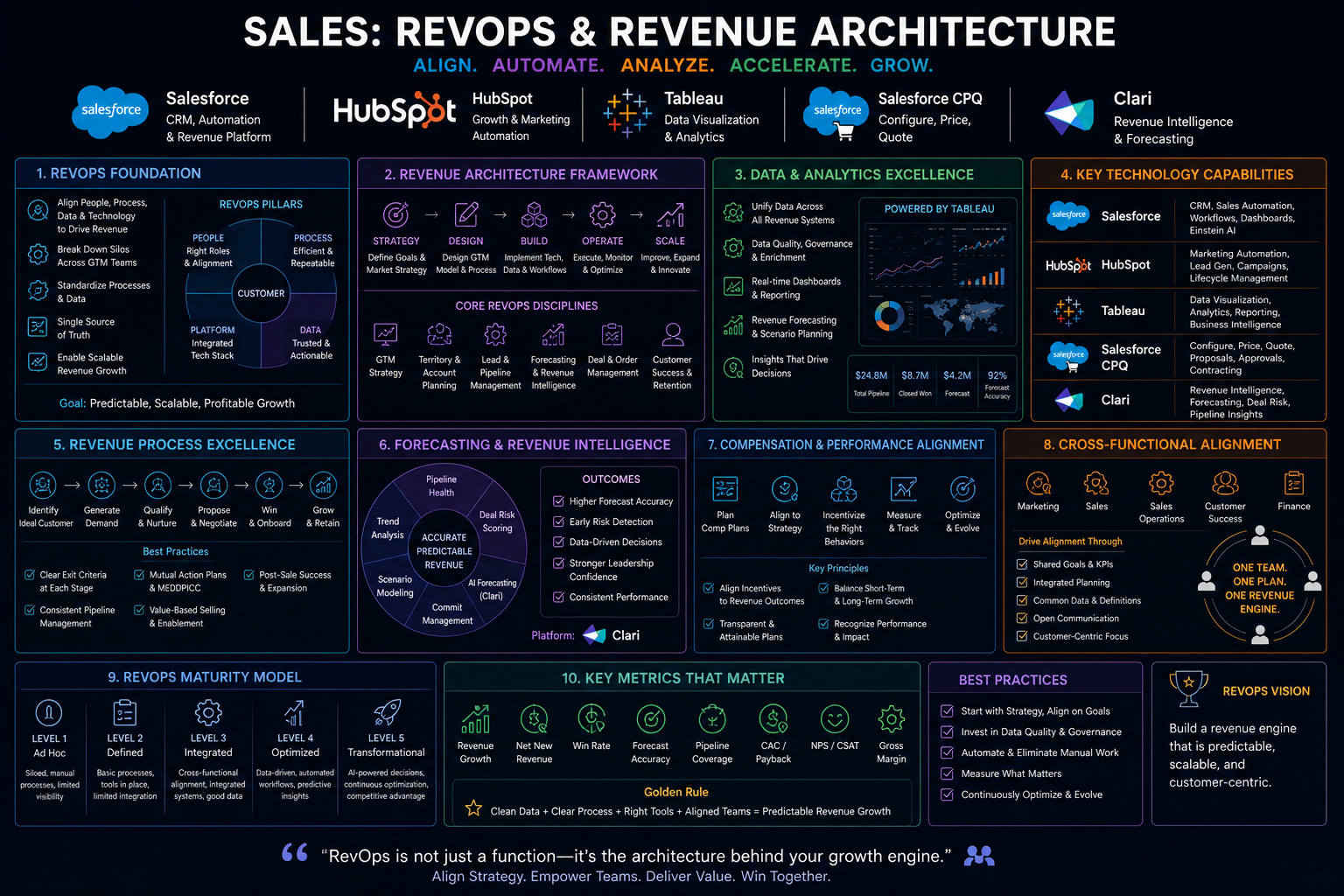
Before diving into training, understand the five functional layers of the RevOps technology stack:
- Core CRM (Salesforce, HubSpot): The central nervous system where all customer and revenue data lives. You cannot do RevOps without deep CRM fluency .
- CPQ (Salesforce CPQ): Configure-Price-Quote streamlines the quoting process, ensuring accurate pricing, product configuration, and approval workflows. This is essential for companies with complex product catalogs or discounting rules.
- Revenue Intelligence (Clari): AI-powered forecasting and pipeline inspection. Clari connects to your CRM to provide real-time visibility into deal health, forecast accuracy, and revenue predictions.
- Analytics & BI (Tableau): Visualization and dashboarding that turns raw CRM data into executive-ready insights. Organizations with unified RevOps tools grow up to 19% faster than those running fragmented systems .
- AIRops (Emerging Discipline): AI embedded directly into CRM workflows, data pipelines, and decision-making processes rather than bolted on top . This is the fastest-growing specialization in RevOps today.
The 14-Week RevOps Training Roadmap
Phase 1: Weeks 1-4 – Core CRM Mastery (Salesforce or HubSpot)
What to focus on
RevOps professionals must be fluent in at least one CRM. The market is roughly split between Salesforce (enterprise) and HubSpot (mid-market). Choose the ecosystem that matches your target employers.
Salesforce Path
Salesforce is the enterprise standard for revenue operations. Roles requiring Salesforce experience consistently command higher salaries, with RevOps Managers earning 122,400–
122,400–165,600 at firms like GDIT and Directors averaging $195,668 nationally .
The most valued Salesforce skills for RevOps include custom objects, workflow rules, process builder (or Flow), and—increasingly—AI features like Einstein. For CPQ specifically, you need to understand product rules, pricing logic, quote templates, and approval chains.
HubSpot Path
HubSpot is dominant in the mid-market and growing quickly in enterprise. HubSearch's 2026 Salary Report shows the HubSpot-specific career path progressing from HubSpot Specialist (65,000–
65,000–80,000) to HubSpot Admin (95,000–
95,000–125,000) to RevOps/Ops Leader (115,000–
115,000–165,000) .
The most valuable HubSpot skills for RevOps include custom objects, custom-coded workflows, data modeling, and Breeze AI features including Copilot and Agents .
Free resources for Phase 1
Salesforce Trailhead is completely free and the industry standard for CRM training. Complete the Admin Beginner trail, then move to Sales Cloud and CPQ modules. For CPQ specifically, focus on the "CPQ Specialist" superbadge.
HubSpot Academy offers free certifications including HubSpot Reporting Certification, Sales Hub Certification, and Revenue Operations Certification. All are accessible with a free HubSpot account.
Paid resources for Phase 1
Salesforce certifications are the most valuable credentials in the RevOps job market. The Salesforce Administrator exam costs 200,theCPQSpecialistexamis
200,theCPQSpecialistexamis200, and the Sales Cloud Consultant exam is $400. Many employers reimburse exam fees.
For CPQ specifically, official instructor-led training from Salesforce ranges from 1,500–
1,500–3,000 but may not be necessary for self-directed learners using Trailhead.
Practical application
Build a complete sales process in your chosen CRM. Create lead-to-close workflows including lead scoring rules, automated task assignment, and pipeline stage automation. For CPQ practice, configure a product catalog with tiered pricing and discount approval rules. Set up a quote template that populates automatically from opportunity data.
Phase 2: Weeks 5-8 – Revenue Intelligence with Clari
What to focus on
Clari is the leading revenue intelligence platform, using AI to analyze pipeline health, predict forecast accuracy, and identify at-risk deals before they slip. Clari connects directly to your CRM—whether Salesforce or HubSpot—to provide a unified view of revenue operations .
The platform's core capabilities include AI-powered forecasting (predicts which deals will close and when), pipeline inspection (identifies deals stuck in stages or missing key information), deal health scoring (flags at-risk opportunities based on activity patterns), and revenue analytics (real-time dashboards showing pipeline velocity, win rates, and coverage ratios).
Free resources for Phase 2
Clari's certification program is available through their partner portal. The "Clari Foundations" certification covers core platform navigation, forecast configuration, and reporting. For learning purposes, request a demo account or watch Clari's webinar library available on their website.
Practical application
Set up a forecast category framework in your CRM that aligns with Clari's methodology (Commit, Best Case, Pipeline, Omitted). Configure weekly forecast submission workflows for sales reps. Build a deal health scorecard that flags deals missing next steps, stagnant in stage for >14 days, or lacking executive sponsor engagement.
Phase 3: Weeks 9-11 – Analytics & Visualization with Tableau
What to focus on
Tableau transforms raw CRM data into executive-ready dashboards that drive revenue decisions. In RevOps, your stakeholders don't want spreadsheets—they want insights at a glance . The core metrics every RevOps dashboard should track include:
- Weighted Pipeline Value: (# of deals) x (ACV) x (win rate). This is your real pipeline, not the fantasy number reps put in Salesforce .
- Sales Velocity: Pipeline Value divided by Average Sales Cycle Length. Sitting on 1.5Minpipelinewitha120−daycyclemeans
- 1.5Minpipelinewitha120−daycyclemeans12,500/day in expected revenue movement .
- Pipeline Coverage Ratio: Total pipeline / Quota. Below 3x means you're flying blind. Above 5x often signals weak qualification.
- CAC (Customer Acquisition Cost): Total sales + marketing spend divided by New Customers. The trend matters more than any single number.
- Net Revenue Retention: Best-in-class SaaS runs 120%+. If yours is below 100%, fix retention before hiring more AEs.
Free resources for Phase 3
Tableau Public is completely free for learning and building public-facing visualizations. Tableau's free training videos cover everything from basic charts to calculated fields and parameters. The Tableau Community forums have millions of active users sharing solutions.
Paid resources for Phase 3
Tableau Desktop license costs approximately 70peruserpermonthfortheprofessionaledition.TableaueLearningsubscriptions(
70peruserpermonthfortheprofessionaledition.TableaueLearningsubscriptions(15-30/month) provide structured learning paths. The Tableau Desktop Specialist certification ($125) validates basic proficiency.
Practical application
Connect Tableau to a sample CRM dataset (Salesforce offers free Developer Edition with sample data). Build a pipeline dashboard showing weighted pipeline by stage, by rep, and over time. Create a forecast accuracy dashboard comparing predicted close dates to actuals. Add a customer health scorecard tracking NRR by segment and product line.
Phase 4: Weeks 12-14 – AIRops & Systems Architecture
What to focus on
AIRops (AI Revenue Operations) is the discipline of designing revenue systems where AI is embedded directly into workflows— not layered on top after the fact . This is the fastest-growing specialization in RevOps, with AIRops Strategists earning 110,000–
110,000–160,000 today .
The distinction: a standard RevOps setup has a human reviewing pipeline data, pulling a report, identifying a problem, and fixing it. An AIRops setup has AI doing that monitoring continuously, surfacing anomalies before a human would catch them, and triggering defined resolution workflows automatically .
The four-step AIRops operating pattern is Read (pull the right CRM context), Think (interpret the task narrowly), Check (review against rules and edge cases), and Write (only update the CRM when the result is trustworthy) . This deliberate, conservative pattern is designed for teams who want real leverage from AI without taking on CRM risk they can't manage.
Key AIRops skills to develop :
- CRM data architecture: AI operating on a poorly structured CRM produces unreliable outputs at scale. If your contact lifecycle stages are inconsistent, your deal properties aren't filled, or your associations are incomplete, no AI layer will fix that—it will amplify it.
- Prompt engineering for structured CRM work: Specific prompts that operate safely on CRM records with narrow task definitions, explicit output formats, and built-in review conditions.
- Workflow design for AI-human handoffs: Knowing where to let AI act autonomously versus where to require human review is a judgment call with real consequences for CRM data quality.
- n8n or similar orchestration tools: For teams building AI workflows outside the native CRM layer, n8n is increasingly the tool of choice for RevOps and AIRops work.
Free resources for Phase 4
The RevOps Careers blog provides detailed analysis of AIRops skills, salaries, and implementation patterns. The AIRops Academy launched its first cohort in April 2026 with a four-step operating pattern curriculum. n8n offers a free self-hosted option with extensive documentation.
Paid resources for Phase 4
The AIRops Academy is paid (pricing not publicly listed; for teams building production capabilities). n8n paid tiers start at $20/month for teams needing advanced features.
Practical application
Design an AI workflow that automatically monitors a key pipeline metric—for example, deals with no activity in 14+ days. Define the trigger, the AI action (draft an email to the rep, update a field, create a task), the confidence threshold, and the human review checkpoint. Document where the AI acts autonomously versus where human approval is required.
Your Portfolio Projects
Build these four artifacts during your training. They demonstrate exactly what hiring managers look for.
Project One: The Complete RevOps Tech Stack Audit
Document the ideal RevOps tech stack for a specific company size (choose a stage: startup, growth-stage, enterprise). Map data flows between CRM, CPQ, Clari, Tableau, and engagement platforms. Identify integration points, potential data quality risks, and a 90-day remediation plan.
Project Two: The Executive Dashboard Suite
Build a Tableau dashboard connecting to sample CRM data showing: weighted pipeline by rep and stage, forecast accuracy trending quarterly, sales velocity by product line, and pipeline coverage ratio by region. Each dashboard should tell a clear story and include specific recommended actions.
Project Three: The CPQ Optimization Case Study
Using Salesforce CPQ demo data or a free trial, document a complete quote-to-cash workflow. Show product rules, pricing logic, discount approval chains, and quote generation. Identify three optimization opportunities and calculate their impact on sales cycle time.
Project Four: The AIRops Workflow Specification
Document a production-ready AIRops workflow: define the business problem, the data sources, the AI decision logic, confidence thresholds, human review checkpoints, and success metrics. Show how you would measure whether the AI is improving outcomes versus creating risk.
Career Application
Job Titles to Target
The RevOps career ladder has clear progression with distinct compensation bands :
| Title | Experience | Focus | Salary Range (US) |
|---|---------|---|
| RevOps Analyst / Specialist | 0-3 years | Execution: workflows, reporting, CRM hygiene | 65,000–
65,000–96,000 |
| Salesforce/HubSpot Administrator | 2-5 years | Platform ownership, configuration, integration | 95,000–
95,000–125,000 |
| RevOps Manager | 3-7 years | Cross-functional alignment, process design, team leadership | 110,000–
110,000–165,000 |
| AIRops Strategist | 3-7 years | AI workflow design, system architecture, AI governance | 110,000–
110,000–160,000 |
| Senior RevOps Analyst | 4-7 years | Funnel optimization, forecasting ownership, strategy | 130,000–
130,000–140,000 |
| Director of RevOps | 7-12 years | Executive alignment, board-facing metrics, full P&L | 162,000–
162,000–228,000 |
| VP of RevOps | 10+ years | Full RevOps function, CRO reporting, organizational design | 180,000–
180,000–250,000+ |
Senior-level roles: The Senior RevOps Analyst role at TurboTenant (130,000–
130,000–140,000 + equity) requires expertise in HubSpot Enterprise, SQL, Python for ETL, and AI-native workflows using tools like Cursor and Claude . The Manager role at ComplyAdvantage (130,000–
130,000–170,000 range) requires Salesforce Admin certification, Tableau fluency, and 3-5+ years including team leadership .
The AI premium in 2026: The RevOps Co-op study of 1,800+ professionals found AI-fluent RevOps professionals earn up to 60,000morethangeneralists.AIOpsrolesaveragearound
60,000morethangeneralists.AIOpsrolesaveragearound200K versus $140K for traditional ops .
Certifications That Matter
Salesforce certifications hold the highest market value. The Salesforce Administrator (200)isthebaseline.TheCPQSpecialist(
200)isthebaseline.TheCPQSpecialist(200) is essential if targeting product-led companies. The Sales Cloud Consultant ($400) signals enterprise-ready expertise. HubSpot certifications (free) including Revenue Operations Certification are valuable in the mid-market ecosystem.
Clari certification is available through their partner portal. Tableau Desktop Specialist (125)validatesbasicanalyticsproficiency.CompTIAAISalesEssentials(4−6hours,
125)validatesbasicanalyticsproficiency.CompTIAAISalesEssentials(4−6hours,200+ish) covers CRM automation and AI workflows.
Skills That Are Actually in Demand
Based on active job postings from TurboTenant, ComplyAdvantage, and GDIT, plus industry analysis :
Technical foundation (non-negotiable):
- CRM proficiency (Salesforce or HubSpot) with admin-level configuration skills
- SQL for data extraction and validation (you cannot be effective without it)
- BI tool fluency (Tableau or Power BI)
- Excel (yes, still—roughly half of organizations still rely on Excel-based calculations)
Revenue architecture:
- Pipeline modeling and forecasting methodology
- Lead scoring design and attribution modeling
- CPQ configuration (product rules, pricing logic, approval chains)
- Data governance frameworks
AIRops & AI implementation (the $60K differentiator):
- CRM AI features (Einstein, Breeze Copilot, Agents)
- Prompt engineering for structured CRM work
- Workflow design for AI-human handoffs
- n8n or similar orchestration tools
Soft skills (the CLEAR framework):
- Connect the dots: Understand business functions and devise optimization strategies
- Lead with inspiration: Coach others while achieving company goals
- Excel at communication: Bring brevity to executive conversations and build trust
- Ask a lot of questions: Spark conversations rather than seeking solutions immediately
- Readily adapt to situations: Combine strategic vision with tactical execution
Interview Prep & 30/60/90 Plan
Questions that come up in nearly every RevOps interview loop :
- Walk me through your first 90 days.
- How would you diagnose a funnel conversion issue between MQL and SQL?
- How do you forecast with imperfect data?
- You've got budget for three tools. How do you prioritize?
- Describe a CRM migration or major process change you've led.
- How do you communicate pipeline health to a board that doesn't speak ops?
The 30/60/90 framework they're looking for :
Days 1-30 (Audit): Map the funnel, audit the tech stack, assess data quality, run stakeholder interviews across sales, marketing, and CS. Don't change anything yet—just listen and document. The fastest way to lose credibility is to "fix" something before you understand why it exists.
Days 31-60 (Quick wins): Fix the most painful data or process gap, present a prioritized roadmap, establish a reporting cadence. The biggest Day 45 win is often simply deduplicating CRM records—it immediately improves every metric downstream because the baseline numbers finally make sense.
Days 61-90 (Lock metrics): Deploy core dashboards, pilot attribution or lead scoring improvements, set baseline KPIs the team will be measured against going forward.AI-Powered RevOps & Revenue Architecture Training Roadmap (Salesforce, HubSpot, Tableau, Salesforce CPQ, Clari)
This roadmap is designed for sales and operations professionals who want to master Revenue Operations—the discipline of aligning sales, marketing, and customer success around shared data, processes, and reporting to drive predictable revenue growth . The role has evolved significantly: what started as a rebranding exercise has become one of the most sought-after skill sets in B2B companies, with salaries nearly doubling from ~96K to 96Kto 198K in the first decade of a RevOps career .
Immediate Next Steps for the Next 7 Days
Day One: Create a free Trailhead account (Salesforce) or HubSpot Academy account. Complete the first module of the Admin Beginner trail.
Day Two: Sign up for Tableau Public. Connect to a sample dataset and build your first chart—pipeline by stage is a perfect start.
Day Three: Research the RevOps job market. Save 5 job descriptions for roles you'd want in 6 months. Note which tools appear most frequently.
Day Four: Watch a Clari demo video or request a Clari demo account. Understand the difference between CRM-native forecasting and AI-powered revenue intelligence.
Day Five: Write your updated LinkedIn headline. Change it from "Sales Operations" or "Business Analyst" to "Revenue Operations Professional | CRM + Analytics + Revenue Architecture." Follow RevOps leaders on LinkedIn and join the RevOps Co-op Slack community.
Day Six: Define your specialization path. Choose one CRM to master first (Salesforce for enterprise, HubSpot for mid-market). Choose whether to pursue CPQ (product-led companies) or Tableau (analytics-heavy roles).
Day Seven: Start your first portfolio project—the Tech Stack Audit or the Executive Dashboard. Commit to completing one project within 30 days. Document your process publicly on LinkedIn to build visibility.
The Long Game
Revenue Operations is one of the highest-leverage roles in B2B. Gartner estimates 75% of the highest-growth companies deploy a RevOps model, and public companies with RevOps see 71% higher stock performance . The job has moved considerably—the expectation now is that RevOps owns the systems architecture behind revenue activities, not just the maintenance .
The most successful RevOps professionals are hybrids: they can talk to a VP about pipeline hygiene at 9am and debug a CRM workflow at 10am . They combine technical depth (SQL, CRM architecture, AI tooling) with strategic thinking (forecasting methodology, go-to-market strategy, cross-functional alignment).
The AIRops discipline is the emerging frontier. The skill isn't using the tools—it's knowing when and how to redesign the system around them. Organizations that add AI without changing their operational structure often perform worse than teams with no AI at all . That's the case for skilled AIRops work: it's not obvious, and it's not automatic.
Your marketing or sales background is an asset, not a limitation. The fastest paths into RevOps are from roles where you've already been solving process problems: Sales Coordinator, Marketing Operations, Business Analyst, Sales Strategy . Build your portfolio, get certified strategically, and connect the dots between systems, data, and revenue outcomes.
Start your week one actions today. The market for RevOps talent has never been stronger, and the professionals who can architect revenue systems for the AI era will command the highest premiums for years to come.
Knowledge / Experience of Sales Ops




 Group / 1: 1 Sessions