AI-Powered Product Marketing Management Training Roadmap (Figma, Miro, Jira, Salesforce, Tableau)
This roadmap is designed for product marketing professionals who want to master the convergence of strategic positioning, cross-functional collaboration, and data-driven decision-making. The role of the Product Marketing Manager has fundamentally shifted—what once required intuition and manual research now demands AI fluency, data synthesis, and the ability to orchestrate complex go-to-market operations across multiple tools simultaneously.
The essential truth for 2026 is that AI will not replace product marketers, but product marketers who use AI will replace those who don't . Your existing skills—understanding audiences, crafting narratives, translating technical capabilities into business value—are your unfair advantage. This roadmap builds on that foundation by teaching you to orchestrate your core tool stack with AI-powered workflows.
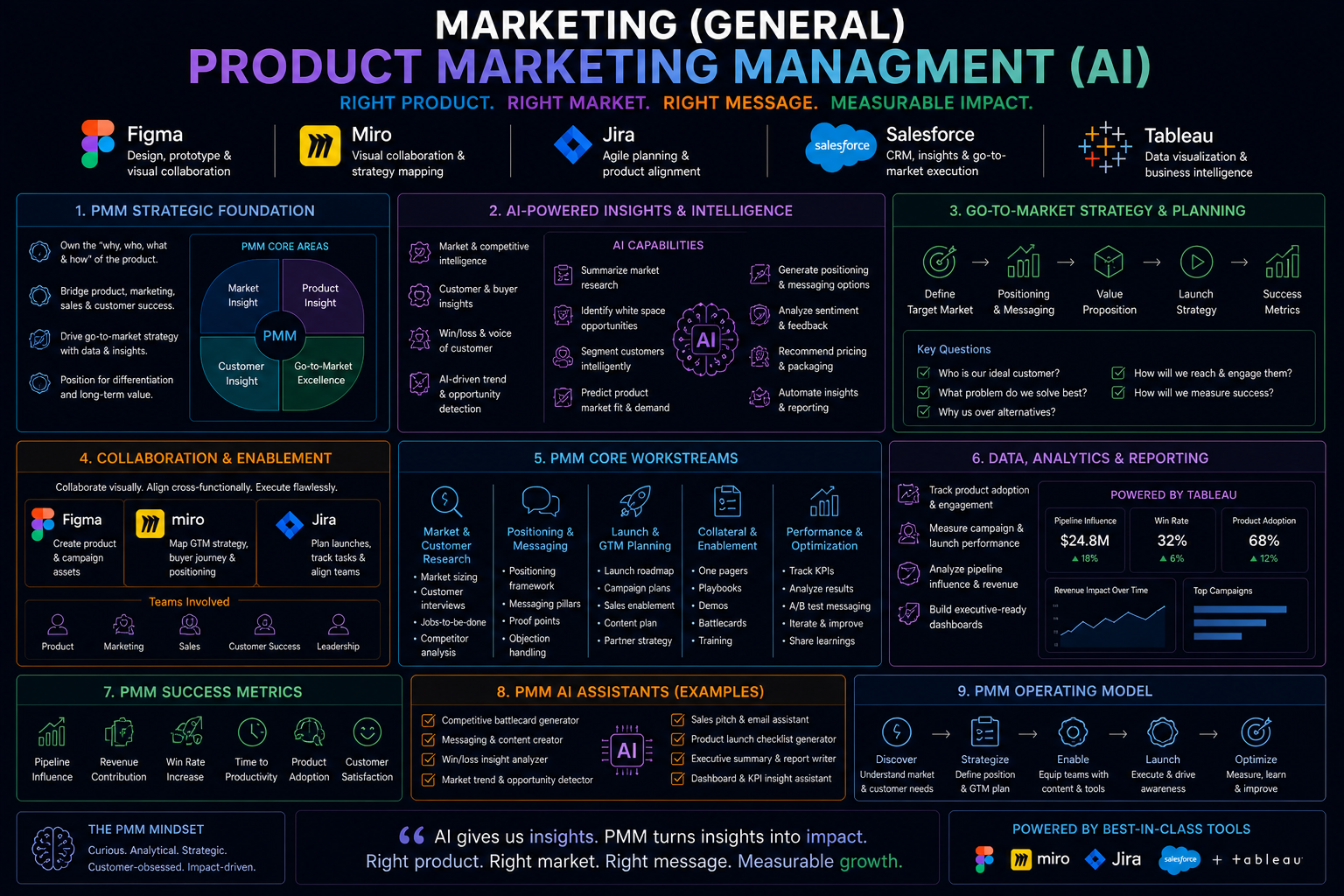
Understanding the Product Marketing Tech Stack
Before diving into training, understand the five functional layers of the modern product marketing tech stack.
Figma is the industry standard for collaborative design. You will use it to create one-pagers, battle cards, sales decks, website mockups, and campaign assets—not as a designer, but as a collaborator who can mock up concepts, give feedback on designs, and maintain brand consistency across all customer-facing materials.
Miro is the virtual whiteboard where product marketing strategy comes together. You will use it to map customer journeys, workshop positioning, align cross-functional teams on launch plans, visualize competitive landscapes, and facilitate brainstorming sessions—all in real-time with stakeholders across time zones.
Jira is how you track the work. While historically owned by engineering, Jira has become essential for product marketing to tag launch tasks, track dependencies on dev timelines, report progress to leadership, and maintain visibility into when features will actually ship.
Salesforce is your customer truth center. You will use it to analyze win/loss data, segment accounts for targeted campaigns, track campaign attribution, understand which messaging resonates with which segments, and close the loop between marketing activities and revenue outcomes.
Tableau turns raw data into executive-ready dashboards. You will use it to visualize campaign performance, track pipeline contribution by segment, measure adoption metrics post-launch, and tell the story of marketing's impact on the business in terms leadership understands.
AI is the intelligence layer that accelerates every one of these tools. It drafts content, synthesizes research, identifies patterns across scattered data sources, and surfaces insights you would otherwise miss. The AI-native product marketer doesn't work harder—they work smarter, using AI to handle the grunt work while they focus on strategy .
The 14-Week Product Marketing Training Roadmap
Phase 1: Weeks 1-4 – Strategic Foundations and Collaboration Tools
What to focus on
Start with the strategic frameworks that define product marketing. You need to understand the disciplines of positioning (defining why your product matters and to whom), messaging (translating that position into customer language), and go-to-market strategy (orchestrating launch across channels, segments, and sales teams).
The Product Marketing Certified Core curriculum from the Product Marketing Alliance emphasizes that being an AI-native product marketer means replacing intuition with algorithms in some areas while using AI to remove practical barriers that once limited your strategic impact . The refreshed curriculum is designed to help you navigate this transition while keeping you in the driver's seat as AI handles the heavy lifting.
Key frameworks you must master include the positioning matrix, which clarifies competitive differentiation and target audience. Battle cards help sales teams win against specific competitors by arming them with objection handlers, differentiators, and competitive intelligence. Launch playbooks provide repeatable frameworks for taking products to market across segments.
Miro mastery for product marketers
Miro is where product marketing strategy becomes visible and collaborative. The free tier includes three editable boards, which is sufficient for learning the fundamentals. Unlimited teams require paid plans starting around $8 per member per month.
Your Miro skills should include building customer journey maps that visualize every touchpoint from awareness to advocacy. You will use journey mapping to identify messaging opportunities, channel gaps, and moments where customers need different information. Competitive positioning workshops allow cross-functional teams to align on how you win against specific rivals. Launch planning boards track tasks, owners, and timelines across marketing, sales, product, and customer success.
Go-to-market canvases are one-page frameworks that capture positioning, target audience, pricing, distribution, and success metrics in a single view. These become your north star for launch execution.
Figma for non-designers
Figma is not just for designers. Modern product marketers use it to mock up concepts, provide annotated feedback, and maintain asset libraries. The free Professional tier includes unlimited files and collaborators, making it accessible for learning.
You need to understand the core interface: frames, components, and layers. You will practice creating simple assets like one-pagers and battle cards using pre-built templates. The comment and feedback workflow—leaving annotations, tagging collaborators, resolving threads—is essential for giving design feedback without becoming a bottleneck. Publishing to the design team ensures your files are organized, named, and ready for handoff.
Free resources for Phase 1
The Product Marketing Alliance offers free resources including templates and community discussions; paid certification is also available. Miro Academy provides free certification courses covering everything from basics to advanced facilitation techniques. Figma's YouTube channel features free tutorials including "Figma for Beginners" and "Collaborative Design Workflows." Pragmatic Institute webinars cover product marketing fundamentals and AI integration .
Paid resources for Phase 1
The Product Marketing Certified Core program provides professional certification demonstrating you understand formal frameworks. General Assembly's AI Marketing pathway includes content strategy modules applicable to product marketing. LinkedIn Learning offers courses on Product Marketing Foundations and Go-to-Market Strategy.
Practical application
Map a complete customer journey in Miro for a product you know well. Include awareness, consideration, decision, onboarding, adoption, and advocacy stages. For each stage, document customer questions, emotions, touchpoints, and messaging needs. Then in Figma, create a simple one-pager template for an upcoming product. Add text, images, and basic shapes. Share it with a collaborator and practice leaving feedback comments.
Phase 2: Weeks 5-8 – AI-Powered Research and Positioning
What to focus on
This phase transforms how you do customer research and competitive intelligence. The traditional challenge is that customer signals are scattered across your organization: CRM notes from sales, Slack threads from customer success, support tickets, interview transcripts, and survey responses . Taken individually, these appear anecdotal. Collectively, they are a goldmine. AI enables you to analyze these fragments together, surfacing emerging risks or opportunities that no single team would identify in isolation.
Scaling qualitative research with AI
The traditional reliance on closed-ended questions and rating scales was a compromise born of necessity. You could not manually analyze thousands of open-ended responses. Today, AI allows you to include open-ended questions alongside quantitative ones and cluster responses in minutes rather than days . You no longer have to choose between depth and volume.
When you analyze win/loss notes, sales call summaries, and support tickets together, AI can identify patterns that would otherwise remain invisible. For example, you might discover that deals lost to a specific competitor share a common objection that your battle cards do not address, or that a feature customers say they want appears most often in conversations where another problem is the real driver.
Free resources for Phase 2
The Product Marketing Alliance's Becoming the AI-Native Product Marketer guide provides frameworks for using AI in research, positioning, and GTM planning . Optimove's AI Marketing Tools Hub includes Data and Insight Power tools like ChatGPT, Perplexity, and Gemini for analyzing campaign performance without waiting for analytics support . Google Gemini is free for users 18 and over with a personal or Workspace Google Account .
Practical application
Export 50-100 customer interview transcripts, sales call notes, or support tickets (anonymize any PII). Use ChatGPT or Gemini to analyze this data with the prompt: "Based on these customer conversations, identify: the top three problems customers mention, the language they use to describe these problems, and any surprising patterns or contradictions." This mirrors how AI-native PMMs synthesize scattered signals into actionable insights .
Phase 3: Weeks 9-12 – GTM Orchestration and Salesforce Integration
What to focus on
Product marketing lives at the intersection of product, sales, and marketing. Your ability to align these functions around a shared plan is what determines launch success. This phase focuses on Jira for task tracking and Salesforce for understanding the customer journey from lead to close.
Jira for launch management
While Jira is traditionally engineering-owned, product marketers need visibility into development timelines to plan launches. You will not configure Jira workflows, but you will tag tasks, run basic filters, and understand how to track dependencies. The free tier is available for up to 10 users.
Key Jira skills include creating issues and sub-tasks for launch deliverables like battle cards, sales training, and website updates. Using filters, you can see what is assigned to you, what is blocked by engineering, and what is approaching deadline. Understanding the workflow—To Do, In Progress, In Review, Done—helps you track launch readiness. Jira's integration with Confluence allows you to link launch plans back to source documents.
Salesforce for customer intelligence
Salesforce is where your product marketing work meets revenue reality. Opportunities, stages, and close dates tell you which segments are winning. Campaign attribution shows which launch activities actually drove pipeline. Contact and account records reveal which personas engage with which content. Win/loss fields capture why deals are won or lost—direct input for your positioning and battle cards.
If your organization uses Salesforce, request read access to Opportunities, Campaigns, and Reports. If not, use Trailhead's free Developer Edition with sample data to learn the concepts.
Free resources for Phase 3
Salesforce Trailhead offers completely free modules including Sales Cloud basics, Campaign Management, and Reports and Dashboards. Atlassian's Jira documentation provides free tutorials for beginners. Pragmatic Institute's GTM Strategy resources are available through free webinars .
Practical application
In Salesforce (using Trailhead's sample data), run a report showing won opportunities by campaign source for the last quarter. Identify which campaigns drove the most pipeline and which had the highest win rate—they are often different. Then in Jira, create a launch plan for a hypothetical product. Break the launch into epics (pre-launch, launch week, post-launch) and add tasks under each with assignees and due dates.
Phase 4: Weeks 13-14 – Analytics, Positioning, and Career Preparation
What to focus on
This phase integrates everything. You will build dashboards that prove marketing impact, then synthesize your learning into portfolio projects that demonstrate your AI-native product marketing capabilities.
Tableau for product marketing dashboards
Tableau transforms raw data into executive-ready visualizations that tell the story of marketing's contribution to revenue. Tableau Public is completely free and allows you to publish visualizations online. Desktop licensing costs approximately 70peruserpermonth,withTableaueLearningsubscriptionsat
70peruserpermonth,withTableaueLearningsubscriptionsat15 to 30permonth.TheDesktopSpecialistcertificationexamcosts
30permonth.TheDesktopSpecialistcertificationexamcosts125.
Your dashboards should answer specific business questions. Which acquisition channels drive the highest-quality pipeline is measured by cost per opportunity at each stage. How adoption varies by segment tells you where to focus post-launch marketing. Which features drive retention helps you prioritize what to highlight in customer communications. Where the pipeline is stalling reveals which stage needs better sales enablement or content.
AI-native positioning frameworks
The risk in positioning is rarely that you have no good story. It is that you pick one without properly seeing the others . AI makes it easy to generate multiple plausible directions—different frames of reference or "so-what" outcomes—so you can compare them side by side.
The pattern that separates generic AI outputs from differentiated ones is built from three ingredients AI cannot invent on its own . Customer language uses the actual words your buyers use to describe their pain. Specific mechanism identifies the precise thing your product does differently from alternatives. Context about who cares specifies the role, company size, and moment that makes your product relevant.
Generic outputs fail because they describe a category of product, not your product. Differentiated outputs work because they are built from these three ingredients, which must come from you: from customer interviews, win/loss analysis, sales call recordings, and your own product knowledge. AI is a transformation engine—it can reshape, refine, and scale your inputs, but it cannot manufacture the specificity that makes marketing land .
Go-to-market scenario planning
One of the biggest challenges in GTM planning is the sheer volume of variables: segments, channels, timelines, budgets, and competitive responses . AI is particularly strong at handling this complexity. You can use AI to model different launch scenarios: what happens if you launch to enterprise first versus mid-market? What if you prioritize a new channel over an existing one? What if a competitor launches a similar feature the same week?
These scenarios do not replace strategic thinking—they augment it. AI helps you see the trade-offs more clearly so you can make better decisions faster.
Free resources for Phase 4
Tableau Public and free training videos provide complete learning resources. The Product Marketing Alliance's AI-native PMM guide offers advanced frameworks for positioning and competitive intelligence . Pragmatic Institute's AI in Product Marketing Job Search webinar covers portfolio building and interview preparation . The Blend roadmap for transitioning from marketing to AI provides career guidance and salary benchmarks .
Paid resources for Phase 4
Productboard Spark, an AI agent purpose-built for product managers, offers a free trial with 150 initial credits . It can draft product briefs, analyze customer feedback, and generate competitive analyses. Product Marketing Certified Core provides professional certification and community access. The Tableau Desktop Specialist certification exam validates your analytics proficiency.
Practical application
Build a Tableau dashboard tracking a mock product launch. Include pre-launch awareness metrics, launch week pipeline creation, and post-launch adoption by segment. Then use AI to generate three positioning statements for that product using the differentiated formula: customer language, specific mechanism, and context about who cares. Compare the outputs—which one feels uniquely yours?
Your Portfolio Projects
Build these four artifacts during your training. They demonstrate exactly what hiring managers for AI-native product marketing roles are looking for in 2026.
Project One: The Complete Go-to-Market Playbook
Choose a real or mock product. Build a complete GTM playbook including positioning statement, messaging hierarchy, launch timeline with Jira tasks, sales enablement assets (battle cards, one-pager, demo script), customer communications, and success metrics with Tableau dashboard. Document where AI accelerated your work—for example, research synthesis, content drafting, or scenario modeling.
Project Two: The Customer Insight Synthesis
Collect customer feedback from three sources: support tickets, sales call notes, and survey responses (anonymize any PII). Use AI to analyze this data and identify three patterns no single source would reveal. Present your findings as a one-page insight brief with specific recommendations for positioning, messaging, or product roadmap. Include your prompt and the AI's analysis as an appendix to demonstrate your process.
Project Three: The Competitive Intelligence Dashboard
Choose three competitors. Using publicly available information (websites, earnings calls, press releases, review sites) and AI assistance, build a Tableau dashboard tracking their positioning changes, feature releases, and customer sentiment over time. Identify one competitive threat and one opportunity that your team should address. Show how you would socialize this intelligence with sales and product teams.
Project Four: The AI-Native Positioning Workshop
Run a positioning workshop in Miro for a mock product. Use AI to generate five different positioning frames based on customer research. Facilitate a cross-functional team (or simulate with stakeholder personas) to evaluate each frame against criteria like differentiation, believability, and defensibility. Document the final position and the rationale for choosing it over alternatives. Show how AI accelerated exploration without replacing human judgment.
Career Application
Job Titles to Target
The product marketing career ladder in AI-forward companies has distinct roles with evolving responsibilities.
Product Marketing Manager (PMM) requires 2 to 5 years of experience. You own positioning, messaging, and launch execution for a product line. The salary range is 90,000to
90,000to130,000.
Senior Product Marketing Manager requires 5 to 8 years of experience. You lead complex, cross-functional launches and manage PMM teams. Compensation ranges from 120,000to
120,000to160,000 plus equity.
Group Product Marketing Manager requires 7 to 10 years of experience. You oversee multiple product lines or business units. The salary range is 150,000to
150,000to190,000.
Director of Product Marketing requires 10 or more years of experience. You own PMM strategy, team development, and executive stakeholder management. Compensation ranges from 170,000to
170,000to220,000 plus significant equity.
AI-Native Product Marketer is an emerging specialization at leading companies. You design AI-powered research workflows, build automated competitive intelligence systems, and create scalable positioning frameworks. Salaries range from 110,000to
110,000to160,000 depending on experience.
AI Product Marketing Manager is a hybrid role requiring both PMM fundamentals and AI fluency. You bring new AI features to market, position AI capabilities against competitors, and enable sales teams on AI value propositions. Compensation is often 10 to 20 percent above standard PMM bands.
Required Skills Based on Industry Trends
Based on analysis from the Product Marketing Alliance, Pragmatic Institute, and job market data, the essential skills for AI-native product marketers include the ability to synthesize qualitative data at scale using AI, generate and evaluate multiple positioning frames rapidly, build dashboards that tell a clear story about marketing impact, orchestrate cross-functional launch execution across tools like Miro, Jira, and Salesforce, and prompt AI effectively to differentiate rather than generalize .
Your marketing background is an advantage, not a limitation. You already understand audiences and communication. You are already data-literate from years of analyzing campaign performance and attribution models. You are used to tools that change every six months—that adaptability is your competitive advantage in AI, where the landscape shifts quarterly . You know how to tell a story, and AI cannot do that on its own.
Certifications That Matter
Product Marketing Certified Core from the Product Marketing Alliance validates professional PMM frameworks and is the most directly relevant credential. The certification fee is approximately 500to
500to700.
Tableau Desktop Specialist costs $125 and validates basic analytics proficiency essential for product marketing dashboards.
Salesforce Administrator Certification costs $200 and is valuable if you will own campaign reporting and attribution. Prepare using free Trailhead modules.
Miro Academy Certifications are free and demonstrate collaboration proficiency.
Pragmatic Institute Product Marketing Certification is recognized by many enterprise product organizations. Costs vary by program .
HubSpot Product Marketing Certification is free and covers launch frameworks and positioning basics.
The AI-Native Job Search Strategy
The job market for product marketers has changed. Fewer roles, more competition, and hiring managers increasingly value candidates who know how to leverage AI in their work . The traditional approach of sending out dozens of resumes no longer works. You need smarter systems, clearer positioning, and tools that help you stand out quickly.
CampaignsGPT, a free tool from the Marketing AI Institute, helps you assess any business campaign for AI exposure . You enter a campaign type—for example, product launch or competitive analysis—and the tool breaks it down into tasks and subtasks, then labels each according to its ability to be accelerated by AI. Use this to understand how AI will change the roles you are applying for and to identify which skills to emphasize.
When you interview, you should be able to articulate specific AI workflows you have built. For example: "I used ChatGPT to analyze 200 win/loss notes and discovered that price was only the third-most-common objection—the top two were implementation complexity and missing integration. That changed our entire competitive strategy." Specific, measurable, and impossible without AI.
When negotiating salary, you can state with confidence: "Based on market data, AI-native product marketers command a 10 to 20 percent premium over traditional PMMs. My portfolio demonstrates the exact AI-powered research and positioning workflows you are hiring for."
Interview Preparation
Questions that come up in nearly every product marketing interview loop include:
Walk me through how you develop positioning for a new product. How would you use AI to analyze customer feedback for messaging insights? How do you ensure alignment between product, sales, and marketing on go-to-market plans? Describe a launch that did not go as planned and what you learned. How do you measure the success of a product launch beyond revenue? How have you used AI to accelerate your product marketing work?
The 30-60-90 day framework hiring managers expect includes auditing existing positioning, messaging, and assets in the first month without changing anything. The second month focuses on quick wins like refreshing outdated battle cards, filling content gaps, and launching one small campaign. The third month is about scaling: implementing new AI workflows, establishing regular competitive intelligence updates, and building dashboards that prove marketing impact.
Continuous Learning
AI changes every quarter. What is cutting-edge today will be table stakes in six months . Make continuous learning part of your routine. Follow product marketing leaders on LinkedIn. Subscribe to newsletters from the Product Marketing Alliance and Pragmatic Institute. Experiment with new AI tools as they launch—most have free tiers. Write about what you learn, as writing reinforces your knowledge and builds your professional profile. The product marketers who succeed long-term are not the ones who know the most today. They are the ones who can learn the fastest tomorrow.
Immediate Next Steps for the Next 7 Days
Day One requires you to create free accounts on Miro, Figma, and Tableau Public. Explore each interface. Open a template in each tool to understand the basic mechanics.
Day Two is for completing the first module of Miro Academy's free certification. Understand how to build a customer journey map.
Day Three means watching a twenty-minute Figma for beginners tutorial on YouTube. Create a simple one-pager layout with text and images.
Day Four involves reading the Product Marketing Alliance's Becoming the AI-Native Product Marketer guide. Focus on the positioning section .
Day Five asks you to define your portfolio project focus. Choose between a complete GTM playbook, customer insight synthesis, competitive dashboard, or positioning workshop. Commit to completing one within thirty days.
Day Six is for updating your LinkedIn headline. Change it from "Product Marketing Professional" to "AI-Native Product Marketer | Positioning + GTM + Analytics." Begin following PMM leaders and joining product marketing communities.
Day Seven means starting your first portfolio project. Document everything publicly on LinkedIn to build visibility and demonstrate the builder mentality hiring managers seek.
The Long Game
Product marketing has always been about translation—turning what engineers build into stories customers love. AI is the most powerful translation tool ever created, but it is still just a tool. The product marketer who knows how to wield it will accomplish more, faster, than the product marketer who ignores it.
Your marketing background is your unfair advantage. You understand people, communication, and strategy—skills that most technical AI practitioners lack . The product marketers who recognize this and act now will be the ones leading teams in two years.
The shift from guessing to testing, from manual research to AI-powered synthesis, from static personas to dynamic models is already underway . The product marketing professional who can combine strategic thinking, cross-functional collaboration, and AI fluency will command the highest premiums in the job market.
Start your week one actions today. Open that Miro board. Build that first journey map. Write that first prompt. The market for AI-native product marketing talent has never been stronger, and the professionals who can architect go-to-market strategies for the AI era will shape the future of product marketing.
Product Marketing Knowledge / Experience




 Group / 1: 1 Sessions