AI-Powered Brand Strategy & Management Training Roadmap (Adobe Creative Suite, Brandwatch, Qualtrics)
This roadmap is designed for brand strategists and marketing professionals who want to master the convergence of creative execution, social intelligence, and consumer research. The discipline of brand strategy has evolved significantly—what once relied on intuition and quarterly reports now demands real-time data, AI-powered insights, and the ability to orchestrate brand experiences across every customer touchpoint .
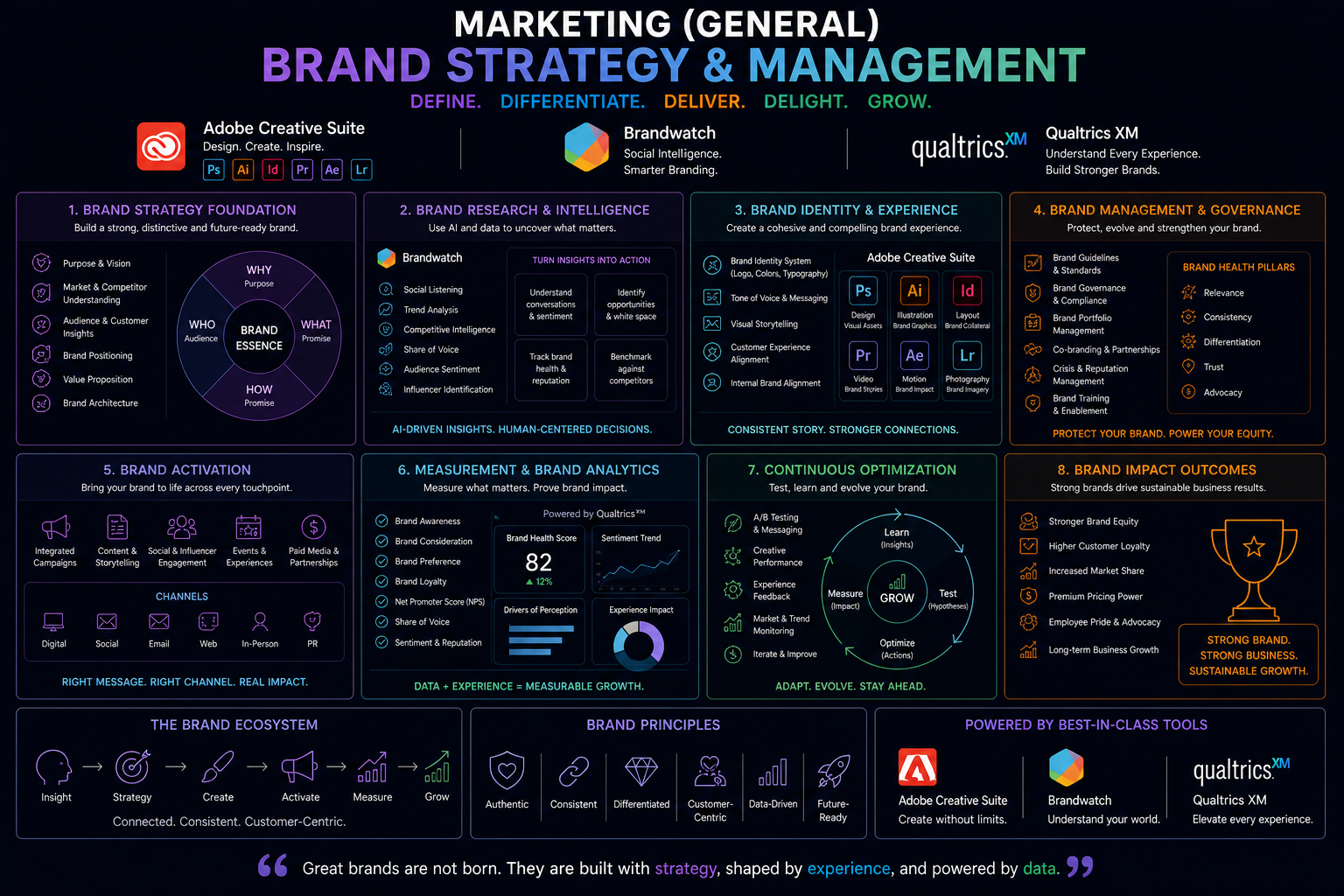
Understanding the Brand Strategy Tech Stack
Before diving into training, understand the three functional pillars of modern brand strategy.
Adobe Creative Suite is the industry standard for creative execution. You will use Photoshop for image editing and visual asset creation. Illustrator builds logos, icons, and scalable brand graphics. InDesign lays out one-pagers, playbooks, and brand guidelines. Premiere Pro edits video content for brand campaigns. After Effects creates motion graphics and animated brand elements. You are not becoming a professional designer—you are becoming a strategic collaborator who can sketch concepts, give precise feedback, and maintain brand consistency across every asset.
Brandwatch is the leading social listening and consumer intelligence platform. It monitors millions of online conversations to tell you what people are saying about your brand, your competitors, and your category. You will use it to track brand sentiment over time and across markets, identify emerging trends before they peak, measure campaign impact through share of voice and conversation spikes, uncover audience insights about what your customers truly value, and perform competitive analysis to see how competitors are perceived. In 2026, Brandwatch has integrated AI capabilities for trend prediction and automated insight generation.
Qualtrics is the enterprise standard for customer experience and brand measurement. You will use it to design and field brand tracking studies that measure awareness, consideration, and preference over time. You will analyze customer feedback to identify drivers of brand loyalty or detraction. You will build dashboards that report brand health metrics to executives. You will measure the impact of campaigns on brand perception before and after launch. The platform's AI features now automate text analysis of open-ended feedback, surfacing themes you might otherwise miss .
The 16-Week Brand Strategy Training Roadmap
Phase 1: Weeks 1-4 – Creative Collaboration with Adobe Creative Suite
What to focus on
Start with the creative tools you need to collaborate effectively with designers, agencies, and production teams. The goal is not mastery of every feature but the ability to communicate visually, provide actionable feedback, and maintain brand consistency.
Photoshop for brand strategists
Photoshop is where brand assets come to life. You will learn to crop and resize images for different placements—social media, email headers, landing pages, print ads—without losing quality. You will adjust color and lighting to match brand guidelines. You will work with layers to combine text and images. You will use basic selection tools to remove backgrounds. Most importantly, you will learn to give feedback in design language, referencing layers, masks, and color values rather than vague statements like "make it pop."
The free trial gives you seven days of full access, which is sufficient to complete the learning objectives. After that, the Photography plan costs approximately 10to
10to20 per month including Photoshop and Lightroom, while the Creative Cloud All Apps plan for full suite access is around 50to
50to60 per month.
Illustrator for brand strategy
Illustrator is where brand identity is built. You will learn to differentiate between raster images (pixel-based) and vectors (scale infinitely without losing quality). You will understand the anatomy of a logo and how to provide feedback on kerning (space between letters), stroke weight, and anchor points. You will create simple diagrams and iconography for presentations. You will understand color systems like CMYK for print versus RGB for digital.
InDesign for brand guidelines
InDesign is the tool for multi-page brand documents. You will learn to create master pages as templates for consistent layouts. You will place text and images without breaking layouts. You will export print-ready PDFs as well as interactive PDFs for digital distribution. You will understand the anatomy of a brand guidelines document: logo usage, color palette, typography, imagery style, tone of voice, and application examples.
Free resources for creative tools
Adobe offers extensive free tutorials on their website and YouTube channel, covering everything from beginner to advanced techniques. The Adobe Creative Cloud YouTube channel provides "Learn Photoshop in 15 Minutes" style content perfect for strategists who need basics fast. Behance showcases professional brand guidelines you can study for structure and best practices.
Practical application
Find a brand you admire. In Photoshop, download their logo and practice isolating it on different backgrounds. In Illustrator, trace their logo to understand its vector construction. In InDesign, create a one-page brand guidelines cheat sheet for that brand, including color values and proper logo placement. This exercise teaches you to see brand systems, not just individual assets.
Phase 2: Weeks 5-8 – Social Intelligence with Brandwatch
What to focus on
Brandwatch transforms the chaotic firehose of social conversations into actionable brand intelligence. You will learn to monitor brand health, track competitors, and uncover audience insights.
Setting up brand monitoring
The first step is building queries that capture all relevant conversations about your brand, your category, and your competitors. You will learn to use boolean operators: AND, OR, NOT, and quotation marks for exact phrases. For example, a query for "brand name" AND (review OR complaint) captures sentiment-bearing mentions. You will learn to exclude noise—like a brand name that is also a common word—using NOT operators.
Sentiment analysis and brand health
Brandwatch's AI automatically classifies mentions as positive, negative, or neutral. You will learn to validate this classification and adjust the model for your brand's context. Sarcasm remains challenging for AI, so human review of edge cases is essential . You will track sentiment over time, noting spikes that correlate with campaigns, product launches, or crises.
Share of voice and competitive tracking
Share of voice is your brand's mentions divided by total category mentions. You will build queries that capture all competitors simultaneously, then generate automated reports showing share of voice trends. A rising share of voice before a campaign launches suggests organic buzz is building. A falling share after a major launch suggests the campaign failed to break through .
Audience insights
Brandwatch builds detailed audience profiles showing what your customers care about. You will learn to surface the topics, influencers, and publications your audience follows. You might discover that your customers care about sustainability but your brand is not talking about it, or that a competitor has won loyalty by engaging with a niche community you have ignored .
Free resources for social intelligence
Brandwatch offers product demos and recorded webinars on their website. The Brandwatch blog publishes case studies and best practices for brand monitoring. Free social listening can be practiced using free tools like Google Alerts, Social Searcher, or Mention.com (limited free tiers). While less powerful than Brandwatch, these tools teach the fundamentals of query building and mention tracking.
Paid resources for social intelligence
Full Brandwatch access requires enterprise licensing typically costing thousands annually, but you can learn the concepts and methodology using free alternatives. Hootsuite Insights offers paid social listening plans. Brand24 offers paid plans with sentiment analysis.
Practical application
Choose a brand you follow. Using a free social listening tool or manual search, track mentions for one week. Calculate positive versus negative sentiment. Identify the top three topics people discuss when mentioning the brand. Identify the top three competitor brands mentioned in the same conversations. Present a one-page social listening report with findings and one recommendation for the brand.
Phase 3: Weeks 9-12 – Brand Measurement with Qualtrics
What to focus on
Qualtrics enables you to measure brand health systematically. You will design surveys that track brand awareness, consideration, preference, loyalty, and advocacy over time .
What to measure
Brand awareness metrics include aided awareness which is percent of respondents who recognize your brand when listed, and top-of-mind awareness which is the first brand they recall in your category. Brand perception metrics include brand attributes like innovative, trustworthy, high-quality, and affordable. You will measure consideration which is percent considering your brand for their next purchase, and preference which is it being their top choice. Loyalty metrics include repeat purchase rate and resistance to switching. Advocacy metrics are Net Promoter Score or willingness to recommend.
Survey design for brand tracking
Good brand tracking surveys are short, consistent, and fielded at regular intervals. You will learn to write questions that are clear, unbiased, and map directly to business decisions. For example, "On a scale of 1 to 5, how much do you trust Brand X?" is less useful than "Which brand do you trust most for [specific need]?"
You will learn to avoid common pitfalls like leading questions which ask "How much do you love our new feature?" rather than "How would you rate your experience?" You will learn to randomize answer order and question order to reduce bias.
Analyzing brand tracking data
Qualtrics gives you crosstab reports showing how brand metrics vary by customer segment. You might discover that your brand is perceived as high-quality among existing customers but unknown among prospects, suggesting an awareness problem rather than a quality problem. You might find that awareness is high but consideration is low, suggesting a positioning or relevance problem.
Free resources for brand measurement
Qualtrics offers a free account with limited responses and basic features. This is sufficient for learning survey design and basic analysis. SurveyMonkey free tier provides basic survey creation and distribution. Google Forms is completely free, though analytics are very basic.
Paid resources for brand measurement
Full Qualtrics licensing requires paid subscription. The Qualtrics XM Institute offers paid certification programs for experience management professionals.
Practical application
Design a simple brand tracking survey for a known brand. Include questions measuring awareness (aided and top-of-mind), perception of three key attributes, consideration, and loyalty. Field the survey to 20 to 30 people through your network. Analyze the results: what is the brand's strength? What is the biggest opportunity for improvement? Present findings as a one-page brand health scorecard.
Phase 4: Weeks 13-16 – Integrated Brand Strategy and Career Preparation
What to focus on
This phase integrates all three tools into a complete brand strategy practice. You will learn to synthesize insights from social listening, brand tracking, and creative execution into strategic recommendations that drive business results.
The brand strategy process
The Brand Management Associate role description outlines exactly what employers expect: developing comprehensive brand strategies that establish clear identity, mission, and value propositions for brands . Key steps include researching the brand's market segment and competitors, defining identity including mission, vision, values, and tone of voice, creating positioning statements that clearly differentiate the brand, and developing visual representations like mood boards . The evaluation criteria emphasize clarity, strategic depth, creativity in competitive differentiation, and overall cohesiveness of the brand narrative .
Developing brand positioning
Positioning is the single most important output of brand strategy. A good positioning statement follows a specific formula: to [target audience], [brand] is the [frame of reference] that provides [point of difference] because [reason to believe]. You will learn to validate each element with data from Brandwatch and Qualtrics.
Building brand guidelines
Brand guidelines are the constitution of your brand. They specify logo usage including minimum size, clear space, and prohibited uses. The color palette includes primary, secondary, and neutral colors with hex, RGB, and CMYK values. Typography includes primary and secondary fonts with usage rules and fallback options . Imagery style defines the type of photography and illustration that represents the brand. Tone of voice specifies brand personality, vocabulary, and grammar rules. Application examples show the brand on packaging, digital, print, and environmental applications.
Measuring brand effectiveness
You will learn to build brand dashboards that track leading indicators like social sentiment, share of voice, and brand awareness, plus lagging indicators like consideration, preference, and loyalty. The goal is to connect brand investments to business outcomes like market share, customer lifetime value, and pricing power .
Free resources for brand strategy
The APG (Account Planning Group) offers free resources including guides to strategy careers and networking advice, emphasizing that becoming a strategist requires re-framing interviews as opportunities to demonstrate curiosity and empathy. The APG emphasizes constructing a unique personal narrative that combines your specific background into a professional superpower, making each connection feel valued .
Teal's brand strategist career guide provides comprehensive advice on developing essential branding skills including analytical abilities, creativity, storytelling, and communication, plus building portfolios that demonstrate your strategic thinking. The guide emphasizes gaining practical experience through internships or project work, compiling a portfolio that showcases brand strategy projects with case studies and positioning statements that demonstrate your problem-solving abilities .
Practical application
Complete the comprehensive brand strategy task: develop a full brand strategy for a hypothetical or existing brand . Conduct competitive research using publicly available information and social listening. Define brand identity including mission, vision, values, and tone of voice. Create a positioning statement. Develop brand guidelines document in InDesign (for structure) with visual mood board in Photoshop. Present as a complete strategy deck with executive summary explaining your strategic choices and expected brand impact .
Your Portfolio Projects
Build these artifacts during your training. They demonstrate exactly what hiring managers for brand strategy roles are looking for.
Project One: The Complete Brand Strategy – Develop a full brand strategy for an existing or hypothetical brand. Include competitive analysis, brand positioning, identity system (mission, vision, values, tone), and brand guidelines document. Create a mood board representing the brand's visual aesthetic. Present as a 15-slide deck with an executive summary explaining your strategic rationale.
Project Two: The Social Listening Report – Using free listening tools or manual search, track a brand's social mentions for one week. Report total volume, sentiment breakdown, top topics, and share of voice versus top three competitors. Identify one emerging trend the brand should act on and provide specific tactical recommendations. Mirror the approach used by Brandwatch professionals.
Project Three: The Brand Tracking Dashboard – Design, field, and analyze a brand tracking survey for a known brand. Report awareness (aided and top-of-mind), perception on three key attributes, consideration, and loyalty. Include segment breaks (by age, by region, by usage frequency) and specific recommendations for improving brand health metrics.
Project Four: The Integrated Brand Health Analysis – Combine data from all three projects. Show how social listening reveals real-time sentiment while brand tracking shows structural brand health. Recommend specific creative or campaign responses based on the integrated data. Show how brand guidelines ensure consistent execution across platforms.
Career Application
Job Titles to Target
The brand strategy career ladder has distinct roles with increasing scope and compensation.
Brand Coordinator or Associate is the entry-level role requiring zero to two years of experience. You will support brand managers in executing campaigns, updating brand assets, and compiling reports. The salary range is 45,000to
45,000to65,000.
Brand Specialist requires two to four years of experience. You will own specific brand initiatives like campaign execution or social listening reports. Compensation ranges from 60,000to
60,000to80,000.
Brand Manager or Brand Strategist requires four to seven years of experience. You own brand strategy for a product line or sub-brand. You will lead campaign development, brand tracking, and agency management. The salary range is 80,000to
80,000to120,000.
Senior Brand Manager requires seven to ten years of experience. You manage a portfolio of brands or a major flagship brand. You will lead cross-functional teams and present to executives. Compensation ranges from 110,000to
110,000to150,000.
Associate Director or Director of Brand Strategy requires ten or more years of experience. You own brand strategy for a business unit or entire organization. You will manage teams, set brand investment priorities, and report to C-suite leadership. The salary range is 140,000to
140,000to200,000 plus significant bonuses or equity.
Marketing Director focuses on more general strategy across all marketing disciplines while your expertise anchors on brand. The role requires seven to twelve years of experience. Compensation ranges from 120,000to
120,000to180,000.
Brand Manager roles in 2025 typically require developing and implementing brand strategies to increase brand awareness and drive customer engagement, conducting market research and analyzing consumer behavior, collaborating with cross-functional teams to execute marketing campaigns, and monitoring the performance of brand initiatives to ensure they align with organizational goals .
Required Skills Based on Industry Standards
Employers expect a specific combination of strategic, creative, analytical, and technical skills based on the Brand Management Associate role requirements and industry job postings .
Strategic skills include brand positioning (defining and differentiating brands in competitive markets), identity development (articulating mission, vision, values, and tone), Go-to-Market planning (launching and relaunching brands effectively), and competitive analysis (understanding market dynamics and brand standing).
Creative skills include storytelling (crafting compelling brand narratives), visual literacy (communicating with designers effectively), copywriting basics (writing taglines, headlines, and brand copy), and campaign concepting (developing integrated creative ideas).
Analytical skills include market research (designing and interpreting consumer research), social listening (monitoring brand health in real-time), brand tracking (measuring awareness, consideration, and loyalty), and data storytelling (turning numbers into strategic recommendations).
Technical skills baseline includes Adobe Creative Suite proficiency. Platform familiarity includes Brandwatch, Qualtrics, or equivalent. Productivity tools include PowerPoint, Keynote, and Google Slides. Project management includes Asana, Trello, or Monday.com.
Certifications That Matter
Adobe Certified Professional certifications validate creative tool proficiency. Pricing varies per exam.
Qualtrics XM Certifications are available through the Qualtrics XM Institute for experience management professionals. Pricing varies by program.
Brandwatch offers product certifications through their learning platform, typically included with enterprise licensing.
HubSpot Academy offers free certifications including Social Media Certification and Marketing Analytics Certification.
Google Analytics Individual Qualification remains relevant for brand tracking and measurement.
The Job Search Strategy
The APG (Account Planning Group) guide to getting a job in strategy offers essential advice for aspiring strategists . Build your personal brand by defining who you are when you are at your best, what you love to do, what is special about you, and how friends and family would describe you.
Develop your personal brand statement. Write it down. Refine it. Keep redefining and re-expressing yourself to get where you want to be . Then express yourself by showing up consistently in all the channels that matter: LinkedIn, industry events, and conversations where you can let your perspective shine.
Networking is essential in the branding industry. The APG suggests having a plan for why you want a network, knowing who you want to connect with, being intentional about how you connect, and following up. Connect with experienced Brand Strategists and join professional associations .
Your portfolio matters more than your resume. The APG recommends showing what you are capable of by creating a portfolio that includes case studies demonstrating strategic thinking, problem-solving skills, and the impact of your work . A well-crafted portfolio demonstrates your strategic thinking, problem-solving skills, and the impact of your work, making you a more attractive candidate .
In interviews, the APG advises re-framing the experience as an opportunity to demonstrate curiosity and empathy . Come prepared to articulate a point of view on relevant topics like creativity or campaigns, and speak with genuine passion . The APG also recommends always following up after networking or interviews, as this simple act is surprisingly powerful and leaves a lasting impression .
Consider internships or entry-level positions in marketing or branding agencies to gain practical experience . Work on projects that allow you to contribute to brand audits, competitive analysis, and marketing strategy development. Additionally, volunteering to help a nonprofit or small business with their brand strategy is an excellent way to build a portfolio when professional experience is limited.
Interview Preparation
Questions that come up in nearly every brand strategy interview loop include: how would you reposition a brand that is losing relevance with younger consumers? Walk me through how you develop a brand positioning statement. How do you measure brand health beyond sales data? Tell me about a campaign that successfully changed brand perception. How would you use social listening to inform brand strategy? What makes a brand guidelines document effective?
The 30-60-90 day framework hiring managers expect in 2026 includes an audit of all existing brand assets, positioning, and measurement in the first month without changing anything. The second month focuses on quick wins like refreshing outdated brand guidelines, filling content gaps, and launching one small campaign. The third month is about scaling: implementing new measurement frameworks, establishing regular brand health reporting, and building dashboards that prove brand impact .
Immediate Next Steps for the Next 7 Days
Day One: Create a free Adobe Creative Cloud trial. Watch a fifteen-minute "Photoshop for Beginners" tutorial. Open a photo and practice cropping and basic color adjustments.
Day Two: Sign up for a free social listening tool like Mention or Social Searcher. Set up alerts for a brand you follow. Review the first batch of mentions.
Day Three: Complete the HubSpot Social Media Certification (free, approximately four hours). The brand measurement sections are directly applicable.
Day Four: Download the Teal brand strategist career guide. Read the sections on essential skills and portfolio building.
Day Five: Define your portfolio project focus. Choose between a complete brand strategy, social listening report, brand tracking dashboard, or integrated brand health analysis. Commit to completing one project within thirty days.
Day Six: Update your LinkedIn headline. Change it from "Marketing Professional" to "Aspiring Brand Strategist | Brand Strategy + Social Intelligence + Creative Collaboration." Follow brand leaders and join the APG Strategy community.
Day Seven: Start your first portfolio project. Document your process publicly on LinkedIn to build visibility and demonstrate the strategic thinking hiring managers seek.
The Long Game
Brand strategy has always been about seeing the whole picture while others see fragments. The best brand strategists notice what is missing. They connect dots across social listening, brand tracking, and creative execution. They ask the question no one else is asking, and they have the data to back up their answer.
Your marketing background is your foundation. You understand audiences, channels, and measurement. You know how campaigns work. This roadmap builds the specialized tools—Adobe for creative collaboration, Brandwatch for social intelligence, Qualtrics for brand measurement—that transform a general marketer into a brand strategist.
The professionals who combine strategic thinking, creative collaboration, and data fluency will command the highest premiums in the job market. Start your week one actions today. Complete that first tutorial. Build that first listening report. Begin your journey into a discipline that shapes how the world sees, feels, and remembers the brands that define our lives.
Brand Marketing Experience / Knowledge




 Group / 1: 1 Sessions