AI CX & Conversation Design Training Roadmap (Zendesk AI, Intercom, Kommunicate, NLP frameworks)
This roadmap is designed for customer service professionals who want to master the convergence of AI-powered customer experience platforms, conversation design, and natural language understanding. The role of the customer service professional has fundamentally shifted—AI now handles routine inquiries while humans focus on empathy, complex problem-solving, and orchestrating outcomes across channels. What separates leaders in AI Customer Experience is not how many agents they remove, but how quickly they upskill those agents into AI-powered problem solvers who manage outcomes across channels .
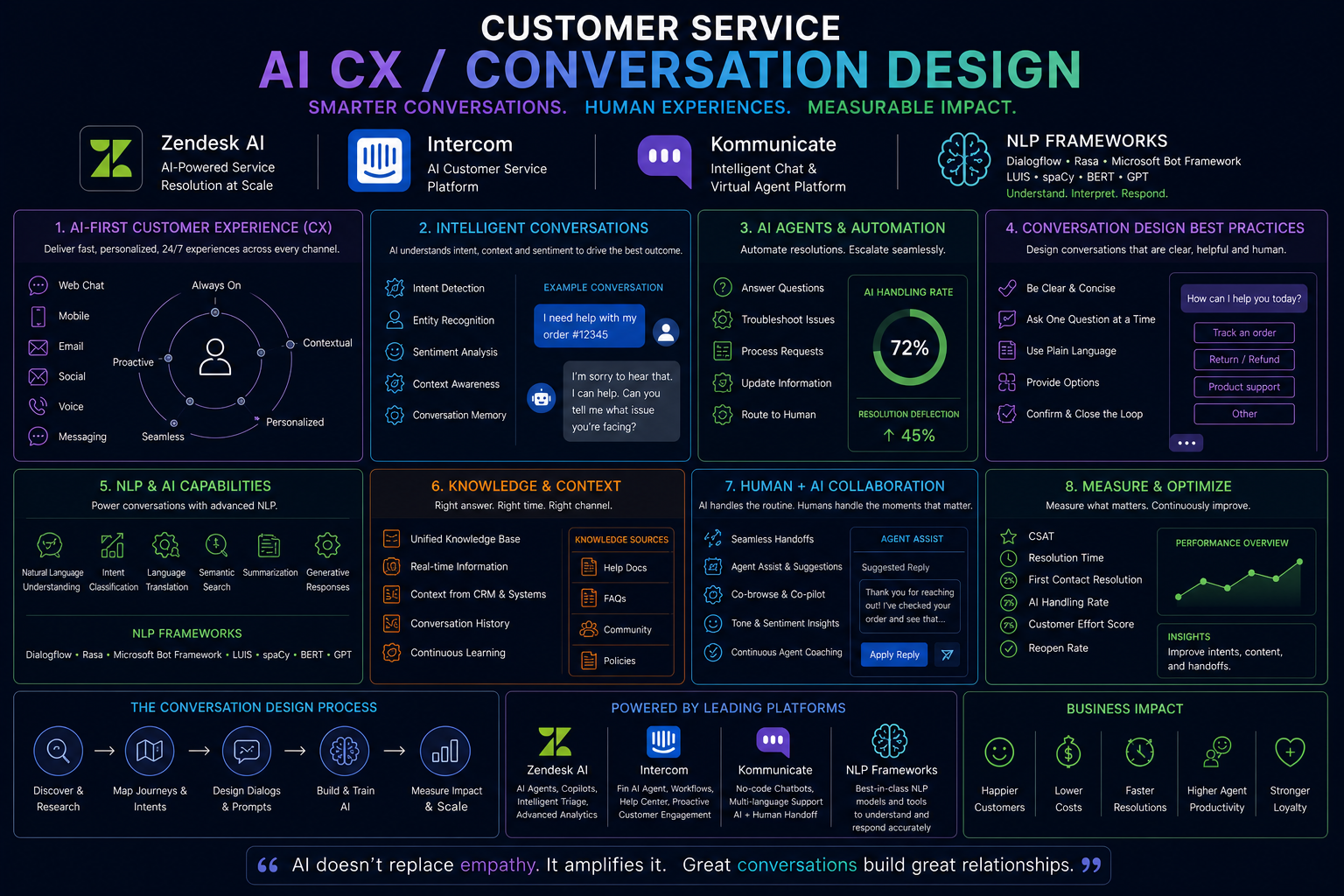
Understanding the AI CX & Conversation Design Stack
Before diving into training, understand the five layers of modern AI-powered customer experience.
Zendesk AI is the intelligent layer built into the Zendesk platform, trained on billions of customer service data points . You will use its AI agents to automate conversations across messaging, email, and web forms, handling routine questions without human intervention. For advanced needs, Zendesk Copilot provides proactive AI assistance including insights and automated actions that help service teams resolve issues faster. The platform includes generative search, answer suggestions, and AI translation to support global teams.
Intercom (Fin AI) is the market-leading AI agent platform for customer service. Fin AI Copilot provides real-time, AI-driven support that expands support capacity without increasing headcount . You will learn to deploy, train, and optimize Fin AI Agent to resolve customer questions automatically, using your knowledge base as the source of truth. The platform offers batch testing to validate answers before launch and guidance features to enforce policies on how Fin responds in live conversations.
Kommunicate is a conversational AI platform designed for customer support automation. While the search results do not contain specific training resources for Kommunicate, the platform serves similar functions to Zendesk and Intercom—automating conversations, routing complex issues to humans, and providing analytics on bot performance. You can apply the conversation design principles learned from other platforms directly to Kommunicate workflows.
NLP frameworks (Natural Language Processing) are the engines that power conversation understanding. The three core tasks you must understand are Intent Recognition (identifying what the customer wants to do), Named Entity Recognition (extracting specific information like dates, product names, or order numbers), and Sentiment Analysis (detecting customer emotion to prioritize escalations) . These frameworks enable your AI agents to understand customer language, not just match keywords.
The 14-Week AI CX Conversation Design Roadmap
Phase 1: Weeks 1-4 – AI CX Foundations and Platform Navigation
What to focus on
Start by understanding what AI can and cannot do in customer service. Self-service bots handle simple tasks very well, but high-stakes journeys remain firmly in human hands . The most successful AI CX teams treat their contact center as a talent engine where agents become AI-powered problem solvers rather than script-following representatives.
Mindset and AI fundamentals
Begin with a shared understanding of what AI means for customers, agents, and the business. Key topics include the basics of machine learning and conversational AI, the limits and risks of current AI systems, how AI changes customer expectations, and an overview of emerging roles like conversation designers and bot supervisors .
You need AI fluency—the ability to understand what conversational AI can and cannot do, and when to override automated suggestions. This is the foundation skill for every role in AI-powered customer service .
Zendesk AI navigation
Zendesk AI is built into the platform as an intelligent layer. You will learn to navigate the AI agent setup wizard, which guides you through training your AI agent using your knowledge base content . The wizard demonstrates how the AI agent will respond to customer questions across different channels.
Key features to master include generative AI agents that conduct back-and-forth conversations via messaging, email, and web forms to resolve requests without human intervention . You will also learn about Zendesk Copilot, which provides proactive AI assistance including relevant insights, helpful guides, and automated actions to help service teams resolve issues more efficiently .
Free resources for Phase 1
The Zendesk training portal offers all AI-related courses completely free . Search for "AI" to view the full catalog covering AI agents (Essential and Advanced) and Zendesk Copilot. The Zendesk Suite free trial includes the AI agent setup wizard that guides you through training an AI agent based on your website content and testing its responses before going live .
Intercom Academy provides completely free courses including "Fin Academy" for learning to deploy and optimize AI agents, "Getting started with Fin AI Copilot" for real-time AI-driven support, and "Fin: Express Deploy" for launching your AI agent in under an hour . All courses are free with an Intercom account.
Practical application
Sign up for a free Zendesk Suite trial. Complete the AI agent setup wizard by entering your website URL so Zendesk can build an initial knowledge base. Test the AI agent by asking common customer questions in the simulator. If using Intercom, complete the "Getting started with Fin AI Copilot" course and deploy a test agent. This exercise teaches you how AI agents learn from your existing content—the foundation of conversation design.
Phase 2: Weeks 5-8 – Conversation Design Principles and Natural Language Understanding
What to focus on
Conversation design is the discipline of crafting AI-driven interactions that feel natural, efficient, and on-brand. This phase teaches you to think like a conversation designer, not just a platform user.
The three pillars of conversation design
A full-stack conversation designer masters three interconnected domains . Natural Language Understanding (NLU) design involves discovering, designing, and maintaining the NLU models for a chat or voice agent, including intent discovery, utterance generation, conflict mapping, model testing, and handoff to dialogue design. Dialogue design determines the conversation logic and creates the script for a chat or voice agent, including defining primary intents and happy path flows along with error handling. Response design is concerned with creating and managing the response content and persona of the agent, including tone of voice and style guide .
Understanding NLU fundamentals
Natural Language Understanding has three core tasks that every conversation designer must understand . Intent Recognition identifies the communicative intention of a customer's statement—whether they are greeting, reporting a problem, requesting a refund, or asking for help. Intent Recognition works without training data using zero-shot models; you simply pass possible intents as labels and the model classifies the customer's message accordingly .
Named Entity Recognition extracts specific pieces of information from customer messages—names, dates, product codes, order numbers, locations, and monetary amounts . This is how your AI agent can understand "I ordered product XYZ on Monday" without you writing separate rules for every possible product name and day of the week .
Sentiment Analysis detects customer emotion in text, classifying messages as positive, negative, or neutral . This is essential for routing angry customers to human empathy specialists while letting satisfied customers continue with automation. Sentiment analysis works particularly well on short messages .
Dialogue design principles
Good dialogue design draws from UX and design thinking to solve customer problems. Recognize that a conversation isn't always the best way to reach a solution—it is one of a number of tools. Understand user behavior and design paths that minimize cognitive load on the customer .
The essential dialogue patterns include happy paths which are the ideal flow where the customer provides all needed information and the agent successfully resolves the issue. Error paths handle what happens when the customer provides unexpected information, goes off-topic, or the agent cannot understand the request. Disambiguation helps customers choose between multiple possible interpretations of their intent without frustrating them.
Response design principles
Craft engaging responses using the principles of good copywriting. Write no-match and no-reply fallbacks in such a way that they elicit the correct response rather than frustrating the customer . Your agent's persona—its tone, vocabulary, and personality—must align with your brand while remaining appropriate for customer service contexts.
Free resources for Phase 2
The Voiceflow blog provides comprehensive guides to conversation design including the full-stack conversation designer framework. The article on NLU, dialogue, and response design is free and includes practical examples of each skill domain . Academic resources explaining Intent Recognition, NER, and Sentiment Analysis are available through university publications, breaking down each concept with practical notebook examples .
Practical application
Take five common customer questions for a product or service you know. For each question, write three different ways a customer might phrase it. This is utterance generation—training your NLU model to recognize variations. Then write the ideal dialogue flow for each intent, including error handling for when the AI cannot understand. Finally, write response templates that match your brand voice. This exercise builds the three core skills of conversation design simultaneously.
Phase 3: Weeks 9-11 – Training, Testing, and Optimizing AI Agents
What to focus on
An AI agent is only as good as its training. This phase teaches you to feed the right content to your AI agent, test its performance rigorously, and optimize based on real conversation data.
Training AI agents with your knowledge base
Both Zendesk and Intercom train their AI agents using your existing content. Zendesk's setup wizard builds an initial knowledge base by crawling your website . Intercom's Knowledge Hub lets you manage, control, and optimize all content that powers AI, agents, and self-serve support .
You need to understand content quality—why high content quality scales accuracy and trust . Poorly written or conflicting knowledge articles produce confused AI responses. Well-structured, consistent content produces reliable automation.
Testing before launch
Never launch an AI agent without testing. Intercom's batch testing feature allows you to review answers at scale, identify exactly what needs fixing, and launch with confidence instead of guesswork . Preview is your fastest feedback loop while configuring Fin—you test answers, see how the AI responds, and refine before customers ever see the output .
Zendesk's setup wizard includes a simulator where you can ask questions and see how your AI agent will respond based on your knowledge base content . This immediate feedback loop is essential for catching gaps before they become customer-facing failures.
Measuring AI agent performance
Key metrics you must track include involvement rate (how often the AI agent is used when available), resolution rate (percentage of conversations the AI resolves without human handoff), CX score (customer satisfaction with AI interactions), and cost per resolution (lower for AI than human agents) . These metrics work together to show whether your AI agent is being used, solving problems, and delivering an experience customers trust.
Building complete AI-first workflows
Combine AI agents with workflow automation to build complete customer service systems. Build a complete Fin-first workflow by combining Fin AI Agent with Workflows to automate answers, route conversations precisely, and deliver smoother handoffs to your team . Understand when to automate versus when to escalate to human empathy specialists .
Free resources for Phase 3
Intercom Academy offers free courses including "How to evaluate Fin's performance" covering involvement rate, resolution rate, and CX score; "Introduction to Testing Fin" for validating answers before launch; "Batch testing" for reviewing answers at scale; and "Build a complete Fin-first workflow" for combining AI with automation . The Zendesk training portal includes AI agent configuration and optimization modules .
Practical application
Take an existing knowledge base or create 20 FAQ articles for a mock product. Use Intercom's free tier to train a test AI agent. Run batch tests with 50 common customer questions. Calculate your resolution rate and CX score. Identify the three questions your AI agent answered poorly, fix the underlying knowledge articles, and retest. Document the improvement. This is the continuous optimization loop that professional conversation designers run daily.
Phase 4: Weeks 12-14 – Advanced NLU, Compliance, and Career Preparation
What to focus on
This phase integrates advanced concepts including entity extraction, compliance guardrails, and the career paths available in AI CX.
Advanced NLU: entities and context
Beyond intents and sentiment, you need named entity recognition to extract specific information from customer messages . Entities include product names, order numbers, dates, locations, and prices. When a customer says "my order #12345 hasn't arrived," your AI agent should extract "12345" as an entity and use it to look up the order status.
Understanding tokenization and embeddings helps you debug when the AI misunderstands. Tokenization is how the AI breaks text into pieces it can process. Embeddings are how it represents meaning numerically. These concepts explain why very similar phrases sometimes produce different results and why training on more examples improves accuracy.
Compliance and risk awareness
AI agents must operate within regulatory boundaries without losing empathy. Understand key regulations like GDPR, CCPA, and industry-specific rules (HIPAA for healthcare, PCI for payments). Use AI checklists and alerts for mandatory disclosures, verification steps, and risk phrases. The most advanced AI CX teams use compliance alerts that gently notify agents when mandatory disclosures or risk phrases are detected during live conversations .
Real-time assist as an enablement engine
Real-time assist systems act as coaches that listen to every interaction and nudge agents at the right moment . They provide live transcription of conversations, suggest next best actions, surface relevant knowledge articles, highlight compliance risks, and even recommend language that matches brand tone. Use real-time assist as an enablement engine rather than a surveillance tool—it is there to help agents succeed, not catch them failing.
The emerging AI CX role architecture
Forward-thinking CX leaders are moving away from one generic agent role toward a portfolio of specialized hybrid roles . Empathy Specialists handle the most emotionally charged interactions after a handoff from self-service or standard agents. AI flags these conversations using sentiment analysis and journey context. Typical backgrounds are senior agents with strong soft skills or hires from hospitality, healthcare, or social work. Core focus is service recovery, complaint resolution, and vulnerable customer support .
Journey Recovery Professionals watch for points where digital experiences break down. They review AI transcripts and journey analytics to spot patterns—abandoned carts after a specific error message, repeated calls after a confusing notification, or chats that always escalate at the same point. Typical backgrounds are analytically minded agents or team leaders. Core focus is proactive outreach, root cause analysis, and collaboration with product, operations, and UX teams .
Conversation Designers translate business intents, customer language, and policy constraints into the flows and prompts that drive virtual agents and agent assist tools. Typical backgrounds are senior agents, trainers, or knowledge managers with strong writing skills. Core focus is designing bot flows, knowledge articles, and agent assist prompts that feel natural and on-brand .
Bot Supervisors are to virtual agents what team leaders are to human teams. They monitor dashboards, review failure cases, and prioritize improvements. They also ensure automated experiences stay within compliance and brand guardrails. Typical backgrounds are team leaders, quality analysts, or data-savvy agents .
Free resources for Phase 4
Academic resources on NLP frameworks explain Intent Recognition, Named Entity Recognition, and Sentiment Analysis with practical notebook examples . The ConvergedHub article provides the complete AI CX skills matrix and role definitions for empathy specialists, journey recovery professionals, conversation designers, and bot supervisors, plus a six-week upskilling curriculum .
Paid resources for Phase 4
The IIENSTITU Systemic Conversation Management course costs approximately 85to
85to140 and covers conversational AI implementation, sentiment analysis, chatbot design, and digital conversation analytics. Target career positions include Conversation Design Lead, CX Strategist, and AI Conversation Analyst with salary ranges from 65,000to
65,000to140,000 depending on role and location .
Practical application
Define a specialized role for yourself based on your background. If you have strong writing skills, orient toward conversation design. If you have analytical strengths, orient toward journey recovery. Build a portfolio artifact demonstrating that specialization—a sample conversation flow for conversation design, a journey audit for journey recovery, or a sentiment analysis dashboard for bot supervision. Present your portfolio alongside traditional application materials. Hiring managers for AI CX roles value demonstrated capability over generic credentials.
Your Portfolio Projects
Build these artifacts during your training. They demonstrate exactly what hiring managers for AI CX and conversation design roles are looking for in 2026.
Project One: The Deployed AI Agent with Batch Test Report – Use free tiers of Zendesk or Intercom to train and deploy a test AI agent. Run batch tests on 50 common customer questions. Document your resolution rate, CX score, and the three most common failure modes. Include before-and-after metrics showing how fixing knowledge articles improved performance. This demonstrates the continuous optimization loop that professional conversation designers run daily .
Project Two: The Conversation Design Portfolio – Design complete conversation flows for three common customer intents: a return request, a technical troubleshooting question, and an account update request. For each intent, include utterance variations, the happy path dialogue, error handling paths, and response templates with brand voice. Show your design thinking and explain why you made specific choices .
Project Three: The Sentiment Analysis and Escalation Framework – Using a free NLP tool or platform feature, analyze 20 customer service transcripts. Classify each by sentiment and identify escalation triggers. Build a decision tree showing when AI should handle, when AI should attempt once then escalate, and when AI should escalate immediately. Test your framework against actual outcomes.
Project Four: The AI CX Skills Matrix Implementation – Using the published skills matrix for AI CX roles, assess yourself against the capabilities expected for Frontline Agents, Empathy Specialists, and Conversation Designers . Identify your three biggest skill gaps and create a 90-day development plan with specific learning resources and practice activities. This demonstrates self-awareness and career management—skills hiring managers value highly .
Career Application
Job Titles to Target
The AI CX conversation design career ladder has distinct roles with increasing compensation and specialization.
Conversation Designer is the core design role requiring two to four years of experience. You design bot flows, knowledge articles, and agent assist prompts that feel natural and on-brand. The salary range is 65,000to
65,000to90,000 .
AI Conversation Analyst requires two to four years of experience. You analyze conversation logs and performance metrics to optimize chatbot responses and identify user intent patterns. The salary range is 65,000to
65,000to100,000 .
Conversation Design Lead requires five to eight years of experience. You design and implement AI-driven conversation flows for chatbots and voice assistants to enhance user engagement. The salary range is 85,000to
85,000to140,000 .
CX Strategist requires five to eight years of experience. You develop holistic strategies to manage all digital touchpoints, using conversation data to improve satisfaction and loyalty. The salary range is 75,000to
75,000to120,000 .
Bot Supervisor requires three to six years of experience. You monitor dashboards, review failure cases, prioritize improvements, and ensure automated experiences stay within compliance and brand guardrails. The salary range is 70,000to
70,000to110,000 .
Digital Engagement Manager requires five to eight years of experience. You oversee real-time customer interactions across social media, live chat, and messaging apps. The salary range is 70,000to
70,000to110,000 .
Empathy Specialist requires two to five years of experience, often transitioning from senior agent roles. You handle the most emotionally charged interactions, using AI sentiment signals to prioritize high-risk cases. The salary range is 45,000to
45,000to65,000 plus shift differentials .
Journey Recovery Professional requires three to six years of experience. You review AI transcripts and journey analytics to spot broken experiences and fix root causes. The salary range is 55,000to
55,000to80,000 .
Required Skills Based on Industry Standards
Based on industry analysis and the AI CX skills matrix, employers expect specific technical, analytical, and soft skills .
Technical platform skills require proficiency with Zendesk AI, Intercom Fin AI Agent, or equivalent conversational AI platforms. Knowledge base management is essential for training and optimizing AI agents. NLU fundamentals including intent recognition, entity extraction, and sentiment analysis are core competencies .
Analytical skills include reading dashboards and spotting trends in conversation data, interpreting involvement rate, resolution rate, and CX score, using batch testing to identify improvement opportunities, and understanding digital journey mapping and common failure points across channels .
Soft skills include advanced listening and de-escalation skills for emotionally charged situations, plain language writing and conversational turn-taking for dialogue design, systems thinking and storytelling with data for journey recovery, comfort with analytics and curiosity about model behavior for bot supervision .
Certifications That Matter
Zendesk AI Certifications are available through the Zendesk training portal covering AI agents (Essential and Advanced) and Zendesk Copilot. Access requires a Zendesk account, courses are free .
Intercom Fin Academy certification includes Fundamentals for Support Managers for leading AI-first teams and hitting automation targets, and Support Agent Certification for mastering world-class customer support using Intercom. Both are completely free .
Conversation Design certification through IIENSTITU costs approximately 85to
85to140 and covers conversational AI implementation, sentiment analysis, systemic chatbot design, and digital conversation analytics .
NLP certification is available through Coursera and other platforms covering intent recognition, named entity recognition, and sentiment analysis using frameworks like spaCy and VADER.
The AI CX Job Search Strategy
Your portfolio matters more than your certifications. Create a portfolio website or document showcasing your deployed AI agent with batch test report, conversation design samples, sentiment analysis framework, and skills development plan. Each project should clearly show your process, your tools, and your results.
On your resume, replace generic bullet points with AI-specific achievements. For example: "Trained and deployed Zendesk AI agent achieving 65 percent resolution rate on first 500 customer conversations, reducing tier-1 support volume by 40 percent." Or "Designed conversation flows for four customer intents including returns, troubleshooting, and account updates, reducing average handle time by 35 percent."
In interviews, you should articulate specific AI CX workflows you have built. For example: "I used batch testing to identify that my AI agent was misclassifying return requests as troubleshooting. By adding 15 utterance variations to the return intent and fixing a conflicting knowledge article, I improved resolution rate from 58 percent to 82 percent within two weeks."
Salary negotiation tip: The conversation design market is projected to reach $32.9 billion by 2030, with businesses reporting up to 70 percent reduction in customer service costs after implementing AI conversation management . You can credibly state: "Conversation designers with demonstrated platform proficiency and NLU skills command premiums of 15 to 25 percent over traditional CX roles. My portfolio demonstrates the exact optimization workflows you are hiring for."
Interview Preparation
Questions that come up in every AI CX and conversation design interview loop include: How would you train an AI agent to handle a new product category? Walk me through your process for designing a conversation flow from intent discovery to response templates. How do you decide which conversations to automate versus escalate to human agents? Describe how you would use sentiment analysis to improve customer outcomes. How do you measure whether an AI agent is successful? Tell me about a time you turned around an AI agent that was performing poorly.
The 30-60-90 day framework hiring managers expect includes auditing existing AI agent performance and knowledge base quality in the first month without changing anything. The second month focuses on quick wins like adding utterance variations to underperforming intents, fixing conflicting knowledge articles, and implementing one new conversation flow. The third month is about scaling: implementing batch testing as a regular process, establishing continuous optimization workflows, and building dashboards that prove AI impact on cost and satisfaction .
Immediate Next Steps for the Next 7 Days
Day One: Sign up for a free Zendesk Suite trial . Complete the AI agent setup wizard to train a test agent on your website content.
Day Two: Create a free Intercom account. Complete the "Getting started with Fin AI Copilot" course in Intercom Academy (free, approximately 20 minutes) .
Day Three: Read the Voiceflow guide to full-stack conversation design. Understand the three pillars of NLU design, dialogue design, and response design .
Day Four: Practice utterance generation. Write five common customer intents. For each intent, write five different ways a customer might phrase it. This is the core skill of NLU design .
Day Five: Define your specialization path. Choose between conversation design (creative/writing focus), journey recovery (analytics focus), empathy specialist (soft skills focus), or bot supervision (technical/operations focus). Use the skills matrix to identify your starting point .
Day Six: Update your LinkedIn headline. Change it from "Customer Service Professional" to "Aspiring AI Conversation Designer | Zendesk AI + Intercom Fin + NLU." Follow CX leaders and join conversation design communities.
Day Seven: Start your first portfolio project—the deployed AI agent or conversation design portfolio. Commit to completing one project within 30 days. Document your process publicly on LinkedIn to build visibility and demonstrate the builder mentality hiring managers seek .
The Long Game
AI Customer Experience and Conversation Design is one of the fastest-growing specializations in customer service. The conversational AI market is projected to reach $32.9 billion by 2030, and businesses report up to 70 percent reduction in customer service costs after implementing AI conversation management .
The most successful AI CX professionals in 2026 are full-stack conversation designers—they understand NLU design, dialogue design, and response design. They know how to train AI agents, test their performance, and optimize based on real conversation data. They combine technical platform proficiency with the soft skills of empathy, de-escalation, and clear communication .
Your customer service background is your foundation. You already understand customer needs, escalation patterns, and what good service looks like. This roadmap builds the technical tools—Zendesk AI, Intercom Fin AI Agent, NLU frameworks—that transform a customer service representative into an AI CX professional.
The shift from generic agent roles to specialized AI CX roles is already underway. Empathy specialists, journey recovery professionals, conversation designers, and bot supervisors are becoming permanent roles in forward-thinking CX organizations . The professionals who develop these specialized skills early will command the highest premiums.
Start your week one actions today. Complete that first certification. Deploy that first AI agent. Write that first dialogue flow. The AI customer experience landscape has never been more demanding—or more full of opportunity for those who master its new tools and roles.
Customer support Experience / Knowledge




 Group / 1: 1 Sessions