Sentiment Analysis & Empathy Training Roadmap (MonkeyLearn, Thematic, CRM Data Tools)
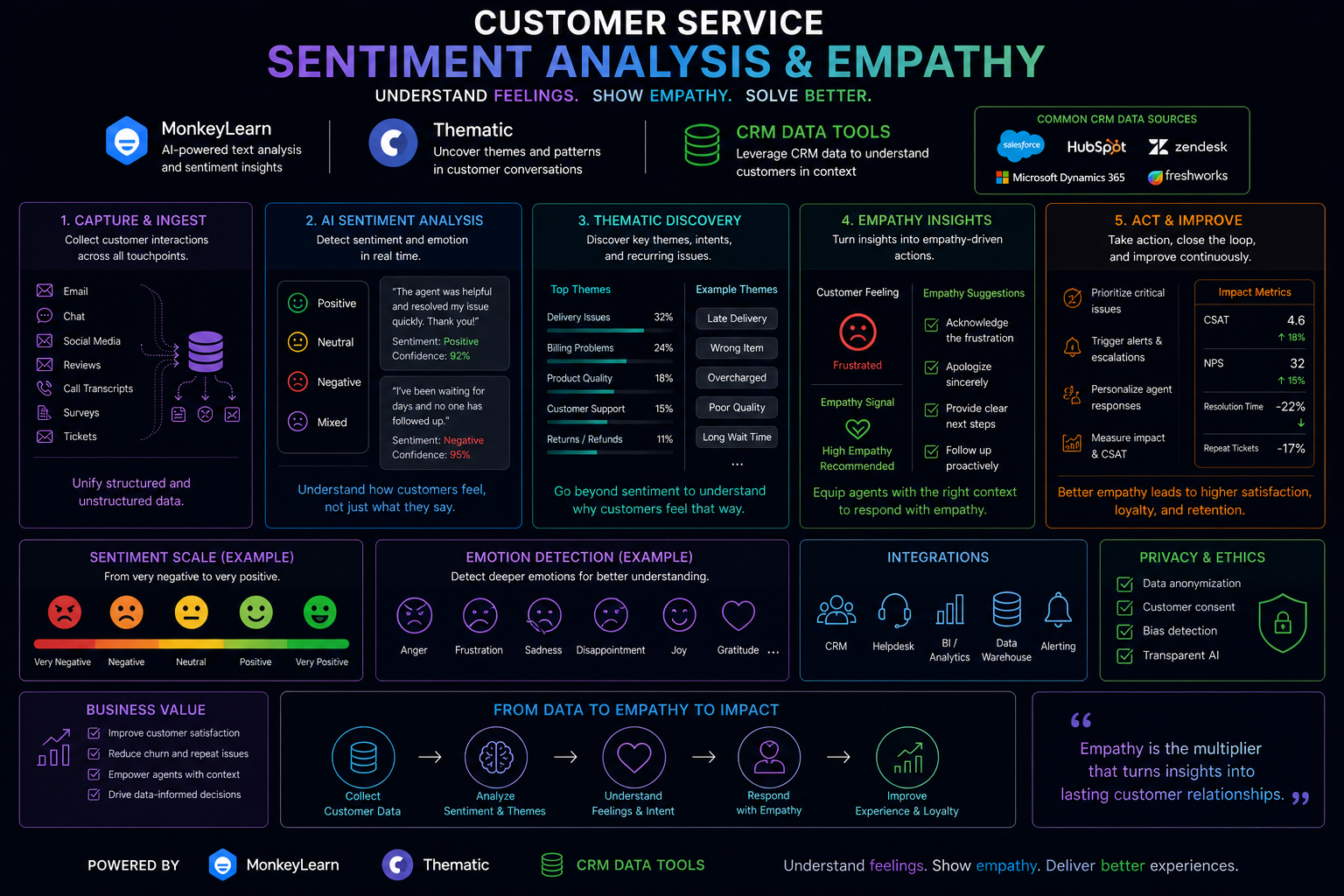
This roadmap is designed for customer service professionals who want to master the convergence of sentiment analysis technology and empathic communication skills. The modern customer service landscape has fundamentally shifted—AI can now detect emotion, urgency, and intent across thousands of conversations simultaneously, but the human ability to respond with genuine empathy remains the differentiator that drives customer loyalty and retention .
Understanding the Sentiment Analysis & Empathy Stack
Before diving into training, understand the four functional layers of modern sentiment-driven customer service.
MonkeyLearn is a no-code text analysis platform that allows you to build custom sentiment classifiers without programming expertise. You will use it to automatically tag incoming customer messages as positive, negative, or neutral, extract specific topics from conversations, and route urgent negative sentiment to your most skilled empathy specialists. The platform offers pre-trained models that work immediately, plus the ability to train custom models on your specific customer language and brand terminology.
Thematic specializes in analyzing large volumes of customer feedback to identify recurring themes and the sentiment associated with each theme. Unlike simple keyword matching, Thematic uses AI to understand context—it can distinguish between "the price is too high" (negative sentiment about pricing) and "the price is fair for the quality" (positive sentiment about value). This tool is essential for moving from individual conversation insights to systemic improvement recommendations.
CRM Data Tools encompass a range of platforms including Dynamics 365 Customer Insights, Zendesk Explore, Salesforce Service Cloud, and Kustomer. These tools store the customer interaction data that feeds your sentiment analysis. You will need basic SQL knowledge to query this data, and familiarity with each platform's analytics features. The integration of predictive AI into CRMs has transformed them from passive databases into active intelligence engines—Kustomer's predictive AI implementation achieved a 2.6x faster response time and increased CSAT from 74 to 89 .
Natural Language Processing (NLP) Frameworks are the technical engines behind sentiment analysis. You do not need to build these models, but understanding your three core tasks is essential. Intent Recognition identifies what the customer wants to accomplish. Named Entity Recognition extracts specific information like product names, order numbers, and dates. Sentiment Analysis detects emotional tone, classifying messages as positive, negative, or neutral—and increasingly, detecting specific emotions like frustration, disappointment, or satisfaction .
The 14-Week Sentiment Analysis & Empathy Training Roadmap
Phase 1: Weeks 1-4 – Empathy as a Foundational Skill
What to focus on
Before you can analyze sentiment at scale, you must understand what makes customers feel heard and valued. Empathy is not an innate trait—it is a skill that can be taught, practiced, and measured . In the age of AI, human empathy has become the competitive differentiator that drives customer loyalty.
The LAER Framework
The LAER framework provides a structured approach to empathic communication that builds trust and de-escalates conflict . Listen means giving customers your full attention, acknowledging their words without interrupting, and demonstrating that you hear both the facts and the emotion behind them. Acknowledge involves validating the customer's feelings—not necessarily agreeing with them, but recognizing that their frustration or disappointment is legitimate. Explore requires asking clarifying questions to fully understand the situation before jumping to solutions. Respond means delivering a solution that addresses both the practical problem and the emotional need.
Why structured empathy works
Improvised empathic responses often miss the mark because they rely on the agent's instincts in a high-pressure moment. Structured frameworks like LAER succeed because they provide a repeatable process that works across diverse customer situations and emotional states. Customers in distress cannot always articulate what they need, and they may not know the right vocabulary. The LAER framework guides agents to uncover the real issue beneath the surface complaint .
Using AI to practice empathy
Modern AI tools like ChatGPT and Claude allow you to practice empathic responses in a safe environment before using them with real customers. You can generate realistic customer personas and challenging scenarios, then draft responses and ask the AI to critique them based on empathy frameworks. This builds muscle memory for high-stakes conversations .
Free resources for Phase 1
Coursera offers the course "Empathic AI Communication and Analysis" through the State University of New York, which covers the LAER framework and the use of AI tools for practicing responses . The Zendesk blog provides free guides on empathy mapping and authentic empathetic language. The article "Filling a Customer Service Role" details the eight essential skills including empathy, problem-solving, resilience, and active listening .
Paid resources for Phase 1
LinkedIn Learning offers courses on "Customer Service: Handling Complaints" and "Communicating with Empathy." Udemy provides "The Complete Empathy for Customer Service Course" covering de-escalation techniques and emotional intelligence.
Practical application
Write five customer scenarios involving different emotional states—frustration, confusion, disappointment, urgency, and gratitude. For each scenario, compose a response using the LAER framework. Use ChatGPT to critique your response against empathy criteria. Practice the dialogue aloud—spoken empathy lands differently than written empathy.
Phase 2: Weeks 5-8 – Sentiment Analysis with MonkeyLearn
What to focus on
MonkeyLearn is your entry point into automated sentiment analysis because it requires no coding while teaching you the fundamental concepts that apply across all platforms.
How sentiment analysis works
Sentiment analysis uses natural language processing to automatically detect the emotional tone of customer messages . The process has three steps. First, the text is broken down into individual words and phrases, a process called tokenization. Second, each word is compared against emotional lexicons—dictionaries that map words to sentiment values. Third, the model considers the context of surrounding words to make a final classification. This is why "not bad" is classified as positive despite containing the word "bad."
Types of sentiment analysis
The simplest form is polarity detection, which classifies messages as positive, negative, or neutral. Fine-grained sentiment adds categories like very positive, positive, neutral, negative, and very negative. Emotion detection goes further, identifying specific emotions such as anger, frustration, disappointment, satisfaction, and delight. Intent analysis determines what the customer wants to do—cancel, return, upgrade, or get help .
Building custom classifiers in MonkeyLearn
MonkeyLearn's pre-trained sentiment model works immediately, but you will achieve better accuracy by training a custom model on your specific customer language. The process involves uploading 500 to 1,000 example messages that you have manually tagged with sentiment labels. MonkeyLearn's algorithms learn the patterns in your data and apply them to new messages automatically. You can continuously improve accuracy by correcting misclassifications, which feeds back into the training process.
Practical applications for customer service
Sentiment analysis enables automatic triage—negative messages can be flagged for priority response by senior agents or empathy specialists . On inbound calls, sentiment detection can route angry customers directly to your best de-escalation experts. Volume tracking over time reveals whether sentiment is improving or deteriorating after product changes or policy updates. Integration with your CRM allows sentiment scores to be stored alongside conversation history, providing context for future interactions.
Free resources for Phase 2
MonkeyLearn offers a free tier that includes pre-trained sentiment models and limited custom model training. The MonkeyLearn Academy provides free tutorials on building classifiers, integrating with Zendesk, and analyzing results. The MarTech article "Using AI to Build a DIY Customer Sentiment Analysis Solution" provides practical guidance on using Gemini and Google Sheets for sentiment analysis without dedicated platforms .
Paid resources for Phase 2
MonkeyLearn paid plans start around $299 per month for higher volume limits and advanced features. Thematic requires enterprise pricing for full platform access. For hands-on practice without budget, the free tiers of MonkeyLearn and the DIY approach with Gemini in Google Sheets are sufficient for learning .
Practical application
Collect 200 customer messages from your own experience or from public datasets. Manually tag 100 of them as positive, negative, or neutral. Use MonkeyLearn's free tier to train a custom classifier on these 100 messages. Test the classifier on the remaining 100 messages and calculate your accuracy rate. Identify the messages the model misclassified and add them to your training set. This exercise teaches you the continuous improvement loop that professional sentiment analysts use daily.
Phase 3: Weeks 9-11 – Thematic Analysis and Root Cause Identification
What to focus on
Sentiment analysis tells you how customers feel. Thematic analysis tells you why they feel that way—and where you need to fix the underlying causes . This phase moves you from individual conversation insights to systemic improvement recommendations.
Beyond sentiment to themes
A customer who says "the website keeps crashing" expresses negative sentiment. A second customer who says "I can't find my order status" expresses frustration. A third who says "the chat agent was wonderful" expresses satisfaction. Without thematic analysis, these appear as three separate data points. With thematic analysis, you group the first two under "website technical issues" and the third under "agent quality." Suddenly, you see that 40 percent of negative sentiment is driven by a single technical problem that engineering can fix .
How thematic analysis works
Thematic platforms use advanced NLP to automatically categorize conversations by topic. Topic modeling identifies recurring subjects across thousands of conversations. Sub-topic clustering breaks broad topics into specific issues. Trend analysis shows whether a topic is increasing or decreasing in frequency. Sentiment by theme reveals which topics generate the most negative emotion—and which topics drive satisfaction.
From insight to action
The value of thematic analysis is not the dashboard—it is the action you take based on what you learn. When you identify that "billing errors" generate 90 percent negative sentiment, you can prioritize fixing the billing system over redesigning the website. When you discover that customers love your "return policy" but hate your "shipping speed," you adjust your logistics strategy. When you see that "agent knowledge" generates consistently positive sentiment, you double down on what is working .
Integrating with CRM data tools
Modern platforms like Dynamics 365 Customer Insights offer built-in sentiment analysis that connects directly to your customer data . The system processes customer feedback, generates sentiment scores on a scale from negative five to positive five, and maps feedback to business aspects such as pricing, customer support, returns, and website quality. This integration allows you to segment customers by sentiment and target retention campaigns specifically to those expressing negative emotion .
Free resources for Phase 3
The en-thu.ai guide to customer conversation analytics provides comprehensive explanations of how thematic analysis works and how to implement it . Bold BI offers a customer sentiment analysis dashboard sample that you can explore to understand visualization best practices . The Microsoft Learn article on Dynamics 365 sentiment analysis explains how enterprise CRM platforms natively support sentiment scoring and thematic grouping .
Paid resources for Phase 3
Thematic platform access requires enterprise pricing. Qualtrics offers customer experience analytics with thematic analysis capabilities, typically requiring paid subscription. If budget is constrained, the DIY approach using Google Sheets and Gemini described in the MarTech article provides a low-cost alternative for learning the concepts .
Practical application
Using a free tool or manual categorization, analyze 200 customer messages to identify the top five themes. For each theme, calculate the percentage of positive versus negative sentiment. Identify the theme with the highest ratio of negative sentiment. Write a one-page recommendation addressed to the appropriate department (product, engineering, operations, or training) explaining the problem, providing evidence from customer language, and proposing three specific solutions. This exercise demonstrates the strategic value of moving from data to action.
Phase 4: Weeks 12-14 – Advanced Integration and Career Preparation
What to focus on
This phase integrates all your skills into a complete customer intelligence practice. You will learn to build sentiment dashboards, automate analysis workflows, and position yourself for the emerging roles in AI-powered customer experience.
Building sentiment dashboards
A customer sentiment dashboard consolidates feedback from surveys, support tickets, reviews, and social media into a single view . The essential metrics include overall sentiment trends over time, showing whether customer experience is improving or declining. Channel-wise sentiment reveals which communication channels deliver the best experience. Issue and category drivers identify the specific problems associated with negative feedback. Customer segment sentiment shows differences by customer type, region, or account value .
Automating sentiment analysis workflows
Modern sentiment analysis can be fully automated. The pipeline begins with data capture, ingesting conversations from Intercom, Zendesk, email, and chat platforms . Next, data sync moves this information to a data warehouse like BigQuery. AI analysis then processes the conversations through GPT models to analyze sentiment. Finally, results are stored back in the data warehouse and visualized in dashboards. Recurring jobs can run daily, processing only new conversations since the last run .
Real-time sentiment for proactive intervention
The most advanced customer service organizations use real-time sentiment detection to intervene before small problems become churn . When a customer's sentiment shifts from positive to negative during a conversation, the system alerts a supervisor who can enter the chat. When a VIP customer uses cancellation keywords, retention specialists receive immediate notifications. When sentiment spikes negative across multiple customers, leadership is alerted to investigate potential system outages or product issues.
The emerging AI CX role architecture
The shift from generic agent roles to specialized AI CX roles has created new career paths . Empathy Specialists handle the most emotionally charged interactions after AI flags them using sentiment analysis. These specialists typically have backgrounds in senior agent roles or hires from hospitality and social work. Journey Recovery Professionals review AI transcripts to spot patterns where digital experiences break down, then work with product and operations teams to fix root causes. Conversation Designers translate business intents and customer language into the flows that drive virtual agents. Bot Supervisors monitor dashboards, review failure cases, and ensure automated experiences stay within compliance and brand guardrails.
Measuring the impact of empathy and sentiment analysis
The business case for investing in these capabilities is compelling. Kustomer's implementation of predictive AI reduced average first response time from 5.3 minutes to 1.8 minutes, increased manual tagging accuracy from 61 percent to 96.4 percent, improved agent productivity from 27 to 45 tickets per day, raised CSAT from 74 to 89, and reduced escalation rate from 12.8 percent to 6.3 percent . A mere 5 percent increase in customer retention has been shown to boost profits by up to 95 percent .
Free resources for Phase 4
The Airbyte tutorial on "Measure Customer Support Sentiment Analysis with GPT" provides a complete walkthrough of building an automated sentiment analysis pipeline . The Bold BI sentiment dashboard documentation explains how to build executive-ready visualizations . The en-thu.ai guide covers the strategic value of conversation analytics for CX transformation .
Practical application
Build a complete sentiment analysis pipeline using free tools. Use Google Forms to collect mock survey responses. Use Google Sheets with Gemini to perform sentiment analysis . Use Google Looker Studio (formerly Data Studio) to build a dashboard showing sentiment trends over time, sentiment by channel, and sentiment by topic. Write a one-page executive summary explaining three key insights and recommending specific actions. This end-to-end project demonstrates the full value chain from raw data to strategic recommendation.
Your Portfolio Projects
Build these artifacts during your training. They demonstrate exactly what hiring managers for AI-powered CX roles are looking for.
Project One: The Empathy Response Portfolio
Collect 10 challenging customer messages expressing different emotional states. For each message, write a response using the LAER framework. Annotate each response to show where you listened, acknowledged, explored, and responded. For bonus impact, use ChatGPT to generate an alternative response and critique both versions against empathy criteria. This portfolio proves you understand the human side of customer experience.
Project Two: The Custom Sentiment Classifier
Using MonkeyLearn's free tier, train a sentiment classifier on 200 customer messages. Document your process: how you selected training data, how you handled edge cases, and how you improved accuracy through iteration. Report your final accuracy rate and identify the three most common misclassifications with explanations. This project demonstrates technical proficiency with sentiment analysis tools.
Project Three: The Thematic Analysis Report
Analyze 200 customer messages to identify top themes and sentiment by theme. Produce a one-page report with three visualizations: theme frequency, sentiment distribution, and sentiment trend over time if data permits. Include three specific recommendations for operational improvements based on your analysis. Present as if to a CX Director who needs to justify budget requests to the C-suite.
Project Four: The End-to-End Sentiment Dashboard
Using free tools (Google Forms, Google Sheets with Gemini, Looker Studio), build a complete sentiment analysis dashboard. Show sentiment trends over time, sentiment by channel, sentiment by topic, and a leaderboard of most common negative issues. Create a "watch list" of keywords that trigger retention alerts. Publish the dashboard as a public link that simulates executive access. This comprehensive project demonstrates full-stack capability from data collection to executive presentation.
Career Application
Job Titles to Target
The sentiment analysis and AI CX career ladder has distinct roles with increasing compensation.
Customer Service Agent (AI-Augmented) requires zero to two years of experience. You handle customer interactions across channels, use AI-powered assist tools for response suggestions, and escalate complex issues to specialists. The salary range is 35,000to
35,000to50,000.
Customer Experience Analyst requires two to four years of experience. You analyze sentiment data to identify trends, build dashboards for leadership, and recommend process improvements based on thematic analysis. The salary range is 55,000to
55,000to80,000.
Quality Assurance Analyst (AI-Enhanced) requires two to four years of experience. You use AI to score 100 percent of interactions rather than sampling 2 to 5 percent manually, identify coaching opportunities from transcript analysis, and verify automated sentiment classifications . The salary range is 50,000to
50,000to75,000.
Empathy Specialist requires two to five years of experience, often transitioning from senior agent roles. You handle the most emotionally charged interactions after AI flags them using sentiment analysis, de-escalate conflicts, and perform service recovery. The salary range is 45,000to
45,000to65,000 plus shift differentials .
Customer Success Manager (Data-Informed) requires three to six years of experience. You use sentiment data to proactively manage account health, identify at-risk customers before they churn, and drive product adoption. The salary range is 65,000to
65,000to95,000.
Customer Experience (CX) Program Manager requires five to eight years of experience. You own CX measurement strategy, sentiment analysis implementation, and cross-functional improvement initiatives. The salary range is 85,000to
85,000to130,000.
Conversation Design Lead requires five to eight years of experience. You design AI agent flows informed by sentiment analysis, build empathy into automated responses, and ensure AI training data represents diverse customer emotions. The salary range is 85,000to
85,000to140,000 .
Director of Customer Experience requires eight or more years of experience. You own CX strategy, VOC programs, and sentiment analysis governance, reporting directly to the C-suite. The salary range is 120,000to
120,000to180,000 plus bonuses.
Required Skills Based on Industry Standards
Based on analysis of the CX job market and the Kustomer case study, employers expect a specific combination of technical, analytical, and soft skills .
Technical skills include platform proficiency with MonkeyLearn, Thematic, or equivalent sentiment analysis tools. You need CRM familiarity with Salesforce, Zendesk, Kustomer, or Dynamics 365 to understand where sentiment data lives and how it flows. Basic SQL knowledge is essential for querying customer data and building reports. BI tool fluency in Tableau, Power BI, Looker Studio, or Bold BI enables dashboard creation.
Analytical skills include sentiment classification—the ability to manually tag messages and understand why AI makes certain classifications. Root cause analysis connects sentiment patterns to operational issues. Trend identification reveals whether sentiment is improving or declining over time. Survey design ensures you collect useful free-text feedback, not just rating scales .
Soft skills remain essential despite AI automation. Empathy is the ability to validate customer emotions and respond authentically. Problem-solving is advanced ability to pinpoint issues and find resolutions . Resilience is the capacity to bounce back from difficult encounters, supported by leadership that debriefs incidents . Communication is superior written and verbal skills across channels.
Certifications That Matter
MonkeyLearn Certification validates platform proficiency through their academy (pricing varies).
Zendesk Support Certification includes sentiment analysis modules for their Explore analytics platform (exam fee approximately $70).
Dynamics 365 Customer Insights Functional Consultant covers sentiment analysis and customer scoring (exam fee approximately $165).
Coursera "Empathic AI Communication and Analysis" provides structured training in the LAER framework and AI-assisted conversation analysis .
Qualtrics XM Certifications validate expertise in customer experience measurement and analysis (pricing varies by program).
The AI CX Job Search Strategy
Your portfolio matters more than your certifications. Create a portfolio website or document showcasing your four projects. Each project should clearly show your process, your tools, your results, and the business impact.
On your resume, replace generic bullet points with sentiment-specific achievements. For example: "Built custom sentiment classifier achieving 86 percent accuracy on customer support messages, reducing manual QA time by 40 percent." Or "Identified through thematic analysis that 35 percent of negative sentiment related to shipping delays, driving process changes that reduced complaints by 28 percent within 90 days."
In interviews, articulate specific workflows you have built. For example: "I built an end-to-end sentiment pipeline using Google Sheets and Gemini, analyzing 500 conversations to identify that customers who mention both 'refund' and 'frustrated' in the same message have a 75 percent churn risk. I recommended proactive outreach to these customers within 24 hours, projecting a 15 percent retention lift."
Salary negotiation tip: The Kustomer case study demonstrates that predictive AI in CX drives measurable business impact—2.6x faster responses, CSAT improvement from 74 to 89 . You can credibly state: "CX professionals with sentiment analysis and empathy training drive documented improvements in CSAT and retention. My portfolio demonstrates the exact workflows that delivered these results."
Interview Preparation
Questions that come up in every sentiment analysis and CX interview loop include: How would you design a sentiment analysis program for a company with no existing VOC infrastructure? Walk me through how you would handle a customer whose sentiment is negative but whose specific issue is outside your scope. Describe a time you used data to identify a root cause that was not obvious from individual conversations. How do you balance automation with human empathy? What metrics would you track to prove the ROI of a sentiment analysis program? Tell me about a time you turned around an angry customer through empathy alone.
The 30-60-90 day framework hiring managers expect includes auditing existing feedback collection and sentiment tools in the first month, conducting stakeholder interviews across support, product, and operations, and establishing baseline sentiment metrics. The second month focuses on quick wins like implementing one automated sentiment workflow, building an executive dashboard showing sentiment trends, and identifying one root cause with a fixable underlying issue. The third month is about scaling: rolling out sentiment tagging across all channels, establishing regular VOC reporting to leadership, and making specific recommendations for CX improvements with projected ROI.
Immediate Next Steps for the Next 7 Days
Day One: Read the en-thu.ai guide to customer conversation analytics to understand the full landscape of sentiment analysis and its strategic value .
Day Two: Set up a free MonkeyLearn account. Run 20 customer messages through their pre-trained sentiment model. Observe what the model gets right and what it misses.
Day Three: Complete the LAER framework introduction in the Coursera "Empathic AI Communication and Analysis" course .
Day Four: Read the MarTech article on DIY sentiment analysis with Gemini and Google Sheets . Set up your own Google Sheet with sample data.
Day Five: Define your portfolio project focus. Choose between the empathy response portfolio, custom sentiment classifier, thematic analysis report, or end-to-end dashboard.
Day Six: Update your LinkedIn headline. Change it from "Customer Service Professional" to "CX Analyst | Sentiment Analysis + Empathy Frameworks | AI-Powered Customer Insights." Follow CX leaders and join customer experience communities.
Day Seven: Start your first portfolio project. Document your process publicly on LinkedIn to build visibility and demonstrate the data-driven mindset hiring managers seek.
The Long Game
Sentiment analysis and empathic communication are two sides of the same coin. Sentiment analysis tells you how customers feel at scale. Empathy tells you how to respond in a way that makes them feel heard and valued. The professionals who master both will be indispensable in the AI-powered customer experience landscape.
The shift from reactive support to proactive, data-driven customer experience is already transforming leading organizations. Kustomer's predictive AI implementation proves that when sentiment analysis is embedded into CRM workflows, the results are dramatic—faster responses, higher CSAT scores, lower escalation rates, and more productive agents . These results are not theoretical. They are being achieved today.
Your customer service background is your foundation. You already understand customer needs, escalation patterns, and what good service looks like. This roadmap builds the technical tools—sentiment analysis platforms, thematic analysis, CRM data integration—that transform a customer service representative into a customer intelligence professional.
The most successful CX professionals in 2026 will be hybrids. They will combine technical proficiency with genuine human empathy. They will know how to build sentiment dashboards and how to de-escalate angry customers. They will use AI to scale their impact while preserving the human connection that drives loyalty.
Start your week one actions today. Complete that first sentiment analysis. Practice that first LAER response. Build that first dashboard. The customer experience landscape has never been more data-rich—or more demanding of genuine human empathy. The professionals who master the balance between these two forces will shape the future of customer service.
Strong Written Communication




 Group / 1: 1 Sessions