AI-Powered Process Mining & Automation Training Roadmap (Celonis, UiPath, Automation Anywhere, SQL)
This roadmap is designed for operations professionals who want to master the convergence of process intelligence and automation. The discipline has fundamentally shifted—what once required manual process mapping and isolated task automation now demands AI-driven discovery, intelligent automation, and continuous improvement at scale . Organizations are moving beyond simple task automation to building end-to-end "intelligent workflows" where process mining identifies inefficiencies and AI augments human judgment with analytics and generative AI .
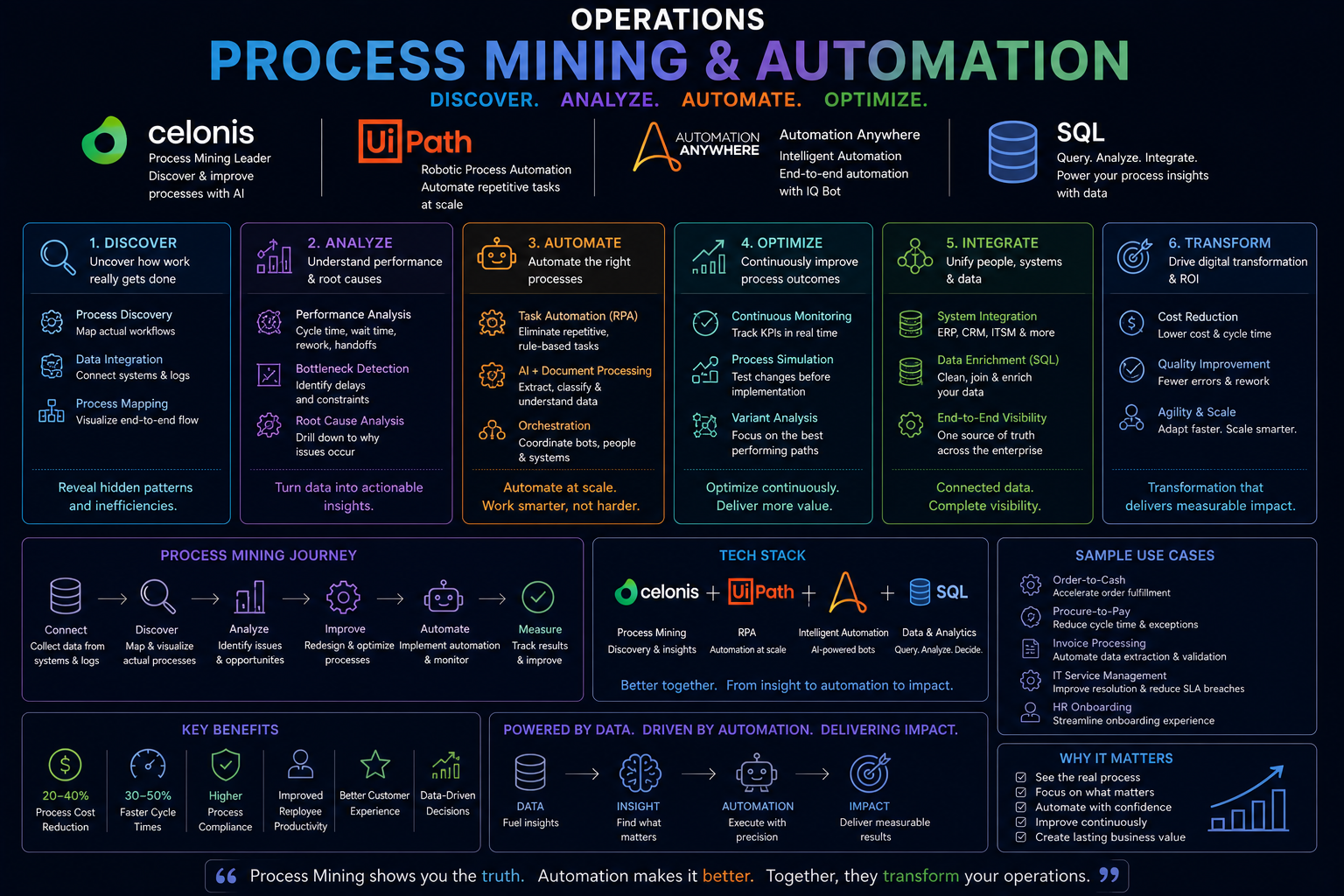
Understanding the Process Mining & Automation Stack
Before diving into training, understand the distinct roles each tool plays and how they work together.
Celonis is the global leader in process mining and process intelligence, serving over 1,400 organizations worldwide . The platform uncovers inefficiencies hidden within business operations by analyzing digital footprints across systems like ERP and CRM . It automatically maps how processes actually run, identifying issues like duplicate invoice payments, delayed purchase orders, and bottlenecks in order-to-cash and procure-to-pay workflows . In 2026, Celonis has integrated AI capabilities that surface root causes and recommend corrective actions automatically.
UiPath and Automation Anywhere are the market leaders in Robotic Process Automation (RPA). While process mining tells you where your processes are broken, RPA gives you the tools to fix them by automating repetitive tasks. UiPath now offers free community certifications including Automation Developer Associate, Specialized AI Associate, and Agentic Automation Associate credentials . The shift toward "agentic automation" means AI-powered agents that can reason, learn, and act independently—not just follow scripted rules .
SQL is the foundational language for data manipulation across all these platforms. Process mining requires extracting event logs from databases. Automation requires querying data sources. Without SQL proficiency, you cannot effectively work with any process mining or automation platform at scale .
The 16-Week Process Mining & Automation Roadmap
Phase 1: Weeks 1-4 – Process Mining Foundations with Celonis
What to focus on
Start by understanding what process mining does that traditional process mapping cannot. Traditional process mapping captures what people think happens. Process mining shows what actually happens by analyzing system logs.
Celonis platform fundamentals
Celonis extracts data from enterprise systems like SAP and Oracle, transforms it through intermediate objects and events, and surfaces insights via dashboards . Unlike SQL which produces tables, Celonis uses PQL (Process Query Language), a domain-specific language that produces columns that automatically join across different tables without explicit specifications . This composability makes PQL dashboard-friendly—filters propagate automatically across visualizations.
Key concepts to master
Event logs are the ordered list of events per object over time—the fundamental data structure of process mining . Process discovery automatically maps the actual process flow from event logs. Conformance checking compares actual processes against ideal models to identify deviations. Root cause analysis identifies why bottlenecks and rework occur.
Core use cases in operations
The most common process mining applications include Purchase-to-Pay (P2P) analysis to identify payment delays and invoice mismatches, Order-to-Cash (O2C) optimization to reduce cycle time and rework, Accounts Payable/Receivable analytics for aging and DSO tracking, and logistics and supply chain process discovery to find bottlenecks .
Free resources for Phase 1
Celonis offers academic licenses that provide free access to the platform, training, and certification through their Academic Alliance program . The Celonis Academy features over 400 hours of free content, interactive process mining lessons, and verified digital badges . TU Dortmund University offers a Celonis Fundamentals Track (5 weeks, 2.5-3.5 hours weekly) covering data analysis foundations and practical software operation .
Paid resources for Phase 1
Celonis enterprise licensing is required for commercial use. Simplilearn offers instructor-led Celonis training for structured learning (pricing varies).
Practical application
Using Celonis free academic access or trial, connect to a sample dataset. Run process discovery on a purchase-to-pay event log. Identify the most common variant, the longest path, and the rework rate. Create a dashboard showing cycle time by supplier and by approver. This exercise teaches you to see processes as data, not diagrams.
Phase 2: Weeks 5-8 – Process Data Preparation with SQL
What to focus on
Process mining platforms cannot work magic on bad data. SQL is the language of event log preparation, and you cannot be effective in process mining without it.
SQL fundamentals for process mining
You need to master SELECT statements to extract specific columns from database tables. JOIN operations (INNER, LEFT, RIGHT) combine data from multiple tables—event tables need to be joined with case tables, object tables, and timestamp tables. WHERE clauses filter to specific time ranges or process types. Aggregation functions like COUNT, SUM, AVG help calculate cycle times and frequencies. Window functions (ROW_NUMBER, LAG, LEAD) are essential for sequencing events chronologically.
Building event logs with SQL
Process mining requires data in a specific structure: case ID (unique process instance identifier), activity name (what happened at each step), timestamp (when it happened, critical for sequencing), and optional attributes (cost, resource, product, region) for drill-down analysis . A complete inventory management process mining dataset available through Zenodo provides a simulated SQLite database with Python scripts to generate event logs, demonstrating exactly how SQL transforms raw data into process-mining-ready formats .
ETL for process mining
At organizations like EY and Capgemini, process mining analysts spend significant time on data engineering tasks: extracting data from source systems like SAP ECC and B1, transforming raw logs into event structures, and loading cleaned data into process mining platforms . This is where you add value—automating data pipelines so process mining happens on current data, not stale snapshots .
Free resources for Phase 2
W3Schools offers completely free SQL tutorials covering everything from basics to advanced joins. Mode Analytics SQL Tutorial provides free, interactive lessons with real datasets. The Zenodo repository includes complete Python scripts for generating inventory management databases and OCEL event logs, demonstrating real SQL-to-process-mining workflows .
Paid resources for Phase 2
DataCamp offers "SQL for Business Analysts" and "SQL for Supply Chain Analytics" courses ($25-30/month). Coursera provides "SQL for Data Science" specialization through UC Davis.
Practical application
Using free SQL practice platforms or the Zenodo SQLite inventory database , write a query that extracts an event log for a specific material-plant combination. Include case ID (order number), activity (goods receipt, goods issue, order creation), and timestamp. Calculate the average cycle time from order to goods receipt. This SQL competence is what employers test in process mining interviews .
Phase 3: Weeks 9-12 – Automation with UiPath and Automation Anywhere
What to focus on
Process mining tells you where to automate. RPA gives you the tools to actually do it. This phase builds hands-on automation skills.
UiPath for automation development
UiPath Academy offers free learning paths for beginners through advanced practitioners . The UiPath Community Certification Framework Program provides free access to comprehensive training and certification resources, helping you gain skills needed to excel in automation and earn UiPath Certified Professional status . Available certifications include Automation Developer Associate (core RPA skills), Specialized AI Associate (AI-powered automation), and Agentic Automation Associate (autonomous AI agents) .
Core RPA concepts
You will learn to create software robots that interact with applications exactly as humans do—clicking, typing, reading screens, and extracting data. Recording allows you to capture mouse clicks and keystrokes as automation steps. Sequences and workflows control the logic flow. Exception handling ensures robots recover gracefully when things go wrong. Orchestrator manages robot deployment, scheduling, and monitoring.
Integration with process mining
The most powerful use case connects process mining insights to automation execution. When Celonis identifies an inefficient step occurring across many cases, that is a prime automation candidate . Export those specific cases to UiPath where robots process the exception handling automatically . The result is a closed loop: mine → identify → automate → remeasure.
Automation Anywhere alternative
While UiPath dominates the free training space, Automation Anywhere offers similar capabilities for enterprise automation. For learning purposes, start with UiPath community edition (free) and then transfer concepts to Automation Anywhere when needed for specific roles.
Free resources for Phase 3
UiPath Community Certification Framework Program is completely free, with certification tracks taking approximately 3 months to complete from registration . The UiPath Automation Developer Associate certification validates core RPA skills—exam details available through the UiPath Community portal . UiPath Academy offers self-paced learning plans for all certification tracks .
Paid resources for Phase 3
Simplilearn offers instructor-led RPA certification training aligned with the UiPath RPA Developer Advanced Certification exam (pricing varies, typically $500-1000) . Note that previous free exam promotions have expired, but the community certification remains free.
Practical application
Using UiPath Community Edition (free), build a simple automation that reads data from an Excel spreadsheet (list of invoice numbers), logs into a mock portal, checks each invoice status, and writes results to a new column. This is the type of "swivel chair" automation that eliminates hours of manual checking. Then add error handling—what happens when an invoice number is not found?
Phase 4: Weeks 13-16 – Integration, AI-Augmentation, and Career Preparation
What to focus on
This phase integrates everything into a complete intelligent automation capability. You will learn how AI is transforming both process mining and automation, and how to position yourself for the roles of the future.
AI in process mining
Celonis has built its platform on StarRocks to handle 20+ billion row queries with P90 latencies around 20 seconds, enabling complex multi-table joins exceeding 100 tables . The platform's AI capabilities include automated root cause analysis that identifies why bottlenecks occur without manual investigation. Predictive process mining forecasts where processes are heading based on current paths . AI-augmented dashboards surface insights rather than just displaying data.
Agentic automation
The Capgemini job description captures the shift: "AI is reshaping how organizations operate, compete, and create value. We are evolving our consulting model to be AI-enabled by design—augmenting human judgment with analytics, automation, and generative AI" . UiPath now offers "Agentic Automation Associate" certification for autonomous AI agents that can reason and act independently, not just follow scripted rules .
The complete intelligent automation workflow
The EY Process Mining Senior role describes the end-to-end capability expected in 2026: building and enhancing process mining data models using Celonis, designing and optimizing data pipelines using SQL and Python, developing front-end process dashboards, supporting RPA opportunity identification, and recommending corrective actions based on root-cause analysis . This is the full stack employers need.
Job-ready skills summary
Based on job postings from EY, Capgemini, and AbbVie, employers expect: process mining proficiency (Celonis, Signavio), automation platform skills (UiPath, Automation Anywhere), SQL and Python for data engineering , visualization tools (Tableau, Power BI) , process documentation standards (BPMN, Visio) , and six sigma or Lean qualification as preferred but not mandatory .
Free resources for Phase 4
Celonis Academy offers advanced content on AI-powered process intelligence . Zenodo provides complete object-centric event log datasets for practicing advanced process mining techniques . UiPath Community forums connect you with practitioners solving real problems.
Paid resources for Phase 4
The UiPath RPA Developer Advanced Certification has a one-year validity period . Exam costs may apply; check UiPath official website for current pricing. Six Sigma certification (Green Belt or Black Belt) is available through ASQ or other providers ($200-500).
Practical application
Build a complete intelligent automation case study for a real process in your organization. Use process mining (or manual process mapping as proxy) to identify the top inefficiency. Document the root cause using Celonis-style analysis. Build a UiPath automation that addresses that specific inefficiency. Then measure the before-and-after metrics—cycle time reduction, error rate improvement, cost savings. Present as a one-page value case to leadership. This is the Capgemini "process diagnostics and automation workstream" delivered .
Your Portfolio Projects
Build these four artifacts during your training. They demonstrate exactly what hiring managers for process mining and automation roles are looking for.
Project One: The Process Discovery Report – Using Celonis free access or trial, analyze a sample event log for any process (purchase-to-pay is common). Create a process map showing the most frequent path, variants, and bottlenecks. Identify the top three inefficiencies with quantified impact (rework rate, cycle time delay, cost). Present as a one-page executive summary with recommendation.
Project Two: The Event Log SQL Pipeline – Using the Zenodo SQLite inventory database , write SQL queries to extract an object-centric event log. Document your data sources, join logic, timestamp handling, and case ID construction. Show a sample of your output event log with at least 100 events. This demonstrates the ETL competency that EY explicitly requires .
Project Three: The Automated Workflow – Using UiPath Community Edition, build an automation that reads from a spreadsheet, processes each row through a decision logic, and writes results. Add exception handling for edge cases. Create an Orchestrator process to schedule the automation daily. Document your development process and testing results.
Project Four: The Intelligent Automation Case Study – Combine all three previous projects into a complete use case. Use process mining to identify an inefficiency, build SQL pipeline to prepare the data, develop UiPath automation to fix the identified issue, and report the projected ROI. Present as a 10-slide deck demonstrating the end-to-end capability .
Career Application
Why This Matters Now
The gap for process mining and automation talent is significant—organizations need professionals who can bridge the operational and digital worlds to elevate decision-making through data-driven process intelligence . At EY, the Process Mining Senior role leads transformation across P2P, O2C, AP/AR, logistics, and operational processes . At Capgemini, the Process Transformation Senior Consultant role (base compensation 105,600−
105,600−199,480) requires 5-8 years of experience with hands-on exposure to process mining and automation tools . At AbbVie, the Senior Analyst, Process Automation role (84,500−
84,500−162,000) requires 3+ years of experience with Celonis, UiPath, Python, and Power Automate .
Job Titles to Target
Process Mining Analyst is an emerging role requiring one to three years of experience. You build process discovery dashboards, analyze event logs, and identify inefficiencies. The salary range is 65,000to
65,000to95,000.
RPA Developer requires two to four years of experience. You build, test, and deploy automation workflows using UiPath or Automation Anywhere. The salary range is 70,000to
70,000to100,000.
Process Mining Senior Analyst (EY level) requires three to five years of experience. You lead end-to-end process mining, ETL, dashboarding, and optimization initiatives across P2P, O2C, and logistics . The salary range is 80,000to
80,000to120,000.
Process Transformation Consultant (Capgemini level) requires five to eight years of experience. You lead process discovery, root-cause analysis, automation roadmap development, and client workshops . The salary range is 105,000to
105,000to199,000 depending on location.
Intelligent Automation Manager requires six to ten years of experience. You own the automation roadmap, lead cross-functional initiatives, and report ROI to leadership. The salary range is 120,000to
120,000to160,000.
Director of Process Intelligence requires ten or more years of experience. You set process mining strategy, manage vendor relationships, and drive cultural adoption of data-driven process improvement. The salary range is 150,000to
150,000to200,000.
Required Skills Based on Job Postings
Based on analysis of active job postings from EY, Capgemini, and AbbVie , employers expect a specific combination of technical and functional skills.
Process mining proficiency requires hands-on experience with Celonis, Signavio, or MPM/MPMx for building data models, event logs, activity mapping, conformance checks, and KPI modeling . Automation skills require proficiency with UiPath, Automation Anywhere, Microsoft Power Automate, ServiceNow, or SmartSheet for designing, implementing, and maintaining automated workflows .
Data engineering capabilities require SQL and Python for building data pipelines, ETL tools like Alteryx or Knime, and SAP data modeling . Visualization skills require Tableau, Power BI, or Qlik for developing front-end process dashboards tracking metrics like cycle time, delay, and mismatch rates .
Process documentation standards include BPMN, Visio, and ARIS for creating TO-BE designs and process governance documentation . Domain knowledge in P2P, O2C, AR/AP, logistics, and vendor management is highly valued .
The Capgemini job description emphasizes AI literacy: understanding core AI and generative AI concepts, ability to identify and support AI-enabled opportunities that improve business outcomes, comfort collaborating across strategy, technology, data, and design to enable AI-driven solutions, and understanding of responsible AI principles such as ethics, privacy, security, and governance .
Certifications That Matter
Celonis Certification is available through the Academic Alliance program with free access for students and educators . Celonis Academy offers verified digital badges upon completion .
UiPath Community Certifications are completely free and include Automation Developer Associate, Specialized AI Associate, and Agentic Automation Associate tracks . Certification tracks take approximately 3 months to complete from registration .
SQL Certification is available through various providers (HackerRank, LeetCode) to validate data manipulation skills.
Six Sigma Green Belt or higher is preferred but not mandatory, valued for structured problem-solving methodology .
The Job Search Strategy
Your portfolio matters more than your certifications. Create a public repository showcasing your process discovery reports, SQL event log pipelines, and UiPath automation workflows.
On your resume, replace generic bullet points with process mining-specific achievements. For example: "Led process mining initiative across P2P, reducing cycle time by 35% and identifying $2M in working capital opportunities." Or "Deployed UiPath automation handling 10,000+ invoice exceptions monthly with 99.7% accuracy."
In interviews, articulate specific intelligent automation workflows you have built. The Capgemini job expects you to "lead process discovery, mining, and root-cause analysis for client workstreams" and "build and prioritize automation roadmaps based on value and feasibility" . The EY role expects you to "build and enhance process mining data models" and "support RPA opportunity identification, automation workflows, and predictive insights" .
Practice explaining how you would: build a process mining data model from SAP event logs, identify the root cause of recurring payment delays, prioritize which process steps to automate first, measure ROI from automation investments, and communicate insights to senior clients.
The 30-60-90 day framework for process mining roles includes auditing available event log data sources and current process KPIs in the first month, identifying quick-win automation opportunities. The second month focuses on delivering one process discovery and one automation workflow. The third month is about scaling: establishing continuous process monitoring, building the automation roadmap, and reporting ROI to leadership.
Academic Pathway
University partnerships provide excellent entry points. TU Dortmund University offers a Celonis Fundamentals Track for students . Celonis Academic Alliance provides free software licenses, training, and certification resources for students and educators . The Zenodo repository provides complete simulated datasets for hands-on practice without enterprise data access .
Immediate Next Steps for the Next 7 Days
Day One: Sign up for Celonis Academic Access. Access the Celonis Academy and start the Fundamentals learning path with over 400 hours of free content .
Day Two: Enroll in the UiPath Community Certification Framework Program. Register for the Automation Developer Associate track. Download UiPath Community Edition.
Day Three: Complete W3Schools SQL tutorial (free, approximately 4-6 hours). Focus on JOINs, aggregations, and window functions—the skills tested in EY's data engineering requirements .
Day Four: Download the Zenodo inventory management SQLite database and Python scripts. Run the event log generation to understand how SQL transforms raw data into process-mining-ready formats .
Day Five: Define your portfolio project focus. Choose between the process discovery report, SQL event log pipeline, UiPath automation workflow, or integrated case study. Commit to completing one project within 30 days.
Day Six: Update your LinkedIn headline. Change it from "Operations Professional" to "Process Mining & Automation | Celonis + UiPath + SQL | Intelligent Workflows." Add your in-progress certifications to your profile.
Day Seven: Start your first portfolio project. Document your process publicly on LinkedIn and GitHub to build visibility. The professionals who can bridge the operational and digital worlds are exactly who Capgemini, EY, and AbbVie are hiring .
The Long Game
Process mining and intelligent automation are among the fastest-growing specializations in operations. The shift from manual process mapping to AI-driven process intelligence is as fundamental as the shift from paper to digital. Every transaction in every enterprise system is a data point waiting to be mined for insights.
The most successful process mining professionals in 2026 are hybrid practitioners. They combine process domain expertise (P2P, O2C, logistics) with technical proficiency (SQL, Python, Celonis, UiPath). They know how to extract event logs and how to interpret what the process map reveals. They build automations that eliminate inefficiencies and measure the ROI of their work.
Your operations background is your foundation. You already understand process flows, bottlenecks, rework, and cycle times. You know which problems actually matter. This roadmap builds the technical tools—Celonis for discovery, SQL for preparation, UiPath for automation—that transform an operations professional into a process intelligence leader.
The professionals who can bridge the operational and digital worlds to elevate decision-making through the science of smarter analytics will be the most valuable in the job market . Start your week one actions today. Mine that first event log. Write that first SQL query. Build that first automation. The future of operations is intelligent, automated, and data-driven—and now, that future includes you.
Knowledge / Experience in process improvement




 Group / 1: 1 Sessions