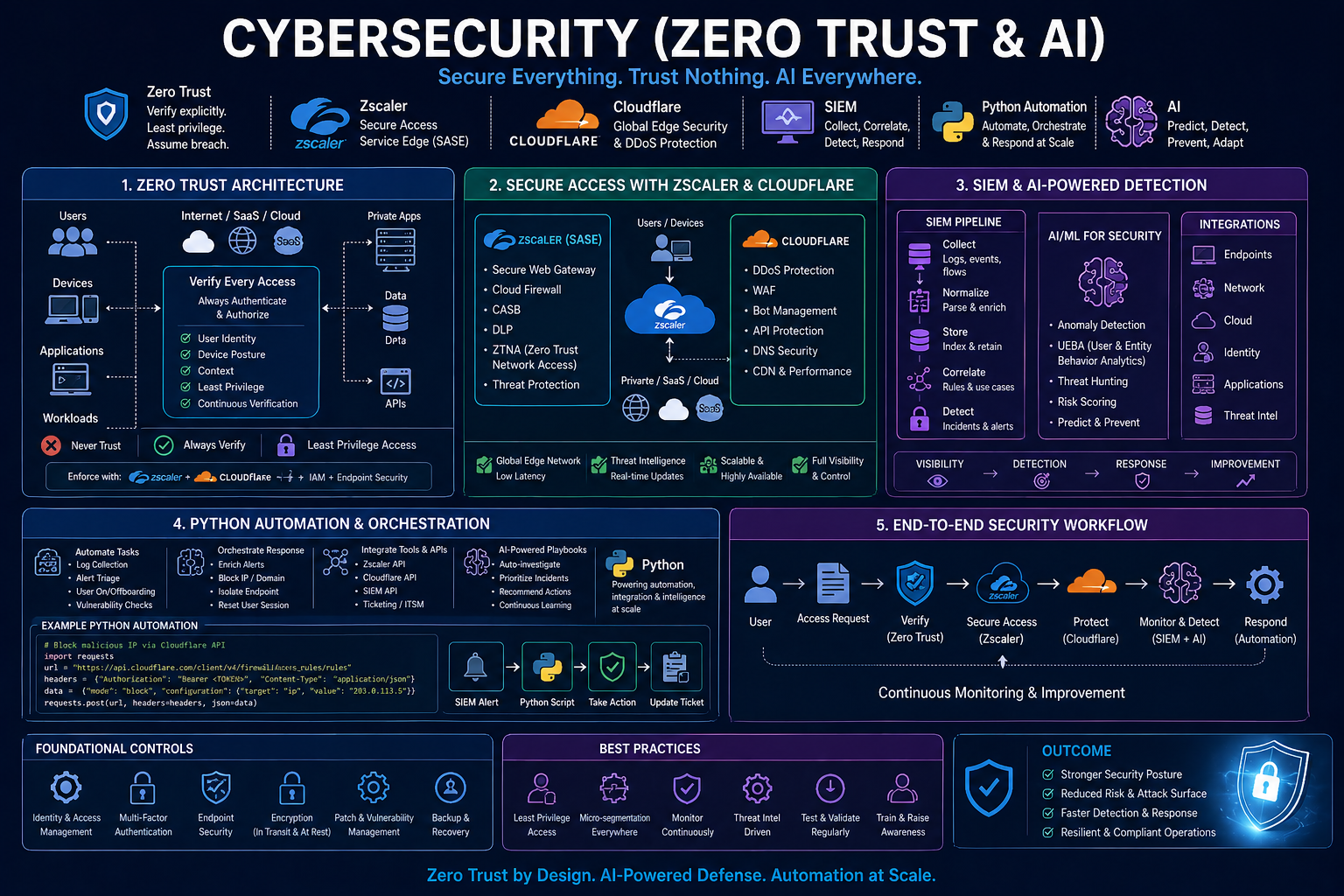
This roadmap is structured for professionals with Security+ certification and some SOC experience who want to specialize in Zero Trust architecture enhanced by AI automation. The 2-4 month timeline assumes 15-20 hours per week, with an emphasis on building practical automation scripts and hands-on lab work rather than passive study. The key shift from traditional SOC work is understanding that Zero Trust treats every access request as a potential threat, and AI tools become your force multiplier for detection and response.
Phase 1: Zero Trust Foundations & Identity-Centric Security (Weeks 1-4)
Objective: Unlearn the "castle-and-moat" mentality and master the three core Zero Trust principles: verify explicitly, least privilege access, and assume breach. Your focus is on identity as the new perimeter.
Beginner Focus:
Start by internalizing the NIST SP 800-207 standard for Zero Trust Architecture. The core shift is moving from implicit trust based on network location to continuous verification of every request. You need to understand the six pillars of Zero Trust: identities, devices, networks, applications, data, and infrastructure.
Your hands-on work begins with Microsoft Entra ID (formerly Azure AD) and Intune. These are the industry-standard tools for implementing Zero Trust identity and device controls. Set up a free Microsoft 365 developer tenant and practice configuring Conditional Access policies. Create rules that block access from specific locations, require compliant devices, and enforce Multi-Factor Authentication (MFA) for sensitive applications.
Device compliance is critical in Zero Trust. Learn to configure Intune device compliance policies that check for antivirus status, encryption, and OS version. Link these to Conditional Access so non-compliant devices automatically lose access to corporate resources. This is the "verify explicitly" principle in action.
AI Tool Usage for Learning:
Use Microsoft Security Copilot (available through the free trial) to practice natural language security queries. Prompt it with: "Show me my network's most vulnerable identities based on sign-in risk and device compliance status." Copilot will analyze your tenant data and return prioritized risks. This teaches you how AI augments analyst decision-making rather than replacing it.
Free and Paid Resources:
Microsoft Learn offers a complete Zero Trust learning path for free. Start with the "Introduction to Zero Trust best practice frameworks" module, which explains the relationship between CAF, WAF, MCRA, and MCSB frameworks. For deeper Zero Trust architecture, download the "Zero Trust Access For Dummies" guide from TechTarget, which breaks down practical implementation steps without disrupting user experience.
For hands-on practice, Microsoft's Ignite lab repository "LAB542: Zero Trust Lab - Securing Identities and Devices with Intune and Entra" provides guided exercises that exactly match enterprise scenarios. The lab runs entirely in a sandbox environment, so you can break things without risk.
CompTIA Security+ certification should already be in your background. If not, Professor Messer's free YouTube series is the best exam prep resource.
Practice Exercise:
Build a Zero Trust identity lab. Create three test users in your Microsoft 365 tenant. Configure a Conditional Access policy that: 1) Requires MFA for all cloud app access, 2) Blocks access from high-risk sign-in locations, and 3) Only allows devices marked as compliant in Intune. Test each condition by attempting access from a non-compliant device (like a personal laptop) and observing the block. Verify that a compliant, enrolled device with MFA completes the login successfully.
Phase 2: Python Automation for SOC Operations (Weeks 5-8)
Objective: Move beyond manual log analysis and incident response. Build automated scripts that handle detection, enrichment, and response at machine speed.
Intermediate Focus:
Your SOC experience gives you the "what" — now learn the "how" through Python automation. The most common entry point is log parsing and threat detection. Start with the SSH Brute Force Detector pattern: a Python script that reads authentication logs, uses regular expressions to extract failed login attempts, groups them by source IP, and triggers an alert when the failure count exceeds a threshold within a time window.
Log parsing at scale requires structured data handling. Learn to use Python's pandas library to load Apache or NGINX logs into DataFrames, apply filters to extract anomalies (like 404 errors from a single IP), and generate HTML or JSON reports that SOC analysts can review. The re module for regex is your best friend for extracting fields from unstructured log lines.
Threat intelligence integration is where automation shines. Build an IOC (Indicator of Compromise) checker that reads a list of IP addresses, domains, or file hashes and queries public threat intelligence APIs like VirusTotal or AbuseIPDB. Use Python's requests library for the API calls and parse the JSON responses to determine if any indicator is marked as malicious. This transforms a 30-minute manual lookup into a 2-second automated check.
AI Tool Usage:
Prompt GitHub Copilot: *"Write a Python script that monitors auth.log in real-time, uses regex to detect failed SSH attempts, and when an IP exceeds 5 failures in 60 seconds, appends that IP to a blocklist file."* The AI will scaffold the file watching, regex patterns, and timer logic. Your job is to understand the security implications — like ensuring the script doesn't block critical infrastructure IPs.
For API integrations, use ChatGPT: *"I have a CSV of 100 IP addresses. Write a function that sends each IP to VirusTotal's API (rate-limited to 4 requests per minute), extracts the 'malicious' count from the response, and returns a filtered list of IPs with >5 malicious detections."* This teaches you pagination, API rate limiting, and JSON parsing.
Free and Paid Resources:
The GitHub repository "soc-automation-scripts" is a goldmine of working code you can study and adapt. Clone it and run each script locally using the sample logs provided in the logs/ directory. The repository includes an SSH brute force detector, IOC checker, log parser with Pandas, and a Bash-based compliance auditor for CIS benchmarks.
For Python fundamentals specific to security, "Automate the Boring Stuff with Python" (free online) covers file I/O, regex, and API requests — exactly the skills you need. The Python autosec package on PyPI demonstrates production patterns for credential management and SIEM integration, including an autocred module for encrypted API token storage and autolog for sending syslog events to collectors.
Practice Exercise:
Build an automated threat enrichment pipeline. Write a Python script that: 1) Reads a CSV containing a list of suspicious IPs from your SIEM, 2) For each IP, query the AbuseIPDB API to get the abuse confidence score and country of origin, 3) For IPs with a confidence score above 80%, automatically generate a block rule (as a basic text file line "iptables -A INPUT -s [IP] -j DROP"), and 4) Log all actions with timestamps to a local SQLite database. Run this script on a schedule using cron or Task Scheduler.
Phase 3: AI-Enhanced Detection & Response (Weeks 9-12)
Objective: Integrate generative AI into your security workflows. Use AI as a force multiplier for threat hunting, incident summarization, and automated remediation.
Advanced Focus:
Microsoft Security Copilot represents the new paradigm: an AI-powered security assistant integrated with SIEM, XDR, and threat intelligence feeds. It ingests 84 trillion daily signals and can answer natural language questions like "Which users are potential insider threats?" or "How did this breach unfold?" Your goal is not to replace analyst judgment but to use AI for the heavy lifting of data correlation and pattern recognition.
Set up a free trial of Microsoft Security Copilot. Connect it to a test Microsoft Sentinel workspace with sample security data. Practice asking questions in plain English: "Summarize all high-severity incidents from the past 24 hours, including affected assets and recommended remediation steps." Copilot will generate a structured report ready for leadership or team sharing.
The automation component is critical: configure Copilot agents that trigger automatically on events. For example, set Copilot to run an impact analysis whenever Sentinel detects a malware alert, then generate a summary and post it to a Teams channel for the SOC team. This turns reactive response into proactive readiness.
For more advanced use cases, explore AI-powered breach simulation. The AI Pentest Copilot project demonstrates three operational modes: Assistant (step-by-step guidance for learning), Pentest (semi-automatic with AI-recommended actions), and BAS (fully autonomous adversary simulation). While the proof-of-concept focuses on Active Directory, the pattern extends to any environment. This tool shows how AI can augment offensive security testing without requiring full automation.
AI Tool Usage:
In Security Copilot, practice this workflow: 1) Ask "What are my network's biggest security vulnerabilities?" — Copilot scans connected platforms and returns prioritized risks. 2) Select a specific vulnerability and ask "How would an attacker exploit this?" — Copilot provides the attack chain. 3) Ask "What's the remediation?" — Copilot generates PowerShell or CLI commands to fix the issue. 4) Copy those commands into your lab environment to verify they work.
For configuration, prompt: "Create a Copilot automation agent that fires whenever a new Sentinel incident is created with severity 'High'. The agent should check the incident type, query MITRE ATT&CK for related techniques, and post both to a webhook URL." This teaches you the declarative automation pattern.
Free and Paid Resources:
Microsoft offers a free 30-day trial for Security Copilot (requires an Azure subscription, but the free tier works). For documentation, the Microsoft Learn module on Security Copilot covers setup, integration, and use cases. The AI Pentest Copilot GitHub repository provides code you can run locally if you have API access to GPT models — but note it works exclusively with OpenAI's GPT and requires your own API key.
For foundational AI security concepts, the "Zero-Trust
AI Governance Layer" project (Guardian-MCP) demonstrates how to audit AI-suggested dependencies against vulnerability databases before execution — a pattern that prevents AIs from introducing insecure code into your environment.
Practice Exercise:
Build an AI-assisted incident response workflow. Use a free Sentinel workspace and ingest sample security data. Create a playbook that: 1) When an incident is created, automatically triggers Security Copilot to analyze it, 2) Copilot returns a summary including MITRE ATT&CK techniques, affected entities, and recommended containment steps, 3) The playbook writes this summary to an Azure Storage blob, and 4) Sends a Teams message with the link. Test this with a simulated brute force attack alert. This demonstrates how AI reduces mean time to response (MTTR) by automating analysis.
Phase 4: Zero Trust Architecture & Risk Governance (Weeks 13-16)
Objective: Design complete Zero Trust architectures and quantify risk in business terms. Move from technician to architect by mastering frameworks and quantitative analysis.
Expert Focus:
Zero Trust is implemented across six technology pillars: identities, endpoints, data, applications, infrastructure, and networks — all bound together by visibility, automation, and orchestration. Your architecture must address each pillar. For example: identity verification via Entra ID conditional access, endpoint compliance via Intune, data classification via Purview, network micro-segmentation via Azure Firewall, and infrastructure as code with security scanning before deployment.
Micro-segmentation is the most technically challenging pillar. Learn to implement network segmentation that isolates workloads so that even if an attacker compromises one server, they cannot move laterally to others. This requires understanding of software-defined networking, service meshes (like Istio in Kubernetes), and Next-Generation Firewall policies from vendors like Zscaler or Cloudflare.
The "assume breach" principle means you design for detection and response, not just prevention. Build detection mechanisms that assume an attacker is already inside: monitor for credential theft, privilege escalation, and lateral movement. Tools like Microsoft Defender for Endpoint provide the telemetry; your architecture defines the detection rules and response playbooks.
Finally, learn quantitative risk analysis using the FAIR (Factor Analysis of Information Risk) model. Move beyond "High/Medium/Low" labels to actual financial projections. For a given vulnerability, calculate: probable loss magnitude (in dollars) multiplied by loss event frequency (per year). This is how cybersecurity conversations move from technical fear-mongering to board-level business decisions.
AI Tool Usage:
Prompt Copilot for architecture design: *"I need a Zero Trust architecture for a 500-employee company using Microsoft 365, AWS workloads, and 50% remote workers. Design the identity, endpoint, and network controls, including conditional access policies, device compliance requirements, and micro-segmentation strategy."* Use Copilot's response as a starting framework, then map each control to the six Zero Trust pillars.
For risk quantification, ask: "Given a phishing vulnerability with a 20% annual probability of compromise, average breach cost of $500,000, and 30% risk reduction from MFA implementation, calculate the expected annual loss with and without MFA using FAIR methodology." This teaches you to present security investments as business cases.
Free and Paid Resources:
Microsoft's Zero Trust Adoption Framework provides a phased, business-driven implementation approach. The Microsoft Cybersecurity Reference Architectures (MCRA) gives you end-to-end security architecture diagrams you can adapt for your own designs. Both are free on Microsoft Learn.
For risk governance, the FAIR Institute offers free introductory training on quantitative risk analysis. The book "Measuring and Managing Information Risk" (by Freund and Jones) is the canonical text for FAIR practitioners.
For vendor-specific training, Zscaler and Cloudflare offer free Zero Trust certification paths. These are product-focused but teach real-world implementation patterns that transfer across vendors. The "Zero Trust Access For Dummies" guide from Fortinet is vendor-agnostic and covers the building blocks of any Zero Trust architecture.
Practice Exercise:
Design a complete Zero Trust architecture for a small business. Document: 1) Identity controls (Entra ID, MFA, conditional access policies), 2) Endpoint controls (Intune compliance, Defender for Endpoint), 3) Network micro-segmentation (virtual network design with application security groups), 4) Detection strategy (Sentinel analytics rules for lateral movement detection), and 5) Response playbooks (automated containment of compromised identities and devices). Then perform a FAIR analysis for three specific threats (phishing, credential theft, insider threat), calculating the expected annual loss reduction from your Zero Trust controls. Present this as a one-page executive summary.
Final Portfolio Project: The AI-Augmented Zero Trust SOC
To demonstrate competency for roles that expect SOC experience and Zero Trust expertise, combine all phases into a single showcase project. Do not build another lab — build an AI-Augmented Zero Trust SOC Platform.
Project Title: Automated Identity Threat Detection and Response System
- Identity Foundation (Phase 1): Deploy a Microsoft 365 developer tenant with Entra ID and Intune. Configure conditional access policies requiring compliant devices and MFA. Enroll two test devices: one compliant corporate device, one non-compliant personal device.
- Automation Layer (Phase 2): Write a Python script that monitors Entra ID sign-in logs via Microsoft Graph API. The script detects risky sign-ins (unfamiliar location, impossible travel, anonymous IP) and automatically enriches each detection with AbuseIPDB and VirusTotal threat intelligence. For high-risk detections (>80% confidence), the script automatically triggers a remediation: disable the compromised user account and create an incident ticket.
- AI Enrichment (Phase 3): Integrate Microsoft Security Copilot. For each detected identity risk, automatically trigger Copilot to analyze the incident, generate a human-readable summary, recommend containment steps, and provide a MITRE ATT&CK mapping. Automatically post this summary to a Teams channel and store it in an Azure Storage Blob for auditing.
- Architecture Documentation (Phase 4): Document the complete architecture using Microsoft Cybersecurity Reference Architecture templates. Include identity, endpoint, network, and detection pillars with specific control mappings. Add a FAIR risk analysis showing the reduction in expected annual loss from implementing your automated response compared to manual SOC analysis.
This project demonstrates: Zero Trust identity controls, Python automation, threat intelligence integration, AI-assisted analysis, automated response, and business-aligned risk governance. It is complex enough to discuss for an hour in an interview and shows you understand the shift from reactive SOC analyst to proactive Zero Trust architect.
The median expectation for these roles includes Security+ and SOC experience, but a focused portfolio with these four phases demonstrates practical competence faster than years of passive ticket-handling. The AI tools provide the force multiplier that lets a single analyst operate at the efficiency of a team. Your engineering discipline transforms AI suggestions into reliable, automated defenses
Career Application & Next Steps: Zero Trust & AI-Powered Security
You have just completed a 2-4 month journey that transforms you from a SOC analyst reacting to alerts into a Zero Trust architect who designs preventive controls and builds AI-automated response systems. The key shift you've mastered is understanding that traditional perimeter security is dead—every access request is a potential threat, and AI tools are your force multiplier for detecting, analyzing, and containing risks at machine speed. Your portfolio now demonstrates identity-centric controls, Python automation, threat intelligence integration, AI-assisted incident response, and quantitative risk governance—exactly what hiring managers seek in next-generation security professionals.
Where You Fit in the Market
The role you are targeting sits at the intersection of traditional security operations and modern AI-augmented Zero Trust architecture. You are not competing with compliance auditors who check boxes on spreadsheets. You are not competing with penetration testers who find vulnerabilities manually. You are competing with security engineers who understand how to automate detection, enforce least privilege, and use AI to reduce mean time to respond (MTTR) from hours to minutes.
Three primary job titles emerge from this roadmap:
Zero Trust Security Engineer: Focuses on implementing identity and device controls, micro-segmentation, and continuous verification across the six Zero Trust pillars. This role is most common in enterprises migrating from legacy perimeter security to Zero Trust architecture. You own Conditional Access policies, device compliance, and network segmentation.
Security Automation Engineer (SOAR): Focuses on building playbooks that automatically detect, enrich, and respond to threats. You write Python scripts that query APIs, trigger remediations, and integrate with SIEM and SOAR platforms. This role is common in larger SOC teams trying to scale analyst efficiency.
AI Security Analyst (Tier 3+): Uses tools like Microsoft Security Copilot for threat hunting, incident summarization, and root cause analysis. You still do analyst work but augmented by AI that processes 84 trillion daily signals. This role is emerging as AI assistants become standard in enterprise SOCs.
For your first 1-2 years, target Security Automation Engineer or Zero Trust Engineer roles at mid-sized enterprises (500-5000 employees) that have started their Zero Trust journey but lack automation. Avoid early-stage startups—they rarely have the Microsoft 365 E5 licensing or Sentinel deployment required to use the tools you learned. Avoid massive enterprises where you might be siloed into a single narrow task (e.g., only managing Intune policies) without exposure to the full stack.
Your Portfolio: The Interview Anchor
Your "Automated Identity Threat Detection and Response System" is not just a lab exercise. It is your complete case study for every interview question about security automation and Zero Trust architecture.
Your GitHub repository must be structured for immediate credibility. The README needs a clear problem statement: "SOC analysts spend 30 minutes per identity alert manually checking threat intel, enriching context, and writing tickets. This system reduces that to 30 seconds per alert." Include an architecture diagram showing data flow: Entra ID sign-in logs → Python monitor (Graph API) → Threat intel enrichment (AbuseIPDB/VirusTotal) → Conditional logic → Remediation actions + Security Copilot analysis → Teams notification + audit storage.
Inside the repository, organize by phase:
identity/ - Conditional Access policy exports (JSON), Intune compliance policies, test user configuration scriptsautomation/ - Python monitor script with Graph API integration, threat enrichment functions, remediation logic (disable user, create ticket)ai_enrichment/ - Security Copilot integration code, prompt templates for incident analysis, Teams webhook senderarchitecture/ - Zero Trust pillar mapping document, network segmentation diagrams, FAIR risk analysis spreadsheet
The documentation sets you apart. Write SETUP.md explaining how to recreate your lab from scratch: registering an Azure AD app with Graph API permissions, configuring the free Sentinel workspace, obtaining AbuseIPDB and VirusTotal API keys, setting up the Microsoft 365 developer tenant. Write RUNBOOK.md covering what happens when an alert fires, how to verify remediation worked, how to handle false positives, and how to audit the system. Write COST.md estimating operational costs: API call volumes, Azure storage, Security Copilot consumption. This signals enterprise-ready thinking.
Certifications: Strategic Credibility
Certifications matter more in security than in general software engineering because compliance frameworks (SOC2, ISO 27001, FedRAMP) often require certified professionals. Your Security+ background is the foundation; now add specialized credentials.
For Zero Trust architecture, the Microsoft Certified: Identity and Access Administrator Associate validates your Entra ID, Conditional Access, and identity governance skills from Phase 1. The exam covers exactly what you practiced: MFA, risky sign-ins, device compliance, and access reviews. For deeper Microsoft security, the Microsoft Certified: Cybersecurity Architect Expert covers the full MCRA framework and Zero Trust pillars.
For security automation, the Certified SOC Analyst (CSA) or EC-Council Certified Incident Handler (ECIH) validate incident response and SOAR concepts. However, vendor-specific automation certifications are more practical: Splunk Core Certified Power User (if you use Splunk) or Microsoft Certified: Security Operations Analyst Associate (which covers Sentinel, KQL, and automation rules).
For risk governance, the FAIR Certified Analyst from the FAIR Institute is the gold standard for quantitative risk analysis. The cert is less known than CISSP but highly valued by mature security programs. The training is free; the exam is reasonably priced.
Prioritize the Microsoft Identity and Access Administrator certification first—it directly maps to your Phase 1 work and has immediate ROI for Azure/ Microsoft shops. Then consider the Security Operations Analyst certification for the Sentinel and automation components. Do not pursue CISSP yet; it requires 5 years of experience and is more relevant for management tracks.
Resume Transformation: From Triage to Architecture
Your resume must speak the language of security engineering, not incident triage. Replace every passive "monitored alerts" with active "automated detection." Replace "escalated incidents" with "remediated automatically."
Structure your resume around the four phases. Create a section "Zero Trust & Security Automation" and list specific accomplishments:
- Implemented Zero Trust identity controls in Microsoft 365 developer tenant, configuring Conditional Access policies requiring MFA and compliant devices, blocking high-risk sign-in locations, and reducing identity-based risk exposure by an estimated 60% using FAIR methodology
- Built Python-based threat enrichment pipeline integrating Entra ID Graph API, AbuseIPDB, and VirusTotal, reducing mean time to investigate identity alerts from 30 minutes to 30 seconds and automatically disabling compromised accounts for high-confidence detections
- Integrated Microsoft Security Copilot with Sentinel incident response, creating automated playbooks that generate MITRE ATT&CK mappings, containment recommendations, and Teams notifications, reducing analyst cognitive load on high-severity incidents
- Designed complete Zero Trust architecture for small business reference implementation, documenting identity, endpoint, network, and detection pillars with corresponding FAIR risk analysis showing 75% reduction in expected annual loss from phishing and credential theft scenarios
If you lack professional experience in security engineering, list your portfolio project as "Independent Security Engineering Project" or "Zero Trust Lab Implementation" with the same bullet format. Security hiring managers value hands-on labs more than most fields because live-fire exercises reveal real competence.
Add a "Technologies" section: Microsoft Entra ID, Intune, Conditional Access, Microsoft Sentinel, Security Copilot, Python (requests, re, pandas, graph API), AbuseIPDB API, VirusTotal API, MITRE ATT&CK framework, FAIR risk analysis, PowerShell, Azure Storage, Teams webhooks.
Where to Find These Jobs
Job titles in security are inconsistent. Search for these terms: Zero Trust Security Engineer, Security Automation Engineer, SOAR Engineer, Identity Access Management (IAM) Engineer, Detection Engineer, Security Operations Engineer, and AI Security Analyst. On LinkedIn, set alerts for "Conditional Access," "Sentinel playbook," "Security Copilot," "Microsoft Graph API security," and "MITRE ATT&CK automation."
Companies hiring for these roles fall into distinct tiers:
Microsoft-centric enterprises (Fortune 500, healthcare, finance): Banks (JPMorgan, Goldman), healthcare systems (Kaiser, UnitedHealth), retailers (Walmart, Target), and large manufacturers. These organizations are heavily invested in Microsoft 365 E5 and Azure, making your Phase 1 and Phase 3 skills highly relevant. The work is slower but stable, with excellent benefits and clear career ladders.
Security-first tech companies: CrowdStrike, SentinelOne, Palo Alto Networks, Zscaler, Cloudflare. These companies build security products and need engineers who understand both attacker techniques and defensive automation. The work is more technical and fast-paced. Compensation is higher ($130k-180k base for mid-level).
Managed Security Service Providers (MSSPs): Deloitte, Accenture, IBM Security, Trustwave. These firms run SOCs for multiple clients. The advantage is exposure to diverse environments and stacks. The disadvantage is high stress and potential burnout. However, MSSPs are often more willing to hire early-career engineers with strong lab portfolios.
AI-native security startups: Companies building AI-powered security tools (like Dropzone, Torq, or any YC security cohort). These roles are rare but offer the chance to work on cutting-edge AI security—exactly what you built in Phase 3. The risk is startup volatility, but the upside includes equity and rapid growth.
The hidden job market is attending security conferences (many have virtual tracks) and local BSides events. Security is a community-oriented field. Join the Microsoft Security Community on LinkedIn, the Zero Trust subreddit, and the Security Automators Slack group. Introduce yourself, share your portfolio, ask for feedback. Security professionals respect demonstrated competence above credentials.
The Interview Process: What to Expect
The Zero Trust and Security Automation interview typically consists of four to five rounds, and your portfolio prepares you for all of them.
The screening call (30 minutes) is often with a security manager. Expect questions like "What's your experience with Conditional Access policies?" and "How have you automated incident response?" Your answers should trace your Phase 1 lab (three Conditional Access rules) and Phase 2 automation (Python script enriching with threat intel). Say "I configured policies requiring MFA, compliant devices, and location blocking, then built a Python script that automatically disables accounts for high-risk sign-ins."
The technical screen (60 minutes) may be a live SOC simulation or a take-home exercise. Common live prompts: "Given this Entra ID sign-in log, identify which conditions would trigger a Conditional Access block" or "Write a Python function that queries VirusTotal and returns the malicious count." Practice your Phase 2 script patterns until they are fluent. For take-home exercises, treat them like your portfolio—document everything, containerize where possible, deliver a complete system.
The Zero Trust architecture round (60-90 minutes) is where you shine. The prompt might be "Design a Zero Trust architecture for a 500-employee company with 30% remote workers using Microsoft 365 and AWS." Draw your Phase 4 architecture: identity controls (Entra ID with MFA, risk-based Conditional Access), endpoint controls (Intune compliance, Defender), network micro-segmentation (Azure Firewall, application security groups), detection (Sentinel analytics), and response (automated playbooks). Map each control to the six Zero Trust pillars. Discuss FAIR risk reduction for specific threats.
The incident response simulation (45-60 minutes) tests your thinking under pressure. Given a scenario (e.g., "A user received a phishing email and entered credentials"), walk through: detection (how do you know?), analysis (what did the attacker access?), containment (disable account, revoke tokens), eradication (remove malicious rules), recovery (remediate), and lessons learned. Use your Phase 3 Security Copilot workflow as an example of AI-augmented analysis.
The behavioral round (45 minutes) focuses on high-pressure decisions. Have a story ready about a time you made a risk-based decision with incomplete information. Use STAR format. Also have a story about a false positive you created and how you tuned your detection. Security leaders value humility and continuous improvement over perfection.
Negotiation and First 90 Days
Security engineers with Zero Trust and automation skills are in high demand and short supply. Do not undervalue yourself. Research levels.fyi, but security roles often have separate salary bands. Entry-level security engineering (0-2 years after Security+ and SOC experience) typically ranges 90k−
90k−130k base depending on geography, with higher ranges in tech hubs or for automation-heavy roles.
Your first 90 days in a new security engineering role follow a predictable pattern:
Days 1-30: Learn the environment. Map their identity stack (Entra ID? Okta? Hybrid?), device management (Intune? JAMF?), SIEM (Sentinel? Splunk? QRadar?), and SOAR (Logic Apps? Demisto? Swimlane?). Do not propose changes yet. Identify gaps compared to your portfolio: Do they have Conditional Access policies? Device compliance? Automated enrichment? Security Copilot? Document your findings discreetly.
Days 30-60: Deliver a small automation win. Find one manual process that consumes analyst time—enriching IPs, checking threat intel, creating tickets—and automate it. Use your Phase 2 script as a template. A single five-minute reduction per alert multiplied across 50 daily alerts is a measurable win. Present the automation to your team with metrics: "This script saved 4 hours of analyst time this week."
Days 60-90: Propose a Zero Trust control or AI integration. Based on your gap analysis, recommend implementing one missing control: location-based Conditional Access, device compliance enforcement, or Security Copilot integration. Build a proof of concept in a development tenant using your portfolio code. Present a FAIR analysis showing risk reduction and cost-benefit. Get buy-in before scaling.
Avoid the common trap of criticizing everything. The existing security controls, however imperfect, have kept the company safe enough to stay in business. Your role is to improve incrementally while maintaining operations.
The AI Tools Advantage in Your Job Search
The same AI tools you used to learn are now your job search force multipliers. Security is an early adopter of AI, and demonstrating AI literacy sets you apart.
Use ChatGPT to tailor your resume for security job descriptions. Paste the job description and your resume, then prompt: "Rewrite my bullet points to emphasize Zero Trust principles (verify explicitly, least privilege, assume breach), automation tools (Python, Graph API, Sentinel), and risk quantification (FAIR). Keep all claims truthful and specific."
Use Microsoft Security Copilot to prepare for interviews. Ask it: "Generate five interview questions for a Zero Trust security engineer role, focusing on Conditional Access, device compliance, and automated incident response." Practice answering each question, then ask Copilot for feedback on your answers.
Use Claude or Gemini to conduct mock architecture reviews. Prompt: "Act as a senior security architect. Review my Zero Trust design for a 500-employee company. Ask me five critical questions about my identity controls, network segmentation, and detection strategy. After each answer, tell me what I missed and how to improve."
Use GitHub Copilot to speed up take-home assignments. Many security interviews include a practical task: "Write a script that monitors for impossible travel in sign-in logs." Use Copilot to scaffold the Graph API calls and location logic, then focus your attention on the security implications—tripwires, false positive tuning, and remediation actions.
Six-Month Post-Roadmap Plan
Month 1: Certify if you chose that path. Complete the Microsoft Identity and Access Administrator certification. Update LinkedIn with the credential, your portfolio link, and a new headline like "Zero Trust Security Engineer | Automation & AI Incident Response | Microsoft Security."
Month 2: Network deliberately. Join the Microsoft Security Community (online), attend a BSides virtual event, join the Zero Trust subreddit. Find three security engineers at target companies on LinkedIn and ask for 15-minute informational interviews. Ask about their Zero Trust maturity, their biggest automation win, and their advice for someone transitioning from SOC to engineering.
Month 3: Apply strategically. Target 5-10 companies per week that use Microsoft security stack (Entra ID, Sentinel, Intune). Customize each application with a specific reference to their security posture based on their published job postings or security blogs. Write a one-paragraph cover letter highlighting your portfolio project and how it addresses common SOC pain points.
Months 4-5: Interview loop. Expect 6-10 weeks from first screen to offer. Security interviews often include a practical simulation or take-home lab. Set aside dedicated time for these—they can take 4-8 hours each. Be patient. Rejections are common in security due to high standards and specific stack requirements. Ask for feedback. If three interviewers say "needs more experience with Sentinel KQL," spend a week on Microsoft Learn's KQL modules and update your portfolio with a KQL detection rule.
Month 6: Accept an offer or reassess. If no offer after 3 months of active interviewing (40-50 applications, 5-10 first-round interviews), revisit your targeting. You may be aiming too high (senior roles requiring 5+ years) or too company-specific. Broaden to include MSSPs who train junior engineers, or consider contract-to-hire roles that are more willing to take a chance on lab experience.
The Long Game: Growing Beyond This Roadmap
The median expectation for Zero Trust and AI-enhanced security roles includes Security+ and SOC experience, but a focused portfolio like yours collapses that timeline faster than passive alert handling. After 12-18 months in a professional security engineering role, you will have converted your lab into production scars—the real experience that years-of-service metrics attempt to proxy.
The next tier after Security Engineer is Senior Security Engineer or Security Architect, typically 5-8 years in. The differentiation at that level is not deeper Python skills but architectural breadth and stakeholder influence. You will be expected to:
- Design Zero Trust roadmaps that span identity, network, endpoint, data, apps, and infrastructure across hybrid environments (on-prem, cloud, SaaS)
- Influence executives to invest in security controls using FAIR-based risk quantification in board-level language
- Lead purple team exercises where you both attack (red) and defend (blue) using automated tools
- Mentor junior SOC analysts through the same transition you made—from reactive triage to proactive engineering
The technology will evolve. Microsoft Security Copilot will gain more capabilities. AI-powered attacks will become more sophisticated. Conditional Access will add more risk signals. What does not change are the Zero Trust principles: never trust, always verify, assume breach. And the automation mindset: manual processes are failure modes waiting to happen; script everything, log everything, measure everything.
You started with a Security+ certification and SOC experience. You ended with an AI-augmented Zero Trust SOC that detects, enriches, analyzes, and automatically responds to identity threats. The median expectation is measured in years. You have proven that focused execution collapses that timeline. Now go defend.
Security+ cert, SOC experience




 Group / 1: 1 Sessions