AI-Powered Compliance & Risk Management Training Roadmap (OneTrust, LogicGate, ServiceNow GRC, RSA Archer)
This roadmap is designed for operations professionals who want to master the convergence of governance, risk management, and compliance with AI capabilities. The discipline has fundamentally shifted—what once required manual control testing and spreadsheet-based risk registers now demands AI-driven continuous monitoring, automated evidence collection, and real-time regulatory intelligence . GRC has emerged as one of the fastest-growing career paths in cybersecurity and fintech, driven by mandatory breach reporting, fintech regulation, insurance cyber scoring, and fraud compliance mandates .
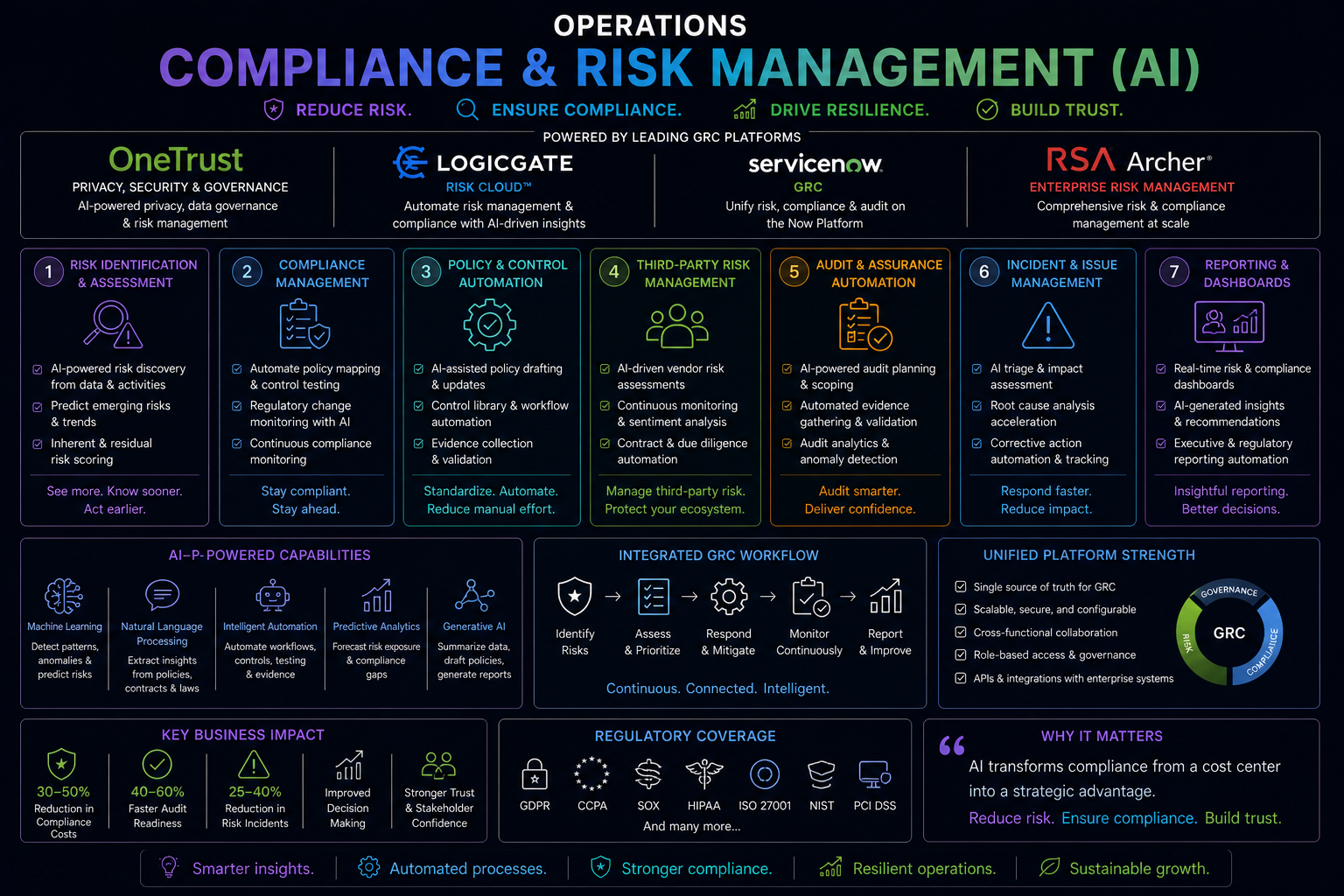
Understanding the GRC Platform Stack
Before diving into training, understand the distinct roles each platform plays in the GRC ecosystem.
OneTrust dominates the privacy, security, and third-party risk management space. The platform offers comprehensive solutions for privacy management (DSAR automation, consent management), ethics and compliance (policy management, incident reporting), and third-party risk (vendor due diligence, risk scoring). OneTrust provides free online training and certification courses tailored for both beginners and advanced professionals, covering AI governance, ethics, and data protection . In 2026, OneTrust has integrated AI capabilities for automated control testing and risk prediction.
LogicGate is a flexible, no-code GRC platform that allows organizations to configure workflows for their specific risk and compliance processes. Unlike more rigid platforms, LogicGate emphasizes agility—compliance teams can build custom applications for risk assessments, audit management, policy acceptance, and incident tracking without engineering support. The platform's AI capabilities include automated risk identification and control monitoring.
ServiceNow GRC is part of the broader ServiceNow ecosystem, integrating risk and compliance directly into IT service management workflows. Key modules include Policy and Compliance Management (centralized policy lifecycle), Risk Management (risk register, scoring, and mitigation tracking), Audit Management (evidence collection and audit trail), and Vendor Risk Management (third-party assessment automation). ServiceNow's AI capabilities include predictive risk scoring and automated evidence collection.
RSA Archer is the enterprise GRC standard for large financial institutions and regulated industries. The platform is known for its "Archer Control Panel" which catalogs applications, risks, controls, tests, and issues—enabling closed-loop remediation from identified risk to tested control to resolved finding . The On-Demand Authoring capability allows power users to create new applications without development resources. RSA Archer is widely used across banking, insurance, healthcare, and energy sectors for regulatory compliance, operational risk, and vendor management.
All four platforms are listed as key players in the Governance, Risk and Compliance (GRC) platforms market by industry analysts . For 2026, the trend across all platforms is AI-augmentation—but you cannot effectively use AI tools without understanding the GRC foundations first .
The 16-Week GRC Training Roadmap
Phase 1: Weeks 1-4 – GRC Foundations & Regulatory Frameworks
What to focus on
Before touching any tool, understand the foundational disciplines. GRC is not purely technical—it sits at the intersection of operations, legal, information security, and executive strategy . However, you cannot assess compliance risk without understanding how systems and networks work; GRC is "not technical" in the sense of coding daily, but it is "less technical" than engineering roles—you still need foundational knowledge of security principles .
Core GRC knowledge areas
The GRC knowledge roadmap includes six essential categories . Foundational Knowledge covers risk management principles, cybersecurity basics, and data privacy regulations (GDPR, HIPAA, PCI DSS). Policy and Frameworks requires learning ISO 27001, NIST CSF, COBIT, and developing skills in drafting policies like access control and incident response. Audit and Compliance includes understanding audit lifecycles, conducting risk assessments, and hands-on experience with gap analysis and audits. Data Security Practices covers encryption, MFA implementation, secure backup methods, and incident response processes. Soft Skills Development includes written communication for reporting findings and leadership skills to drive compliance strategies across teams .
The compliance professional's role
Compliance professionals ensure management and personnel comply with company policies and applicable laws and regulations. A strong compliance program is essential for identifying and mitigating fraud risk . Core responsibilities include planning, administering, and implementing procedures to manage non-compliance risk, verifying departmental compliance, addressing violations, and implementing corrective actions.
Essential regulations and frameworks
The most in-demand frameworks employers reference include ISO 27001 (information security management), NIST Cybersecurity Framework (risk management), SOC 2 (service organization controls), PCI DSS (payment card security), GDPR (European data privacy), and HIPAA (healthcare privacy). You need familiarity with each—what they cover, who they apply to, and how compliance is demonstrated .
Free resources for Phase 1
The ACFE (Association of Certified Fraud Examiners) offers career path resources describing compliance roles, responsibilities, and compensation benchmarks. CFE credential holders earn a 32% income premium over peers without the credential . NIST and ISO websites provide free access to framework documentation. Coursera and edX offer free audit options for GRC and compliance fundamentals courses.
Paid resources for Phase 1
CISSP, CISM, or CRISC certifications are highly valued for GRC roles . ISO 27001 Lead Implementer and Lead Auditor certifications validate framework expertise. CFE (Certified Fraud Examiner) credential provides anti-fraud specialization.
Practical application
Select one compliance framework (SOC 2 Type II is a great starting point). Download the trust services criteria. Map each control to a specific process in an organization you know. Identify which controls are satisfied by existing processes and which would require new implementation. This exercise builds the control mapping mindset that GRC platforms automate.
Phase 2: Weeks 5-8 – AI Governance & Responsible AI
What to focus on
As AI systems become embedded in operations, traditional GRC must expand to cover AI-specific risks. AI governance has emerged as a distinct discipline that goes well beyond the legal realm, requiring input from risk, security, privacy, product, and compliance disciplines . The field is growing rapidly, with professionals from operations, legal, security, and product backgrounds all moving into AI governance roles.
Core AI governance frameworks
The most referenced AI governance standards include ISO/IEC 42001:2023 (the international standard for AI management systems, providing a strong basis to build an AI Management System or AIMS), NIST AI Risk Management Framework (AI RMF functions: Govern, Map, Measure, Manage), and the EU AI Act (risk-based regulation classifying AI systems by risk level) .
Key concepts in AI risk management
A working portfolio of applied AI governance includes compliance risk analyses of AI systems, vendor due diligence assessments for AI tools, framework-mapped findings using NIST AI RMF and ISO/IEC 42001, and risk registers with conditional-approval decisions . Real-world AI risk examples include biometric voiceprint exposure (Illinois BIPA), workplace affect-inference prohibition (EU AI Act Article 5(1)(f)), and minor-employee governance gaps in AI training data.
The AI governance workflow
Applied AI governance follows a consistent structure across any organization: executive summary of the AI system and its risks, detailed findings with framework alignment, risk register documenting identified issues with severity, recommendations for mitigation, and sources documenting evidence . The output is designed for a mixed audience of legal, security, privacy, product, and business stakeholders.
Free resources for Phase 2
Securiti offers a free "AI Security & Governance Certification" covering security frameworks and governance structures for AI systems . The AIQI Consortium provides a free "ISO/IEC 42001 overview" course to master the international standard for AI management systems . Alison offers a free "AI Governance and Ethics" course exploring ethical considerations and governance principles in AI deployment . Microsoft Learn provides a free "Explore Responsible AI" course covering Microsoft's approach to building responsible AI solutions . All these certifications are completely free, can be completed at your own pace, and are essential for any GRC professional in 2026 .
Paid resources for Phase 2
Specialized AI governance training is available through providers like Luiza Jarovsky's AI Governance training programs (paid cohorts). The AI Governance Certificate through IAPP (International Association of Privacy Professionals) is an emerging credential. Formal ISO/IEC 42001 Lead Implementer training is available through certification bodies.
Practical application
Select an AI system you use or have access to (ChatGPT, Claude, Midjourney, or an internal tool). Conduct a simplified compliance risk analysis: identify three risks, map each to a framework (NIST AI RMF or ISO 42001), propose a mitigation, and document your findings as a one-page memo to a fictional CISO. This exercise mirrors the applied AI governance work professionals are doing today .
Phase 3: Weeks 9-12 – GRC Platform Proficiency (RSA Archer & ServiceNow GRC)
What to focus on
This phase builds hands-on skills with the platforms most commonly required in enterprise GRC job postings. According to the GRC roadmap, you need to master tools like RSA Archer, ServiceNow GRC, or AuditBoard for governance tracking . The key concept across all platforms is the closed-loop remediation flow: from identified risk to tested control to resolved finding .
RSA Archer capabilities
RSA Archer remains the standard for large financial institutions and regulated enterprises. The platform is built around the Archer Control Panel, which catalogs applications, risks, controls, tests, and issues, enabling complete traceability from risk identification through remediation . The On-Demand Authoring capability allows power users to create new applications without development resources—this is the skill that distinguishes Archer administrators from casual users. Key modules include Operational Risk Management, Business Continuity Management, Regulatory Compliance Management (with pre-built content packages for GDPR, SOX, HIPAA), and Third-Party Governance.
ServiceNow GRC capabilities
ServiceNow GRC integrates risk and compliance directly into the ServiceNow platform, leveraging the same workflow engine as IT service management. Key modules include Policy and Compliance Management (centralized policy creation, attestation, and exception handling), Risk Management (risk register with inherent/residual scoring), Audit Management (audit planning, evidence collection, and issue tracking), and Vendor Risk Management (third-party assessment workflows). ServiceNow's competitive advantage is its integration with CMDB and ITSM—control testing can reference actual configurations, not just documentation.
The closed-loop remediation workflow
Regardless of platform, the workflow follows a standard pattern. A control test fails, generating an issue. The issue is assigned to a control owner with remediation plan and due date. The remediation is implemented and evidence collected. A retest confirms the control now operates effectively. The issue is closed. All steps are tracked, timestamped, and auditable. This is what RSA Archer's Control Panel catalogs .
Platform-specific learning resources
RSA Archer training is available through RSA's official education services. ServiceNow GRC training is available through Now Learning (ServiceNow's training platform) with free digital learning options. The ServiceNow Community provides forums, documentation, and free learning paths. For LogicGate, their Academy offers free foundational training.
Practical application
Using demo environments or free tiers, map a complete closed-loop remediation workflow. Start with a hypothetical risk (e.g., "user access reviews not performed quarterly"). Design a control to mitigate the risk (e.g., "monthly user access review by manager"). Define how you would test the control (e.g., "sample 10 terminations, verify access removed within 24 hours"). Document the full workflow from risk to control to test to issue to remediation. This mental model applies to every GRC platform—the specific buttons change, but the logic is identical.
Phase 4: Weeks 13-16 – Automation, Integration, and Career Preparation
What to focus on
This phase integrates everything into a complete GRC capability. You will learn how AI is transforming GRC operations and how to position yourself for the roles of the future.
The automation imperative in GRC
In organizations that haven't automated evidence collection and testing, most of the GRC team's time is spent "chasing control operators for evidence of control operations" . This doesn't scale. The GRC Maturity Model provides practical steps for how companies can improve their GRC processes—moving from manual, reactive compliance to automated, continuous monitoring .
AI in GRC platforms
OneTrust has integrated AI capabilities for automated privacy impact assessments, DSAR response, and risk scoring. ServiceNow GRC uses AI for predictive risk scoring and automated evidence collection. RSA Archer incorporates AI for control testing automation and issue prediction. The common thread is moving from periodic, sample-based testing to continuous, population-wide monitoring.
Third-party risk management as a specialty
Third-party risk has emerged as a distinct GRC specialization. Third-Party Risk Analysts assess vendors, PSPs, and fintech partners, reviewing contracts, SLAs, and data-sharing risks, and running due diligence and security questionnaires . Salary ranges for this role are 4,000to
4,000to7,500 per month ($48,000-90,000 annually). The discipline is growing due to mandatory vendor risk management requirements in regulations like GDPR (data processor agreements) and NY DFS (vendor oversight).
Job titles and compensation
Based on the 2025 GRC salary guide , GRC Analysts earn 3,000−6,000permonth(
3,000−6,000permonth(36,000-72,000 annually) and identify security, fraud, and operational risks while maintaining compliance frameworks. Risk and Compliance Officers earn 5,000−9,000permonth(
5,000−9,000permonth(60,000-108,000 annually), own company compliance posture, interface with regulators, and approve risk policies. Third-Party Risk Analysts earn 4,000−7,500permonth(
4,000−7,500permonth(48,000-90,000 annually). GRC Managers earn 9,000−15,000+permonth(
9,000−15,000+permonth(108,000-180,000+ annually), leading company risk and compliance strategy and reporting to executives.
The CFE credential provides a significant boost: CFEs earn a 32% income premium over peers without the credential .
Required certifications
The most valuable certifications in GRC include ISO 27001 Lead Implementer/Auditor (framework validation), CISA (Certified Information Systems Auditor), CRISC (Certified in Risk and Information Systems Control), CISM (Certified Information Security Manager), PCI DSS Practitioner, and SOC 2 Practitioner . For AI governance specifically, the Securiti AI Security & Governance Certification and ISO/IEC 42001 overview are free and highly relevant .
Practical application
Build a complete GRC program documentation for a mock company. Include a risk register (10 risks with inherent/residual scoring), a control matrix mapping controls to risks, a compliance checklist for one framework (SOC 2 or ISO 27001), a vendor risk assessment template, and an AI governance policy covering acceptable use of AI tools. Present as a 15-page documentation package demonstrating end-to-end GRC capability. This is what hiring managers for GRC Analyst roles expect you to produce.
Your Portfolio Projects
Build these four artifacts during your training. They demonstrate exactly what hiring managers for GRC roles are looking for.
Project One: The Risk Register and Control Matrix – Create a risk register for a mock company (fintech or SaaS). Include 10 risks across compliance, operational, and security categories. Score each risk for inherent likelihood and impact. Assign controls to each risk. Document control owners and testing frequency. Calculate residual risk after controls. This mirrors the risk management work GRC Analysts perform daily.
Project Two: The Compliance Gap Analysis – Select a framework (SOC 2 or ISO 27001). Download the control criteria. For a mock or real organization, assess each control as "implemented," "partially implemented," or "not implemented." Identify the top 5 gaps with highest risk impact. Propose remediation plans with estimated effort and timeline. Present as a one-page executive summary to the CISO.
Project Three: The AI Governance Assessment – Select a public-facing AI system (ChatGPT, an internal tool, or a vendor product). Conduct a simplified compliance risk analysis using NIST AI RMF. Identify three risks, map to framework functions (Govern, Map, Measure, Manage), document your findings, and propose mitigations. This mirrors the applied AI governance work professionals are doing today . Include a conditional-approval decision with specific requirements.
Project Four: The Vendor Risk Assessment – Select a real SaaS vendor your organization uses (or a public vendor). Complete a security questionnaire (use SIG or CAIQ as template). Score the vendor across 7 risk dimensions. Document any gaps requiring remediation. Make a recommendation: approve, approve with conditions, or reject. Present as a one-page vendor risk memo to the procurement team. This mirrors the third-party risk management specialization .
Career Application
Job Titles to Target
GRC Analyst is the entry-level to mid-level role requiring one to three years of experience. You identify security, fraud, and operational risks, maintain compliance frameworks (ISO 27001, SOC 2, PCI DSS, NIST), support audits and regulatory reporting, and track internal controls and policies. The role is entry-level friendly for candidates with foundational knowledge of ISO, NIST, PCI, and SOC frameworks . The salary range is 36,000to
36,000to72,000 annually ($3,000-6,000 monthly).
Risk and Compliance Officer requires three to six years of experience. You own the company compliance posture, interface with regulators and banks, manage third-party risk, and approve risk policies and controls . The salary range is 60,000to
60,000to108,000 annually ($5,000-9,000 monthly).
Third-Party Risk Analyst requires two to four years of experience. You assess vendors, PSPs, and partners, review contracts, SLAs, and data-sharing risks, and run due diligence and security questionnaires . The salary range is 48,000to
48,000to90,000 annually ($4,000-7,500 monthly).
Information Security Compliance Analyst requires two to four years of experience. You maintain certifications (ISO, SOC, PCI), handle audit preparation and evidence, and monitor control gaps and remediation . The salary range is 54,000to
54,000to96,000 annually ($4,500-8,000 monthly).
GRC Manager requires six or more years of experience. You lead company risk and compliance strategy, report to executives and board, and oversee audits and regulatory alignment . The salary range is 108,000to
108,000to180,000+ annually ($9,000-15,000+ monthly).
AI Governance Specialist is an emerging role requiring three to six years of experience. You assess AI systems for compliance with emerging regulations, conduct vendor due diligence for AI tools, and develop AI acceptable use policies. The salary range is 80,000to
80,000to140,000 depending on organization.
Required Skills Based on Job Postings
Based on analysis of GRC roles, employer expectations, and the GRC roadmap , required competencies span technical, analytical, and soft skills.
Technical and platform skills require mastery of tools like RSA Archer, ServiceNow GRC, or AuditBoard for governance tracking . Cloud compliance basics in AWS and Azure environments are increasingly necessary . Foundational knowledge of risk management and cybersecurity principles is non-negotiable . Familiarity with data privacy regulations (GDPR, HIPAA, PCI DSS) is essential .
Framework proficiency requires deep understanding of ISO 27001, NIST CSF, and COBIT for policy alignment . You need skills in drafting and analyzing policies like access control and incident response. Audit lifecycle knowledge and hands-on experience with gap analysis and audits are required. Data security practices including encryption, MFA implementation, and incident response processes are essential .
Soft skills development is critical. Written communication for reporting findings and leadership skills to drive compliance strategies across teams are as important as technical capabilities . The ability to translate technical risk into business language for executives is what separates managers from analysts.
Domain knowledge by industry matters. In fintech, you need AML, KYC, and fraud transaction risk analysis . In healthcare, HIPAA compliance and patient privacy are paramount. In retail and payments, PCI DSS and fraud prevention dominate. In technology/SaaS, SOC 2, ISO 27001, and vendor risk are central.
Certifications That Matter
ISO 27001 Lead Implementer and Lead Auditor are the most frequently referenced certifications for GRC professionals . They validate framework expertise and audit capability.
CISA (Certified Information Systems Auditor) is essential for audit-focused GRC roles . CRISC (Certified in Risk and Information Systems Control) validates risk management specialization . CISM (Certified Information Security Manager) is valued for management-track roles . CISSP is the broadest security credential, respected across GRC functions.
PCI DSS Practitioner and SOC 2 Practitioner credentials validate specific framework expertise . The CFE (Certified Fraud Examiner) provides anti-fraud specialization with a 32% income premium .
For AI governance, the Securiti AI Security & Governance Certification is free and covers security frameworks and governance structures for AI systems . The AIQI ISO/IEC 42001 overview is free and provides the international standard foundation . The Microsoft Responsible AI course is free and covers Microsoft's approach to ethical AI . All are essential for 2026.
The GRC Job Search Strategy
Your portfolio matters more than your certifications. Create a public repository or document showcasing your four projects with framework mappings, risk registers, and assessment reports.
On your resume, replace generic bullet points with GRC-specific achievements. For example: "Implemented risk register for SaaS company, identified 45 risks across 8 categories, scored inherent and residual risk, and tracked remediation to closure for 92% of high-severity items." Or "Conducted SOC 2 Type II gap analysis, identified 12 control deficiencies, led remediation across engineering and operations teams, and achieved certification within 6 months."
In interviews, articulate specific GRC workflows you have built. SHADY ELBODY's guide notes that companies no longer ask "Are we secure?" They ask "Can you prove it?" Your ability to demonstrate documented, auditable processes is what separates you from candidates who only have theoretical knowledge.
Interview questions to prepare for include: Walk me through your process for conducting a vendor risk assessment. How would you handle a control test failure where the control owner disagrees with the finding? Describe your experience with a specific compliance framework (SOC 2, ISO 27001, or PCI DSS). How do you stay current with changing regulations? Tell me about a time you communicated a complex risk to non-technical executives. How have you used AI or automation in GRC?
The 30-60-90 day framework for GRC roles includes auditing existing risk register, control documentation, and compliance evidence in the first month without changing anything. The second month focuses on quick wins like closing the top 5 overdue remediation items, automating one evidence collection process, and building one missing control. The third month is about scaling: establishing continuous monitoring, implementing regular risk reporting to leadership, and building the compliance roadmap for the next certification.
Why GRC Careers Are Exploding
Several trends are driving GRC job growth : mandatory breach reporting laws require documented compliance programs, fintech and digital payments regulation increases oversight requirements, insurance cyber scoring forces organizations to prove security controls, vendor risk mandates require formal third-party management, and fraud and AML regulations expand compliance teams across financial services.
Companies no longer have the option to rely on informal processes. They must prove compliance. That proof requires skilled GRC professionals who understand frameworks, platforms, and audit requirements.
Academic and Alternative Pathways
The Association of Certified Fraud Examiners (ACFE) offers career path resources describing compliance roles, responsibilities, and compensation. The CFE credential is highly valued for compliance professionals, with a 32% income premium over non-certified peers . For those without formal experience, consider the Security+ and Network+ certifications as foundational knowledge before pursuing GRC-specific credentials . The GRC Maturity Model provides a framework for understanding how companies progress from manual to automated GRC .
Immediate Next Steps for the Next 7 Days
Day One: Enroll in the free Securiti AI Security & Governance Certification . Complete the first module on AI security frameworks and governance structures (1-2 hours).
Day Two: Enroll in the free AIQI ISO/IEC 42001 overview course . Understand the international standard for AI management systems (2-3 hours).
Day Three: Download the NIST AI RMF framework document. Read the four core functions (Govern, Map, Measure, Manage). This is the most referenced AI governance framework in practice .
Day Four: Access free training for ServiceNow GRC through Now Learning, or request a demo of RSA Archer, OneTrust, or LogicGate. Understand the platform landscape before committing to a specialization.
Day Five: Define your portfolio project focus. Choose between the risk register and control matrix, compliance gap analysis, AI governance assessment, or vendor risk assessment. Commit to completing one project within 30 days.
Day Six: Update your LinkedIn headline. Change it from "Operations Professional" to "GRC Analyst | AI Governance + Compliance Frameworks | ISO 27001 + SOC 2." Add your in-progress certifications to your profile.
Day Seven: Start your first portfolio project. Document your process publicly on LinkedIn or GitHub to build visibility. The professionals who can bridge operational and compliance worlds are exactly who organizations are hiring .
The Long Game
Governance, Risk and Compliance (GRC) has emerged as one of the fastest-growing career paths in cybersecurity and fintech . The shift from manual, spreadsheet-based compliance to AI-driven continuous monitoring is as fundamental as the shift from paper to digital. Every regulated organization needs GRC professionals who understand frameworks, platforms, and audit requirements.
The most successful GRC professionals in 2026 are hybrid practitioners. They combine framework expertise (ISO 27001, NIST, SOC 2) with platform proficiency (RSA Archer, ServiceNow GRC, OneTrust). They understand AI governance as an extension of traditional GRC, not a replacement . They know how to document risks, test controls, and close issues in a closed-loop system .
Your operations background is your foundation. You already understand processes, controls, and documentation. You know what "evidence" means in an audit context. This roadmap builds the technical tools—GRC platforms, AI governance frameworks, compliance assessment methodologies—that transform an operations professional into a GRC leader.
The professionals who can bridge the operational and compliance worlds, who can translate technical risk into business language for executives, will be the most valuable in the job market. Companies no longer ask "Are we secure?" They ask "Can you prove it?" That proof is your work product.
Start your week one actions today. Complete that first AI governance certification. Build that first risk register. Conduct that first vendor assessment. The GRC job market has never been stronger, and the professionals who can architect compliance for the AI era will shape the future of risk management.
Compliance Knowledge/ compliance experience, Law degree a plus




 Group / 1: 1 Sessions