Training Roadmap: HR Tech & People Analytics (Workday, Rippling, Visier, Tableau, Python/R)
This roadmap is designed for HR operations and people analytics professionals who want to master the intersection of HR technology, workforce data, and strategic decision-making. The HR landscape has fundamentally shifted—organizations are moving from administrative, spreadsheet-based reporting to AI-powered people analytics that drives talent strategy, retention, and business outcomes .
Understanding HR Tech & People Analytics
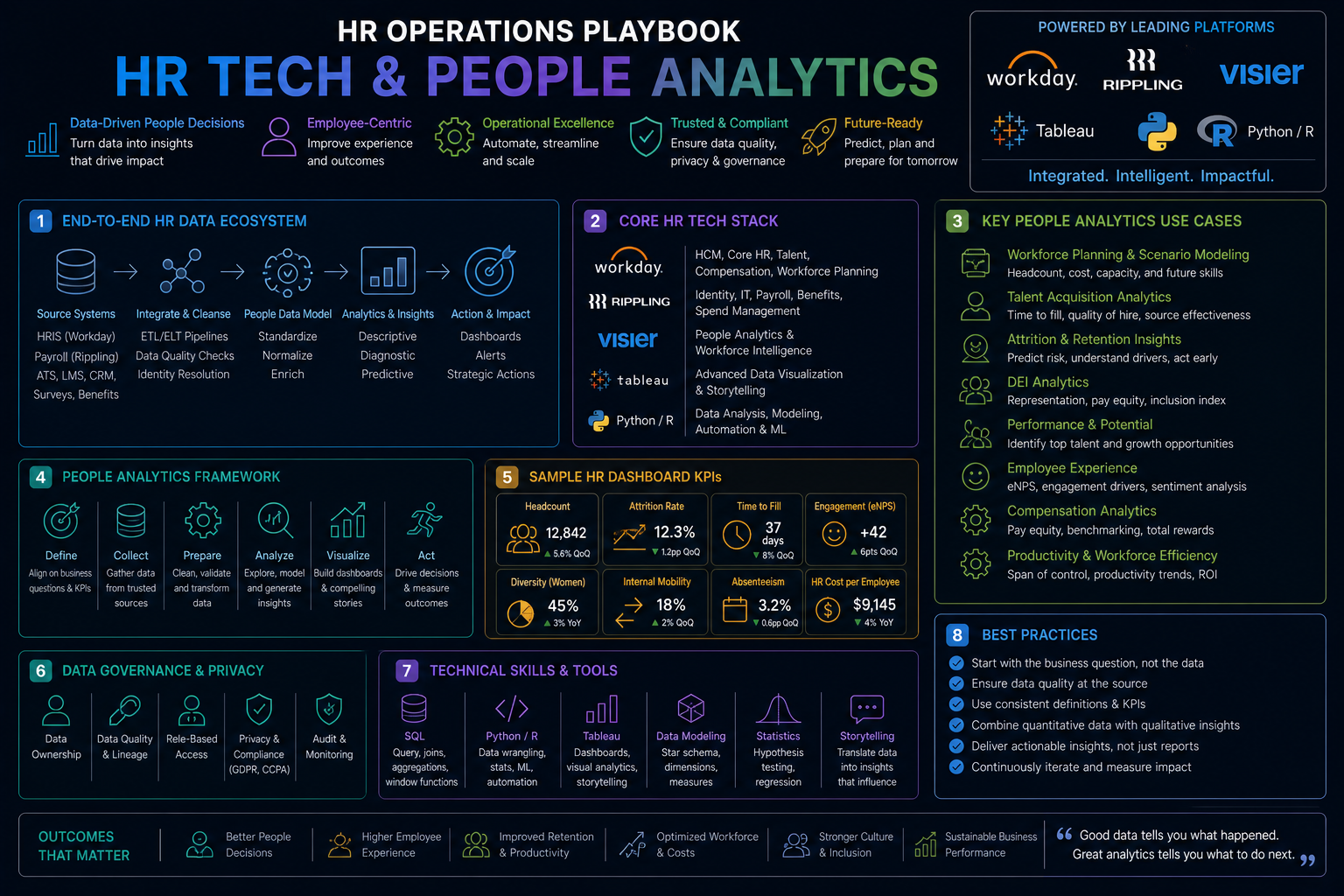
HR technology and people analytics address several interconnected functions that together enable data-driven workforce management:
Core HRIS (Workday, Rippling): These platforms serve as the system of record for all employee data—hiring, compensation, benefits, time tracking, and organizational structure. Workday dominates the enterprise space with deep HCM functionality, while Rippling offers a modern, unified approach that connects HR, IT, and finance in one platform.
People Analytics Platforms (Visier): Specialized analytics tools that aggregate data from multiple HR systems to provide workforce insights, predictive modeling, and benchmarking. Visier is the market leader for purpose-built people analytics, offering pre-built metrics and AI-driven insights without requiring data science expertise .
Data Visualization (Tableau): Business intelligence tools that transform raw HR data into interactive dashboards and visual stories. Tableau enables HR teams to explore workforce data, identify patterns, and communicate insights to stakeholders effectively.
Statistical Analysis (Python/R): Programming languages for advanced analytics including predictive modeling, text analysis, and complex statistical tests. Python has become the preferred language for people analytics due to its extensive libraries (pandas, scikit-learn, matplotlib) and integration capabilities .
A critical 2026 distinction: People analytics is no longer just about descriptive reporting ("what happened"). Leading organizations are moving toward predictive analytics ("what will happen") and prescriptive analytics ("what should we do about it") using machine learning models and AI-powered recommendations .
The 14-Week HR Tech & People Analytics Training Roadmap
Phase 1: Weeks 1-4 – Core HRIS Foundations
What to focus on
Start with the foundational HR systems that serve as the source of truth for all people data. Workday and Rippling represent two different approaches to HR technology. Workday is the enterprise standard with deep HCM functionality, while Rippling offers a modern, unified platform connecting HR, IT, and finance.
Workday dominates large enterprises with comprehensive HCM, payroll, recruiting, and talent management. Key capabilities include organizational structure management, compensation and benefits administration, workforce reporting and dashboards, and security role configuration. Workday certification is highly valued in enterprise roles.
Rippling offers a unified platform that connects HR, IT, and finance in one system. Key capabilities include automated onboarding workflows, global payroll across 50+ countries, device management and app provisioning, and real-time reporting. Rippling is best for mid-market and growth-stage companies seeking a modern, integrated approach.
Key HRIS concepts to master include organizational hierarchy design, position management vs. job management, employee lifecycle data flow, security role administration, and data integration patterns.
Practical application
Set up a free trial or demo access for either Workday (available through Workday Community) or Rippling (request demo). Create a sample organizational structure with 3-5 departments and job profiles. Practice entering employee records and running basic headcount reports. Generate a simple turnover report for a fictional quarter.
Free resources for Phase 1
Workday Community provides free access to documentation, training materials, and a sandbox environment for learning (requires partner or customer affiliation; academic access available through university partnerships).
Rippling offers demo requests and extensive documentation on their platform capabilities. Their blog provides practical guides on HR automation and global workforce management.
YouTube hosts numerous free tutorials on Workday HCM basics, including navigation, reporting, and security role configuration.
Paid resources for Phase 1
Workday Pro Certification is the industry standard credential for Workday practitioners. Training and exam fees typically range from 2,000−
2,000−5,000 depending on module and delivery method. Employer sponsorship is common.
Rippling Implementation Certification is available through Rippling's partner program for consultants and administrators (pricing varies by agreement).
Phase 2: Weeks 5-8 – People Analytics & Workforce Intelligence
What to focus on
This phase transforms HR data into actionable workforce intelligence. People analytics is the systematic application of data, statistical methods, and technology to understand workforce patterns and improve talent decisions . The most successful people analytics teams progress through four maturity levels:
Level 1: Reactive (Operational Reporting)
Basic headcount reports, turnover summaries, and compliance reporting. Focus is on "what happened?" Most organizations operate at this level.
Level 2: Proactive (Advanced Reporting)
Automated dashboards, self-service analytics, and trend analysis. Focus is on "what is happening?" and begins to identify patterns.
Level 3: Strategic (Strategic Analytics)
Predictive models for attrition risk, quality of hire, and workforce planning. Focus is on "what will happen?" and "what should we do?"
Level 4: Predictive (Prescriptive Analytics)
AI-powered recommendations, scenario modeling, and real-time workforce intelligence. Focus is on optimizing outcomes with machine learning.
Key metrics frameworks include ISO 30414 Human Capital Reporting standard, SHRM metrics, and the CIPD People Profession standards. Core metrics span workforce demographics, talent acquisition, engagement, performance, learning, compensation, and turnover .
Practical application
Using Visier's free trial (or Tableau Public with sample HR data), build a workforce dashboard tracking headcount by department, voluntary turnover trend over 12 months, and average time-to-hire by role. Practice segmenting data by location and tenure. Run a simple attrition risk analysis identifying the top three factors correlated with turnover.
Free resources for Phase 2
Visier offers free trials and extensive learning resources through their Visier University platform, including self-paced courses on people analytics fundamentals.
Hyring's People Analytics Maturity Framework provides a free, comprehensive toolkit for assessing organizational maturity and building analytics roadmaps, including assessment templates and best practice guides .
HRD Connect features expert interviews on people analytics roadmap creation, including practical advice from Ankit Saxena (Global Head of People Insights at PPG) on short-term wins and long-term strategy .
HR Grapevine offers detailed guides on conducting initial audits, prioritizing projects, and executing people analytics transformations based on Deloitte research and expert practitioner insights .
Paid resources for Phase 2
Visier requires paid subscription for production use (typically 20,000−
20,000−100,000+ annually depending on employee count, with self-service options starting lower).
Wharton People Analytics Certification is a paid executive education program (1,500−
1,500−3,000) covering advanced people analytics methods and applications.
UCL People Analytics Program offers paid certification (pricing varies) for HR professionals seeking formal training in workforce analytics.
Phase 3: Weeks 9-11 – Data Visualization & Advanced Analytics
What to focus on
This phase builds technical skills for transforming data into insights that drive action. Tableau enables interactive visualization and dashboard creation, while Python and R enable advanced statistical modeling and machine learning.
Tableau capabilities to master include connecting to HR data sources (Excel, databases, cloud platforms), creating interactive dashboards with filters and parameters, calculating metrics using table calculations and LOD expressions, and designing executive-friendly visualizations that tell a clear story.
Python for People Analytics focuses on data manipulation with pandas, exploratory analysis, and visualization with matplotlib/seaborn. Essential skills include loading and cleaning HR data, calculating descriptive statistics (means, medians, distributions), creating visualizations (bar charts, histograms, scatter plots), and performing correlation analysis.
R for People Analytics offers similar capabilities with dplyr and ggplot2. R has historically been the academic standard for statistical analysis, though Python has gained significant ground in industry .
Advanced methods to master include logistic regression for attrition risk scoring, survival analysis for time-to-event modeling (e.g., time-to-promotion), natural language processing for survey text analysis, and clustering for employee segmentation .
Practical application
Download a public HR dataset (e.g., IBM HR Analytics Attrition dataset from Kaggle). Using Tableau Public (free), build a turnover dashboard with three visualizations: turnover rate by department, by tenure band, and by performance rating. Using Python (Google Colab is free), load the same dataset and calculate attrition correlations by age, income, and job satisfaction.
Free resources for Phase 3
Tableau Public is completely free and includes access to Tableau Desktop for public data visualization. Tableau's free training videos and knowledge base provide comprehensive learning paths.
Google Colab offers free cloud-based Python notebooks with access to GPUs—no installation required. Pre-installed libraries include pandas, numpy, matplotlib, and scikit-learn.
Kaggle provides free public datasets (including HR analytics data), free Python notebooks, and free micro-courses on data science fundamentals.
DataCamp offers free introductory courses on Python, R, and SQL, with advanced content requiring paid subscription.
Python for Everybody (PY4E) is a completely free online course from the University of Michigan covering Python fundamentals with practical examples.
Paid resources for Phase 3
Tableau Desktop Professional requires paid license (70/monthor
70/monthor840/year) for commercial use, though Tableau Public is sufficient for portfolio development.
DataCamp Premium provides structured learning paths for data science ($25-50/month depending on billing cycle).
Coursera's Data Science Specialization from Johns Hopkins offers paid certification ($49-79/month) with comprehensive coverage of R and statistical analysis.
Phase 4: Weeks 12-14 – Strategic Roadmaps & Business Impact
What to focus on
This final phase transforms technical skills into strategic capability. The most valuable people analytics professionals don't just build dashboards—they partner with business leaders, demonstrate ROI, and embed analytics into decision-making processes .
Key strategic capabilities include developing a people analytics roadmap aligned with business priorities, prioritizing projects based on business impact and feasibility, calculating ROI for analytics initiatives through retention savings and productivity gains, and securing executive sponsorship and ongoing investment .
The 90-day pilot framework from industry practitioners emphasizes: connecting with stakeholders to understand pain points, assessing current maturity and capability gaps, delivering quick wins (e.g., attrition dashboard) to build credibility, and creating a multi-year roadmap with clear milestones and investment requirements .
Executive communication skills are critical. Transform analytical findings into business-relevant stories using the "so what, now what" framework. Tailor presentations for different audiences: executives need strategic implications, managers need actionable recommendations, and analysts need methodological transparency .
Ethical considerations include ensuring privacy through data anonymization, testing models for disparate impact across protected groups, and establishing review processes for analytics projects involving sensitive data .
Practical application
Create a people analytics roadmap for a fictional mid-sized company (500 employees). Include a current state assessment (describe their likely maturity level), three strategic priorities with business cases, a phased implementation timeline (6-12-18 months), and a budget estimate for tools and headcount. Calculate projected ROI for one priority (e.g., reducing voluntary turnover by 5%).
Free resources for Phase 4
Hyring's People Analytics Maturity Framework includes free assessment templates, roadmap examples, and business case calculators for demonstrating analytics ROI .
HR Grapevine provides detailed guides on balancing short-term projects with long-term transformation, including expert perspectives on stakeholder management and impact measurement .
HRD Connect features practitioner interviews on building stakeholder relationships, securing budget, and measuring people analytics success based on real-world experience at MassMutual, HSBC, and PPG .
Paid resources for Phase 4
Lattice offers performance management and people analytics with AI-powered insights (pricing starts at $10 per user per month, with advanced analytics as add-ons) .
Eightfold.ai provides enterprise talent intelligence platform for skills-based workforce planning (pricing starts around 650/monthforbasicfunctionality,withenterpriseimplementationsfrom
650/monthforbasicfunctionality,withenterpriseimplementationsfrom50,000-$500,000+ annually) .
Your Portfolio Projects
Build these artifacts during your training to demonstrate your HR tech and people analytics capabilities.
Project One: The Workforce Dashboard
Using Tableau Public and a public HR dataset (e.g., IBM HR Analytics from Kaggle), build an interactive dashboard tracking five metrics: headcount by department, voluntary turnover trend, average tenure, time-to-hire, and attrition risk score by role. Add filters for location, business unit, and date range. Publish the dashboard to Tableau Public and share the link.
Project Two: The Attrition Prediction Model
Using Python in Google Colab, build a logistic regression model predicting employee attrition. Load the IBM HR dataset, clean and prepare features, split into training and test sets, train the model, and evaluate accuracy (AUC-ROC). Include feature importance analysis identifying the top three predictors of turnover. Document your code and findings in a public GitHub repository.
Project Three: The People Analytics Roadmap
Create a strategic roadmap document for a real or fictional organization. Include: current state maturity assessment (using the framework from Hyring), three prioritized initiatives with business cases (e.g., attrition prediction, quality of hire analysis, workforce planning), 12-month implementation timeline with resource requirements, and ROI calculation for one initiative. Format as a professional slide deck.
Project Four: The Executive Insight Brief
Select a real workforce challenge (e.g., remote work's impact on retention). Using any analytics tool, analyze a relevant dataset and create a one-page executive brief with: one key insight, supporting data visualization, business implication (the "so what"), and specific recommendation (the "now what"). Design for a C-suite audience—clear, concise, and action-oriented.
Career Application & Next Steps
Job Titles to Target
The HR tech and people analytics career ladder has distinct roles with clear compensation bands:
HR Operations Analyst (Entry to Mid Level)
1-4 years of experience. Support HR systems, maintain data integrity, process onboarding/offboarding transactions, resolve system tickets, and generate standard reports . Skills needed: HRIS platform knowledge (Workday, Oracle, PeopleSoft), Microsoft Excel proficiency, process optimization, and compliance awareness. Typical range: 55,000−
55,000−75,000 .
People Data Analyst (Mid Level)
2-5 years of experience. Build dashboards and reports, analyze workforce trends, support HR business partners with data needs, and maintain data quality. Skills needed: Tableau or Power BI, SQL, statistical analysis, HR domain knowledge. Typical range: 70,000−
70,000−100,000.
People Analytics Specialist (Mid to Senior Level)
3-7 years of experience. Develop predictive models for attrition and performance, conduct survey text analysis, present insights to stakeholders, and contribute to analytics roadmap. Skills needed: Python or R, machine learning, data storytelling, business acumen. Typical range: 90,000−
90,000−130,000.
HRIS Manager (Senior Level)
5-9 years of experience. Own HR technology stack, manage system implementations and upgrades, lead vendor relationships, ensure data governance and security, and manage team of analysts. Skills needed: Workday or Rippling expertise, project management, compliance knowledge, team leadership. Typical range: 100,000−
100,000−150,000.
People Analytics Manager (Senior Level)
6-10 years of experience. Lead analytics team, set strategic roadmap, partner with CHRO and business leaders, measure ROI, and drive data-driven culture. Skills needed: Strategic thinking, stakeholder management, advanced analytics, change leadership. Typical range: 120,000−
120,000−170,000.
Director of People Analytics (Leadership Level)
10+ years of experience. Function ownership, board-level reporting, budget management, organizational design of analytics function, and C-suite advisory. Skills needed: Executive presence, strategic vision, cross-functional leadership, advanced analytics fluency. Typical range: 150,000−
150,000−220,000.
VP of HR Technology & People Analytics (Executive Level)
12+ years of experience. Enterprise-wide HR technology and analytics strategy, digital transformation leadership, AI governance, and workforce intelligence for strategic planning. Skills needed: Technology strategy, organizational transformation, AI ethics, C-suite influence. Typical range: 180,000−
180,000−280,000+.
Companies Hiring for These Roles
Based on active job postings and industry trends, employers seeking HR tech and people analytics professionals include enterprise technology companies (Microsoft, Google, Salesforce), financial services firms (banks, insurance companies requiring compliance expertise), healthcare organizations (large workforce with complex scheduling), retail and e-commerce brands (high-volume hourly workforce), and professional services firms (consulting, legal, accounting) .
Boston University, for example, recently hired an HR Operations Analyst with SAP HCM experience for their HR Systems team at a salary grade of 55,300−
55,300−69,700 . Société Générale actively recruits HR Operations Analysts with Workday, Oracle, or PeopleSoft experience for their Bangalore operations, emphasizing data integrity and process optimization .
Required Skills Based on Job Postings and Industry Frameworks
Based on active job postings from Société Générale, Boston University, and industry skill frameworks from Morgan McKinley and Hyring, employers expect :
Platform proficiency: Workday, Oracle HCM, PeopleSoft, SAP SuccessFactors, or Rippling for HRIS roles; Visier, Tableau, Power BI for analytics roles
Data & analytics: Advanced Excel (pivot tables, VLOOKUP), SQL for data extraction, statistical analysis, predictive modeling, data visualization, and dashboard creation
HR domain knowledge: Employee lifecycle (onboarding to offboarding), compensation and benefits, performance management, compliance (GDPR, local labor laws), and HR metrics frameworks (ISO 30414, SHRM)
Technical skills (analytics roles): Python or R (pandas, scikit-learn, matplotlib), logistic regression, clustering, natural language processing for surveys, and survival analysis
Soft skills: Stakeholder management, data storytelling, business acumen, project management, attention to detail, process improvement, and change management
Strategic capabilities: Roadmap development, ROI calculation, executive communication, ethics and bias awareness, and cross-functional collaboration
Certifications That Matter
Workday Pro Certification
Industry-standard credential for Workday practitioners across HCM, Reporting, and Analytics modules. Training and exam fees 2,000−
2,000−5,000 depending on module. Highly valued for enterprise HRIS roles.
Rippling Implementation Certification
Available through Rippling's partner program for administrators and consultants (pricing varies by agreement). Valuable for mid-market and growth-stage company roles.
Visier Certified Analyst
Validates expertise in Visier people analytics platform—dashboard creation, metric configuration, and insight generation. Pricing not publicly listed (typically included in enterprise subscription).
Tableau Desktop Specialist
Entry-level Tableau certification ($100 exam fee) covering fundamentals of data connection, visualization, and dashboard creation. Useful for demonstrating visualization skills.
Certified People Analytics Professional (CPAP)
Offered by the People Analytics Institute (pricing varies). Covers analytics methods, HR metrics, data storytelling, and ethical considerations.
SHRM-CP or SHRM-SCP
HR certification from Society for Human Resource Management (300−
300−500 exam fee). Provides foundational HR knowledge essential for people analytics roles.
Salary Expectations
Based on industry data from job postings and salary guides:
- Entry (0-2 years): HR Operations Assistant / Analyst — 45,000−
- 45,000−65,000
- Mid (2-4 years): HR Operations Analyst / HRIS Specialist — 55,000−
- 55,000−85,000
- Senior (4-7 years): People Data Analyst / Senior HRIS Analyst — 75,000−
- 75,000−110,000
- Leadership (7-12 years): People Analytics Manager / HRIS Manager — 100,000−
- 100,000−160,000
- Executive (12+ years): Director / VP of People Analytics — 150,000−
- 150,000−250,000+
Geographic premiums: Major metro areas (San Francisco, New York, Boston, Seattle) add 20-40% to base ranges. Remote roles typically align with national median rather than local premiums.
Industry variations: Technology and financial services pay 25-50% above education, healthcare, and nonprofit sectors. Enterprise SaaS and consulting firms consistently at higher end of ranges.
Immediate Next Steps for the Next 7 Days
Day One: Read the Hyring People Analytics Maturity Framework to understand the four maturity levels and assess where your target organizations likely sit. Download the free assessment templates .
Day Two: Create a free Tableau Public account and download a public HR dataset from Kaggle (IBM HR Analytics dataset is excellent for beginners). Build a simple bar chart of headcount by department—your first visualization .
Day Three: Sign up for Google Colab (free) and complete the first module of Python for Everybody (PY4E). Write your first Python code—calculate the mean age from a simple list.
Day Four: Read the HRD Connect interview with Ankit Saxena on creating people analytics roadmaps. Understand the three essential assessments: connect with people, assess maturity, and evaluate capabilities .
Day Five: Research Workday Community access options. If you have academic or partner affiliation, request access to the sandbox environment. If not, explore Rippling's demo options as an alternative.
Day Six: Update your LinkedIn headline: "Aspiring HR Tech & People Analytics Professional | Workday + Tableau + Python." Follow people analytics leaders and join the People Analytics Community group.
Day Seven: Define your portfolio project focus. Choose one: a workforce dashboard (Tableau), an attrition prediction model (Python), a strategic roadmap document, or an executive insight brief. Commit to completing it within 30 days and sharing it publicly on GitHub or Tableau Public.
The Long Game
People analytics is rapidly transforming from a nice-to-have function to a strategic imperative. Gartner research shows that while 69% of organizations are building people analytics teams, only 9% believe they understand which talent dimensions actually drive performance—the gap represents enormous opportunity for skilled practitioners .
The most successful people analytics professionals think in systems, not reports. An attrition analysis isn't a one-time PowerPoint slide. It's a recurring dashboard, a predictive model that improves with each data refresh, a conversation with managers about retention strategies, and a business case for investment in engagement programs. They anchor on metrics their CHRO and CFO already care about: retention, quality of hire, workforce cost, and productivity. If an analysis can't connect to business outcomes, they cut it .
Your portfolio matters more than your resume. Build something real—a dashboard, a prediction model, a roadmap, an executive brief. Document your process and findings. Share it publicly on GitHub, Tableau Public, or LinkedIn. The people analytics community values demonstrated capability over credentials.
The distinction between administrative reporting and strategic workforce intelligence is the most important trend in HR for 2025-2026 . The professionals who understand how to close this gap—combining HRIS proficiency with analytics skills and business acumen—will be the most valuable in the market.
Start your week one actions today. Complete that first Python exercise. Build that first Tableau visualization. Begin your journey into a field where you directly determine whether organizations attract, retain, and develop talent effectively—and where the best practitioners earn $150,000+ doing work that actually matters.
Experience / Knowldge of HR operations




 Group / 1: 1 Sessions