AI-Powered Modern Sales Mastery Roadmap
This roadmap is designed for sales professionals who want to master the advanced disciplines of modern B2B selling. The sales landscape has fundamentally transformed—what once relied on relationship-based gut instinct and price-driven negotiation now demands value-based frameworks, technical fluency, multi-stakeholder navigation, and AI-augmented workflows. According to industry research, effective sales training yields a staggering 353% ROI, leading to 19% more deals and 10% shorter sales cycles .
The Core Philosophy: Selling Value, Not Price
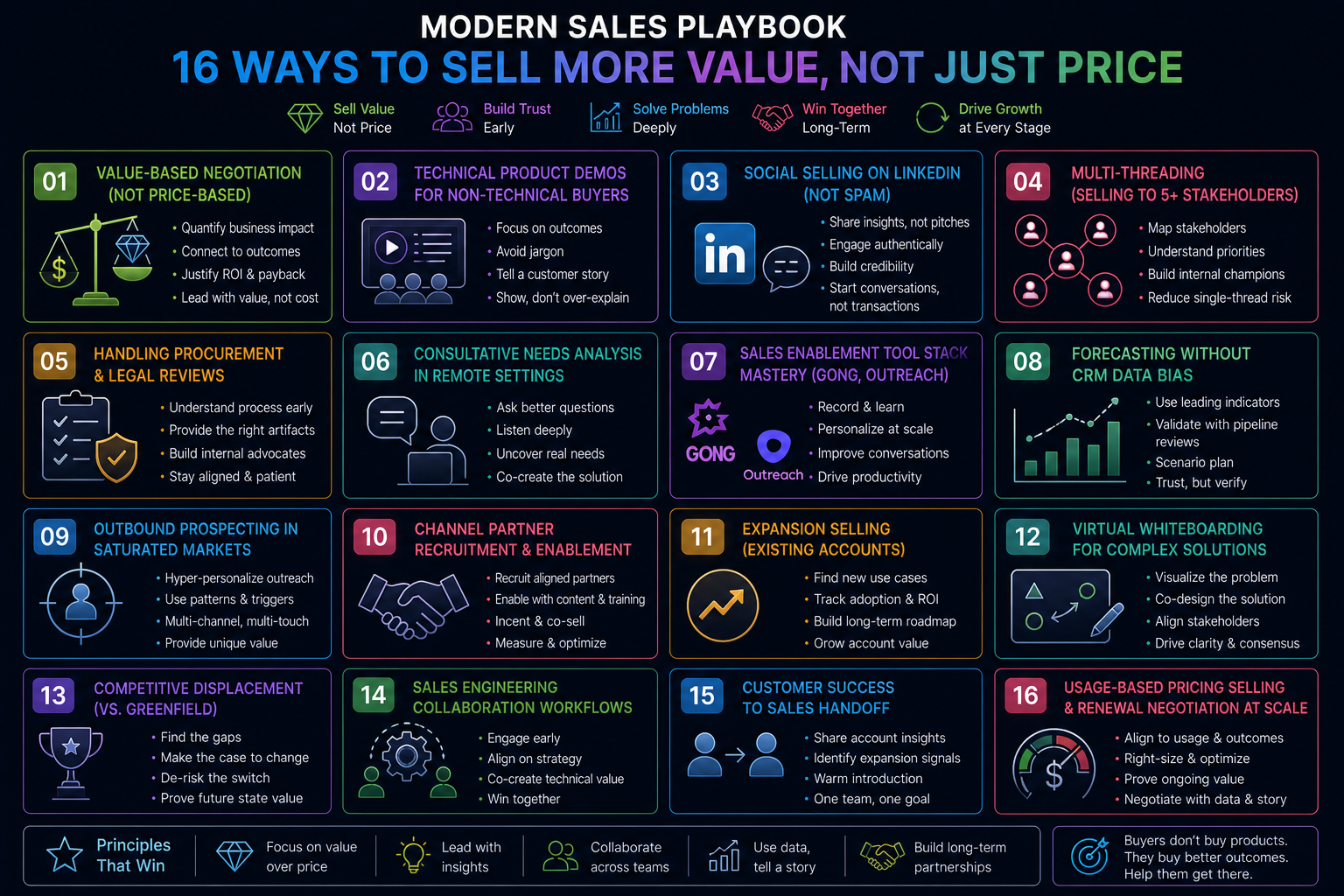
The most successful B2B sellers in 2026 are not order-takers or discounters—they are value architects. The shift from transactional to consultative selling requires deep understanding of customer business problems, the ability to articulate ROI in customer terms, and the discipline to hold value-based pricing even when procurement pushes back . The seventeen disciplines in this roadmap do not exist in isolation—they form an integrated system for winning complex, multi-threaded deals in saturated markets.
Phase 1: Weeks 1-4 – Value Negotiation & Technical Demonstration
Value-Based Negotiation (Not Price-Based)
Traditional negotiation focuses on price concessions. Value-based negotiation focuses on expanding the pie before dividing it.
What to focus on
Harvard Business School's Negotiation Mastery course, led by Professor Michael Wheeler, provides the foundational framework for unlocking value in real-world negotiations . The course covers the three key phases of negotiation: Opening, Critical Moments, and Closing. Over 8 weeks, participants master fundamental negotiation principles, learn valuable self-assessment tools, and complete real-time negotiations with global peers .
The key shift is moving from positional bargaining ("we need X price") to interest-based negotiation ("what does each party actually need to succeed?"). Value creation means identifying trade-offs where something of low cost to you has high value to the customer. Preparation tools like the Negotiation 360 app help users track negotiation performance, document what went well, and build personal best practices libraries .
Free resources
The Negotiate 1-2-3 web project from Harvard Business School provides free, interactive online resources covering openings, critical moments, and closing in negotiation through text, videos, quizzes, and interactive tools . The Negotiation 360 app (free for Apple and Android) generates personalized profiles of users' relational and problem-solving skills, highlighting strengths and improvement areas .
Paid resources
Harvard Business School Online's Negotiation Mastery is an 8-week, 40-hour interactive course taken by leaders from over 193 countries. The program includes 4 real-time negotiations with global cohort members .
Practical application
Before your next negotiation, complete a preparation worksheet documenting your BATNA (Best Alternative to a Negotiated Agreement), reservation price, and ZOPA (Zone of Possible Agreement). Identify three non-price value levers you can trade (payment terms, implementation timeline, training inclusion, support levels). Practice the "opening" phase using the Negotiate 1-2-3 framework.
Technical Product Demos for Non-Technical Buyers
The technical demo is often where deals succeed or fail. When presenting to non-technical buyers, the goal is not feature overload but business value translation.
What to focus on
Successful technical demos for non-technical buyers follow a narrative arc: start with the business problem (not the product), demonstrate the solution in context using customer language, and connect every feature back to a business outcome . Immersive 3D experiences and interactive demonstrations have been shown to increase interaction rates and make complex functions emotionally understandable .
A key technique is the "show, don't tell" approach. Instead of describing features, show them solving a real customer problem. Use the customer's own data when possible. Build a story around a day-in-the-life of the user before and after your solution.
Practical application
Shadow a technical sales engineer on a demo call. Identify where the conversation shifts from business problem to feature explanation. Practice re-framing three technical features as business outcomes. Record yourself delivering a 10-minute demo and review it for non-technical language.
Sales Engineering Collaboration Workflows
The best sales engineering relationships are partnerships, not request-handling.
What to focus on
Gong's AI Trainer platform demonstrates how modern sales teams use technology to align sales and technical resources. Reps can practice messaging and pitches through simulated conversations with customer personas generated from real interactions, allowing technical team members to prepare for specific customer scenarios without burning prospect time .
Key collaboration practices include joint discovery calls where both sales and technical reps participate, pre-call strategy sessions aligning on roles and messaging, and post-mortem debriefs documenting what worked technically and commercially.
Practical application
Create a "deal alignment template" for your next complex opportunity. Document: commercial value props (owned by sales), technical validation steps (owned by SE), proof points needed, and shared success metrics. Review the template with your SE before customer meetings.
Phase 2: Weeks 5-8 – Social Selling & Multi-Threading
Social Selling on LinkedIn (Not Spam)
Modern social selling is not about pitching—it's about building credibility and trust before the buyer ever meets you. According to industry research, 75% of B2B buyers are millennials, and 70% complete their buyer journey before ever talking to sales .
What to focus on
The HiFuture Social Selling Excellence course, built on 13 years of B2B sales experience and 7 years focused on social selling, emphasizes that "there is no sales without marketing anymore" . Buyers seek credibility and trust, not pitches, and LinkedIn has become essential to influencing the entire buyer journey .
Effective social selling includes optimizing your profile for buyer search, sharing valuable content that demonstrates expertise, engaging in relevant group discussions, and personalizing connection requests. The shift is from broadcasting to building—every piece of content should serve the buyer's journey.
Free resources
The first video module of the Social Selling Excellence course is available for free, providing an introduction to LinkedIn social selling frameworks .
Paid resources
The full Social Selling Excellence course is a 6-hour self-directed video course with video instructions, templates, AI prompts, and personal branding exercises available in English and Polish .
Practical application
Audit your LinkedIn profile. Does it speak to your ideal buyer's problems or just list your experience? Write three posts over two weeks that share specific insights from deals you've won or lost—not promotional content, but value-add observations. Track engagement and inbound connection quality.
Multi-Threading (Selling to 5+ Stakeholders)
Modern B2B deals involve multiple stakeholders—often 5-10 individuals across different functions. Relying on a single champion is risky; multi-threading builds redundancy and accelerates decisions.
What to focus on
Technical implementations of multi-threading can be modeled in software. A multi-threaded Python sales agent demonstrates the concept: simultaneous conversations with multiple leads, thread-safe data management, and automated follow-up scheduling . In human terms, multi-threading means mapping the decision-making unit, building relationships with each stakeholder, and ensuring consistent messaging across threads.
The Coursera digital prospecting course emphasizes market-specific techniques for different regions, multi-channel utilization, and cross-cultural communication—all essential for managing distributed buying committees .
Practical application
Map the decision-making unit for your current largest deal. Identify each stakeholder's role (economic buyer, technical evaluator, end user, champion, blocker). Document what each stakeholder cares about and what message resonates. Build a plan for reaching stakeholders you haven't yet met.
Outbound Prospecting in Saturated Markets
Standing out in crowded inboxes requires data-driven personalization at scale.
What to focus on
The Coursera Mastering Digital Prospecting course covers lead research excellence, segmenting prospects for micro-personalized outbound campaigns, prioritizing high-potential leads with AI, designing omni-channel outreach sequences, and A/B testing messaging . Key techniques include leveraging short-form video and interactive content to break through digital noise .
Practical application
Build a 5-touch outbound sequence for a target account list of 20 companies. Include a video prospecting message, a value-add content share, and a multi-threading attempt reaching different stakeholders. A/B test two different opening hooks. Track connection rates and iterate.
Phase 3: Weeks 9-12 – Procurement, Forecasting & Channel Management
Handling Procurement & Legal Reviews
Contract negotiations are often where deals slow down or die. Understanding procurement and legal processes gives you a significant advantage.
What to focus on
Procurement departments follow structured processes. Practical Law provides guidance designed to train non-legal employees such as procurement or sales teams on contract formation, covering key considerations for reviewing commercial contracts in a B2B context . Understanding standard contract terms, common procurement objections, and the difference between negotiating points vs. non-negotiable compliance requirements is essential.
Free resources
Contract review checklists and training materials for sales teams are available through legal resource platforms, covering pre-printed purchase orders, invoices, and standard commercial terms .
Practical application
Request a meeting with your legal or procurement team. Ask them to walk through the three most common contract redlines they see. Document the difference between "this is a company policy" vs. "this is negotiable." Build your own negotiation playbook for common legal terms.
Forecasting Without CRM Data Bias
Sales forecasts are notoriously optimistic. Removing bias requires structured processes.
What to focus on
Modern forecasting frameworks emphasize probability-based assessment rather than binary commit/non-commit. Key techniques include reviewing historical win rates by stage, forcing documentation of next steps and decision criteria, and separating pipeline reviews from forecast calls to reduce social pressure.
The Gong AI Trainer platform can be used to practice forecast calls in a safe environment, where reps receive objective feedback on their deal assessments .
Practical application
Audit your last 10 closed-lost deals. For each, document the stage at which you were most confident. Calculate your actual win rate by stage. Adjust your forecast weightings accordingly. Implement a "three questions" discipline before moving any deal to commit: What is the specific next step? Who is the economic buyer? What is the decision timeline?
Channel Partner Recruitment & Enablement
Channel sales requires different muscle than direct sales—recruiting, onboarding, and enabling partners who sell for you.
What to focus on
ProChannel Partners' accredited training program covers the complete channel management lifecycle: partner recruitment and onboarding, performance management, incentives, and partner enablement . The program is Continuous Professional Development accredited, recognizing that effective channel management has become a critical success factor for companies aiming to expand market reach through third-party partners .
Key frameworks include partner tiering (strategic vs. transactional partners), joint business planning, and co-selling motions.
Paid resources
ProChannel Partners' "Channel Management in the Software Industry" program provides a comprehensive curriculum with real-world case studies and certification upon successful completion .
Practical application
Interview your top-performing channel partner. Ask: What makes our partnership work? What's missing? What would help you sell more? Build a "partner enablement checklist" based on their feedback. Share it with your channel team.
Phase 4: Weeks 13-16 – Expansion, Renewals & Sales Tech Stack
Expansion Selling (Existing Accounts)
Your current customers are your most valuable source of growth.
What to focus on
Expansion selling requires understanding the customer's evolving needs, identifying untapped use cases, and building relationships beyond the initial champion. Key signals include increased product usage, organizational changes (new leadership, new locations), and upcoming contract anniversary dates.
The Gong platform provides visibility into customer conversations across the account, helping identify expansion signals before they're overt .
Practical application
For your five largest existing accounts, map the adoption status of every product feature. Identify three features that are underutilized but high-value. Build a business case showing the ROI of expanding usage. Schedule a business review focused on value delivered and opportunities ahead.
Usage-Based Pricing Selling
Usage-based pricing requires different sales motion than subscription selling—customers need to understand their consumption patterns and the economics of scaling.
What to focus on
Selling usage-based models means shifting from "features and price" to "value per unit of consumption." Key skills include helping customers model their projected usage, identifying the tipping point where usage-based becomes more expensive than committed tiers, and positioning overage prevention.
Practical application
For your product, build a simple ROI calculator that shows a prospect their total cost at different usage levels. Practice the conversation about "what happens when you grow faster than expected." Create a migration path from usage-based to committed as customers scale.
Renewal Negotiation at Scale
Renewals should not be panic events—they are predictable processes.
What to focus on
At-scale renewal negotiation requires early starts (90-120 days pre-renewal), value review documentation, and standardized discounting frameworks. Gong's AI Trainer can be configured with renewal-specific personas to help reps practice objection handling around price increases and downsells .
Practical application
Create a 90-day renewal playbook for your book of business. Include timeline, required customer touchpoints, value review template, and discount approval matrix. Test the playbook on your next five renewals.
Sales Enablement Tool Stack Mastery (Gong, Outreach)
The modern sales tech stack is a competitive differentiator—but only if you use it effectively.
What to focus on
Gong provides conversation intelligence that analyzes sales calls to identify winning patterns. The AI Trainer feature allows reps to practice talk tracks with realistic customer personas generated from real interactions and receive objective feedback using the same scorecards applied to live calls . Gong is available to any team member with appropriate permissions .
The 5-step remote sales training framework emphasizes leveraging technology for interactive practice. AI-powered roleplay platforms allow reps to practice in a risk-free environment with hyper-realistic buyer personas, receiving personalized AI-driven feedback .
Free resources
The Gong AI Trainer documentation provides complete guidance on building lessons, creating practice scenarios with personas, and tracking team performance .
Practical application
Identify the three talk tracks your team uses most frequently. Build practice scenarios in Gong AI Trainer (or a comparable platform) for each. Have reps complete 10 practice sessions before their next live calls. Compare pre-training and post-training win rates .
Your Portfolio Projects
Build these artifacts during your training. They demonstrate exactly what hiring managers for advanced sales roles are looking for.
Project One: The Value-Based Negotiation Playbook – Document your framework for moving negotiations from price to value. Include your pre-negotiation preparation template, three non-price value levers specific to your offering, common procurement objections with response scripts, and a "trade-off matrix" showing what you can give versus what you need to protect. Test the playbook on a real (or simulated) negotiation.
Project Two: The Multi-Threading Account Map – For a target account, map the complete decision-making unit across functions and levels. For each stakeholder, document: their role in the decision, their key initiatives, their likely objections. Build a relationship plan for reaching each stakeholder. Track progress over 60 days.
Project Three: The AI-Powered Prospecting Sequence – Build a 10-touch, multi-channel outbound sequence for a specific ICP. Include email, LinkedIn, video, and direct mail touches separated by 2-3 days. Use AI tools to personalize at scale. Run the sequence on 50 prospects. Document open rates, reply rates, and meeting conversion. Iterate based on data.
Project Four: The Renewal Value Review Template – Create a standardized value review deck for renewal conversations. Include: value delivered since last renewal (with metrics), adoption milestones achieved, expansion opportunities identified, pricing options for upcoming term. Test the deck on three renewals and document changes in renewal terms achieved.
Career Application
Job Titles to Target (2025-2026)
Sales Development Representative (SDR) requires zero to two years of experience. You prospect into target accounts, book meetings for AEs, and qualify leads. The salary range is 50,000to
50,000to70,000 base plus commission.
Account Executive (Mid-Market) requires two to five years of experience. You manage full sales cycles for mid-sized customers, run value-based negotiations, and close deals. The salary range is 80,000to
80,000to120,000 base plus commission (on-target earnings $160,000-240,000).
Enterprise Account Executive requires five to eight years of experience. You sell to Fortune 1000 accounts with complex buying committees, lead multi-threaded sales cycles, and navigate procurement. The salary range is 120,000to
120,000to180,000 base plus commission (on-target earnings $240,000-360,000).
Sales Engineer / Solutions Consultant requires three to seven years of experience. You deliver technical product demonstrations, handle technical validation, and partner with sales on complex opportunities. The salary range is 100,000to
100,000to160,000.
Channel Account Manager requires three to six years of experience. You recruit, onboard, and enable partners who sell through indirect channels. The salary range is 70,000to
70,000to110,000 plus commission.
Customer Success Manager (Expansion Focus) requires three to six years of experience. You drive adoption, identify expansion opportunities, and manage renewals. The salary range is 70,000to
70,000to100,000 plus variable.
Remote Sales Training & Development Trends
According to the Hyperbound guide to sales skills development for remote teams, effective virtual sales training requires a fundamentally different approach than in-person training . Key differences include:
Lack of hands-on coaching and mentorship means remote managers can't easily observe behavior and provide immediate feedback. AI sales coaching platforms are designed to fill this gap, providing scalable, objective feedback to reps without manager burnout .
Digital fatigue means hour-long lectures become mental endurance tests on screens. Training should focus on interactive, bite-sized modules (15-30 minutes maximum) with built-in practice .
Maintaining connection requires intentional effort—asynchronous doesn't mean isolated. Use peer-review frameworks and virtual whiteboarding to keep reps engaged with each other's learning .
The 5-step framework for remote sales training includes: conduct a needs assessment (surveys, metrics, interviews), develop a dynamic curriculum (product knowledge, sales techniques, CRM hygiene, tool mastery), master remote onboarding (1-2 subjects at a time, interactive playbooks), empower core skills with AI-powered roleplay (Hyperbound, Gong AI Trainer), and implement continuous feedback loops .
The AI Sales Training Revolution
AI-powered roleplay platforms have transformed how sales teams practice. Gong's AI Trainer provides a structured training environment where reps practice messaging and pitches through simulated conversations with customer personas generated from real interactions already captured in Gong . This allows teams to train on their own data without introducing external tools or exposing sensitive information .
Key features of AI sales trainers include: realistic practice scenarios with dynamic customer personas that reflect the objections and questions reps will actually encounter, consistent feedback using the same scorecards applied to live calls, and scalable training delivery where enablement teams can build structured learning programs with micro-learning, practice, and assessments .
Certifications That Matter
Harvard Negotiation Mastery (HBS Online) provides an 8-week credential in value-based negotiation frameworks taught by Professor Michael Wheeler. Taken by leaders from over 193 countries .
Social Selling Excellence (HiFuture Academy) is a 6-hour self-directed video course covering B2B social selling, AI prompts, and personal branding .
Advanced Sales Prospecting (Coursera/LearnQuest) covers market-specific strategies, omni-channel outreach, and AI-powered lead research .
Channel Management in the Software Industry (ProChannel Partners) provides CPD accredited certification for partner recruitment, onboarding, and enablement .
The Job Search Strategy
Your portfolio matters as much as your certifications. Create a public document or Notion page showcasing your negotiation playbook, multi-threading account maps, prospecting sequence results, and renewal templates.
On your resume, replace generic bullet points with specific achievements. For example: "Implemented value-based negotiation framework, increasing average deal size by 35% while maintaining 92% win rate." Or "Developed multi-threading account strategy for Fortune 500 target, engaging 7 stakeholders across 4 functions, resulting in $2.4M closed within 90 days."
In interviews, articulate specific workflows you have built. The remote sales training framework emphasizes that "training is not one-and-done—it must be a continuous process" . Share how you've used AI tools like Gong AI Trainer to practice objection handling, how you've navigated procurement reviews, and how you've built channel partner programs.
Interview questions to prepare for include: Walk me through a complex negotiation where price was the primary objection—how did you move to value? How do you prospect into a saturated market where every competitor is already calling? Describe a time you lost a deal because you didn't multi-thread effectively—what did you learn? How do you forecast beyond CRM data? What's your process for expanding an existing customer account? How do you enable channel partners to sell your product effectively?
Immediate Next Steps for the Next 7 Days
Day One: Access the free Negotiate 1-2-3 web project from Harvard Business School . Complete the Opening module to understand value-based negotiation fundamentals.
Day Two: Audit your LinkedIn profile against social selling best practices. Identify three improvements to make your profile speak to buyer problems, not just your experience .
Day Three: Map the complete decision-making unit for your current largest opportunity. Identify which stakeholders you have relationships with and which you don't .
Day Four: Shadow a technical demo or request a practice session with your sales engineering team. Identify where the conversation shifts from business value to feature explanation .
Day Five: Request Gong AI Trainer access if available at your organization. Explore the practice scenario builder and create one persona for a common objection .
Day Six: Define your portfolio project focus. Choose between the value-based negotiation playbook, multi-threading account map, AI-powered prospecting sequence, or renewal value review template. Commit to completing one project within 30 days.
Day Seven: Update your LinkedIn headline. Change it from "Sales Professional" to "Value-Based Seller | Multi-Threading + Social Selling | AI-Augmented Sales." Begin following sales thought leaders and join communities like RevGenius or Sales Hacker.
The Long Game
The shift from price-based to value-based selling is the most significant transformation in B2B sales history. Organizations that master multi-threading, social selling, and AI-augmented training will outperform those still relying on relationships and price concessions.
The most successful sales professionals in 2026 will be hybrid practitioners—combining value negotiation expertise with technical demo fluency, multi-stakeholder navigation, and AI tool mastery. They will use Gong AI Trainer to practice objection handling and Outreach to scale prospecting . They will navigate procurement reviews and build channel partner programs.
Your sales background is your foundation. You already understand the customer journey, objection handling, and closing discipline. This roadmap builds the advanced capabilities—value-based negotiation, technical demonstration, multi-threading, procurement navigation—that transform a good salesperson into a strategic enterprise seller.
Start your week one actions today. Access that Harvard negotiation resource. Audit that LinkedIn profile. Map that decision-making unit. The B2B sales landscape has never been more demanding—or more full of opportunity for those who master its new disciplines.
Knowledge / Experience in Sales




 Group / 1: 1 Sessions