Training Roadmap: FinOps Foundation (Cloud Financial Operations)
This roadmap is designed for cloud engineers, finance professionals, and technology leaders who want to master the discipline of cloud financial operations. FinOps has fundamentally shifted from a niche cost-management practice to a strategic imperative—72% of companies now report reducing cloud waste as a top priority, according to the State of FinOps report from the FinOps Foundation .
Understanding FinOps: The 2026 Landscape
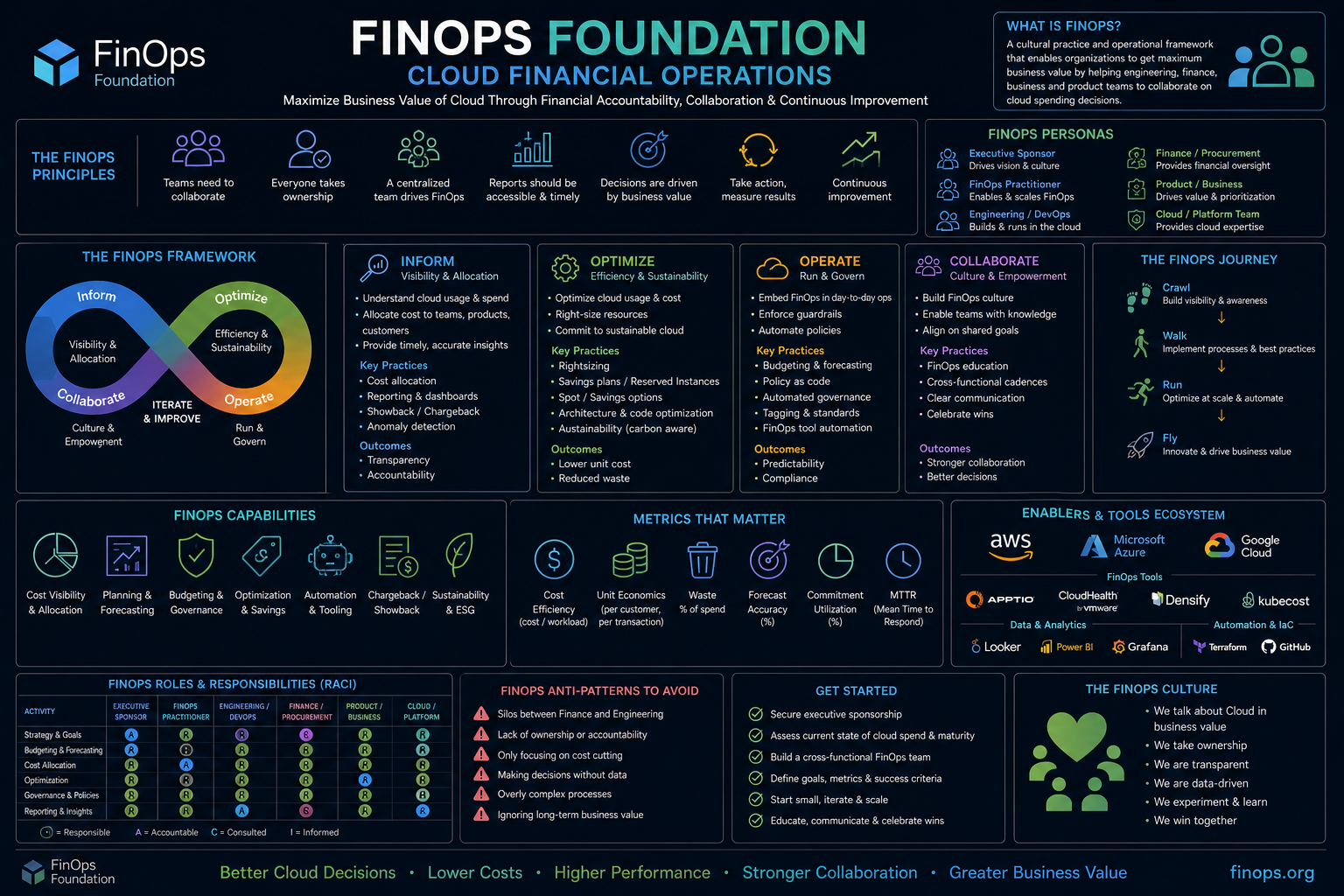
FinOps (Cloud Financial Operations) is the practice of bringing financial accountability to the variable spend model of cloud computing. It sits at the intersection of engineering, finance, and business leadership, enabling organizations to maximize business value from every dollar spent on cloud infrastructure .
The FinOps Framework organizes cloud cost management into three phases and six core domains. The phases include Inform (visibility and allocation of cloud spend), Optimize (improving efficiency and reducing waste), and Operate (continuous improvement and cultural adoption) .
A critical 2026 distinction: FinOps has expanded beyond traditional infrastructure cost management into specialized domains including AI workloads (GPU-heavy training and inference costs), containerized environments (Kubernetes/EKS/GKE/AKS), and SaaS spend management. The FinOps Foundation now offers dedicated training for each of these specialized areas .
The AI in FinOps evolution: AI tools are transforming cloud financial management. Platforms like CloudKeeper's LensGPT enable natural-language queries for cloud cost data—teams can ask "What did we spend on production AI workloads last month?" and receive immediate answers without building dashboards. Finout uses AI to automate cost tag building and allocation rules, moving organizations from 80% to 100% cost attribution .
The 14-Week FinOps Training Roadmap
Phase 1: Weeks 1-4 – FinOps Foundations & The FinOps Framework
What to focus on
Start with the foundational understanding of FinOps principles, domains, and maturity model. The FinOps Certified Practitioner certification is the industry-standard baseline credential that establishes a shared language across engineering, finance, and business stakeholders .
The FinOps Framework consists of six capability domains: Understanding Cloud Usage and Cost (visibility and allocation), Performance Tracking and Benchmarking (KPIs and accountability), Real-Time Decision Making (planning and estimating), Rate Optimization (commitment discounts), Usage Optimization (eliminating waste), and Unit Economics (business value measurement). Each domain requires specific practices and cross-functional collaboration between engineers and finance teams .
The FinOps Personas include Engineering (designing cost-aware infrastructure), Finance (budgeting and forecasting), Product (understanding unit economics), and Leadership (setting strategy and enabling culture). Understanding which persona you align with shapes your learning path .
Key Financial Concepts include cloud pricing models (on-demand, reserved instances, savings plans, spot instances), commitment-based discounts, rate negotiations, amortization of upfront commitments, and capitalization of cloud costs for accounting purposes .
Practical application
Complete the free "Introduction to FinOps" course offered by the FinOps Foundation. This 1.5-hour course covers the FinOps Foundation overview, principles, personas, domains, phases, and maturity model. Pass the quiz to earn your completion certificate .
Free resources for Phase 1
Introduction to FinOps (free on learn.finops.org) is a 1.5-hour self-paced course covering all FinOps fundamentals. No prerequisites are required. The course includes interactive modules and a final quiz. Register for a free FinOps Foundation account to access .
FinOps Foundation YouTube Channel offers free recorded sessions from FinOps X conferences, including practitioner case studies and framework deep-dives.
State of FinOps Report (free download from FinOps Foundation website) provides industry benchmark data including the finding that 72% of companies prioritize waste reduction, helping you understand real-world priorities .
Paid resources for Phase 1
FinOps Certified Practitioner ($500) is the foundational certification covering all FinOps fundamentals. Delivery options include self-paced learning with included exam, virtual instructor-led training with live sessions, or exam-only for experienced practitioners .
Phase 2: Weeks 5-8 – Cloud Platform-Specific FinOps Training
What to focus on
Each cloud provider has unique billing mechanics, discount vehicles, and optimization tools. Mastering platform-specific FinOps is essential for hands-on implementation roles. Major employers specifically seek deep hands-on experience with Azure Reservations, Savings Plans, and GCP Committed Use Discounts .
AWS Cloud Financial Management (CFM) focuses on using AWS Cost Explorer, AWS Budgets, Compute Optimizer, and Trusted Advisor for cost visibility and optimization. Key discount vehicles include Savings Plans (compute-focused) and Reserved Instances (service-specific). AWS also offers Marketplace SaaS procurement and consolidated billing for multi-account structures .
Microsoft Azure discount vehicles include Azure Reservations (1 or 3-year commitments) and Azure Savings Plans (compute-agnostic). Azure Cost Management provides budgeting, alerts, and recommendations. The AZ-900 (Azure Fundamentals) and AZ-104 (Azure Administrator) certifications provide the baseline cloud literacy needed for FinOps work .
Google Cloud Platform (GCP) offers Committed Use Discounts (CUDs) for predictable workloads and sustained use discounts for automatic savings on consistent usage. GCP's billing export to BigQuery enables advanced analytics. The Technical Foundations of FinOps on Google Cloud course covers these tools and strategies .
Multi-cloud considerations include normalizing cost data across providers using FOCUS (FinOps Open Cost & Usage Specification), handling different discount structures, and building unified dashboards .
Practical application
Using a free AWS account (or Azure/GCP free tier), set up billing alerts for your account. Explore Cost Explorer to analyze your spending patterns. Identify one optimization opportunity—such as an idle resource or a reservation recommendation—and document the potential savings.
Free resources for Phase 2
AWS Skill Builder: Cloud Financial Management (CFM) Digital Training is available free on AWS Skill Builder. The modular courses cover AWS cost and billing tools, better cost visibility and governance, and cost optimization techniques across compute, storage, databases, networking, analytics, and containers .
Microsoft Learn offers free self-paced content for AZ-900 (Azure Fundamentals) covering core Azure services, pricing, SLA, and lifecycle—foundational knowledge for Azure FinOps work.
Google Cloud Skills Boost provides free introductory modules on GCP billing and cost management, including hands-on labs in an actual cloud environment.
Paid resources for Phase 2
Technical Foundations of FinOps on Google Cloud (approximately €1,300-1,600) is a 2-day instructor-led course for cloud architects and engineers. It covers tools, techniques, and strategies for effective cloud financial management across virtual or classroom delivery options .
AZ-900 and AZ-104 Certification exam fees are approximately $100-165 each. While general cloud certifications rather than FinOps-specific, they provide essential context for cloud cost drivers .
AWS Solutions Architect – Associate exam fee is $150. This certification validates architecture depth including cost-performance tradeoffs, making it valuable for technical FinOps practitioners .
Phase 3: Weeks 9-12 – Advanced FinOps Specializations
What to focus on
Once you master FinOps fundamentals, specialized training addresses emerging cost centers. AI workloads, containerized environments, and SaaS spend represent the fastest-growing and most complex areas of cloud cost management .
FinOps for AI addresses the unique cost drivers of AI workloads: GPU and TPU compute for training runs, inference serving costs, specialized pricing models for AI services, and unpredictable usage patterns. The FinOps Foundation's FinOps for AI certification focuses on moving from "AI costs are unpredictable" to repeatable visibility, financial accountability, and decision-making. Topics include understanding training versus inference cost drivers, GPU-heavy spend, and AI-specific billing models; translating complex AI cost structures into optimization strategies leaders can act on; and using FinOps to align AI investment with measurable KPIs and governance .
FinOps for Containers focuses on Kubernetes/EKS/GKE/AKS cost visibility and optimization. Containerized environments present unique challenges including shared compute costs, idle resources vs. allocations, and difficulty attributing costs to specific teams or workloads. This course teaches cost-conscious development and operations for containerized environments, communicating container cost concepts to non-engineers, identifying common waste sources (idle/shared components, inefficient requests, overallocation, scaling gaps), and building observability to track and allocate container costs .
FinOps for SaaS (coming soon) applies FinOps structure to the growing challenge of SaaS cost management. As SaaS spend becomes a bigger share of technology budgets—and harder to govern than infrastructure spend—this upcoming certification covers managing and optimizing SaaS spend by connecting cost, renewals, and compliance to business value .
FOCUS (FinOps Open Cost & Usage Specification) is an open-source standard for cloud billing data that normalizes cost and usage datasets across providers. The free "Introduction to FOCUS" course (approximately 1 hour) covers what FOCUS is, why it matters for FinOps practitioners and vendors, and how it enables consistent allocation, budgeting, and forecasting regardless of data source. The FinOps Certified FOCUS Analyst certification ($400) provides deeper training on using FOCUS-conformed datasets to solve real-world business challenges .
Practical application
If your organization runs Kubernetes workloads, analyze one cluster's cost allocation using kubecost or cloud-native tools. Identify the percentage of "unallocated" or "shared" costs and propose a tagging or namespace strategy to improve attribution. For AI-focused learners, document a simple GPU training job's cost breakdown and identify which cost drivers were predictable versus variable.
Free resources for Phase 3
Introduction to FOCUS (free on learn.finops.org) is a 1-hour entry course covering what FOCUS is and why it's important. You will learn to speak about FOCUS at an introductory level and prepare for the full FOCUS Analyst certification .
FinOps Foundation Community Slack provides free access to practitioner discussions on AI, containers, and multi-cloud FinOps. Network with over 20,000 FinOps practitioners worldwide.
Paid resources for Phase 3
FinOps Certified: FinOps for AI ($500) is the FinOps Foundation's focused intermediate-level series for AI workload cost management. The certification exam is scheduled to launch in March 2026. No prerequisites are required, though a strong FinOps foundation (Practitioner certification) is recommended. Passing yields a digital certificate and Credly badge, valid for 24 months .
FinOps for Containers ($250) is an intermediate course (approximately 2-3 hours) covering cost-conscious operations for containerized environments. Completion yields a "FinOps Trained" Credly badge. Note that this is training, not a full certification exam .
FinOps Certified FOCUS Analyst ($400) provides an in-depth understanding of FOCUS, teaching you to use conformed datasets for real-world business challenges. Includes 12 months of access to all course modules and the certification exam .
FinOps Certified Engineer (500self−paced,or
500self−paced,or325 exam-only) is the intermediate-level credential for cloud engineers who want to translate FinOps into day-to-day technical decisions. Focuses on practical ways to incorporate FinOps data into the development lifecycle, shifting conversations from cost of running in the cloud to value cloud investment creates. Self-paced bundle is approximately 10 hours .
Phase 4: Weeks 13-14 – Strategic FinOps & Career Application
What to focus on
This final phase transforms technical FinOps skills into strategic capability. The most valuable FinOps leaders don't just optimize costs—they build cultures of financial accountability, influence architecture decisions, and communicate cloud value to executive stakeholders .
The FinOps Maturity Model progresses through three phases: Crawl (visibility and allocation—understanding where money is going), Walk (optimization and governance—actively reducing waste and improving efficiency), and Run (business value integration—aligning cloud investment with strategic outcomes). Most organizations operate in Crawl; the most valuable practitioners can lead them to Run .
Key Performance Metrics include unit economics (cost per transaction, cost per customer), cloud cost as percentage of revenue, commitment coverage ratio (reservations/savings plans coverage), waste percentage (unused or idle resources), and forecasting accuracy .
Cross-functional collaboration skills are critical. FinOps sits at the intersection of Cloud Engineering (understanding architecture decisions), Finance (budgeting and accounting), Procurement (vendor negotiations and licensing), Product (unit economics and feature prioritization), and Leadership (strategic alignment and investment decisions). The ability to influence without authority across these groups is a core competency .
The FinOps Certified Professional is the most advanced credential for experienced practitioners who want to lead and scale FinOps in real organizations. The course goes beyond fundamentals into practical working-level application, including business case collaboration, workshop facilitation, and driving measurable return on cloud investment. The time commitment is approximately 40-50 hours, typically completed in 8 weeks or less. Prerequisites include active FinOps Certified Practitioner plus approximately 6 months of FinOps working experience, and the FinOps Certified FOCUS Analyst certificate is required before taking the Professional exam .
Practical application
Complete the FinOps Certified Practitioner certification (if you haven't already). Build a stakeholder map for your organization or a fictional company, identifying who owns each FinOps persona (Engineering, Finance, Product, Leadership). Draft a one-page "FinOps charter" establishing principles, decision rights, and success metrics.
Free resources for Phase 4
FinOps Foundation Webinars and Virtual Summits are free to attend and cover major announcements, industry insights, and best practices from organizations like AWS, Microsoft, and community ambassadors .
FinOps Mentorship Program (free to apply) connects practitioners with experienced FinOps leaders. Apply as a mentee to accelerate your learning or as a mentor to give back to the community .
Paid resources for Phase 4
FinOps Certified Professional (1,999)istheflagshipadvancedcertificationforexperiencedpractitioners.Includes34modulescoveringallsixFinOpsdomainsindepth.Recertificationrequiredannually(
1,999)istheflagshipadvancedcertificationforexperiencedpractitioners.Includes34modulescoveringallsixFinOpsdomainsindepth.Recertificationrequiredannually(500). Bundles are available with FOCUS Analyst (2,100)orcompletepathwayincludingPractitioner(
2,100)orcompletepathwayincludingPractitioner(2,250) .
Your Portfolio Projects
Build these artifacts during your training to demonstrate your FinOps capabilities.
Project One: The Cloud Cost Optimization Audit
Using AWS Free Tier or a sample cloud bill dataset, perform a complete cost audit. Identify: top five cost drivers by service, percentage of committed vs. on-demand spend, waste percentage (idle resources, unattached storage, oversized instances), and three specific optimization opportunities with projected savings. Document findings as a professional audit report.
Project Two: The Unit Economics Dashboard
Build a dashboard (using Excel, Tableau Public, or cloud native tools) tracking unit economics for a sample SaaS product. Include cost per active user, cost per transaction, cloud cost as percentage of revenue, and trend over 6 months. Annotate the dashboard with explanations of what each metric means and why it matters.
Project Three: The FinOps Implementation Roadmap
Create a 12-month FinOps implementation roadmap for a fictional mid-sized company spending $500,000 monthly on AWS. Include: current state maturity assessment, three prioritized initiatives (e.g., tag enforcement, reservation strategy, showback reporting), phased timeline with milestones, resource requirements (headcount, tools, training), and projected ROI calculation.
Project Four: The Stakeholder Communication Package
Create three communication artifacts for different FinOps stakeholders: an executive summary (one page, C-suite focus on business value and ROI), a finance detail pack (cost allocation methodology, amortization schedules, budgeting recommendations), and an engineering guide (optimization playbook, tagging standards, CI/CD integration for cost checks).
Career Application & Next Steps
Job Titles to Target
The FinOps career ladder has distinct roles with clear compensation bands:
FinOps Analyst (Entry to Mid Level)
1-4 years of experience. Monitor cloud spending, generate cost reports, identify anomalies, support tagging and allocation efforts, and assist with reservation planning. Skills needed: cloud fundamentals (any major provider), spreadsheet proficiency, basic FinOps framework knowledge. Typical range: 70,000−
70,000−110,000.
Cloud FinOps Engineer (Mid Level)
3-6 years of experience. Implement cost optimization (rightsizing, scheduling, reservation purchases), build cost visibility dashboards, integrate FinOps data into CI/CD pipelines, and partner with engineering teams on architecture decisions. Skills needed: hands-on cloud experience, infrastructure-as-code, Python/scripting for automation, cloud provider cost APIs. Typical range: 100,000−
100,000−150,000.
FinOps Practitioner / Specialist (Mid to Senior Level)
3-7 years of experience. Own cross-functional FinOps processes including forecasting, budgeting, showback/chargeback, and unit economics. Lead FinOps culture initiatives and training. Skills needed: FinOps Certified Practitioner, financial acumen (budgeting, forecasting), stakeholder management, data analysis. Typical range: 90,000−
90,000−140,000.
Cloud FinOps Lead / Manager (Senior Level)
5-9 years of experience. Lead financial governance and cost optimization across multi-cloud environments, partner with engineering on architecture decisions, build reporting and controls, and influence senior leadership. Skills needed: FinOps Certified Professional, multi-cloud experience, team leadership, executive communication. Typical range: 120,000−
120,000−180,000.
Wells Fargo Cloud FinOps Lead posting (139,000−
139,000−260,000) requires 7+ years of information technology experience with deep hands-on Azure and GCP, understanding of Reservations, Savings Plans, CUDs, and experience operating in regulated environments. The role sits at the intersection of cloud engineering, finance, and risk .
Director of FinOps / FinOps Practice Lead (Leadership Level)
8-12 years of experience. Own organization-wide FinOps strategy, lead the FinOps Center of Excellence, set cloud financial policies, and report to C-suite on cloud ROI. Skills needed: strategic vision, organizational change management, advanced analytics fluency, vendor negotiation experience. Typical range: 150,000−
150,000−220,000.
VP of FinOps / Cloud Economics (Executive Level)
12+ years of experience. Enterprise-wide cloud financial strategy ownership, board reporting, organizational design, and cloud value realization. Skills needed: executive presence, cross-functional leadership, advanced FinOps maturity. Typical range: 180,000−
180,000−280,000+.
Companies Hiring for FinOps Roles
Based on active job postings and industry trends, employers seeking FinOps professionals include:
Financial Services: Wells Fargo, JPMorgan Chase, Bank of America, Mastercard, American Express—these highly regulated organizations prioritize audit-defensible cloud financial management .
Technology Companies: Apple, Workday, SAP, Booking Holdings, Equifax, Fidelity, Capital One .
Insurance and Healthcare: AIA, CME, Fannie Mae, Lockheed Martin, Humana .
Consulting and Service Providers: CloudKeeper, nOps, Finout—specialized FinOps tool and service providers .FinOps Foundation: Cloud Financial Operations
Required Skills Based on Job Postings
Based on active job postings from Wells Fargo and industry skill frameworks, employers expect:
Cloud platform expertise: Deep hands-on experience with at least one major provider (AWS, Azure, GCP); understanding of billing mechanics, usage metering, and discount vehicles (Reservations, Savings Plans, CUDs) .
Financial acumen: Budgeting and forecasting, cost allocation (showback/chargeback), amortization schedules, capitalization considerations for cloud spend, unit economics .
Data analytics: Working with large cost and usage datasets, building executive-level dashboards and financial narratives, experience with BI platforms (Tableau, Power BI), understanding of FOCUS specification .
Technical skills (for engineering roles): Infrastructure-as-code (Terraform, CloudFormation), Python for automation and analysis, Kubernetes cost management, CI/CD integration for cost checks .
Soft skills: Influence without authority across engineering, finance, and leadership teams; executive communication; project management; change management; audit and regulatory awareness .
Certifications: FinOps Certified Practitioner (foundation), FinOps Certified Professional (advanced), cloud provider certifications (AWS Certified Cloud Practitioner/Solutions Architect, Azure AZ-900/AZ-104) .
Certifications That Matter
FinOps Certified Practitioner ($500)
The foundational credential for establishing a shared FinOps language across the organization. Covers FinOps Framework, practice areas, and roles. Best starting point for most teams. Self-paced, virtual instructor-led, or exam-only options available .
FinOps Certified Engineer (500self−paced/
500self−paced/325 exam-only)
Intermediate-level engineering-focused credential for cloud engineers who want to translate FinOps into technical decisions. Covers incorporating FinOps data into the development lifecycle and shifting conversations to cloud value .
FinOps Certified Professional ($1,999)
The most advanced FinOps Foundation certification for experienced practitioners. Requires active Practitioner and FOCUS Analyst certifications plus 6+ months of experience. Approximately 40-50 hours over 8 weeks. Focuses on practical, working-level application including business case collaboration and measurable ROI .
FinOps Certified: FinOps for AI ($500)
Intermediate-level specialization for AI workload cost management. Covers training vs. inference cost drivers, GPU-heavy spend, AI-specific billing models, and aligning AI investment with KPIs. Exam scheduled for March 2026. Valid for 24 months .
FinOps Certified FOCUS Analyst ($400)
Certification for using FOCUS-conformed datasets to solve real-world business challenges. Includes 12 months of access to all course modules and exam. Free "Introduction to FOCUS" prerequisite available .
FinOps for Containers ($250)
Training (approximately 2-3 hours) covering cost-conscious development for Kubernetes/EKS/GKE/AKS. Yields "FinOps Trained" badge—not a full certification exam. Valuable for practitioners managing containerized workloads .
AWS Certified Cloud Practitioner / Solutions Architect (Associate)
General AWS baseline credentials ($100-150 exam fees). Cloud Practitioner is lighter foundation for finance/ops stakeholders; Solutions Architect provides deeper architecture depth including cost-performance tradeoffs for technical roles .
Microsoft Azure AZ-900 / AZ-104
Azure Fundamentals (99examfee)islightweightfoundation;AzureAdministrator(
99examfee)islightweightfoundation;AzureAdministrator(165 exam fee) is for technical practitioners who influence configuration choices affecting cost and governance .
Salary Expectations
Based on industry data from job postings and salary guides:
- Entry (0-2 years): FinOps Analyst / Cloud Cost Analyst — 60,000−
- 60,000−85,000
- Mid (2-4 years): FinOps Specialist / Cloud FinOps Engineer — 80,000−
- 80,000−120,000
- Senior (4-7 years): Senior FinOps Practitioner / Cloud FinOps Lead — 110,000−
- 110,000−160,000
- Leadership (7-12 years): FinOps Manager / Practice Lead — 140,000−
- 140,000−200,000
- Executive (12+ years): Director / VP of FinOps — 170,000−
- 170,000−280,000+
Wells Fargo Cloud FinOps Lead posting offers 139,000−
139,000−260,000 base pay plus benefits including 401(k), health, parental leave, tuition reimbursement, and commuter benefits. The role requires 7+ years of experience with deep hands-on Azure and GCP .
Geographic premiums: Major tech hubs (San Francisco, New York, Seattle) and financial centers (Charlotte, NYC) add 20-40% to base ranges. Remote roles typically align with national median.
Industry variations: Financial services and regulated industries pay 15-30% above technology and SaaS sectors due to compliance and audit requirements. Wells Fargo specifically notes pay may vary based on demonstrated performance, skills, and experience .
Immediate Next Steps for the Next 7 Days
Day One: Register for a free FinOps Foundation account at learn.finops.org. Access the free "Introduction to FinOps" course (1.5 hours). Complete the foundation modules and pass the final quiz to earn your completion certificate .
Day Two: Complete the free "Introduction to FOCUS" course (approximately 1 hour) to understand the open specification for cloud billing data. This prepares you for the full FOCUS Analyst certification later .
Day Three: Define your learning path based on your current role. Choose one:
- Finance/Business focus → FinOps Certified Practitioner
- Engineering/Cloud focus → FinOps Certified Engineer + cloud provider training
- AI/Containers focus → FinOps for AI or FinOps for Containers
Day Four: Explore cloud provider free training. Access AWS Skill Builder for Cloud Financial Management modules, or start Microsoft Learn's AZ-900 learning path, or Google Cloud Skills Boost introductory modules .
Day Five: Set up a cloud free tier account (AWS Free Tier, Azure Free Account, or Google Cloud Free Program) if you don't have one. Explore the native cost management console—find Cost Explorer (AWS), Cost Management (Azure), or Billing Reports (GCP).
Day Six: Update your LinkedIn headline: "Aspiring FinOps Professional | Cloud Financial Operations | [AWS/Azure/GCP]." Join the FinOps Foundation Community Slack group and introduce yourself.
Day Seven: Define your portfolio project focus. Choose one: a cloud cost optimization audit, a unit economics dashboard, a FinOps implementation roadmap, or a stakeholder communication package. Commit to completing it within 30 days and sharing it publicly on GitHub, LinkedIn, or Tableau Public.
The Long Game
FinOps is rapidly transforming from a reactive cost-control discipline to a strategic enabler of cloud value. Organizations that mature beyond "Crawl" (basic visibility) into "Run" (business value integration) see measurable competitive advantages: faster innovation cycles, more accurate forecasting, and engineering teams that treat cost as a first-class metric alongside performance and availability.
The most successful FinOps professionals think in systems, not tools. An optimization isn't a one-time reservation purchase. It's a tagging strategy that enables allocation, a dashboard that makes waste visible, a governance policy that prevents reoccurrence, a training program that builds cost awareness, and a culture where engineers proactively consider cost in architecture decisions. They anchor on metrics their CFO and CTO already care about: unit economics, cloud cost as percentage of revenue, forecasting accuracy, and compliance readiness .
Your portfolio matters more than your resume. Build something real—an audit report, a dashboard, a roadmap, a communication package. Document your methodology and findings. Share it publicly on GitHub, LinkedIn, or your portfolio site. The FinOps community values demonstrated capability over credentials.
The distinction between basic cost reporting and mature FinOps practice is the most important trend in cloud management for 2025-2026. The professionals who understand how to close this gap—combining FinOps Framework knowledge with platform-specific skills, cross-functional collaboration, and strategic communication—will be the most valuable in the market. With 72% of companies prioritizing waste reduction and cloud budgets continuing to grow, skilled FinOps practitioners are in critical demand .
Start your week one actions today. Complete that first free course. Set up that cloud free tier. Define your portfolio project. Begin your journey into a field where you directly determine whether organizations extract maximum value from their cloud investments—and where the best practitioners earn upwards of $260,000 doing work that actually matters
Educational Qualifications Required for the FinOps Training Roadmap
FinOps is fundamentally a professional certification pathway rather than an academic degree program. The FinOps Foundation certifications do not require specific college degrees—they are designed for professionals from diverse backgrounds including finance, engineering, product management, and business leadership . However, for those seeking employment in FinOps roles, educational qualifications become relevant.
Formal Educational Qualifications
No Degree Required for Certification
The FinOps Foundation certifications themselves have no formal academic degree prerequisites. Anyone can pursue:
Introduction to FinOps (free) – No prerequisites whatsoever
FinOps Certified Practitioner – No formal degree required; open to all professionals
FinOps Certified Engineer – Requires active Practitioner certification, not a degree
FinOps Certified FOCUS Analyst – No degree required; open to all
FinOps for AI / FinOps for Containers – No degree prerequisites
FinOps Certified Professional – Requires Practitioner + FOCUS Analyst certifications plus ~6+ months experience, not a degree
The Foundation's philosophy prioritizes demonstrated knowledge and practical experience over academic credentials. The free "Introduction to FinOps" course is the recommended starting point for absolutely anyone .
Preferred Degrees for Employment
While certification does not require a degree, employers actively hiring for FinOps roles frequently list educational qualifications as requirements or preferences. Based on job postings from major employers :
Bachelor's Degree (Most Commonly Required)
Most FinOps job postings list a Bachelor's degree as a minimum requirement, typically in one of these fields:
Technology Fields: Computer Science, Information Technology, Cloud Technology, Software Engineering, Computer Engineering
Business-Finance Fields: Business Administration, Finance, Accounting, Business Finance, Economics
Analytics Fields: Data Analytics, Data Science, Business Analytics, Information Systems
Related Fields: Engineering (general), Mathematics, Statistics
Examples from Active Job Postings:
"Bachelor's Degree in Information Technology, Computer Science, Cloud Technology ... Business Finance, Data Analytics or related" – ZipRecruiter
"Bachelor/Master's (or equivalent) in Computer Science, Engineering, or related fields" – Siemens Healthineers FinOps Academy Internship
"Bachelor's degree in Computer Science, Information Systems, Finance, or related discipline" – Cloud Financial Analyst role
"Bachelors degree in Computer Science, SW Engineering" – Cloud FinOps Engineer role
"Bachelor's degree holder in Computer Science, Information Technology or other relevant fields" – FinOps Practitioner role
Master's Degree (Preferred, Not Required)
Many employers list a Master's degree as a "plus" or preference:
"Master's Degree in Information Technology, Computer Science, Cloud Technology, Business Finance, Data Science is a plus" – ZipRecruiter
"Master's Degree in Computer Science or related field" – Various senior roles
Equivalency Clauses
Some employers explicitly accept equivalent experience in lieu of a degree, using phrasing like "Bachelor/Master's (or equivalent)" .
Target Audience by Background (No Degree Required)
The FinOps training roadmap is explicitly designed for professionals from all three major functional backgrounds, none of whom need specific degrees to succeed .
Finance & Business Professionals
Typical backgrounds: Finance, Accounting, FP&A, Procurement, Business Operations
Recommended preparation: Complete free "Introduction to FinOps" (1.5 hours). Build basic cloud literacy through cloud provider free courses. Then pursue FinOps Certified Practitioner.
Why no degree is required: Financial skills (budgeting, forecasting, cost allocation) can be learned through experience or non-degree professional certifications. The FinOps Practitioner builds cloud knowledge progressively.
Engineering & Technical Professionals
Typical backgrounds: Cloud Engineering, DevOps, SRE, Platform Engineering, Solutions Architecture
Recommended preparation: Complete free "Introduction to FinOps" to understand FinOps principles. Leverage existing cloud expertise. Consider FinOps Certified Engineer pathway.
Why no degree is required: Many successful cloud engineers are self-taught or have non-CS degrees. The FinOps certifications validate FinOps-specific knowledge, not general engineering degrees.
Product & Business Leadership
Typical backgrounds: Product Management, Program Management, Business Operations, General Management
Recommended preparation: Complete free "Introduction to FinOps". Focus on strategic FinOps concepts rather than technical implementation.
Why no degree is required: Leadership roles value experience and demonstrated capability over specific academic credentials. The FinOps Certified Practitioner provides the shared language needed to lead cross-functional FinOps initiatives.
Certification Prerequisites (Not Educational Degrees)
The FinOps Foundation certifications have specific certification prerequisites, which are different from academic degree requirements :
FinOps Certified Practitioner
Prerequisites: None formally. Recommended: free "Introduction to FinOps" course.
FinOps Certified Engineer
Prerequisites: Active FinOps Certified Practitioner certification.
FinOps Certified FOCUS Analyst
Prerequisites: None formally. Recommended: free "Introduction to FOCUS" course.
FinOps Certified Professional
Prerequisites (strict requirements) :
Active FinOps Certified Practitioner certification
Active FinOps Certified FOCUS Analyst certificate
Approximately 6+ months of FinOps working experience (recommended)
Note: A university degree is not among the prerequisites for any FinOps Foundation certification.
FinOps for AI / FinOps for Containers
Prerequisites: FinOps Certified Practitioner recommended but not formally required.
Experience Requirements (Not Degree-Based)
Internship Level
Siemens Healthineers FinOps Academy (paid internship) :
Target: Bachelor/Master's students (or equivalent) in Computer Science, Engineering, or related fields
This is an internship designed for current students or recent graduates—the degree is actively being pursued, not a pre-hire requirement
Entry Level (0-2 years experience)
Typical requirements:
Bachelor's degree preferred but not always required
Foundational cloud certification (AWS Cloud Practitioner, Azure Fundamentals) may substitute
FinOps Certified Practitioner is the key differentiator
Mid Level (2-5 years experience)
Typical requirements:
Bachelor's degree in related field (often required)
2+ years cloud or finance experience
Active FinOps Certified Practitioner
Cloud provider certification (AWS/Azure/GCP Associate level) is a plus
Senior Level (5-10 years experience)
Typical requirements:
Bachelor's degree required (Master's preferred)
5+ years cloud or finance experience
FinOps Certified Practitioner + advanced certification (Engineer or Professional)
Deep expertise in cloud platforms and cost structures
Equivalent Experience in Lieu of Degrees
For candidates without formal degrees, the most valuable qualifications are:
FinOps Certified Practitioner – This matters more than a degree for FinOps-specific roles
Cloud provider certifications – AWS Certified Cloud Practitioner, Azure Fundamentals, or Solutions Architect credentials demonstrate cloud literacy
Demonstrated experience – Portfolio projects (cost optimization audits, unit economics dashboards, implementation roadmaps) provide tangible proof of capability
Professional experience – 3-5 years in cloud operations, finance analysis, or related fields often substitutes for degree requirements
Many job postings explicitly state "or equivalent experience" alongside degree requirements, recognizing that the FinOps field draws from diverse backgrounds




 Group / 1: 1 Sessions