Training Roadmap: Legacy System Modernization Without Downtime
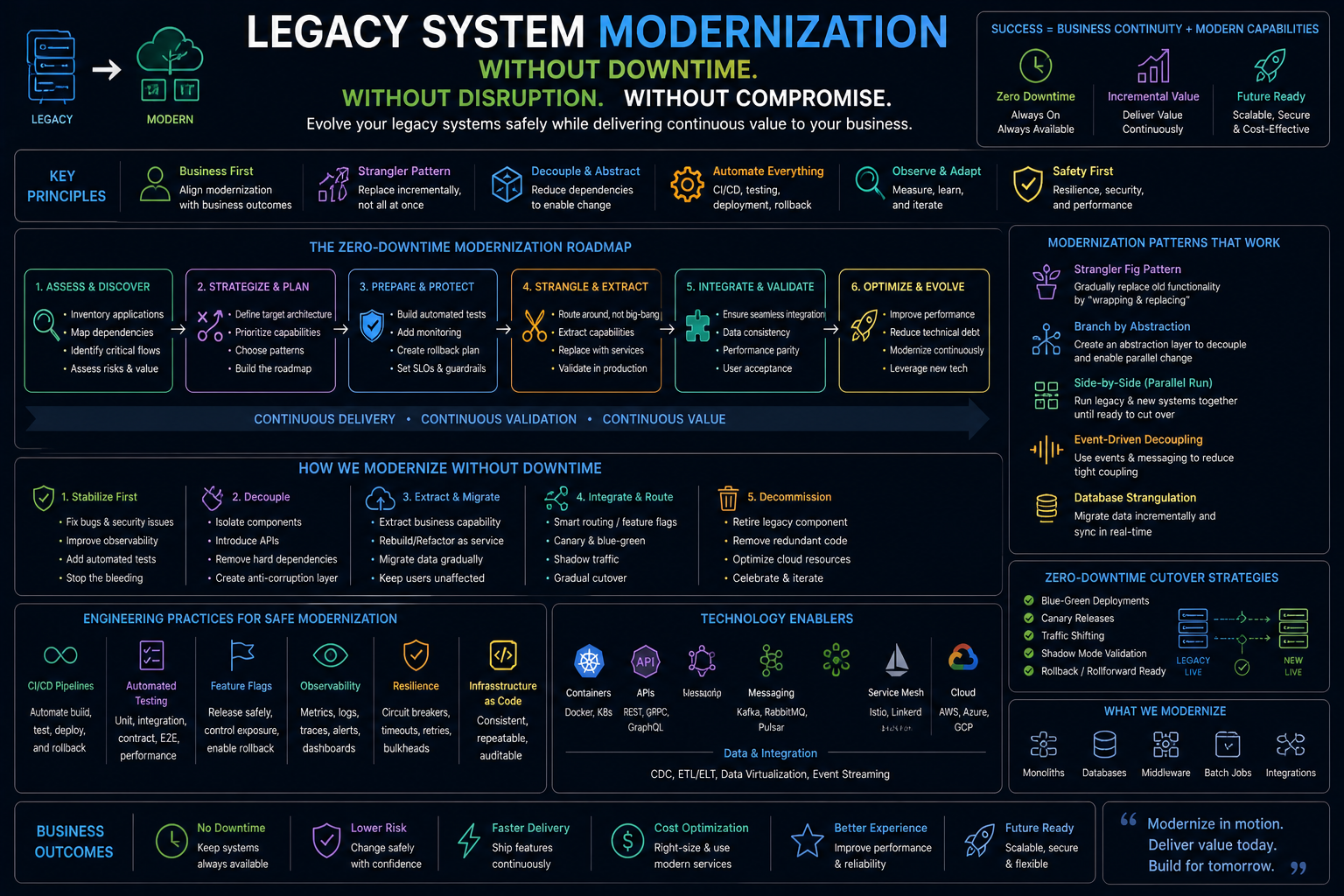
This roadmap is designed for software architects, cloud engineers, DevOps professionals, and IT leaders who want to master the discipline of modernizing legacy systems while maintaining continuous operations. Legacy system modernization has fundamentally shifted from risky "big bang" replacements to phased, zero-downtime strategies that preserve business continuity while transforming technical infrastructure .
Understanding Legacy System Modernization Without Downtime
Legacy system modernization without downtime refers to the practice of updating, migrating, or replacing outdated software and infrastructure while keeping business operations running continuously. Organizations face three major risks when relying on legacy systems: unsupported hardware and software that cannot be replaced, eroding institutional knowledge as original engineers retire, and inadequate cybersecurity features that leave systems vulnerable .
The critical distinction in 2025-2026: Modernization is no longer about "rip and replace" extended shutdowns. Instead, organizations are adopting phased strategies including parallel systems, shadow testing, and strangler pattern migrations that distribute risk and control disruption. Zero-downtime migration strategies keep systems running and available throughout the entire process .
Why this matters now: Legacy systems hold back 88% of organizations, with IT downtime costing the Eurozone approximately €4,600 every minute. Global 2000 companies lose an average of €181 million yearly due to downtime. Meanwhile, global spending on public cloud services reached 9billionin2024andcontinuesgrowingbeyond
9billionin2024andcontinuesgrowingbeyond1 trillion by 2027 .
The Core Frameworks for Zero-Downtime Modernization
The Phased Modernization Approach
Successful legacy modernization follows a sequential strategy that prioritizes maximum improvements with minimal disruption :
Phase 1: System Assessment & Roadmap Development
Every modernization effort begins with a thorough assessment of existing hardware and software, IT/OT network architecture, component criticality, and lifecycle risks. A Front-End Engineering Design (FEED) study creates a detailed project roadmap that reduces financial and temporal risks through meticulous planning .
Phase 2: Parallel Systems & Shadow Testing
New systems are deployed alongside existing ones. Data is mirrored from the live system to the new platform, allowing logic, interfaces, and analytics to be tested under real operating conditions without affecting production. This strategy also integrates operator training as users gain confidence before final cutover .
Phase 3: Gradual Migration of Control & Functionality
Modernization is separated into layers rather than upgraded simultaneously. The typical sequence upgrades visualization first (improving user experience and cybersecurity without interfering with core logic), followed by network and infrastructure improvements, then controller or data migrations, and finally advanced functionality and analytics .
The Strangler Pattern
The Strangler Fig pattern is an architectural strategy for systematically transitioning from monolithic applications to modern architectures. Rather than rebuilding everything at once, you gradually replace specific functionalities with new microservices while the legacy system continues to run. The legacy system is "strangled" over time as more functionality migrates to the new architecture, until eventually the old system can be retired .
The Four-Stage Migration Pattern
For zero-downtime cloud migration, organizations follow a proven four-stage pattern :
Old Mode: The current legacy system remains the standard, with thorough documentation of performance, usage patterns, and error rates establishing baselines for comparison.
Shadow Mode: Both systems run in parallel. The legacy system handles production workloads while the new cloud environment processes identical data silently in the background, revealing functional gaps and confirming data consistency.
Reverse Shadow Mode: After validation, user traffic gradually shifts to the new system starting with a small percentage (e.g., 5% of users) and increasing as performance proves reliable.
New Mode: Once the new system is proven, the legacy system is fully transitioned and retired—but organizations are advised to maintain read-only access initially for troubleshooting needs.
The 16-Week Legacy Modernization Training Roadmap
Phase 1: Weeks 1-4 – Foundations & Assessment Methodologies
What to focus on
Start with the fundamental concepts and assessment techniques that underpin every successful modernization project. Understanding what you have and why it needs to change is prerequisite to designing a migration strategy.
Legacy System Analysis includes building a complete inventory of IT assets, documenting all applications, infrastructure components, and interdependencies. For white-box applications with available source code, reverse engineering reveals functionality. For black-box systems without source code, analysis focuses on inputs, outputs, and system responses .
Risk and Business Impact Assessment requires identifying factors including customer experience degradation from outdated interfaces, lost revenue opportunities due to system limitations, delayed product releases, decreased employee efficiency, and security gaps from unpatched vulnerabilities. Up to 80% of IT budgets in large organizations go toward maintaining existing legacy systems, leaving little room for innovation .
Migration Strategy Selection (The 3 R's): Choose between rehosting (lift and shift) which moves applications without changes for foundational cloud experience, replatforming which requires minimal code changes to leverage PaaS benefits, and refactoring which improves internal code structure to address technical debt .
Documentation and Knowledge Recovery practices include as-built drawings, logic documentation, configuration backups with version control, change logs and audit trails, and clear ownership of documentation updates .
Practical application
Select a sample legacy application (real or simulated) and perform a complete system assessment. Document outdated components, dependencies, and business impact. Create a SWOT analysis (Strengths, Weaknesses, Opportunities, Threats) for migrating this system. Choose an appropriate migration strategy (rehost, replatform, or refactor) and justify your decision.
Free resources for Phase 1
Microsoft Learn offers free self-paced learning paths covering cloud migration fundamentals, Azure migration tools, and legacy system assessment methodologies. The "Azure Migrate" documentation provides practical assessment frameworks.
YouTube features numerous free conference talks from Microsoft Ignite and AWS re:Invent covering legacy modernization strategies and case studies.
GitHub hosts open-source assessment templates and modernization framework documentation from various cloud providers and consulting organizations.
Paid resources for Phase 1
Pluralsight offers the course "Microservices: Transition Strategies and Techniques" (approximately 2-3 hours) covering the strangler application pattern and dependency resolution during transition. Created by Rag Dhiman, this course teaches systematic transformation of monolithic applications to microservices architecture .
Coursera provides courses on microservices migration including "Step 5: Design and Implement Interservice Communication" as part of migrating eShop modules using the Strangler Fig pattern. Basic knowledge of .NET and microservices concepts is recommended .
AWS Training and Certification offers paid courses on cloud migration strategies including the AWS Cloud Migration Fundamentals pathway (pricing varies by course).
Phase 2: Weeks 5-8 – Architectural Patterns & Migration Strategies
What to focus on
This phase addresses the specific architectural patterns and technical strategies that enable zero-downtime modernization.
The Strangler Fig Pattern in Depth involves intercepting calls to legacy functionality, redirecting selectively to new microservices, and gradually expanding the scope of new implementations while reducing the legacy footprint. This pattern handles missing dependencies and integration complexities systematically .
Parallel Running and Shadow Testing requires deploying new systems alongside existing ones, mirroring live data to the new platform, and validating functionality without affecting production. Factory Acceptance Testing (FAT) using simulations or digital twins, failover and recovery testing for redundant systems, regression testing to preserve behaviors, and Site Acceptance Testing (SAT) under real conditions are essential validation strategies .
Database Migration Without Downtime uses technologies like Oracle Data Guard, GoldenGate, or other database mirroring solutions to maintain data synchronization between source and target environments throughout the migration process. Dual-write patterns maintain consistency during transition phases .
High Availability Architecture requires eliminating single points of failure through multi-zone distribution of services, automated failover mechanisms, immediate monitoring with alerts, and redundant systems that create "digital safety nets" .
Containerization and Orchestration using Docker and Kubernetes (AKS, EKS, GKE) provides the deployment infrastructure for modernized applications. Understanding containerization is essential for cloud-native modernization.
Practical application
Design a strangler pattern migration for a sample monolithic application. Define which functionality would be extracted first. Create a high-level architecture diagram showing how traffic would be routed between legacy and new systems. Plan data synchronization strategies to maintain consistency.
Free resources for Phase 2
GitHub hosts open-source migration pattern examples and reference architectures. The repository "reconsumeralization/GraphHub-MCP" demonstrates agent-driven integration between legacy and modern systems .
Cloud Provider Documentation from AWS, Azure, and Google Cloud provides free, comprehensive guides on migration patterns, strangler fig implementations, and zero-downtime strategies.
YouTube offers free conference sessions including Microsoft Ignite 2024 talk "Harnessing the power of AI to futurize legacy and mainframe systems" (47 minutes) covering Azure AI and Microsoft Copilots for transformation .
Paid resources for Phase 2
Pluralsight subscription ($29-45/month) provides access to advanced microservices and migration pattern courses including hands-on labs for strangler pattern implementation.
ACloudGuru ($35-50/month) offers cloud migration and modernization courses across AWS, Azure, and GCP with sandbox environments for practice.
Cloud Academy provides enterprise-focused modernization training with hands-on labs for database migration and high availability architecture (pricing varies by plan).
Phase 3: Weeks 9-12 – AI-Powered Modernization Tools & Techniques
What to focus on
This phase addresses the emerging category of AI-powered modernization tools that accelerate legacy system analysis, documentation, and migration.
AI-Powered Reverse Engineering tools like Reversa transform legacy systems into executable specifications for AI coding agents. Reversa installs within legacy projects and coordinates specialized AI agents to analyze existing code and generate complete, traceable specifications ready for any coding agent to use for understanding, evolving, refactoring, or reimplementing the system .
The Reversa Pipeline operates through five phases orchestrated by a "Maestro" agent: Recognition (mapping surface structure, languages, frameworks, dependencies), Excavation (deep analysis of algorithms, control flows, data structures), Interpretation (extracting implicit business knowledge, rules, state machines), Generation (producing specifications as operational contracts with code traceability), and Review (validating specifications and gaps) .
AI Agents for Legacy Integration platforms like GraphHub-MCP provide an AI-native automation engine where agents build, manage, and execute complex workflows. These agents can construct and modify workflows dynamically, operate across web browsers and desktop OS environments, bridge legacy systems (mainframes, legacy databases, old desktop apps) with modern APIs, and leverage the Model Context Protocol (MCP) for context, memory, and tool access. The Legacy Bridge Toolkit includes plugins for screen scraping, OCR, and data format translation for older protocols like SOAP/XML .
Microsoft AI Modernization Approach uses Azure AI and Microsoft Copilots to transform outdated systems into innovative solutions that drive efficiency and enhance customer experiences. This approach addresses common modernization challenges including knowledge asymmetry (lost institutional knowledge), uncertain ROI, and potential disruption to core processes .
AI for Documentation Recovery uses large language models to analyze legacy codebases, extract business logic, and generate human-readable documentation. This addresses the critical problem of eroding institutional knowledge as original engineers retire .
Practical application
Using an AI coding assistant (Claude, ChatGPT, or GitHub Copilot), analyze a small legacy code snippet. Ask the AI to explain the business logic, identify potential modernization paths, and generate documentation. Experiment with Reversa (npx reversa install) on a sample project to understand AI-powered specification extraction .
Free resources for Phase 3
Reversa GitHub Repository provides open-source access to the AI-powered reverse engineering framework. Requires Node.js 18+ and integrates with Claude Code, Codex, Cursor, or other AI coding agents. The tool never modifies existing project files—analysis writes only to new directories .
GraphHub-MCP GitHub Repository offers open-source access to the AI-native automation engine for legacy system integration. Features plugin-based architecture for bridging legacy and modern systems .
Microsoft Learn includes free documentation and learning paths for Azure AI and Copilot integration with legacy modernization scenarios.
YouTube provides free access to the Microsoft Ignite 2024 session "Harnessing the power of AI to futurize legacy and mainframe systems" (47 minutes) .
Paid resources for Phase 3
Anthropic Claude API or OpenAI API requires paid credits (approximately $0.01-0.10 per 1,000 tokens depending on model) for programmatic legacy code analysis.
Microsoft Azure AI Services requires Azure subscription with pay-as-you-go pricing for AI model access and Copilot integration.
Enterprise AI Coding Agents (Claude Code Enterprise, GitHub Copilot Business) require paid subscriptions ($19-39 per user per month depending on tier).
Phase 4: Weeks 13-16 – Implementation, Testing & Career Application
What to focus on
This final phase transforms technical knowledge into practical implementation capability and career readiness.
Zero-Downtime Migration Execution requires defining success metrics aligned with migration goals, establishing rollback plans before beginning, and implementing continuous monitoring of application availability, response time, error rates, CPU utilization, and storage metrics. Rollback plans must include backup procedures for source databases, recovery procedures for potential issues, and specific triggers that would require reverting changes .
Comprehensive Testing Strategies include functional testing (unit tests for application workflows), performance testing (database response times), data validation (record counts matches, checksum generation, statistical sampling of 5-10% of important records), user acceptance testing (end-users testing daily tasks on test sites), and automated testing tools which work better than manual testing due to repeated execution needs .
User Training and Change Management requires early operator involvement in design reviews, clear communication about what is changing, hands-on training using realistic scenarios, and post-implementation technical support. Modernization success hinges on usability—when operators trust the new system, the transition runs smoothly .
Modernization as an Ongoing Effort treats upgrades as episodic updates rather than isolated retrofits. The design of upgrades and component replacement choices determine future flexibility. Platform-agnostic design informed by production needs (not product availability) and long-term scalability thinking allows organizations to grow into systems without overhauls at every step .
Practical application
Create a complete modernization project plan for a sample legacy application including: pre-migration assessment, migration strategy selection, success metrics with rollback triggers, phased execution timeline with shadow testing period, testing strategy including UAT, user training plan, and post-migration validation criteria.
Free resources for Phase 4
Cloud Provider Free Tiers (AWS Free Tier, Azure Free Account, Google Cloud Free Program) provide hands-on environments for practicing migration techniques with zero financial risk.
GitHub hosts open-source migration project templates, documentation frameworks, and sample modernization project plans.
YouTube offers free tutorials on zero-downtime migration execution, testing strategies, and rollback procedures from cloud providers and consulting organizations.
Paid resources for Phase 4
Pluralsight offers advanced courses on testing strategies for microservices migration and zero-downtime deployment patterns ($29-45/month subscription).
AWS Training and Certification provides paid migration-focused labs and workshops (pricing varies by course and duration).
Microsoft Azure Training offers instructor-led virtual courses on zero-downtime migration and modernization (pricing varies by course and region).
Your Portfolio Projects
Build these artifacts during your training to demonstrate your legacy modernization capabilities.
Project One: Legacy System Assessment Report
Using a sample legacy application description (or a real system you can access), produce a comprehensive assessment document. Include: inventory of outdated components and dependencies, SWOT analysis, business impact assessment, prioritized modernization recommendations, and migration strategy selection with justification (rehost, replatform, or refactor).
Project Two: Zero-Downtime Migration Architecture
Design a migration architecture for a sample monolithic application using the strangler pattern. Include: high-level architecture diagram showing legacy and new components, traffic routing strategy between environments, data synchronization approach for dual-write phase, rollback plan with specific triggers, and success metrics definition.
Project Three: AI-Powered Code Analysis
Using an AI coding assistant, analyze a legacy code snippet (find open-source legacy code examples on GitHub). Document: extracted business logic, identified technical debt areas, modernization recommendations, AI prompt strategy used, and evaluation of AI analysis accuracy. Include the original code and AI-generated documentation.
Project Four: Modernization Project Plan
Create a complete project plan for a 6-month legacy modernization initiative. Include: pre-migration assessment timeline, phased migration stages (Old Mode → Shadow Mode → Reverse Shadow → New Mode), testing strategy phases (FAT, SAT, UAT, regression), user training plan, success metrics dashboard, rollback procedures, and post-migration support plan.
Career Application & Next Steps
Job Titles to Target
The legacy modernization career ladder has distinct roles with clear compensation bands:
Legacy Systems Analyst (Entry to Mid Level)
1-4 years of experience. Analyze legacy codebases, document system dependencies, support migration assessments, and assist with testing. Skills needed: understanding of legacy programming concepts, basic cloud knowledge, analytical thinking. Typical range: 65,000−
65,000−95,000.
Legacy Modernization Engineer (Mid Level)
3-6 years of experience. Execute migration tasks, implement strangler pattern components, maintain parallel systems during shadow mode, and resolve integration issues. Skills needed: Programming in Java, C#/.NET, or Python plus knowledge of legacy languages (COBOL, Assembler, JCL). DevOps tools including Azure DevOps, Jenkins, Docker, Kubernetes. Cloud platforms (AWS or Azure) . Typical range: 90,000−
90,000−140,000.
Technical Services Consultant (Legacy Transformation) (Senior Level)
5-9 years of experience. Lead legacy transformation projects, facilitate delivery of migrated sources and data, investigate defects, provide client training and knowledge transfer, and lead technical workshops. Skills needed: 3+ years programming in Java or C#/.NET, knowledge of legacy mainframe environments (z/OS, Unisys), DevOps practices, cloud infrastructure, and database experience (PostgreSQL, SQL Server) . Typical range: 110,000−
110,000−160,000.
OpenVMS System Legacy Engineer (Senior Level)
7+ years of experience. Serve as enterprise expert for critical legacy platforms including OpenVMS, CorVision, TOLAS, RDB, and WMS. Ensure continuity of operations across dealer systems, distribution centers, and enterprise accounting processes during multi-year modernization transitions. Skills needed: OpenVMS system operations, DCL scripting, CorVision, HP Basic, SQL (Oracle or RDB), job scheduling with Control-M, strong documentation and communication . Typical range: 120,000−
120,000−180,000.
Senior Mainframe Modernization Consultant (Senior Level)
7-12 years of experience. Lead mainframe migration projects, design zero-downtime strategies for critical financial and operational systems, manage stakeholder relationships, and oversee post-migration validation. Skills needed: Mainframe infrastructure (z/OS, CICS, IMS, DB2), modernization methodologies, project leadership, regulatory compliance (financial services, healthcare). Typical range: 130,000−
130,000−190,000.
Director of Legacy Modernization (Leadership Level)
10-15 years of experience. Own modernization portfolio across enterprise, set technical strategy, manage budget and vendor relationships, report to CTO/CIO, and lead practice development. Skills needed: Strategic planning, organizational change management, portfolio governance, executive communication, deep technical understanding of legacy and modern platforms. Typical range: 150,000−
150,000−220,000.
Modernization Practice Lead (Executive Level)
12+ years of experience. Enterprise-wide transformation ownership, board reporting, modernization methodology ownership, partnership development with cloud providers and system integrators. Skills needed: Executive presence, organizational design, industry thought leadership, advanced technical architecture. Typical range: 180,000−
180,000−280,000+.
Companies Hiring for These Roles
Based on active job postings and industry trends, employers seeking legacy modernization professionals include :
Enterprise Technology Consultancies: Avanade, Accenture, Deloitte, IBM Consulting, Capgemini—these firms provide legacy transformation services and seek consultants with both legacy and modern skills.
Financial Services: Banks, insurance companies, and financial institutions running mainframe-based core systems (accounting, trading, risk management) are actively modernizing.
Healthcare and Life Sciences: Organizations with legacy systems requiring regulatory validation and zero-downtime requirements for patient care systems.
Manufacturing and Distribution: Companies with legacy control systems (SCADA, DCS, PLCs) in plants, warehouses, and distribution centers undergoing Industry 4.0 transformation .
Government and Public Sector: Agencies with decades-old systems requiring modernization while maintaining continuous citizen services.
Required Skills Based on Job Postings
Based on active job postings from Avanade, VTekis Consulting, and industry skill frameworks, employers expect :
Legacy Platform Knowledge: Mainframe environments (z/OS, Unisys, OpenVMS), legacy programming languages (COBOL, Assembler, JCL, CorVision, HP Basic, PL/I, RPG), legacy databases (IMS, DB2, RDB, ADABAS), legacy operating systems (VMS, OS/400, MVS)
Modern Platform Skills: Cloud platforms (AWS, Azure, GCP), modern programming languages (Java, C#/.NET, Python), containerization (Docker, Kubernetes), DevOps practices (CI/CD pipelines, infrastructure-as-code), modern databases (PostgreSQL, SQL Server, Oracle)
Migration Patterns: Strangler Fig pattern, parallel running, shadow testing, blue-green deployments, canary releases, feature flags, database mirroring (Oracle Data Guard, GoldenGate)
Architecture & Design: Microservices architecture, event-driven architecture, API design (REST, GraphQL), domain-driven design, cloud-native patterns, high availability design, disaster recovery
Testing & Validation: Functional testing, performance testing, regression testing, user acceptance testing(UAT), data validation (checksum generation, record count matching, statistical sampling), factory acceptance testing (FAT), site acceptance testing (SAT)
Soft Skills: Stakeholder management across technical and business teams, executive communication, change management, technical documentation, knowledge transfer and training, process fidelity mindset, risk management
AI & Modern Tools: AI-powered code analysis and documentation generation, using AI coding agents for reverse engineering (Reversa framework), MCP (Model Context Protocol) for legacy integration, familiarity with agentic automation platforms
Certifications That Matter
AWS Certified Solutions Architect – Associate
Validates cloud architecture knowledge including migration patterns and high availability design. Exam fee $150. Essential for cloud-based modernization roles.
Microsoft Certified: Azure Solutions Architect Expert
Validates Azure migration and modernization expertise. Exam fees vary (approximately $165 per exam, two exams required). Highly valued in enterprise Microsoft shops.
AWS Certified DevOps Engineer – Professional
Validates CI/CD, automation, and deployment strategy skills for zero-downtime migrations. Exam fee $300.
Certified Kubernetes Administrator (CKA)
Validates container orchestration skills essential for modernized application deployment. Exam fee $395.
TOGAF 9 Certified (The Open Group Architecture Framework)
Enterprise architecture certification valuable for modernization strategy roles. Exam fees approximately $550.
Legacy-Specific Certifications: IBM Certified Solution Architect – Cloud Pak for Business Automation, Micro Focus (OpenText) certification for COBOL and mainframe modernization (pricing varies, often employer-sponsored).
AI Agent Certifications (Emerging): Anthropic, OpenAI, and cloud providers offer AI engineering certifications relevant to AI-powered modernization (pricing varies, many in development as of 2026).Legacy System Modernization Without Downtime
Salary Expectations
Based on industry data from job postings and salary guides:
- Entry (0-2 years): Legacy Systems Analyst / Junior Migration Engineer — 60,000−
- 60,000−85,000
- Mid (2-4 years): Legacy Modernization Engineer — 85,000−
- 85,000−120,000
- Senior (4-7 years): Technical Services Consultant / Senior Legacy Engineer — 110,000−
- 110,000−160,000
- Senior Specialist (7-12 years): OpenVMS Engineer / Mainframe Modernization Lead — 130,000−
- 130,000−190,000
- Leadership (10-15 years): Director of Legacy Modernization — 160,000−
- 160,000−220,000
- Executive (12+ years): Modernization Practice Lead / VP Transformation — 180,000−
- 180,000−300,000
Geographic premiums: Major tech hubs (San Francisco, New York, Seattle, London, Singapore) and financial centers (New York, Charlotte, London, Hong Kong) add 20-40% to base ranges. Remote roles typically align with national median.
Industry variations: Financial services and healthcare pay 15-30% above manufacturing and government sectors due to regulatory requirements and downtime costs. Enterprise consulting pays premium rates for client-facing roles .
Rare skill premiums: OpenVMS, mainframe COBOL specialists, and professionals who understand both legacy and modern platforms command 20-50% premiums due to scarce talent pools
Recommended Learning Path for Non-Degree Candidates
For individuals without formal degrees seeking legacy modernization careers:
- Build a portfolio of modernization projects (use the four portfolio projects in this roadmap)
- Earn cloud certifications (AWS Solutions Architect, Azure Administrator) as alternative credentials
- Contribute to open-source migration tools on GitHub to demonstrate practical skills
- Document everything publicly—create a technical blog or GitHub profile showcasing migration work
- Target consulting firms and technology companies (rather than financial services) where skills matter more than degrees
- Gain 2-4 years experience at the entry level; experience often substitutes for degree requirements in subsequent roles
Immediate Next Steps for the Next 7 Days
Day One: Read the E Tech Group article on phased legacy control system upgrades. Understand the three-phase strategy (Assessment → Parallel Systems → Gradual Migration) .
Day Two: Complete a sample legacy system assessment. Choose any old application or website you can access. Document outdated components, dependencies, and hypothetical business impact.
Day Three: Explore the Reversa GitHub repository. Understand how AI agents can reverse-engineer legacy code into specifications. If you have a legacy codebase available (or find one on GitHub), attempt to run npx reversa install .
Day Four: Read the Netguru zero-downtime cloud migration framework. Understand the four-stage pattern (Old Mode → Shadow Mode → Reverse Shadow Mode → New Mode) and database mirroring strategies .
Day Five: Watch the Microsoft Ignite 2024 session "Harnessing the power of AI to futurize legacy and mainframe systems" (47 minutes free on YouTube) .
Day Six: Update your LinkedIn headline: "Legacy Modernization Engineer | Zero-Downtime Migration | Cloud Transformation." Follow legacy modernization leaders and join industry groups.
Day Seven: Define your portfolio project focus. Choose one: a legacy system assessment report, a zero-downtime migration architecture, an AI-powered code analysis demonstration, or a complete modernization project plan. Commit to completing it within 30 days and sharing it publicly on GitHub or LinkedIn.
The Long Game
Legacy system modernization is one of the highest-value disciplines in technology. Organizations running mission-critical systems on outdated platforms face existential risks—and the professionals who can guide them safely to modern infrastructure command premium compensation and job security.
The most successful modernization professionals think in systems, not projects. A migration isn't a one-time event. It's an assessment methodology, a migration pattern library, a testing framework, a rollback discipline, and a continuous improvement mindset. They anchor on metrics their CTO and CIO already care about: downtime avoidance, risk reduction, technical debt retirement, and cloud cost optimization. If a migration activity can't connect to business continuity, they question its value .
Your portfolio matters more than your resume. Build something real—an assessment report, a migration architecture, a code analysis, a project plan. Document your methodology and results. Share it publicly on GitHub, LinkedIn, or a personal website. The modernization community values demonstrated capability over credentials.
The distinction between "rip and replace" and phased zero-downtime modernization is the most important trend in infrastructure for 2025-2026. The professionals who understand how to close this gap—combining legacy platform knowledge with cloud-native skills, AI-powered analysis tools, and rigorous testing disciplines—will be the most valuable in the market.
Start your week one actions today. Complete that first system assessment. Watch that AI modernization talk. Explore that reverse engineering tool. Begin your journey into a field where you directly determine whether organizations transform safely or fail catastrophically—and where the best practitioners earn $200,000+ doing work that actually matters.
Educational Qualifications Required
Formal Degree Requirements for Employment
While modernization certifications and experience are valuable, employers frequently list specific educational qualifications in job postings. Based on active job postings and industry analysis:
Bachelor's Degree (Most Commonly Required)
Most legacy modernization roles require a Bachelor's degree, typically in one of these fields :
Technology Fields: Computer Science, Software Engineering, Information Technology, Computer Engineering, Information Systems
Engineering Fields: Systems Engineering, Electrical Engineering (for control system modernization), Industrial Engineering
Related Fields: Mathematics, Data Science, Computational Physics
Examples from Active Job Postings:
"Bachelor's Degree in Information Technology, Computer Science, or related field" – Technical Services Consultant roles
"Bachelor/Master's (or equivalent) in Computer Science, Engineering, or related fields" – Siemens FinOps Academy
Master's Degree (Preferred for Senior Roles)
Senior and lead roles often prefer or require a Master's degree:
"Master's Degree in Computer Science or related field" – Senior Modernization Consultant roles
MBA or Master's in Information Systems for modernization leadership roles
Equivalency Clauses
Many employers accept equivalent experience in lieu of a degree, particularly for technical roles where demonstrated capability matters more than credentials. Typical equivalency: 2-4 years of relevant experience substituting for a Bachelor's degree.
No Degree Required for Learning the Skills
The technical skills required for legacy modernization can be learned without formal academic programs. Many successful modernization engineers are self-taught or have non-traditional backgrounds. The value of practical portfolio projects and demonstrated capability often exceeds degree requirements for technical roles in consulting and technology companies—though financial services and government roles may strictly require degrees.
Preferred Backgrounds by Role Type
For Software Engineer / Modernization Engineer Roles
Bachelor's in Computer Science, Software Engineering, or related field (often required)
Or 3+ years of relevant experience in lieu of degree
For Mainframe Specialist Roles
Bachelor's in Computer Science, Information Systems, or related field (preferred)
Or 5+ years mainframe experience
Legacy-specific training and certifications valued more than degrees
For Technical Services Consultant Roles
Bachelor's in Computer Science, Information Technology, or related field (required by many firms)
Plus 3+ years programming experience (Java, C#/.NET, or Python)
Cloud certifications (AWS, Azure) highly valued
For Control Systems / OT Modernization Roles
Bachelor's in Electrical Engineering, Computer Engineering, or Systems Engineering (typically required)
Experience with SCADA, DCS, PLC systems
For Modernization Leadership Roles
Bachelor's degree required (Master's preferred)
10+ years technology and transformation experience
MBA or Master's in Information Systems for executive roles




 Group / 1: 1 Sessions