This roadmap is designed to take you from a complete beginner to a job-ready CRM specialist. Rather than trying to master all platforms at once, you will focus on building a foundational skillset that applies to any system, then specialize based on your career goals.
The strategy here follows a Three-Phase Approach:
- Foundation: Learn the universal logic of CRM (data, pipelines, automation).
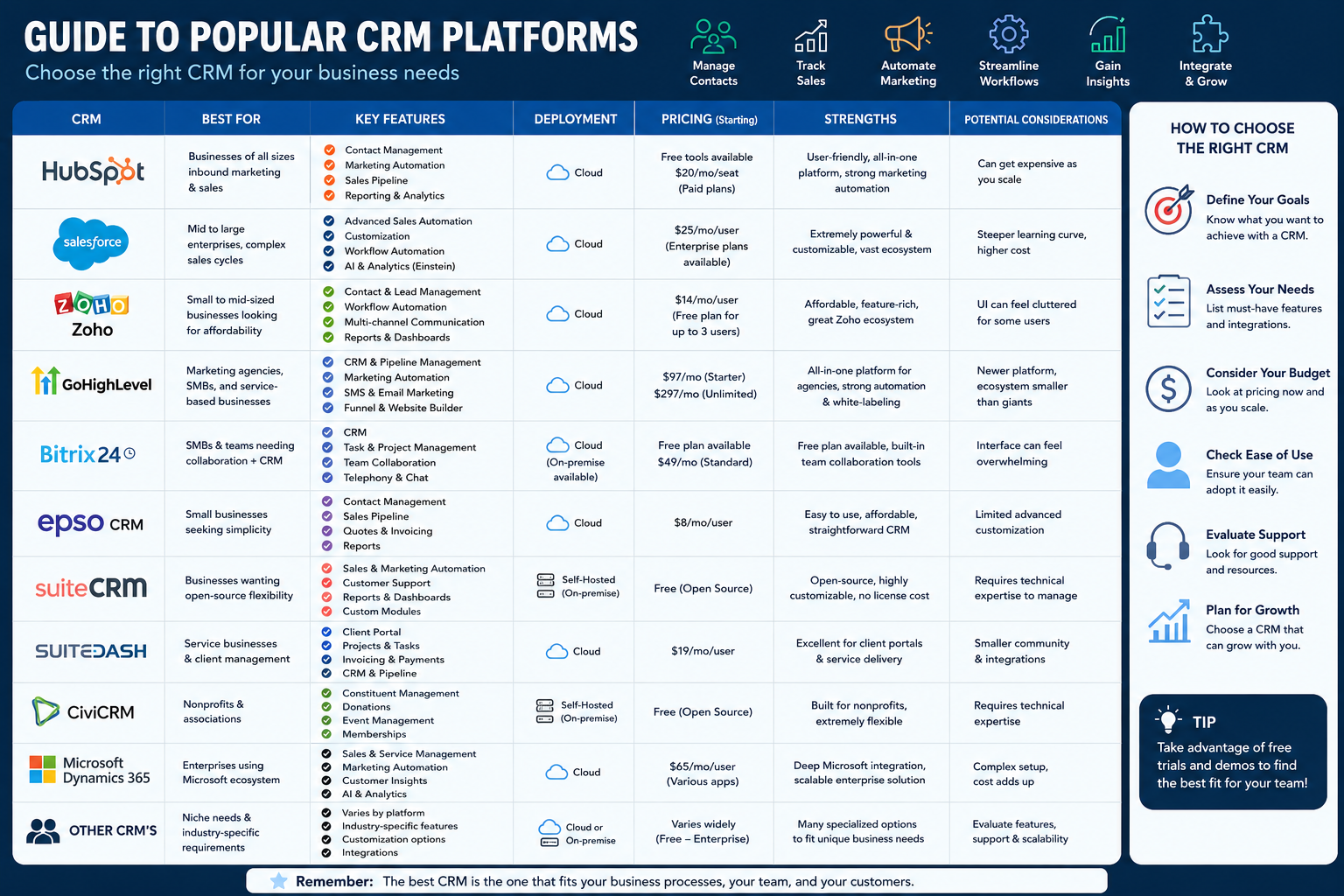
- Specialization: Deep-dive into specific platforms (Salesforce, HubSpot, Dynamics).
- AI-Augmentation: Learn to use AI tools to work faster and smarter.
Phase 1: The Universal Foundation (4-6 Weeks)
Before touching software, you must understand why CRMs exist. A CRM is not just a database; it is a revenue engine.
Core Concepts to Master:
- The Sales Pipeline: Lead, MQL, SQL, Opportunity, Quote, Closed-Won.
- Data Architecture: Objects (Leads, Contacts, Accounts), Fields, Relationships, and Record Types.
- The "Last Mile": Email integration, Calendar sync, and Activity tracking.
How to learn this for free (without a specific platform):
- HubSpot Academy: Take the "Sales Hub Certification" and "Inbound Marketing" courses. HubSpot is excellent for learning industry-standard pipeline management terminology because their interface is very intuitive.
- Microsoft Learn: Review the "Dynamics 365 Sales" learning paths to understand the enterprise perspective.
Practice:
- Use a free spreadsheet (Google Sheets or Excel) to manually build a pipeline tracker. Define stages, probabilities, and expected close dates. This low-tech practice forces you to think like a database architect.
Phase 2: Platform Specialization (8-12 Weeks)
Here, you will choose a "tribe." Do not learn all ten at once. The skills are highly transferable, but you need depth in one to get hired.
Path A: The Enterprise & AI Heavyweight (Salesforce & Microsoft Dynamics 365)
Target Roles: Salesforce Administrator, Business Analyst, Dynamics 365 Consultant.
Salary Potential: High, due to ecosystem complexity.
- The Resource: Trailhead by Salesforce.
- This is the gold standard of free tech education. You do not need a credit card. You get a free "Playground" (a fake org) to break and rebuild.
- The Path: Start with "Admin Beginner" trail, then "Sales Cloud Specialist". Aim for the "Associate Certification" first.
- AI Training: Salesforce has "Agentforce" and "Einstein." Trailhead has specific modules for "AI for Sales."
- Microsoft Route: Use the official Microsoft Learn platform. Focus on "Dynamics 365 Sales" and the new "Copilot" modules which teach you how to prompt AI to generate summaries and emails.
Path B: The Marketing & Growth Hub (HubSpot & Zoho)
Target Roles: Marketing Operations Manager, CRM Specialist, RevOps Analyst.
Resources:
- HubSpot Academy: Offers deep certifications (free) for Marketing Hub, Sales Hub, and Service Hub. Their "Reporting" certification is very valuable.
- Zoho: While Zoho offers its own free academy, niche platforms like airSlate Academy offer specific courses on automating Zoho workflows (document generation, approval processes).
- AI Edge: HubSpot’s "Content Assistant" and Zoho's "Zia" (AI assistant) are core features. Learn how to set up AI-powered sequence emails.
Path C: The Agency / Entrepreneur Stack (GoHighLevel & Bitrix24)
Target Roles: Marketing Agency Owner, Operations Manager, High-volume Sales Manager.
Resources:
- GoHighLevel (GHL): This software moves fast, so books get outdated. Use Community Hubs. The GHL Blueprint community on Skool is a massive free resource with step-by-step video walkthroughs.
- Bitrix24: Look for partner-led training. TLJ Academy (a Bitrix24 partner) offers specific modules on tasks, workflows, and telephony.
Path D: The Open-Source & Niche Specialist (SuiteCRM & CiviCRM)
Target Roles: Non-profit Technology Director, Developer, Cost-conscious Startup.
Resources:
- CiviCRM: This is specific to non-profits (Constituent Management). Use Joinery resources and the CiviCRM Stack Exchange for Q&A. They also have an AI "DocBot" to help you search documentation.
- SuiteCRM: Focus on the Developer Guide and the community forums. Learning PHP would be beneficial here if you want to customize it heavily.
Phase 3: Master AI Tools for Workflow (Integrate Throughout)
Modern CRM training is incomplete without AI. You are not training to replace the human, but to use the AI to do the work of three people.
What to learn:
- Prompt Engineering for CRM: How to tell the AI to draft a follow-up email from a lead note.
- Copilot for Service: Training specifically on how to use AI to summarize customer cases and draft knowledge base articles.
- Document Automation: Connecting tools like airSlate to CRM to auto-generate contracts when a deal is "Closed-Won".
Free Resource: Microsoft’s "Empower your workforce with Copilot" module. Even if you don't use Dynamics, the logic applies to Salesforce Einstein or HubSpot AI.
Career Application & Next Steps
Once you have completed your training, you need to translate that into a job. CRM professionals are hired for their ability to fix processes, not just click buttons.
Immediate Actions to Take (Next 30 Days):
1. Build a "Sandbox" Portfolio
- Do not just list "Completed Trailhead modules" on your resume.
- Action: Create a free Developer Edition org (Salesforce) or HubSpot account. Build a sample app for something you love (e.g., a CRM for a local dog-walking business or a small bookstore). Take screenshots of your custom reports and automation workflows.
2. Pursue the "High-Value" Free Certifications
- Salesforce: Aim for the free "Associate" cert or the "Business Analyst" cert.
- HubSpot: Get the "HubSpot Sales Software" certification (free for life).
- Note: You do not necessarily need the expensive proctored exams to get an entry-level job; the "Course Completion" certificates show initiative.
3. Tailor Your Resume for the Role
- For Consulting Roles: Highlight "Requirements gathering" and "User training." The job involves listening to a client, mapping their process to the software, and documenting it.
- For Admin Roles: Highlight "Data hygiene," "Dashboard creation," and "Automation rules."
4. The "Volunteer" Strategy
- This is the fastest way to get real experience. Offer to clean up the CRM for a local non-profit, a church, or a friend's startup.
- Why this works: You will encounter "dirty data" (duplicates, missing fields) which is what real-world work looks like, not the clean data from training courses.
5. Understand the Career Path
- Entry Point: Junior Admin or Sales Operations Analyst (Typically focusing on data entry -> reporting).
- Mid-Level: CRM Consultant or Administrator (Configuring fields, workflows, managing users).
- Senior: CRM Architect or RevOps Manager (Designing the entire tech stack strategy and integrating AI tools).
- Salary Expectation: In many markets, entry-level CRM roles start in the range of 50k−
- 50k−70k, with senior technical consultants earning significantly more as they bridge the gap between sales teams and IT.
The final recommendation:
Start with HubSpot Academy for the theory (it is the most polished free resource), and simultaneously open a Salesforce Trailhead account for the hard technical skills on data modeling. If you finish those two, you will be able to walk into any company using Zoho, Bitrix24, or SuiteCRM and figure it out in a week.
Any




 Group / 1: 1 Sessions