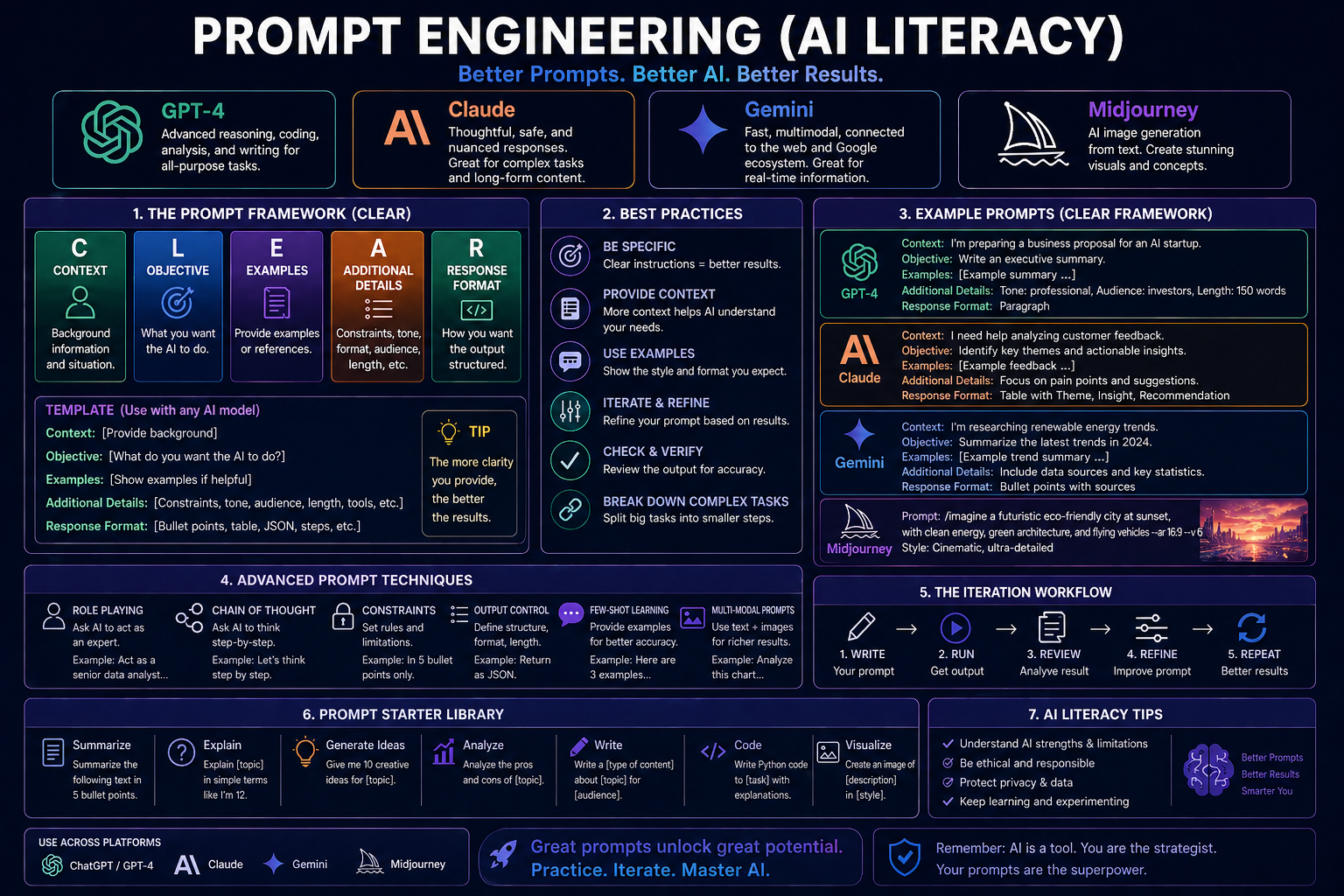
This roadmap is designed for learners from any bachelor's degree background—no coding experience required, though technical familiarity helps at advanced levels. The 1-2 month timeline assumes 10-15 hours per week, with a focus on developing AI literacy through hands-on practice across multiple models (GPT-4, Claude, Gemini, and image generators like Midjourney). Prompt engineering is fundamentally about learning to communicate effectively with AI systems, and this skill transfers across all tools you'll encounter.
Phase 1: Foundations - Learning to Talk to AI (Weeks 1-3)
Objective: Understand what large language models are, how they process prompts, and develop basic conversational fluency. No technical background required.
Beginner Focus:
Start by understanding the core concept: prompt engineering is the process of communicating effectively with AI to achieve desired results. You don't need to understand neural networks; you need to understand that LLMs are prediction engines that complete patterns based on their training.
The first skill is writing clear and specific instructions. Most beginners write vague prompts like "Write about dogs" and get mediocre results. Learn to specify format, length, tone, and audience. A better prompt: "Write a 100-word paragraph about Labrador retrievers for a children's book, using simple vocabulary and an enthusiastic tone."
Your goal in this phase is to use all four major models—ChatGPT (GPT-4), Claude, Gemini, and a brief introduction to Midjourney for image generation. Each model has slightly different strengths: Claude excels at following complex XML-structured instructions, Gemini is strong with clear task decomposition, and ChatGPT handles a wide range of creative and analytical tasks.
Practice the four core prompt patterns that apply across models: summarization (distilling long texts), inference (classification and extraction), transformation (translation and editing), and expansion (generating longer content from short prompts). These four patterns form the foundation of almost everything you'll do with LLMs.
Model-Specific Setup:
Create free accounts on each platform. For ChatGPT, use the free tier with GPT-3.5 or the limited GPT-4 access. For Claude, access through claude.ai free tier. For Gemini, use the free tier via Google AI Studio or the Gemini API playground. For Midjourney, you'll need a Discord account and a paid subscription (starting around $10/month), so prioritize this later or use free alternatives like Playground AI or Leonardo.ai initially.
Free and Paid Resources:
The single best starting point is the "ChatGPT for Everyone" course from Learn Prompting, created in partnership with OpenAI. It's completely free, takes about one hour, and covers account setup, prompt creation, use cases, and AI safety. With over 82,000 learners and a 4.8-star rating, it's the most accessible entry point.
For deeper foundational knowledge, IBM's "Generative AI: Prompt Engineering Basics" on Coursera (free audit option, 7 hours) covers zero-shot and few-shot prompting, chain-of-thought, and tree-of-thought techniques with hands-on labs. The free audit gives you full access to course materials without the certificate.
The Learn Prompting open-source course (free, self-paced) is the most comprehensive beginner resource available. It's cited by Wikipedia, used by employees at OpenAI and Scale AI, and has taught over 620,000 users. The course is structured by difficulty levels (indicated by colored dots) and lets you skip around based on your interests.
AI Tool Usage for Learning:
Use the AI itself to teach you prompting. A powerful meta-prompt: "I'm new to prompt engineering. Act as my tutor and give me 5 exercises to practice writing clear instructions for an LLM, starting with simple summarization tasks." Then paste the AI's response into a new chat and complete the exercises.
Practice Exercises:
Exercise 1: Take a 500-word Wikipedia article and paste it into ChatGPT. Write three different summarization prompts: one for a 50-word summary, one for a bulleted list of key facts, and one for a summary written for a 10-year-old. Compare the outputs.
Exercise 2: Practice inference by giving the model a restaurant review and asking it to extract the sentiment (positive/negative/mixed), the mentioned dishes, and the overall rating (1-5 stars). Try this with Claude and Gemini to see how outputs differ.
Exercise 3: Practice transformation by taking a formal email you've written and prompting "Rewrite this as a casual text message to a friend" and then "Rewrite this as a professional LinkedIn message." Notice how the model adjusts tone and vocabulary.
Exercise 4: Practice expansion by giving the model a one-sentence idea: "A smart device for houseplants." Prompt: "Generate 10 product features, then write a one-paragraph product description, then create a list of marketing taglines."
Phase 2: Intermediate - Structure, Examples, and Multi-Step Reasoning (Weeks 4-7)
Objective: Move from basic prompting to structured techniques that reliably produce high-quality outputs. Learn few-shot prompting, chain-of-thought reasoning, and model-specific optimization.
Intermediate Focus:
Zero-shot prompting (giving instructions without examples) is your baseline. But the real power comes from few-shot prompting—providing examples that show the model what "correct" looks like. For any task where format matters, include 2-5 examples in your prompt. This is especially important for classification, extraction, and structured output generation.
Example of few-shot prompting for classification:
"Classify the sentiment of each review as Positive, Negative, or Neutral.
Review: 'This product changed my life!' Sentiment: Positive
Review: 'Arrived broken and customer service ignored me.' Sentiment: Negative
Review: 'It works as expected, nothing special.' Sentiment: Neutral
Now classify: 'The battery life is decent but the screen is too dim.' Sentiment:"
The model learns the pattern from your examples and applies it consistently.
Chain-of-thought (CoT) prompting is essential for reasoning tasks. Instead of asking for a direct answer, ask the model to show its work. Compare: "What is 37% of 89?" versus "What is 37% of 89? Let's think step by step: First, calculate 10% of 89 = 8.9. Then calculate 1% of 89 = 0.89. 37% = 30% + 7% = (3 × 8.9) + (7 × 0.89). Let me calculate..." The step-by-step approach dramatically improves accuracy on math, logic, and multi-step reasoning tasks.
Model-Specific Techniques:
For Claude, learn to use XML tags to structure your prompts. Anthropic's official guidance indicates that XML tags help Claude parse complex prompts more accurately. Wrap instructions in <instructions></instructions>, examples in <examples></examples>, and input data in <input></input>. The Claude Handbook GitHub repository contains 32 detailed technique guides based on Anthropic's official documentation. The five core techniques to master: System Prompts (defining role and behavior), Clear Direct instructions, XML Tags for structure, Multishot Prompting (few-shot with Claude), and Chain of Thought for reasoning.
For Gemini, focus on the prompt design strategies from Google's official documentation. Key concepts include: understanding input types (question, task, entity, completion), using constraints to limit response length or scope, and specifying response format (JSON, tables, bulleted lists). Gemini excels at following format specifications when you provide a response prefix—starting the model's response for it.
For example, to get JSON output from Gemini:
"Valid fields are name, age, city.
Order: John is 30 and lives in Chicago.
Output:
{
"name": "John",
"age": 30,
"city": "Chicago"
}
Order: Sarah is 25 from Boston.
Output:"
Then let the model complete the pattern.
For Midjourney, learn the basic parameter structure: /imagine prompt [description] --aspect 16:9 --style raw --no [unwanted elements]. Move from simple prompts like "a cat" to structured prompts like "a cyberpunk cat wearing sunglasses, neon lights background, digital art style, high detail --ar 16:9 --v 6". Understand parameters for aspect ratio, stylization level, and chaos (randomness).
Advanced Technique - Prompt Chaining:
Instead of asking a model to do everything in one prompt, break complex tasks into chains. For example, to analyze a business document: Prompt 1: "Summarize this document in 3 bullet points." Prompt 2: "Based on the summary, identify 3 risks." Prompt 3: "For each risk, suggest a mitigation strategy." Each step uses the output of the previous step. This improves accuracy because each sub-task is simpler.
Free and Paid Resources:
The DAIR.AI Prompt Engineering Guide (free, open-source) is the most comprehensive reference available. With 58,000 GitHub stars, it covers every major technique: zero-shot, few-shot, chain-of-thought, self-consistency, prompt chaining, ReAct, and RAG. It includes model-specific guides for ChatGPT, Claude, Gemini, Llama, and Mistral, plus a Prompt Hub with ready-to-use examples for classification, coding, QA, and summarization.
The Claude Handbook GitHub repository (free) is essential if you plan to use Claude seriously. It contains 32 detailed technical guides, each following an 11-chapter structure with official verification, implementation examples, code templates, best practices, and testing methods. Start with the five core techniques: System Prompts, Clear Direct instructions, XML Tags, Multishot Prompting, and Chain of Thought.
Vanderbilt University's "Prompt Engineering for ChatGPT" on Coursera (free audit, 18 hours) is more comprehensive than shorter courses. It covers prompt patterns, advanced techniques, and real-world applications. The instructor leads you through building actual applications like a recipe generator and a travel planner.
Google's official Gemini API documentation includes a detailed prompt design strategies guide with dozens of examples. It covers zero-shot vs. few-shot, optimal number of examples, consistent formatting, and response prefix strategies.
Practice Exercises:
Exercise 1 - Few-Shot Classification: Create a prompt that classifies customer support tickets into three categories (Billing, Technical, General). Write 5 examples for each category, then test on 10 new tickets you invent. Iterate on your examples until the model achieves 90% accuracy
.
Exercise 2 - Chain of Thought: Take 5 logic puzzles or math word problems. First, ask the model directly for the answer. Then, ask the same questions with "Let's think step by step" added. Compare accuracy. Document the improvement percentage.
Exercise 3 - XML Structure with Claude: Write a complex prompt that includes system instructions (in <system> tags), three examples (in <examples> tags), and a user question (in <input> tags). Ask Claude to follow a specific output format
using <quotes> and <answer> tags. Test how removing the XML tags changes output quality.
Exercise 4 - Gemini Response Prefix: Create a prompt asking for JSON output from Gemini. First, give only instructions. Second, give instructions plus a response prefix (start the JSON object for the model). Compare whether the prefix improves format compliance.
Exercise 5 - Midjourney Parameter Mastery: Generate 5 images of the same subject (e.g., "a futuristic library") using different aspect ratios (--ar 1:1, 16:9, 4:5), different stylization levels (--s 100, 500, 1000), and different versions (--v 5, --v 6). Document how each parameter affects the output.
Phase 3: Advanced - Application Building and Specialization (Weeks 8-10)
Objective: Build practical applications using prompt engineering as the core technology. Move from ad-hoc prompting to system design with memory, tool use, and specialized techniques.
Advanced Focus:
At the advanced level, you're no longer writing one-off prompts—you're designing prompt-based systems. The most common advanced pattern is Retrieval-Augmented Generation (RAG), where the model has access to external documents. Instead of relying on the model's training data (which may be outdated or incomplete), you retrieve relevant information from a knowledge base and inject it into the prompt.
For RAG, your prompt needs to: 1) Accept retrieved documents as context, 2) Instruct the model to base answers only on those documents, 3) Handle cases where the documents don't contain the answer, and 4) Cite sources. A sample RAG prompt structure:
"Here are documents retrieved from our knowledge base:
<documents>
{documents_with_sources}
</documents>
Answer the user's question using ONLY information from these documents. If the documents don't contain the answer, say 'I cannot find this information in the available documents.' Cite which document provided each piece of information.
Question: {user_question}"
Tool use is another advanced pattern. Modern LLMs can be configured to call external tools—search engines, calculators, databases, APIs. While implementing tool use requires programming, understanding the prompt structure for tool use is valuable for AI literacy. The prompt typically includes: a description of available tools, their parameters, examples of tool use, and instructions for when to use each tool.
System prompts become critical at this level. Unlike user messages that change with each interaction, system prompts set persistent behavior for an entire conversation. A well-crafted system prompt defines the AI's role, constraints, tone, and capabilities. Example system prompt for a customer support bot:
"You are a customer support agent for an electronics company. You are helpful, patient, and concise. You never invent information about products—if unsure, you say 'I need to check with my team.' You always ask for order numbers when discussing specific purchases. You escalate to a human agent if a customer mentions returns or refunds."
Hallucination Mitigation:
Advanced prompt engineers know how to reduce hallucinations (the model inventing false information). Strategies include: 1) Explicit instructions ("Only answer using the provided text"),
2) Asking for citations ("Quote the exact sentence that supports your answer") 3) Converting generative tasks to classification tasks (reducing open-ended generation), 4) Using chain-of-thought to expose reasoning, and 5) Setting appropriate temperature parameters (lower temperature = less creative, more factual).
Evaluation and Testing:
At the professional level, you need to evaluate prompt performance systematically. Create a test set of inputs with expected outputs. Run your prompt against the test set and measure accuracy. For generative tasks, use LLM-as-judge: ask a separate model instance to evaluate the output quality on criteria like helpfulness, accuracy, and conciseness.
Free and Paid Resources:
DeepLearning.AI's "ChatGPT Prompt Engineering for Developers" (free, 1.5 hours) is taught by OpenAI's Isa Fulford and Andrew Ng. It focuses on API-based applications for summarization, inference, transformation, and expansion, plus a full chatbot-building section. Over 300,000 learners have enrolled. The course uses built-in Jupyter notebooks so you can experiment with code without installing anything.
The Complete Prompt Engineering Bootcamp on Udemy (paid, around $15 on sale, 19 hours) requires some Python skills but covers prompting principles, AI models, real-world projects, and advanced techniques. It's the most comprehensive paid option if you want to combine prompting with basic coding.
Google's "Prompt Engineering with Gemini API" lab (free on Google Cloud Skills Boost, hands-on) covers prompt design for ideation, question answering, text classification, extraction, and summarization. It includes system instructions for guardrailing and strategies for reducing hallucinations.
The Midjourney Documentation (free) contains the official guide to all parameters, commands, and settings. Spend time understanding --stylize (affects artistic interpretation), --chaos (affects variety across image grids), --no (negative prompting to exclude elements), and --seed (reproducible results).
For RAG implementation without coding, explore no-code tools like Google's AI Studio or Anthropic's Console, which allow you to upload documents and build RAG applications through a graphical interface.
Practice Exercises:
Exercise 1 - Build a RAG System (No Code): Use Google AI Studio or Anthropic Console to upload 5-10 documents (PDFs or text files) about a specific topic (e.g., your company's product documentation). Create a prompt that answers user questions using only these documents. Test with questions inside and outside the document scope. Measure how often the model correctly says "I don't know" for out-of-scope questions.
Exercise 2 - System Prompt Design: Write three different system prompts for the same role (e.g., "fitness coach"). Variation 1: Motivational and enthusiastic. Variation 2: Scientific and data-driven. Variation 3: Strict and disciplined. Chat with each for 10 exchanges. Document how the system prompt changes the interaction style.
Exercise 3 - Hallucination Reduction: Take a prompt where the model previously hallucinated (invented a fact). Apply three hallucination reduction techniques: 1) Add explicit "only use provided information" instructions, 2) Ask for citations, 3) Lower the temperature parameter if using an API. Test whether hallucination rate improves.
Exercise 4 - Midjourney Style Exploration: Build a prompt library for a consistent visual style. Create 10 images using a structured prompt format: "Subject in [style] style, [lighting description], [color palette], [camera angle] --ar 16:9 --v 6 --s 500". Save the exact prompt for each image. Notice which parameters affect which aspects of the output.
Exercise 5 - Evaluation Framework: For a specific task (e.g., email drafting), create a test set of 10 inputs and your ideal outputs. Run your prompt against all 10. Score each output on a scale of 1-5 for accuracy, tone, and conciseness. Iterate on your prompt until you achieve an average score of 4.5 or higher.
Final Portfolio Project: The Prompt Engineering Toolkit
To demonstrate comprehensive AI literacy across models and techniques, build a "Prompt Engineering Toolkit" that showcases your ability to adapt prompts to different tasks and models. This is not a single application but a collection of 10-15 battle-tested prompts organized by use case.
Project Title: Multi-Model Prompt Library
Create a structured document or GitHub repository containing:
- Summarization Module: Three prompts optimized for different scenarios: a 50-word executive summary, a bulleted key-points list, and a detailed summary for subject matter experts. Test across ChatGPT, Claude, and Gemini, noting how each model performs.
- Extraction Module: Prompts for extracting structured data from unstructured text. Include few-shot examples that work reliably. Document the model-specific adjustments needed (XML tags for Claude, response prefixes for Gemini).
- Transformation Module: Prompts for tone shifting (formal to casual), format conversion (paragraph to bullet points), and language translation with cultural adaptation.
- Reasoning Module: Chain-of-thought prompts for math, logic, and analytical tasks. Include the "step by step" instruction patterns that yield the highest accuracy.
- Image Generation Module (Midjourney): A structured prompt template with parameters documented. Include 5 examples showing how different --s (stylize) values change the output for the same subject.
- System Prompts: Three complete system prompts for different personas (customer support agent, creative writing coach, technical tutor), each with documented design decisions.
- RAG Template: A prompt template designed for retrieval-augmented generation, with document formatting, source citation requirements, and hallucination guardrails.
- Evaluation Protocol: Your method for testing and comparing prompt performance across models, including a scoring rubric and test cases.
This toolkit demonstrates that you understand prompt engineering as a systematic discipline, not just random experimentation. It shows recruiters that you can adapt to any LLM, structure prompts for reliability, and evaluate outputs critically.
Career Application and Next Steps
After completing this 1-2 month roadmap, you will have AI literacy that is valuable across virtually every white-collar role. Specific job titles that value prompt engineering include: AI Trainer, Prompt Engineer, LLM Operations Specialist, AI Product Manager, Technical Writer for AI Documentation, and AI Integration Specialist. However, the most common path is adding prompt engineering as a skill to an existing role—marketer, product manager, developer, analyst, or educator.
To demonstrate your skills professionally:
- Add "Prompt Engineering" as a skill on LinkedIn with specific techniques listed (few-shot, chain-of-thought, RAG)
- Share your Prompt Engineering Toolkit on GitHub and link to it from your resume
- Complete a free certificate from DeepLearning.AI or IBM and add it to your LinkedIn certifications section
- Write 2-3 LinkedIn posts demonstrating a specific prompting technique with before/after examples
The field evolves rapidly, so continue learning through communities like Learn Prompting (33,000+ Discord members), DAIR.AI (open-source contributors), and the Prompt Engineering Guide (updated continuously with new research). The most advanced prompt engineers stay current by reading papers from the 1,500+ academic studies analyzed in the field's comprehensive surveys.
Remember: prompt engineering is fundamentally about communication clarity. The technical skill matters less than the discipline of specifying exactly what you want, providing examples, and iterating based on results. That skill transfers to every AI tool you'll encounter in your career.
Career Application & Next Steps: Prompt Engineering & AI Literacy
You have just completed a 1-2 month journey that transforms you from someone who types basic questions into chatbots into someone who systematically engineers AI outputs for reliability, accuracy, and creativity. The key shift you've mastered is understanding that AI models are not magic oracles—they are pattern completion engines that respond predictably to well-structured inputs. Your toolkit now demonstrates few-shot prompting, chain-of-thought reasoning, model-specific optimization, RAG systems, and rigorous evaluation—skills that are immediately valuable across virtually every white-collar role.
Where You Fit in the Market
Prompt engineering is unique because it is rarely a standalone career for beginners. Instead, it is a force multiplier skill that enhances your existing domain expertise. A marketer who can engineer prompts generates better copy faster. A product manager who can engineer prompts writes clearer specifications. A developer who can engineer prompts debugs code more efficiently. An educator who can engineer prompts creates better lesson plans.
Three primary career paths emerge from this roadmap, ranging from pure prompt engineering to AI-augmented domain roles:
Specialist Prompt Engineer (Emerging Role): This title exists at AI-first companies like Anthropic, OpenAI, Scale AI, and consultancies building LLM applications. You own the prompt optimization process, build evaluation suites, and maintain prompt libraries. These roles typically require some programming skills (for API integration) but prioritize linguistic precision and systematic testing over deep coding. Entry-level salaries range 80k−
80k−120k depending on location and company stage.
AI Product Manager / AI Business Analyst: You use prompt engineering to accelerate product work—generating user stories, analyzing feedback, writing documentation, and prototyping features. Your value is combining domain knowledge (e.g., healthcare, finance, education) with AI literacy to ship faster. This path requires no coding but demands strong product instincts. Salaries match standard product roles
(90k−90k−140k) with an AI premium.
AI-Augmented Domain Professional (Most Common): You add "Prompt Engineering" as a skill to your existing title: Marketing Analyst + AI, Technical Writer + AI, Customer Success + AI, Operations Analyst + AI, Educator + AI. Your resume now includes specific prompting techniques as tools in your toolkit. This path has no salary premium beyond your domain, but it makes you more efficient, more valuable, and harder to replace.
For the first 6-12 months after this roadmap, focus on becoming the AI-literate person on your current team or in your current domain. Do not quit your job to become a full-time prompt engineer unless you already have programming skills and a portfolio of API-based applications. Instead, use these skills to excel in your current role, then leverage that success into a more AI-focused position.
Your Portfolio: The Prompt Engineering Toolkit
Your "Multi-Model Prompt Library" is not just a collection of text files. It is your demonstration of systematic thinking, cross-model fluency, and quality assurance. Every hiring manager or client who sees this toolkit will know you understand that prompting is engineering, not magic.
Structure your toolkit repository with obsessive clarity. The README must state your philosophy: "Prompt engineering is the discipline of crafting inputs to produce reliable, measurable outputs. This toolkit contains battle-tested prompts organized by task type, with evaluation metrics and model-specific optimizations."
Organize the repository by module:
summarization/ - Three prompts (executive, bulleted, detailed) with test documents and output examples for ChatGPT, Claude, and Geminiextraction/ - Few-shot prompts for entity extraction, sentiment analysis, and classification with documented accuracy scorestransformation/ - Tone shifting, format conversion, and translation prompts with before/after examplesreasoning/ - Chain-of-thought prompts for math, logic, and analytical tasks with accuracy comparisonsimage/ - Midjourney structured templates with parameter documentation and image output samplessystem_prompts/ - Three complete system prompts with design rationalesrag/ - RAG prompt template with citation requirements and hallucination guardrailsevaluation/ - Your test methodology, scoring rubric, and sample evaluation runs
The documentation distinguishes you from casual prompt collectors. Write USAGE.md explaining when to use each prompt type, how to adapt prompts to different models, and common failure modes to watch for. Write EVALUATION.md detailing your test methodology: how many test cases, what scoring criteria, how you handle edge cases, and how you iterated to reach target accuracy. Include a CHANGELOG.md showing how your prompts evolved based on testing—this signals that you treat prompting as an iterative engineering discipline.
Certifications: Optional but Helpful for Credibility
Prompt engineering certifications are still emerging. Unlike established fields like cloud architecture or security, no single certification dominates hiring. However, several credentials signal serious commitment:
DeepLearning.AI's "ChatGPT Prompt Engineering for Developers" (Free certificate): This is the most recognized course in the field, taught by OpenAI's Isa Fulford and Andrew Ng. The certificate confirms you understand API-based prompting, summarization, inference, transformation, and expansion. Add it to your LinkedIn certifications section.
IBM's "Generative AI: Prompt Engineering Basics" (Coursera, free audit, paid certificate): IBM's brand carries weight in enterprise hiring. The certificate covers zero-shot, few-shot, chain-of-thought, and tree-of-thought techniques. The paid version ($49-79) includes graded assessments and a shareable certificate.
Vanderbilt University's "Prompt Engineering for ChatGPT" (Coursera, free audit, paid certificate): This 18-hour course is more comprehensive than shorter options. The certificate signals deeper commitment. If you completed the full course, definitely add it to your profile.
Learn Prompting's Certification (Paid, ~$150): Learn Prompting is the most respected community-driven education platform for prompt engineering. Their certification includes practical assessments, not just multiple-choice questions. It is recognized within the AI community but less known to general recruiters.
Do not collect multiple certifications. Choose one (DeepLearning.AI is the best starting point), complete it, add it to LinkedIn, and move on. Your portfolio toolkit is far more valuable than any certificate.
Resume Transformation: From "Used ChatGPT" to "Engineered Prompts"
Your resume must replace vague "familiar with AI" statements with specific prompting techniques and measurable outcomes. This applies whether you are applying for specialist roles or adding AI literacy to an existing domain.
Replace weak statements like "Experienced with ChatGPT for content creation" with specific engineering language:
- "Designed few-shot classification prompts achieving 92% accuracy on customer support ticket categorization across 10 test categories"
- "Implemented chain-of-thought prompting for analytical tasks, improving mathematical reasoning accuracy from 65% to 88% compared to zero-shot baselines"
- "Built cross-model prompt library (ChatGPT, Claude, Gemini) with model-specific optimizations including XML tags for Claude and response prefixes for Gemini"
- "Developed RAG system for product documentation, enabling answer retrieval from 50+ pages with citation and hallucination guardrails, achieving 95% answer accuracy on in-scope questions"
- "Created systematic evaluation framework for prompt quality, including 50-test-case dataset and LLM-as-judge scoring on three dimensions (accuracy, tone, conciseness)"
If you are adding prompt engineering to an existing role, integrate these bullet points into your domain accomplishments. For example, a marketer might write: "Engineered prompts for ad copy generation using few-shot techniques with Gemini, reducing copywriting time by 40% while maintaining brand voice consistency across 20+ campaigns."
Add a "Skills" section that includes specific techniques: Zero-shot Prompting, Few-shot Prompting, Chain-of-Thought, Prompt Chaining, RAG, System Prompt Design, Hallucination Mitigation, LLM Evaluation, Cross-Model Optimization (ChatGPT, Claude, Gemini, Midjourney).
Where to Find Opportunities
Your job search strategy depends on whether you are pursuing specialist prompt engineering roles or adding AI literacy to a domain role.
For Specialist Prompt Engineering Roles:
Job titles to search: Prompt Engineer, AI Prompt Engineer, LLM Operations Specialist, Generative AI Specialist, AI Trainer, Conversation Designer. On LinkedIn, set alerts for "prompt engineering," "few-shot prompting," "chain-of-thought," and "LLM evaluation."
Companies hiring specialist prompt engineers fall into tiers:
AI model providers: Anthropic (Claude), OpenAI (ChatGPT), Google (Gemini), Cohere, Mistral. These companies need prompt engineers for model testing, red-teaming, and documentation. Roles are competitive but high-prestige.
AI application builders: Companies building LLM-powered products like Jasper, Copy.ai, Runway, or any YC AI cohort. These roles involve prompt optimization for specific use cases—marketing copy, code generation, image prompts.
Consultancies and agencies: Deloitte, Accenture, BCG X, and smaller AI consultancies hire prompt engineers for client projects. The work is varied (different domains every few months) and excellent for building portfolio diversity.
Enterprise AI teams: Large companies (Walmart, JPMorgan, Nike) building internal AI tools. These roles are more stable but may involve slower iteration and more bureaucracy.
For specialist roles, your portfolio toolkit is your primary credential. Link it prominently on your resume, LinkedIn, and applications. Share it in relevant subreddits (r/PromptEngineering, r/LocalLLaMA) and Discord communities (Learn Prompting, DAIR.AI) for feedback—visibility in these communities leads to referrals.
For Adding AI Literacy to Your Domain Role:
This is the more common and often wiser path. Update your LinkedIn headline and summary to reflect AI literacy: "Marketing Analyst | AI-Augmented | Prompt Engineering for Content & Analytics" or "Customer Success Manager | Prompt Engineering for Support Automation."
Internally, volunteer for projects that involve AI. Offer to build a prompt library for your team's common tasks (summarization, extraction, content generation). Document the time savings. Become the team's AI resource. This internal visibility leads to promotions or lateral moves into AI-focused roles.
Externally, target companies that are adopting AI but lack AI literacy. Most small-to-mid-sized businesses need employees who can bridge the gap between AI capabilities and business needs. Your resume should say: "I can help your team use AI effectively without hiring a full engineering team."
The Interview Process: What to Expect
The specialist prompt engineering interview typically consists of three to four rounds. The domain-plus-AI interview follows domain norms but adds a prompt engineering demonstration.
Screening call (30 minutes): Expect questions like "What's the difference between zero-shot and few-shot prompting?" and "How do you reduce hallucinations?" Your Phase 1 and Phase 3 knowledge answers these directly. Mention your evaluation framework and RAG experience.
Technical prompt design round (60 minutes, often live): The interviewer gives you a task: "Design a prompt that extracts all dates, dollar amounts, and counterparty names from this contract excerpt." Or "Write a chain-of-thought prompt for this logic puzzle." You'll share your screen and iterate on the prompt in real time. Use your toolkit patterns: start with instructions, add few-shot examples if needed, specify output format, test with edge cases. Speak aloud about your design decisions—this shows systematic thinking.
System design round (senior roles, 60 minutes): "Design a prompt-based customer support system for an e-commerce company." You'll discuss: classification (few-shot for intent), RAG for product knowledge, system prompts for brand voice, evaluation methodology, and hallucination guardrails. Your Phase 3 RAG exercise and Phase 2 system prompts prepare you exactly for this.
Portfolio review (45 minutes): You walk the interviewer through your Multi-Model Prompt Library. Explain a specific prompt you optimized, the iterations you made, the evaluation results, and a lesson learned. This is your strongest round because your portfolio is real, not theoretical.
For domain-plus-AI roles: The interview follows standard domain patterns, but you will face an AI literacy question: "How would you use AI to improve [domain task]?" Have a concrete answer ready from your Phase 3 practice. For example, a product manager might say: "I would build a RAG system over user feedback to generate prioritized feature requests with supporting evidence."
The AI Tools Advantage in Your Job Search
Use the same AI models you mastered to accelerate your job search. This meta-application of prompt engineering demonstrates the skill in action.
Use ChatGPT to tailor your resume. Paste the job description and your resume, then prompt: "Rewrite my prompt engineering experience bullet points to match keywords from this job description. Keep all claims truthful and specific. Emphasize my evaluation methodology and cross-model testing."
Use Claude to practice interview questions. Prompt: "Act as a prompt engineering interviewer at Anthropic. Ask me five technical questions about few-shot prompting, chain-of-thought, RAG, hallucination mitigation, and evaluation. After each answer, give me feedback on what I missed and how to improve."
Use Gemini to research target companies. Prompt: "Research [Company Name] and tell me what AI models and prompt engineering techniques they likely use based on their engineering blog, job posts, and product features. Identify gaps in their current approach that I could address in an interview."
Use Midjourney to create a memorable portfolio cover image or LinkedIn banner that visually represents your toolkit. A well-designed image signals attention to detail and AI fluency.
Six-Month Post-Roadmap Plan
Month 1: Certify if you chose that path. Complete the DeepLearning.AI "ChatGPT Prompt Engineering for Developers" course and add the certificate to LinkedIn. Publish your Prompt Engineering Toolkit to GitHub with a polished README. Share it on LinkedIn with a post: "After 2 months of systematic study, I've built a prompt engineering toolkit optimized for reliability and cross-model performance. Key takeaway: few-shot examples and chain-of-thought matter more than model choice."
Month 2: Build visibility. Write 2-3 LinkedIn posts demonstrating specific prompting techniques with before/after examples. Example post: "I tested zero-shot vs few-shot classification on 100 customer support tickets. Accuracy improved from 72% to 91% with just 3 examples per category. Here's the template I used." Join the Learn Prompting Discord (33,000+ members) and DAIR.AI community. Share your toolkit for feedback.
Month 3: Apply or pivot. If pursuing specialist roles, apply to 5-10 companies per week. Include a link to your toolkit in every application. If adding AI literacy to a domain role, update your internal resume, volunteer for AI projects, and start conversations with your manager about AI-augmented workflows.
Months 4-5: Interview or execute. For specialist job seekers, expect 4-8 weeks from first screen to offer. Be patient. For every rejection, ask for one piece of feedback. If consistent feedback is "weak on API integration," spend two weeks learning basic Python and LangChain. If "weak on evaluation methodology," expand your evaluation suite with more test cases and LLM-as-judge scoring.
Month 6: Assess and iterate. If you landed a role, congratulations—your toolkit worked. If not, expand your toolkit with more complex techniques (ReAct, self-consistency, tree-of-thoughts) or contribute to an open-source prompt engineering project. Consider targeting adjacent roles (AI product manager, technical writer for AI, AI trainer) rather than pure prompt engineer.
The Long Game: Growing Beyond This Roadmap
Prompt engineering as a standalone field will evolve rapidly over the next 2-3 years. The most likely trajectory is that basic prompting becomes a standard skill like typing or email, while advanced prompt engineering merges with software engineering (for API-based systems) or product management (for AI feature design).
Your long-term career growth depends on whether you specialize or generalize:
Specialize (API + Programming): Learn Python, LangChain, and basic API integration. Move from prompt design to building AI applications. Role titles: AI Engineer, LLM Application Developer, RAG Specialist. Timeline: 3-6 months of programming fundamentals, then start building applications using your prompt engineering as the core logic layer.
Specialize (Product + Domain): Learn AI product management, user research for AI features, and evaluation methodologies. Move from prompt design to AI feature strategy. Role titles: AI Product Manager, Generative AI Strategist, AI Business Analyst. Timeline: 1-2 months of product fundamentals, then apply to roles at AI-first companies or AI teams within enterprises.
Generalize (Domain + AI Literacy): Keep prompt engineering as a tool within your existing domain. Become the most AI-literate person in your field—marketing, education, operations, customer success. Role titles stay the same, but your efficiency and value increase. This path has the lowest barrier to immediate application.
The technology will evolve. New models will emerge with different strengths. Prompting techniques will become standardized and possibly automated. What does not change is the meta-skill you built: the discipline of specifying exactly what you want, providing examples, iterating based on results, and measuring quality systematically. That skill transfers to every AI tool you will encounter for the rest of your career.
You started with typing "Write about dogs" into ChatGPT. You ended with a multi-model, evaluation-driven, RAG-capable, systematically optimized prompt engineering toolkit. The field is new, the standards are emerging, and you are ahead of the curve. Now go apply your AI literacy to the work you already do—or to the new role you will create for yourself.
Any Bachelor's degree




 Group / 1: 1 Sessions