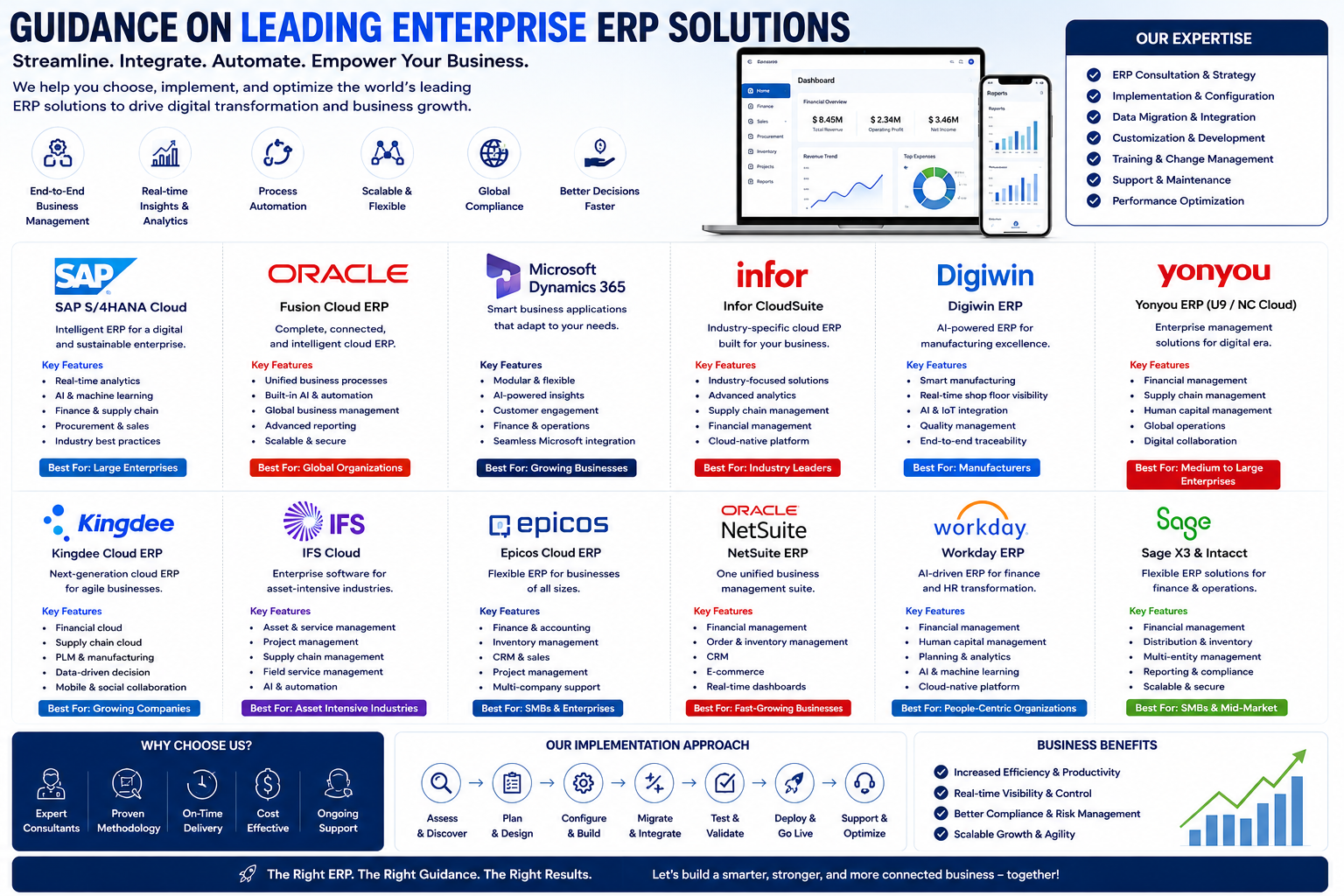
Advanced ERP's
- SAP (S/4HANA Cloud): Best for Large & Global Enterprises
- Key Features: Industry-leading real-time analytics, in-memory computing, and advanced AI (Joule). Supports 25+ industries and 200+ country regulations.
- Oracle (Fusion Cloud ERP): Best for Data-Heavy & Finance-Focused Firms
- Key Features: Autonomous AI agents, financials with embedded GenAI, and top-tier security. Excels at processing massive volumes of data with high accuracy.
- Microsoft Dynamics 365: Best for Microsoft Ecosystem Users
- Key Features: Native integration with Office 365, Teams, and Power BI. Features Copilot AI assistant and a modular, flexible design.
- Infor: Best for Specific Industrial Verticals
- Key Features: Deeply tailored CloudSuite solutions (e.g., for Aerospace, Automotive). Highly intuitive, role-based user interfaces.
- Digiwin: Best for Manufacturing & China Market Leadership
- Key Features: #1 in China's manufacturing ERP segment. Strong AI for production scheduling and IIoT integration; T-series offers full lifecycle coverage.
- Yonyou: Best for Large SOEs & Complex Group Governance
- Key Features: YonBIP platform excels at cloud-native, full-stack IT architecture. Widely adopted by state-owned and large enterprises.
- Kingdee: Best for Mid-Market & Cloud-Native Growth
- Key Features: 100% cloud-native (EAS Cloud, K/3 Cloud). Focuses on easy deployment, "Financial + Business + Taxation" integration, and AI assistants.
- IFS: Best for Heavy Industry & Asset-Intensive Sectors
- Key Features: Specializes in Enterprise Asset Management (EAM) and Field Service Management (FSM) for sectors like energy and construction.
- Epicor: Best for Industrial Manufacturing & SMBs
- Key Features: Kinetic ERP is designed specifically for SMBs in making, moving, and selling products. Strong MES capabilities.
- NetSuite (Oracle): Best for Fast-Growing Midmarket & DTC Brands
- Key Features: True cloud-native unified suite (ERP/CRM/Ecommerce). Offers strong scalability and real-time financial visibility.
- Workday: Best for Service-Based & People-Centric Orgs
- Key Features: Renowned for HR and Financial Management. Provides a unified data model for HR, payroll, and planning.
- Sage (X3 & Intacct): Best for Midsize Enterprises & Project Accounting
- Key Features: Sage X3 is strong in manufacturing, while Sage Intacct is a leading financial management solution.
How to Choose the Right ERP System
Selecting an ERP is a significant decision. Here are a few key considerations to guide your research:
- Assess "Best Fit" vs. "Best in World": The most expensive or globally recognized system (like SAP or Oracle) is not always the best. If you are a manufacturing SME in Asia, a solution like 鼎捷 (Digiwin) or Epicor may offer better industry-specific features and local support at a lower total cost .
- Deployment Preference (Cloud vs. On-Premise): Modern ERPs are mostly cloud-native (e.g., NetSuite, SAP Public Edition), offering lower upfront costs and automatic updates. However, some industries or regulations may require on-premise or hybrid deployments (offered by SAP Private Edition or Microsoft) .
- User Adoption: An ERP is only effective if people use it. Solutions like Microsoft Dynamics 365 leverage familiar interfaces (like Teams), while Infor focuses on specialized consumer-grade UIs to reduce training time .
🗺️ The ERP Training Roadmap
This roadmap assumes you are starting from scratch. Focus on one ERP ecosystem first (like SAP or Oracle) to build deep, marketable expertise before expanding into others .
Phase 1: Foundation & First Principles (Weeks 1-4)
Goal: Understand what ERP is and how it solves real business problems.
- Learn the Business Process First: Before touching any software, understand the real-world logic. Learn how a plant runs, how materials move through a supply chain, or how financial postings work. An ERP system simply digitizes and automates these existing processes .
- Take a Foundational Course: Start with a free, high-level course to see the big picture.
- SAP Path: Enroll in the free course *"Intelligent ERP with SAP S/4HANA Cloud"* on SAP Learning (available via Class Central). This covers how AI and machine learning are built into modern ERPs .
- General Path: Look for introductory videos on YouTube explaining core concepts like General Ledger (GL), Accounts Payable (AP), and Supply Chain Management (SCM).
- Choose Your Module Wisely: Match your first module to your background. If you are from finance, start with SAP FI or Oracle GL. If you are from a technical background (IT/Engineering), start with SAP ABAP or Oracle Technical .
Phase 2: Deep Dive & Technical Skills (Weeks 5-12)
Goal: Get hands-on with the software and learn the specific tools of the trade.
- Set Up a Practice Environment: You need a sandbox to play in.
- Odoo/Open Source: Download the free Community Edition or use an online demo .
- SAP: Students can access the SAP Learning Hub for free using their university email .
- Oracle: Use Oracle's free Cloud trial environments to practice .
- Master the Core Technical Skills: Focus on the specific toolkit required for your chosen path.
- For Oracle Fusion: Learn SQL, PL/SQL, BI Publisher (for reports), and Oracle Integration Cloud (OIC) .
- For SAP S/4HANA: Learn the core transactions for your module (e.g., MM, SD, FI), understand "Org Structure," and learn "Master Data" management .
- Follow a Structured Roadmap:
- Oracle Path: Follow the Oracle Certification Roadmap 2026. Start with Oracle Fusion General Ledger (GL) as the foundation, then move to AP/AR or SCM .
- SAP Path: Follow the 60-day foundation plan: focus on mastering one "End-to-End" cycle (like Procure-to-Pay) before moving to configuration .
Phase 3: Certification & Portfolio Building (Weeks 13-16)
Goal: Prove your skills to employers.
- Earn a Certification: Certifications validate your knowledge and significantly boost hiring chances.
- SAP: Students get 2 free certification attempts through the SAP Learning Hub. Target the SAP S/4HANA or SAP BTP certifications .
- Oracle: Target the Oracle Cloud Infrastructure (OCI) Foundations (Beginner) and then the Oracle Integration Cloud (OIC) Specialist (High value) .
- Build a "Proof Portfolio": Don't just list certificates on your resume. Create a portfolio that proves you can do the job. Include :
- 3 Mini Case Studies: Document a specific business problem you solved in your practice system.
- 1 End-to-End Flow: Map out a full process (e.g., "Create Purchase Order -> Receive Goods -> Pay Vendor").
- 1 Error-Handling Document: Show you know how to fix common system errors.
🛠️ Free vs. Paid Training Resources
You can get very far using free resources, but paid options offer structure and deeper dives.
Resource TypeExamplesBest ForFree ResourcesSAP Learning Hub (Free for students) , Odoo Education Program (Free databases & workshops) , Class Central (Free SAP/Oracle intro courses) , YouTube (Tutorials), Oracle ERP Guide (Blogs & roadmaps) .Beginners and students who need foundational knowledge and practice environments.Low-Cost/PaidUdemy/Coursera (Courses for 10−
10−50), Oracle ERP Guide Subscription (Structured learning paths) , Official Oracle University (High cost, but official depth) .Professionals seeking structured guidance, specific exam prep, or official training hours.
📈 Career Application & Next Steps
Once you have the skills, here is how to translate them into a job.
Step 1: Target the Right Entry-Level Roles
You probably won't start as a lead consultant. Look for roles that build project experience :
- ERP Support Analyst: Helping users with daily tickets. Great for learning real-world issues.
- Junior Functional Consultant: Assisting senior consultants on implementation projects.
- Data Migration Associate: Moving data from old systems to the new ERP (a critical first step in any project).
- Technical Fresher (SAP/Oracle): Many large consulting firms (like Accenture, Deloitte, Infosys, Wipro) have massive hiring batches for freshers .
Step 2: Optimize Your Job Search
- Build a LinkedIn Profile: Add keywords like "Oracle Fusion Technical | OIC | BIP" or "SAP S/4HANA | FI | Fiori" to your headline. Recruiters actively search for these terms .
- Join a Community: Join SAP's "KONNECT" or Oracle forums. Answering other people's questions builds your reputation and visibility .
- Work with a Specialist Recruiter: ERP recruitment is niche. Agencies like SGI specialize in placing ERP talent and have access to roles not listed on public job boards .
Step 3: Acknowledge the Salary Potential
ERP skills command premium salaries due to high demand .
- SAP Fresher (India): ₹6 - ₹12 LPA .
- Oracle Fresher (India): ₹4 - ₹7 LPA .
- Oracle Mid-Level (US): 90,000−
- 90,000−102,000 .
- SAP Senior (Global): Often exceeds $120,000.
Your immediate next step today: Go to the SAP Learning Hub or Oracle ERP Guide, create a free account, and sign up for the "Introduction to S/4HANA" or "Oracle GL" course. Spend one hour learning the basic vocabulary of enterprise software. That is the first step toward a high-value career.
Career Application & Next Steps from the enterprise ERP roadmap (SAP, Oracle, Microsoft Dynamics 365). This is where we translate your background and the structured phases into a concrete, actionable job search and career progression plan.
The core principle remains: focus on one ecosystem first. The table below assumes you have completed the 16-week roadmap (Foundation → Deep Dive → Certification/Portfolio) for your chosen platform. It outlines your immediate job targets, the specific actions to get those jobs, and your long-term career trajectory.
🚀 SAP (S/4HANA Cloud): Career Application & Next Steps
- Your Immediate Job Target (Post-Roadmap): SAP Associate Consultant (via large firm campus hiring) or SAP Support Analyst. Target the massive fresher hiring batches at Accenture, Deloitte, Infosys, TCS, Wipro, and Capgemini. These firms are the primary entry point for SAP careers globally.
- Your Portfolio (What to Show): A Proof of Configuration Document. This is not a certificate. It is a 5-page PDF showing a completed end-to-end cycle (e.g., Procure-to-Pay or Order-to-Cash) in your practice S/4HANA system. Include screenshots of the master data, the transactional documents (Purchase Order, Goods Receipt, Invoice), and the resulting accounting entries. This proves you can do, not just study.
- Your Interview Strategy: In the interview, you will be asked about a specific module (e.g., FI, MM, SD). Be ready to say: "I configured a complete Order-to-Cash cycle. I created a customer master, a sales order, a delivery, a PGI (post goods issue), and finally the customer invoice. I can show you the document flow in my portfolio." This is far more compelling than listing course names.
- 5-Year Career Path: SAP Consultant (Years 1-2) → SAP Senior Consultant (Years 3-4) → SAP Team Lead / Solution Architect (Year 5+). After 2-3 years of implementation experience, you can command senior consultant rates ($100k+ globally) or move in-house as an ERP Manager.
- Your Next Action (After Certification): Do not just wait for job postings. Go to LinkedIn, search for "SAP Associate Consultant" and filter by companies like Deloitte or Infosys. Find three people in that role at your target firm. Send them a connection request with a note: "Completed my S/4HANA FI certification and built a Procure-to-Pay portfolio. Would love 10 minutes to hear about your path into [Company Name]." This network-first approach bypasses the HR black hole.
🚀 Oracle (Fusion Cloud ERP): Career Application & Next Steps
- Your Immediate Job Target (Post-Roadmap): Oracle Fusion Functional or Technical Fresher. Same large consulting firms (Accenture, Deloitte, PwC, KPMG, Infosys, Wipro) plus Oracle-specific partners like Infosys, TCS, and HCL. Also directly target companies that are implementing Oracle Fusion (look for job titles like "Junior Oracle Analyst").
- Your Portfolio (What to Show): A Technical Portfolio (if technical path) containing three things: an SQL script that extracts meaningful data, a BI Publisher report (even a simple one), and a documented OIC (Oracle Integration Cloud) integration flow between two dummy systems. For functional path, a similar end-to-end document as SAP, but showing a Subledger to General Ledger flow (e.g., Create an Invoice in AP → Run Accounting → Transfer to GL → Post).
- Your Interview Strategy: Oracle interviews love technical screens. If you are technical, be ready to write a simple
SELECT statement with a JOIN on a whiteboard. For functional, be ready to explain the difference between a ledger, a legal entity, and a business unit in Oracle's multi-org structure. Your portfolio is your evidence for both. - 5-Year Career Path: Oracle Technical/Functional Consultant → Senior Consultant → Oracle Cloud Architect or Project Manager. Oracle skills are highly portable, and senior Oracle contractors (especially with OIC skill) can earn 120−
- 120−180/hour in the US market.
- Your Next Action (After Certification): Get your Oracle Cloud Infrastructure (OCI) Foundations certification first. It is a beginner-level, relatively cheap ($95-150 USD) certification that proves you understand Oracle's cloud model. Put it on your LinkedIn headline immediately. Then, apply for roles using the same "find 3 people at target company" networking strategy described for SAP.
🚀 Microsoft Dynamics 365: Career Application & Next Steps
- Your Immediate Job Target (Post-Roadmap): Junior Dynamics 365 Consultant (Functional or Technical). Target Microsoft Partners (massive ecosystem) like HCL, Avanade, Hitachi Solutions, and many smaller regional firms. Also target companies already using Dynamics 365 for Finance & Operations (F&O) or Business Central (BC). Because it integrates with Office 365, many mid-sized companies adopt it.
- Your Portfolio (What to Show): Two things. First, a Power BI dashboard connected to a demo Dynamics 365 dataset. Since D365 natively integrates with Power BI, showing you can build a simple sales dashboard is huge. Second, a Power Automate flow that automates an approval process (e.g., "When a sales order exceeds $10k, send approval email to manager"). This proves you understand the low-code power of the Microsoft stack.
- Your Interview Strategy: Your advantage is the Microsoft ecosystem. In the interview, say: "I built a Power BI dashboard that shows real-time sales order data from a demo D365 environment, and I used Power Automate to trigger manager approvals for high-value orders. This shows I can extend D365 without heavy custom code." This resonates with companies that want agile, integrated solutions.
- 5-Year Career Path: D365 Junior Consultant → D365 Functional/Technical Consultant → D365 Solution Architect or Microsoft Practice Lead. The demand for D365 is growing fast as companies move from legacy on-premise systems (like Great Plains or AX) to cloud D365. Specialising in Finance & Operations (F&O) for manufacturing or Business Central (BC) for SMBs are two distinct and valuable paths.
- Your Next Action (After Certification): Sign up for a free Microsoft Dynamics 365 trial environment (often 30 days). Do not just watch videos. Spend one hour creating a customer, a sales order, and then building a simple Power BI report off that data. Take a screenshot of the report. That single image is worth more than three certificates on your CV. Then, update your LinkedIn headline to "D365 F&O | Power BI | Power Automate."
⚠️ A Critical Reminder: Your Background Dictates Your First Module
The roadmap you provided wisely notes that your first module should match your background. This single decision greatly accelerates your career.
- If your background is in Finance or Accounting: Your first module is SAP FI (Financial Accounting) or Oracle General Ledger (GL) or D365 Finance. You will understand debits, credits, and period-end close intuitively. Your career path is into Finance Systems Manager roles, which are among the highest-paid and most stable ERP positions.
- If your background is in IT, Engineering, or Computer Science: Your first module is SAP ABAP (Programming) or Oracle Technical (SQL/PLSQL/OIC) or D365 Technical (X++ or Power Platform). You will be the person who customises the system, builds integrations, and fixes performance issues. Your career path is into ERP Technical Architect or Integration Specialist.
- If your background is in Supply Chain, Logistics, or Operations: Your first module is SAP MM (Materials Management) or Oracle SCM (Supply Chain) or D365 Supply Chain Management. You understand inventory, procurement, and warehouse flows. Your career path is into Supply Chain Systems Manager or Logistics Technology Lead.
Your Final, Concrete, Provable Next Step (Do This Today)
You have completed the roadmap. You have your certification. You have your portfolio.
- Open LinkedIn. Change your headline to exactly this format:
[Certification Name] | [Module Focus] | ERP Consultant (e.g., SAP S/4HANA FI Certified | Order-to-Cash | ERP Consultant). - Search for 5 job postings with the titles: "ERP Support Analyst," "Junior Functional Consultant," or "[Your System] Fresher."
- Find the name of the hiring manager or a team member at each company using LinkedIn. Do not apply through the portal alone.
- Send a direct message to one person per company with this script: "Hi [Name], I saw [Company] is hiring a [Role]. I recently completed my [Certification] and built a portfolio with a full [Procure-to-Pay/Order-to-Cash] cycle. I'd appreciate the chance to share it with the hiring team. Would you be open to a brief chat or a referral?"
That is the career application. That is the next step. The roadmap got you this far; now, direct outreach gets you the job.
Specific background in finance, IT, or supply chain




 Group / 1: 1 Sessions