Here is the complete road map to learning Market Research & Competitive Intelligence, presented without tables.
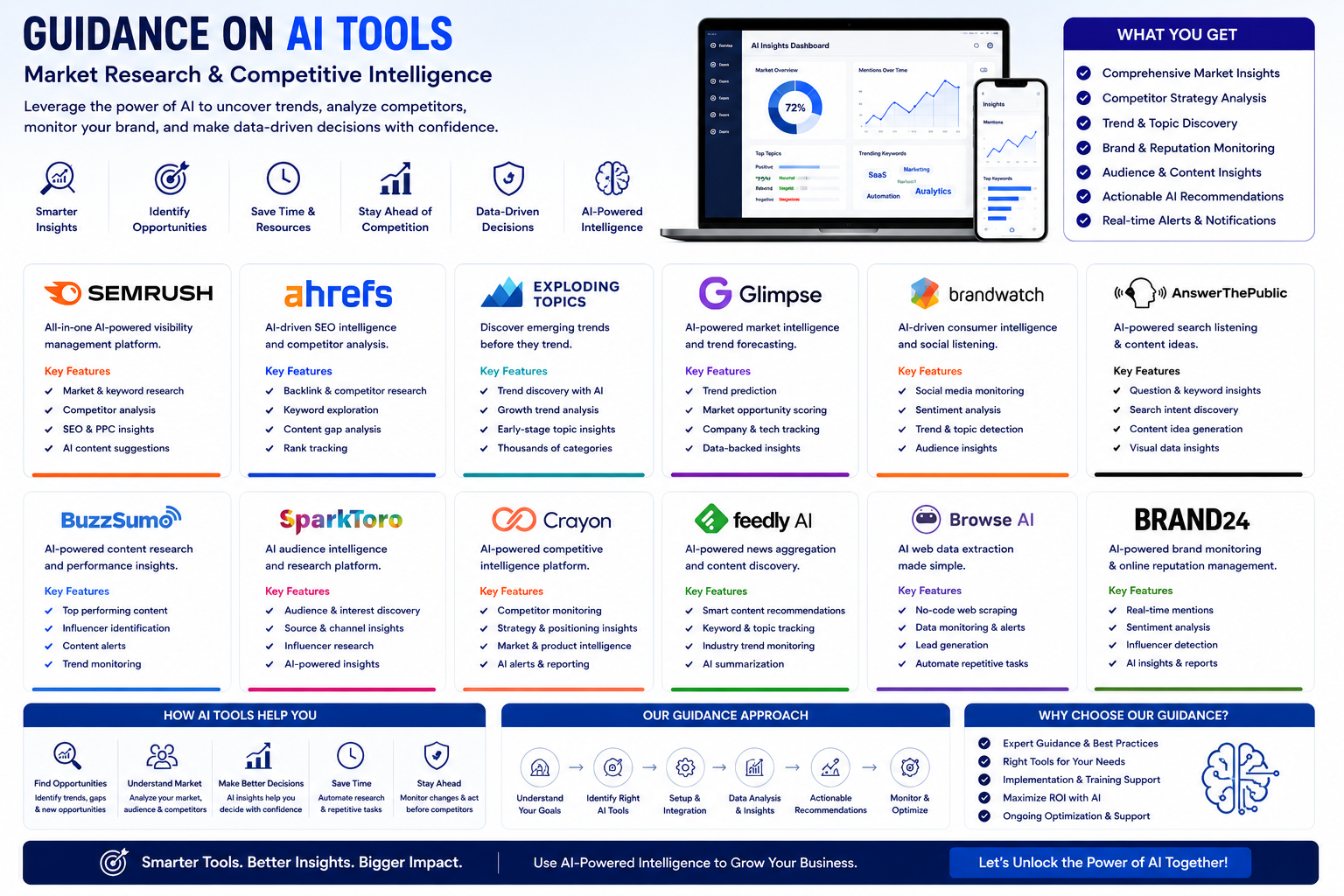
Tools that automate trend discovery, keyword analysis, and competitor benchmarking.
- SEMrush: Specializes in SEO & keyword research. Offers a freemium model (~$139+/mo). Its key strength is AI-powered keyword intent scoring, with a reported 25% organic traffic increase.
- Ahrefs: Focuses on backlink & content analysis. Paid (~$99+/mo). Known for its AI content explorer that targets emerging markets.
- Exploding Topics: Early trend detection. Freemium. Flags rising trends before mainstream adoption.
- Glimpse: Combines Google Trends + AI. Freemium. Provides deeper insights into search volume fluctuations.
- Brandwatch: Social listening. Enterprise level. Features visual logo tracking and a real-time command center.
- AnswerThePublic: Search query visualization. Freemium. Maps consumer questions and prepositions.
- BuzzSumo: Content performance. Paid (~$199+/mo). Identifies viral topics and influencer reach.
- SparkToro: Audience research. Paid (~$120+/mo). Reveals underserved demographics.
- Crayon: Competitive intelligence. Enterprise. Tracks market shifts and competitor moves.
- Feedly AI: Intelligence gathering. Freemium ($8+/mo). Automates competitor move tracking and provides executive summaries.
- Browse AI: Web scraping. Freemium ($29+/mo). Offers live competitor pricing radars and SERP monitors.
- Brand24: Brand monitoring. Freemium ($79+/mo). Features automated PR crisis detection and micro-influencer discovery.
Phase 1: Foundations (Weeks 1–2)
No tools yet – build the mental framework.
Concepts to learn:
- Market Sizing – Understand TAM (Total Addressable Market), SAM (Serviceable Available Market), and SOM (Serviceable Obtainable Market). Use CB Insights free reports for practice.
- Competitive Positioning – Master SWOT analysis (Strengths, Weaknesses, Opportunities, Threats), Porter’s Five Forces, and perceptual maps. MindTools.com offers free articles.
- Data Types – Learn the difference between primary data (surveys, interviews you conduct) and secondary data (published reports, articles). Search Google Scholar for “competitive intelligence framework” to find academic grounding.
- Ethics & Legal – Know how to avoid trade secret violations and always respect robots.txt when scraping. The Strategic and Competitive Intelligence Professionals (SCIP) website offers a free ethics code.
Mini project: Pick a product you use daily. Write a one-page competitive landscape identifying three competitors, their strengths and weaknesses, and one emerging threat you see on the horizon.
Phase 2: Keyword & SEO Intelligence (Weeks 3–4)
Tools: SEMrush (freemium), Ahrefs (paid trial or free limited)
Skills and learning actions:
- Keyword intent scoring using SEMrush’s “Intent” column – Run five keywords for a niche, such as “project management software.” Classify each result as Informational, Navigational, Commercial, or Transactional.
- Organic gap analysis using SEMrush’s “Keyword Gap” tool – Compare a client website against two competitors. Identify ten keywords that competitors rank for but your target does not.
- Content gap analysis using Ahrefs’ “Content Gap” feature under Site Explorer – Input two competitor domains to find missing topics that have traffic potential.
- Early trend detection via keywords using SEMrush’s “Trending Keywords” dashboard – Spot three rising terms from the last 30 days and validate them with Google Trends.
Free alternative: Google Keyword Planner combined with Google Trends. Less automated but follows the same logic.
Output: A one-page competitor keyword map showing where your competitors invest versus where you can claim open space.
Phase 3: Trend Discovery (Weeks 5–6)
Tools: Exploding Topics, Glimpse, AnswerThePublic
Tool breakdown:
- Exploding Topics is best for early trend flags before mainstream adoption – Search for “AI writing tools” and note three exponential growth curves. Follow five trends for one month to see which persist.
- Glimpse (Google Trends plus AI) helps you understand why volume fluctuates – Compare “meal prep” versus “delivery kit” seasonality. Write a short hypothesis for each peak and trough you observe.
- AnswerThePublic excels at question mapping to reveal consumer pain points – Enter “electric scooter” and export the question clusters. Turn the top “why” and “can I” questions into a survey script.
Career application: Trend reports are highly valued in product marketing and corporate strategy. Create a three-slide “Emerging Signals” deck using these tools.
Phase 4: Social Listening & Content Performance (Weeks 7–8)
Tools: Brandwatch (enterprise demo), BuzzSumo (paid trial), Brand24 (freemium)
Tool capabilities:
- BuzzSumo handles viral topics and influencer reach – Search for “remote work burnout” and sort by total engagements. Identify three headline patterns that repeat across high-performing content.
- Brand24 provides PR crisis detection and micro-influencer discovery – Set an alert for your brand or a competitor. Observe how sentiment spikes correlate with news events.
- Brandwatch (demo) features visual logo tracking with image recognition – Upload a competitor’s logo to see where it appears across social images, revealing unlinked brand mentions.
Free alternative: Social Searcher (free tier) plus Google Alerts. Less polished but functional.
Output: A competitive content calendar with ten topic ideas your rivals are ignoring, based on their lowest-engagement yet high-potential keywords.
Phase 5: Audience & Competitive Intelligence (Weeks 9–10)
Tools: SparkToro, Crayon (enterprise demo), Feedly AI
Unique tool values:
- SparkToro reveals underserved demographics – Enter “small business accounting software” and go to the Overlap tab. Find an audience competitors do not reach, such as freelancers versus agencies.
- Crayon tracks competitor moves including pricing changes, messaging shifts, and job postings – Request a demo, track a rival, and notice when they add the word “enterprise” to their sales page, which often precedes a pricing change.
- Feedly AI automates competitor move summaries – Create a “Competitors” board and add RSS feeds from five rivals’ blogs, press rooms, and job boards. Use the AI summary to scan daily.
Career application: Competitive Intelligence roles (for example, Competitive Intelligence Analyst at Salesforce, Amazon, or Gartner) expect you to maintain a “Battle Card” – a one-page PDF updated weekly with recent competitor actions. Use Crayon or Feedly AI to automate these updates.
Phase 6: Web Scraping & Pricing Intelligence (Weeks 11–12)
Tools: Browse AI, custom Python (BeautifulSoup/Scrapy)
Tool best uses:
- Browse AI is best for live competitor pricing radars and SERP monitors – Set a robot to monitor three competitors’ pricing pages daily. Configure it to email you whenever a price changes by more than five percent.
- Custom scraping (free) handles any public data such as reviews or product specs – Use Google Colab with Python. Scrape Amazon reviews for a competitor’s product and extract the features users complain about most frequently.
Legal note: Only scrape public data, respect robots.txt files, and never bypass login walls. Browse AI is safer for beginners who want to avoid legal risks.
Output: A price positioning chart with price on the y-axis and features on the x-axis. Find the “dead zone” where no competitor currently plays.
Phase 7: Career Application Guide
Role and recommended tools:
- Market Research Analyst – Master SEMrush, AnswerThePublic, and Glimpse. Sample interview task: “Take this brand. Size its TAM using free data and trend signals.”
- Competitive Intelligence Analyst – Master Crayon, Feedly AI, and SparkToro. Sample interview task: “Here are three moves a competitor just made. What do they signal, and what is your counter?”
- Product Marketing Manager (PMM) – Master BuzzSumo, Brand24, and Browse AI. Sample interview task: “Build a launch battle card against the number two competitor.”
- SEO Strategist – Master Ahrefs, SEMrush, and Exploding Topics. Sample interview task: “Find three untapped content clusters that have rising search volume but low competition.”
- Pricing Analyst – Master Browse AI plus custom scraping. Sample interview task: “Predict a competitor’s next price change based on historical patterns.”
Where these skills apply with real titles:
- McKinsey or BCG – Research Associate focused on market landscaping.
- Gartner or Forrester – Competitive Intelligence Specialist.
- Amazon or Google – Product Marketing role with CI embedded.
- Small startups – Growth Marketer who wears the CI hat.
Phase 8: Next Steps (After 12 Weeks)
A. Build a portfolio – no job required
Create these four deliverables:
- A two-page trend brief using Exploding Topics and Glimpse.
- A one-page competitor battle card using Crayon or Feedly AI plus SparkToro.
- A one-page keyword gap report using SEMrush or Ahrefs.
- A visual chart from a scraped pricing analysis using Browse AI.
Host these on GitHub or a public Notion page. Link to them in job applications.
B. Certifications – free or cheap
- SEMrush SEO Toolkit Course – free with trial, takes about four hours.
- Ahrefs Blogging for Business – free, takes about two hours.
- Crayon CI Fundamentals webinars – free, one hour each.
- SCIP Certified CI Professional – approximately $500, self-paced.
C. Networking and practice
Join SCIP student membership for roughly $50 per year to attend webinars. Follow Lenny’s Newsletter for product and competitive strategy insights. Practice weekly: pick a public brand such as Notion, Figma, or Rippling and answer this question – “What one move will their top competitor make next month, and why?”
D. Land your first role
Job titles to search for include Market Research Coordinator, Competitive Intelligence Analyst, Marketing Insights Specialist, and Growth Analyst.
On your resume, even before you have direct experience, write something like: “Built competitor tracking system using Feedly AI and Browse AI, producing weekly battle cards that identified three pricing moves ahead of market.”
Where to apply: Mid-sized B2B SaaS companies that need CI but do not yet have a dedicated team, agencies that value SEMrush or Ahrefs certification, and startups looking for a generalist with trend detection skills.
Any




 Group / 1: 1 Sessions