This roadmap is designed for professionals with 2+ years of development or operations experience who want to specialize in agentic AI and workflow automation. The 2-4 month timeline assumes 10-15 hours per week, with a focus on building autonomous systems that can reason, plan, and act. Unlike traditional automation that relies on rigid if/else rules, agentic AI gives language models the ability to decide which tools to call, in what order, and how to handle unexpected situations .
The key insight from production experience: agentic workflows rarely fail because of reasoning models—they fail because the orchestration layer isn't treated like infrastructure. Logging, retries, state management, and human checkpoints determine whether your agents survive contact with production .
Phase 1: Foundations - Understanding Agentic Architecture (Weeks 1-3)
Objective: Grasp what makes an AI agent different from a traditional automation script. Learn the core components: reasoning engine (LLM), tool integrations (APIs), memory systems, and orchestration logic .
Beginner Focus:
Start by understanding the three levels of automation, because agentic AI is the most advanced tier, not the starting point .
Level 1 is rule-based automation—classic tools like Zapier or cron jobs. Trigger leads to action, no intelligence involved. Example: new row in Google Sheet triggers an email. This works until the input doesn't match the expected pattern.
Level 2 is AI-powered automation. You drop an LLM into a fixed workflow. The model classifies, summarizes, or generates content, but the workflow structure remains linear. Example: support ticket arrives, LLM categorizes urgency, routes to the right team, drafts a reply.
Level 3 is autonomous agents. The LLM decides what to do next. You give it a goal, and it determines the sequence of actions, handles errors, and adapts to new information.
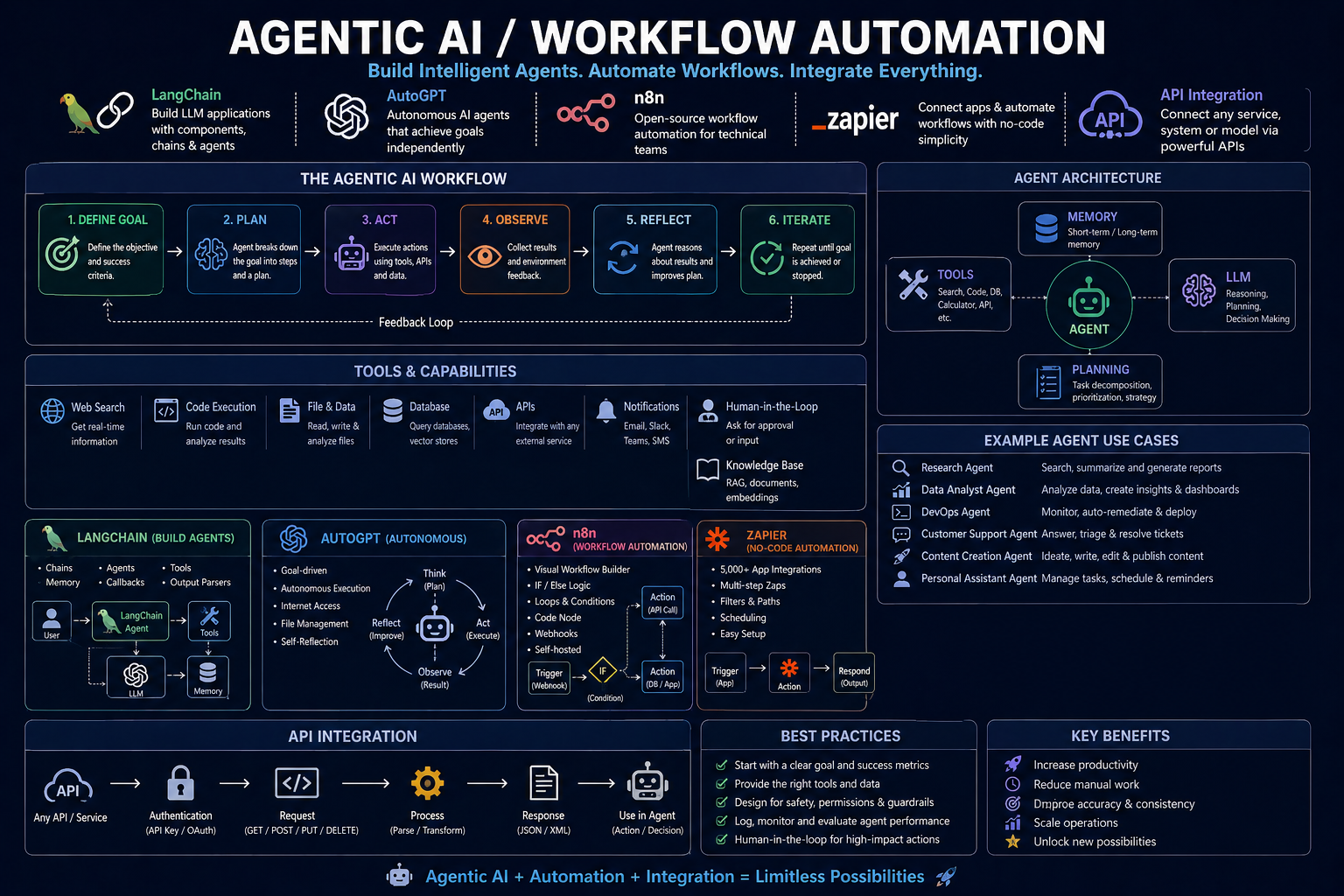
The agent loop follows a simple but powerful pattern: THINK about the goal and what's known, ACT by calling a tool or API, OBSERVE the result, REPEAT the loop, and STOP when the goal is achieved .
Core Architecture Components:
An AI agent has four superpowers beyond a standard LLM . Memory provides context across steps and sessions. Tools give the ability to act on the world through APIs, databases, or search. The planning loop enables the think-act-observe-repeat cycle. And the LLM itself provides reasoning and language understanding.
Multi-agent systems represent the next evolution. Instead of one agent trying to do everything, specialized agents handle narrow tasks and collaborate. By 2027, Gartner predicts 70% of multi-agent systems will contain agents with focused roles, improving accuracy while introducing challenges around coordination and compounding errors .
Tool Categories You'll Learn:
For developer-focused frameworks, LangChain and LangGraph provide Python/TypeScript libraries for building custom agents. LangGraph specifically adds state management for complex, multi-step workflows .
For no-code and visual automation, n8n is an open-source workflow platform with 400+ integrations and native AI nodes. It runs self-hosted for privacy and supports custom JavaScript/Python. Zapier AI offers similar capabilities with a larger app ecosystem but less code flexibility .
For specialized agent frameworks, AutoGPT focuses on autonomous goal-seeking, CrewAI enables role-based agent teams, and AutoGen (from Microsoft) supports multi-agent conversations .
Free Resources:
The DEV Community guide "From LLMs to AI Agents" provides the clearest technical explanation of agent architecture, including code snippets for LangChain agents and RAG pipelines. It directly addresses why LLMs break in production and how to fix those issues .
The GitHub repository "Complete RoadMap To Learn AI 2025" includes a dedicated Agentic AI section covering fundamentals, LangChain, LangGraph, multi-agent systems, RAG, and tool use. It's structured as a learning path with clear progression .
Paid Resources:
The Great Learning "Generative AI For Practitioners" program offers a 12-week hands-on curriculum specifically covering agentic AI from week 7 onward. Topics include single-agent systems, the ReAct framework, memory management, multi-agent collaboration patterns (sequential, supervisor, reflector, and handoff architectures), and using LangGraph, LangChain, and CrewAI .
AI Tool Usage:
Use Claude or ChatGPT to role-play agent architectures. Prompt: "Act as an AI agent with access to a calculator tool, a web search tool, and a database lookup tool. I will give you a goal. Show me your think-act-observe loop at each step. Goal: Find the population of France in 2024, calculate 15% of that number, and tell me the result." This teaches you to think like an agent designer.
Practice Exercise:
Map an agentic workflow on paper before building anything. Choose a simple business process: customer support ticket triage. Draw the agent loop: THINK (what's the issue?), ACT (search knowledge base, check order status, analyze sentiment), OBSERVE (what did each tool return?), REPEAT (is issue resolved? if not, escalate), STOP (send reply or create ticket). Identify which steps require AI reasoning and which can be deterministic rules.
Build your first no-code agent using n8n cloud free tier or Zapier AI. Create a workflow that: 1) Listens for a form submission (webhook trigger), 2) Uses an LLM node to extract intent and urgency from the message, 3) Routes to different actions based on classification, and 4) Logs everything to Google Sheets. This teaches you the AI-powered automation level before moving to true agents.
Phase 2: Intermediate - Building with LangChain and RAG (Weeks 4-8)
Objective: Move from no-code workflows to programmatic agent development using LangChain. Master Retrieval-Augmented Generation (RAG) for giving agents access to private data.
Intermediate Focus:
LangChain is the framework for building LLM applications. It provides abstractions for chains (sequences of LLM calls), agents (LLMs that choose tools), memory, and retrieval. You need Python comfort for this phase, but you don't need to be an expert .
Start with the simplest agent pattern: zero-shot ReAct (Reasoning + Acting). The agent receives a prompt describing available tools, a user goal, and instructions to reason step by step. It outputs "Thought: I need to do X. Action: tool_name Action Input: parameters." A parser executes the tool and returns the Observation. The agent loops until it produces a Final Answer.
Tool Integration:
Agents are only as useful as their tools. A tool is simply a function with a name, description, and parameters. The LLM reads the description to decide when to call it, so write descriptions clearly. Example calculator tool: "Useful for arithmetic operations. Input should be a mathematical expression as a string."
Common tools you'll build: web search (using SerpAPI or DuckDuckGo), database query (SQL or vector search), API caller (REST endpoints with authentication), file operations (read/write CSV, JSON, text), and email sender (SMTP or Gmail API).
Retrieval-Augmented Generation (RAG):
RAG is how you give agents access to your private data without retraining the model . The pattern: take your documents (PDFs, Notion pages, Confluence wikis), split them into chunks, convert each chunk to a vector embedding (a numerical representation of meaning), store embeddings in a vector database (Chroma, Pinecone, Weaviate), and at query time, retrieve the most relevant chunks and inject them into the prompt.
Think of RAG as giving the LLM a cheat sheet before every exam. The model doesn't need to know your data—it just needs to read the relevant chunks you provide.
Memory Management:
Agents need memory to maintain context across steps. Simple memory keeps recent conversation history. Buffer memory keeps the last N exchanges. Summary memory compresses long histories. Vector memory retrieves relevant past interactions. LangChain provides all these patterns.
For production agents, you need both short-term memory (within a single task execution) and long-term memory (across sessions). Store long-term memory in a database keyed by user or session ID.
Free Resources:
The GitHub repository "End-to-End Agentic AI Automation Lab" contains hands-on projects covering LangChain, LangGraph, CrewAI, AutoGen, RAG pipelines, and deployment with Docker and AWS. Clone it and work through the examples incrementally .
The DEV Community guide includes working code snippets for LangChain agents, RAG with Chroma, and tool definition patterns. Use these as templates for your own experiments .
Paid Resources:
Great Learning's program dedicates weeks 7-8 to Python and OOP essentials for agentic systems, including type hints, Pydantic for data validation, decorators for creating reusable tools, and LangChain Expression Language (LCEL) for compositional workflows. Weeks 9-10 cover single-agent systems, function/tool calling, the ReAct framework, and memory management .
Coursera offers "Building and Deploying GenAI Agents for Process Automation" as part of a GenAI for Business Process Automation specialization. It covers agent fundamentals, decision-making models, memory systems, no-code agent building, deployment best practices, and performance evaluation. The course was updated in September 2025 .
AI Tool Usage:
Use GitHub Copilot when writing LangChain code. Type a comment like # Create a LangChain agent with a calculator tool and a web search tool and let Copilot scaffold the imports, tool definitions, and agent initialization. Focus your attention on the orchestration logic, not the boilerplate.
For debugging, prompt ChatGPT: "My LangChain agent is stuck in a loop calling the same tool repeatedly. Here's my code. What should I add for max iterations and early stopping?" Learn to implement guardrails before you need them.
Practice Exercise:
Build a RAG-powered research agent. Step 1: Collect 5-10 text documents on a topic you understand well (e.g., product documentation or a technical guide). Step 2: Write a Python script using LangChain and Chroma to load, chunk, embed, and store these documents. Step 3: Build a retrieval chain that answers questions using only the retrieved context. Step 4: Extend this into an agent with two tools: retrieve_from_knowledge_base and web_search (for when the knowledge base lacks an answer). Step 5: Test the agent with questions inside and outside your documents. Measure how often it correctly says "I don't know" versus hallucinating.
Production Reality Check:
One lesson from production agentic systems: start with 2-3 tools maximum. Every additional tool increases the LLM's decision space and the chance of incorrect tool selection. Simplicity beats complexity . Add logging before adding features. You cannot debug an agent's decision process without seeing its thoughts and actions.
Phase 3: Advanced - Multi-Agent Systems and Production Deployment (Weeks 9-12)
Objective: Design and deploy multi-agent systems that collaborate on complex tasks. Implement production guardrails, monitoring, and cost controls.
Advanced Focus:
Single agents have limits. When a task requires multiple specialized skills, multi-agent systems outperform one generalist agent. Common patterns include :
Sequential architecture: Agent A completes its task, passes results to Agent B, which passes to Agent C. Useful for pipelines like research -> draft -> review.
Supervisor architecture: A central supervisor agent receives the goal, delegates sub-tasks to specialized agents, and synthesizes their outputs. The supervisor decides which agent to call next based on progress.
Reflector architecture: One agent generates a solution, another agent critiques it, the first revises based on feedback. This improves output quality through iterative refinement.
Handoff architecture: The conversation is handed off between specialized agents based on topic or intent. Common in customer service where billing, technical, and general inquiries route to different agents.
LangGraph for Complex Workflows:
While LangChain handles linear chains, LangGraph adds stateful, cyclic workflows. It's built on top of LangChain and represents agent logic as a graph: nodes are agent actions or LLM calls, edges define transitions based on conditions. This allows for loops, conditional branching, and human-in-the-middle checkpoints .
Production Guardrails:
Agentic systems introduce new risks. An agent with too much freedom can loop indefinitely, call expensive APIs excessively, or take harmful actions. Production guardrails include :
Set maximum iteration limits (e.g., 10 steps before forcing a stop). Implement human checkpoints for high-stakes actions like sending emails or making API writes. Add budget controls per agent run or per user session. Create independent safety guardrails that test for jailbreaks, prompt injection, and model poisoning .
Logging is non-negotiable. For every agent step, log the timestamp, thought, action taken, observation received, and running state. Without structured logs, you cannot answer "why did the agent do that?" .
Evaluation and Testing:
Traditional unit tests don't work for agents because outputs are non-deterministic. Instead, build evaluation suites :
Create a golden dataset of inputs and expected outputs. For each test case, run the agent multiple times and measure success rate. Track metrics like journey completion rate (did the agent achieve the goal?), tool call accuracy (did it call the right tool with the right parameters?), cost per run, and latency.
Use LLM-as-judge: have a separate model instance evaluate your agent's outputs on criteria like helpfulness, accuracy, and conciseness. This scales evaluation beyond what humans can manually review.
Deployment and Infrastructure:
Agentic workflows need always-on, observable, cost-stable infrastructure. Even well-designed agent flows degrade quickly in real usage if the execution layer isn't treated seriously .
Dockerize your agents. Use GitHub Actions or similar for CI/CD. Deploy to AWS (ECS, Lambda for lightweight agents, EC2 for stateful ones) or similar platforms. Use BentoML for model serving if you're customizing LLMs .
For no-code agents, run n8n on predictable infrastructure rather than relying solely on cloud-hosted versions. Self-hosting gives you control over uptime, costs, and data privacy.
Free Resources:
IBM's 2026 enterprise AI predictions article provides strategic context on why multi-agent orchestration matters and how leading firms approach governance. It includes specific metrics for measuring agent success: payback period, internal rate of return per initiative, and outcome reproducibility .
The End-to-End Agentic AI Automation Lab GitHub repository includes deployment workflows using GitHub Actions, Docker, and AWS, plus monitoring integrations with LangSmith, Opik, and ClearML .
The InformationWeek 2026 predictions article covers the shift from glue code to standardized agentic primitives. The key insight: your competitive advantage is not in building the agent's brain but in defining high-quality, agent-callable APIs for your proprietary business logic .
Paid Resources:
Great Learning's program covers collaborative and autonomous agentic systems in weeks 11-12, including sequential, supervisor, reflector, and handoff architectures, plus a capstone project on AI agents for retail analytics .
AI Tool Usage:
Use AI to design multi-agent architectures. Prompt: "I need to build a multi-agent system for competitive intelligence. One agent researches competitors, one analyzes pricing, one writes reports, and one coordinates. Design the handoff protocol and state schema. What should each agent's tool access look like?" Use the AI's architecture as a starting point, then refine based on your specific constraints.
For code, prompt: "Write a LangGraph workflow with a supervisor agent that routes to either a research agent or a summarization agent based on the user's intent. Include state management and a human-in-the-loop checkpoint before final output."
Practice Exercise:
Build a multi-agent research and reporting system. Use CrewAI or LangGraph to create three agents: a Researcher Agent with web search and RAG tools, an Analyst Agent that calculates metrics and finds patterns, and a Writer Agent that produces final reports. The workflow: User asks a complex question (e.g., "What are the top three trends in AI automation for 2026?"). The Researcher gathers information. The Analyst extracts key findings. The Writer synthesizes into a structured report. Add a human checkpoint before the Writer produces the final output. Log every step to a database. Run the system five times with the same question and measure consistency.
The Governance Reality:
The real scaling constraint for agentic AI isn't technical—it's organizational. Teams that treat logging, guardrails, and human checkpoints as first-class primitives ship agents that survive production. Teams that don't ship impressive demos that stall under audit, compliance, or customer trust pressure . The question isn't just "can the agent do the task?" but "who can halt execution when confidence drops? Where do escalation routes live when tools disagree? How does rollback work when an agent does the right thing at the wrong time?"
Phase 4: Specialization and Portfolio (Weeks 13-16 for 4-month track, or integrated into weeks 9-12 for 2-month accelerated track)
Objective: Build an end-to-end agentic automation project that demonstrates all three levels of automation. Specialize based on your career goals.
Portfolio Project: The Multi-Level Automation Platform
Build a single project that showcases rule-based automation, AI-powered automation, and autonomous agents working together. This demonstrates that you understand when to use each level.
Project Title: Intelligent Customer Support Orchestrator
Level 1 - Rule-Based Foundation: Build an n8n or Zapier workflow that listens for incoming support tickets via webhook. Apply deterministic rules: if email contains "password reset," route to authentication queue; if email contains "refund," flag for manager review. No AI yet. This handles predictable patterns.
Level 2 - AI-Powered Enhancement: Add an LLM node to the workflow. The AI classifies intent (billing, technical, general, complaint), extracts entities (order number, product name, urgency level), and drafts an initial suggested response. The workflow still follows a fixed path, but the AI enriches data and generates content.
Level 3 - Autonomous Agent: For complex tickets that Level 2 cannot resolve, hand off to a LangChain agent. The agent has tools: search knowledge base (RAG), check order status (API call), analyze sentiment (LLM), and escalate to human (Zendesk API). The agent decides which tools to call and in what order. Set a max iteration limit of 5 steps. Log every decision.
Integration Layer: Connect all three levels. Level 1 handles 50% of tickets (simple patterns). Level 2 handles 40% (predictable but requires understanding). Level 3 handles 10% (complex, multi-step). Metrics dashboard shows automation rates, cost per resolution, and escalation patterns.
Deployment: Containerize each component with Docker. Use GitHub Actions for CI/CD. Deploy to AWS free tier (EC2 for LangChain agent, Lambda for n8n webhook). Add monitoring with LangSmith.
This portfolio project is complex enough to discuss for an hour and demonstrates you understand the spectrum from simple to intelligent automation .
Specialization Paths:
If you want to become an AI Architect specializing in multi-agent orchestration, focus on LangGraph, CrewAI, and AutoGen. Build systems with 3+ collaborating agents. Study supervisor and handoff architectures.
If you want to become an Automation Engineer using no-code/low-code tools, master n8n and Zapier AI. Build complex workflows with branches, loops, and error handling. Learn to run n8n on self-hosted infrastructure for production deployments.
If you want to become an AI Product Manager focused on agentic systems, focus on evaluation and governance. Build testing frameworks for agent quality. Develop metrics for ROI: operational efficiency (cycle time, error rate), customer experience (CSAT, conversion lifts), and financial impact (cost-to-service, margin improvement) .
Career Application:
The 2-4 month timeline positions you for roles like AI Automation Engineer, Agentic AI Developer, or LLM Operations Specialist. However, the most common path is adding agentic skills to an existing DevOps, software engineering, or data engineering role .
To demonstrate your skills professionally:
- Add "Agentic AI" and "LangChain" to your LinkedIn skills section
- Push your portfolio project to GitHub with a detailed README explaining the three automation levels
- Write a blog post or LinkedIn article comparing rule-based, AI-powered, and agentic automation with your project as a case study
- Complete a certificate from Linkedin Learning / Great Learning or Coursera and add it to your LinkedIn certifications
The Strategic Insight:
The smartest approach to agentic AI in 2026 is recognizing that low-level agent orchestration will become a commodity. Don't overinvest in bespoke planners and routers that your cloud provider will give you next year. Instead, invest where value persists :
High-quality domain knowledge and ontologies (your business logic as agent-callable APIs). Golden datasets and evaluation suites (so you can test agent quality). Security and governance policies (who can approve what actions). Integration into your existing development and security workflows. Metrics you'll use to decide if an agent is safe and cost-effective.
Your competitive advantage is not building the agent's brain—it's defining and standardizing the tools those agents use . The enterprises that win will be those that have meticulously documented, secured, and exposed their proprietary business logic as high-quality, agent-callable APIs.
Final Notes on the 2-4 Month Timeline
The 2-month accelerated track (10-12 weeks) compresses phases 3 and 4, focusing on LangChain and RAG as the core skills and treating multi-agent systems as an advanced topic to explore post-roadmap.
The 4-month comprehensive track (14-16 weeks) includes full multi-agent coverage, production deployment with Docker and AWS, and the complete portfolio project.
Both tracks assume you have the prerequisite development experience. If you're newer to code, extend the timeline by 4-6 weeks and spend extra time on Python fundamentals and API integration patterns before diving into LangChain.
Career Application & Next Steps: Agentic AI & Workflow Automation
You have just completed a 2-4 month journey that transforms you from a developer or operations professional who writes scripts and API integrations into someone who designs autonomous systems that reason, plan, and act. The key shift you've mastered is understanding that agentic AI is fundamentally different from traditional automation—not just smarter rules, but systems that decide which tools to call, in what order, and how to recover from failures. Your portfolio now demonstrates LangChain agents, RAG pipelines, multi-agent collaboration, production guardrails, and the critical insight that logging and human checkpoints determine whether agents survive contact with the real world.
Where You Fit in the Market
The role you are targeting sits at the intersection of software engineering, AI integration, and workflow automation. You are not competing with data scientists who build models. You are not competing with DevOps engineers who manage infrastructure. You are competing with automation engineers who understand that agentic systems require the same engineering discipline as any production service: version control, testing, observability, and rollback strategies.
Three primary job titles emerge from this roadmap, ranging from pure agent development to AI-augmented platform engineering:
AI Automation Engineer (Most Common): You build agentic workflows that automate business processes—customer support, lead qualification, document processing, data enrichment. You work with LangChain, n8n, or similar tools, and you collaborate with operations teams to identify automation opportunities. This role exists in mid-to-large enterprises and AI-native startups. Salaries range 110k−
110k−160k depending on location and experience.
LLM Operations Specialist (LLMOps): You focus on the infrastructure and governance layer: deploying agents, monitoring costs and latency, implementing guardrails, and building evaluation suites. You are the bridge between AI prototypes and production systems. This role is more common in larger tech companies and AI-first organizations. Salaries range 130k−
130k−180k.
Agentic AI Developer (Emerging): You build the agent frameworks themselves—custom LangChain integrations, multi-agent orchestration layers, tool-calling infrastructure. This role requires deeper programming skills and is most common at AI infrastructure companies (LangChain, CrewAI, AutoGen) or research-oriented teams. Salaries range 140k−
140k−200k+.
For your first 6-12 months after this roadmap, target AI Automation Engineer roles at mid-sized companies (200-2000 employees) that have started exploring AI but lack structured automation. Avoid early-stage startups without existing engineering discipline—you will be expected to build everything from scratch without mentorship. Avoid massive enterprises where bureaucracy may prevent you from deploying agents to production.
Your Portfolio: The Intelligent Customer Support Orchestrator
Your "Intelligent Customer Support Orchestrator" is not just a project. It is your complete case study for every interview question about agentic automation. The three-level architecture (rule-based → AI-powered → autonomous agent) demonstrates that you understand when to use each approach and that you don't reach for agents as the first solution to every problem.
Your GitHub repository must be structured to tell this story clearly. The README should open with a problem statement: "Most support teams use pure rule-based automation (brittle) or pure AI agents (unpredictable). This project demonstrates a hybrid approach: rules for predictable patterns, AI for classification and enrichment, and autonomous agents only for complex, multi-step tickets."
Include an architecture diagram showing the three levels and the escalation path. Use Mermaid or Excalidraw to create a diagram that lives in version control. The diagram should show: Webhook → Level 1 Router (rules) → Level 2 LLM Enrichment (classification, extraction, draft) → Level 3 LangChain Agent (tools: knowledge base RAG, order API, sentiment, escalate) → Human checkpoint → Response delivery.
Inside the repository, organize by level:
level1_rules/ - n8n workflow export or Zapier template, webhook configuration, deterministic routing ruleslevel2_ai_powered/ - LLM node configuration, prompt templates for intent classification and entity extraction, response drafting logiclevel3_agent/ - LangChain agent code, tool definitions, RAG pipeline (Chroma), memory configuration, guardrails (max iterations, human checkpoints)integration/ - Code that connects all three levels, escalation logic, metrics collectiondeploy/ - Dockerfiles, docker-compose for local development, GitHub Actions workflow, AWS deployment scriptsmonitoring/ - LangSmith configuration, logging setup, metrics dashboard definitions
The documentation separates you from hobbyists. Write DESIGN.md explaining why you chose three levels instead of a single agent, the trade-offs between rule-based and AI-powered automation, and the specific guardrails you implemented. Write RUNBOOK.md covering how to deploy the system, how to monitor agent performance, what to do when an agent loops or hallucinates, and how to roll back to Level 2 if Level 3 fails. Write COST.md estimating API costs per ticket resolution and comparing to pure human or pure agent alternatives. Write EVALUATION.md showing your test results: accuracy of Level 2 classification, success rate of Level 3 agent, average iterations per resolution, cost per resolution.
This level of documentation signals that you understand production is about maintenance, observability, and cost control—not just getting an agent to work once.
Certifications: Building Credibility
Agentic AI is too new for standardized certifications. However, several credentials signal that you have systematically studied the field:
LangChain Certification (if available by the time you read this): LangChain has announced certification paths. Check their official website. This would be the most direct credential for Phase 2 and Phase 3 skills.
DeepLearning.AI's "Building Systems with LangChain" (Free certificate): This course focuses on LangChain for building agentic systems, including chains, memory, RAG, and agents. Taught by Harrison Chase (LangChain creator) and Andrew Ng. The certificate is recognized within the AI engineering community.
Coursera's "Building and Deploying GenAI Agents for Process Automation" (Paid certificate, audit available): This specialization was updated in September 2025 and covers agent fundamentals, multi-agent patterns, and deployment. The certificate adds credibility for enterprise roles.
n8n Automation Certification (Free): If you specialized in no-code agents, n8n offers a certification covering workflow design, error handling, and self-hosting. This is valuable for roles focused on visual automation.
Do not over-index on certifications. In this field, your GitHub portfolio and a blog post explaining your design decisions will impress hiring managers more than a certificate. However, the DeepLearning.AI LangChain certificate is worth the time (approximately 4-6 hours) and the free credential.
Resume Transformation: From Scripts to Agents
Your resume must speak the language of agentic systems, not traditional scripting. Replace "built API integrations" with "designed agent tools for API calling with natural language descriptions." Replace "automated workflows" with "built multi-level automation system with rule-based, AI-powered, and autonomous agent tiers."
Structure your resume around the three levels of automation. Create a section "Agentic AI & Workflow Automation" and list specific accomplishments:
- Designed and built three-tier intelligent customer support orchestrator: rule-based (50% of tickets), AI-powered classification and enrichment (40%), and autonomous LangChain agent (10%) with RAG, order API, and human escalation tools
- Implemented production guardrails including maximum iteration limits (5 steps), human checkpoints for high-stakes actions, and structured logging of every agent thought-action-observation cycle
- Built RAG pipeline using LangChain and Chroma, ingesting 50+ product documentation pages and achieving 94% answer accuracy on in-scope support questions while correctly declining out-of-scope queries 87% of the time
- Containerized agent system with Docker, deployed to AWS free tier (EC2 for agent, Lambda for webhook), and implemented CI/CD with GitHub Actions reducing deployment time from manual to automated
- Evaluated agent performance across 100 test cases, measuring journey completion rate (86%), tool call accuracy (92%), cost per resolution (0.04vs0.04vs2.50 human baseline), and latency (12 seconds average)
If you have professional experience in automation or DevOps, restructure it using agentic language. For example, "Built ETL pipelines" becomes "Built data processing pipelines that inspired agent tool design for database queries." Connect your past work to agent concepts—this shows you see the continuity.
Add a "Technologies" section: LangChain, LangGraph, CrewAI, n8n, Zapier, Python, Chroma, Pinecone, Docker, AWS (EC2/Lambda/ECR), GitHub Actions, LangSmith, OpenAI API, Anthropic API.
Where to Find These Jobs
Agentic AI roles are emerging rapidly. Job titles are inconsistent. Search for these terms: AI Automation Engineer, Agentic AI Developer, LLM Operations Specialist, AI Workflow Engineer, Autonomous Agent Developer, Generative AI Automation Specialist. On LinkedIn, set alerts for "LangChain," "CrewAI," "AI agent," "agentic workflow," and "RAG pipeline."
Companies hiring for these roles fall into several tiers:
AI-first startups (Series A-C): Companies building on LLMs—customer support (Forethought, Intercom AI), sales automation (Clay, Regie), document processing (Kudra, Nanonets). These roles are hands-on and fast-paced. You will build agents that directly impact revenue. Compensation often includes meaningful equity. This is the best fit for your portfolio.
Enterprise AI teams: Large companies (Walmart, JPMorgan, Nike, Siemens) have internal AI automation groups. The work is slower, involves more compliance review, and may use vendor tools (Microsoft Copilot Studio, AWS Bedrock Agents) rather than open-source frameworks. The advantage is stability and resume brand.
Consultancies and system integrators: Deloitte, Accenture, BCG X, and smaller AI consultancies need agentic automation experts for client projects. You will see diverse use cases across industries. The pace is high, but the learning is rapid.
AI infrastructure companies: LangChain, CrewAI, AutoGen, and similar companies building agent frameworks. These roles require deeper systems knowledge but offer the chance to shape the tools themselves.
The hidden job market is the AI automation community. Join the LangChain Discord, CrewAI Slack, n8n community forum, and the r/AIAutomation subreddit. Share your portfolio. Ask for feedback. Offer to help others debug their agents. Referrals from these communities are unusually effective because the field is small and skilled practitioners are scarce.
The Interview Process: What to Expect
The agentic AI interview typically consists of four to five rounds, and your portfolio prepares you for all of them.
Screening call (30 minutes): Expect questions like "What's the difference between AI-powered automation and autonomous agents?" and "How do you prevent an agent from looping indefinitely?" Your Phase 1 answer: "AI-powered automation follows a fixed workflow with LLM nodes; autonomous agents decide which tools to call and in what order. I prevent loops with maximum iteration limits (I use 5 steps) and human checkpoints for high-stakes actions."
Technical screen (60 minutes, often live coding): Common prompts: "Write a LangChain agent with two tools—a calculator and a weather API" or "Design a prompt for an agent that decides when to search a knowledge base versus when to ask for human help." Practice your Phase 2 patterns until they are fluent. Speak aloud about your design decisions: why you wrote tool descriptions a certain way, why you set a specific max iteration limit, how you handle errors.
System design round (60-90 minutes): The prompt might be "Design an agentic system for expense report processing." Walk through the three levels: Level 1 rules (reject receipts under $10?), Level 2 AI (extract vendor, amount, date, categorize expense), Level 3 agent (handle exceptions: missing receipts, out-of-policy spending, ask manager approval). Draw the agent loop, define tools (OCR API, policy database, approval workflow), add guardrails and logging, estimate costs. This is your strongest round—your portfolio project is exactly this pattern.
Evaluation and metrics round (45 minutes, more common for senior roles): "How do you know if your agent is working?" Walk through your Phase 3 evaluation suite: golden dataset of test cases, journey completion rate, tool call accuracy, cost per run, LLM-as-judge for output quality. Discuss trade-offs: accuracy vs latency vs cost. Show your EVALUATION.md as evidence.
Behavioral round (45 minutes): Have a story ready about an agent that failed unexpectedly (e.g., looped, hallucinated, called the wrong tool). Use STAR format. The action should include how you diagnosed (logs), fixed (added guardrail), and prevented recurrence (added test case to evaluation suite). Agentic systems fail in unique ways—showing you learn from failures signals maturity.
Negotiation and First 90 Days
Agentic AI engineers are scarce, and salaries reflect this. Research levels.fyi for "AI Engineer" or "Automation Engineer" at your target companies. Entry-level agentic roles (0-2 years specific experience, plus 2+ years dev/ops background) typically range 120k−
120k−170k base depending on location and company stage. Equity at startups can add significant upside.
Your first 90 days in a new agentic AI role follow a pattern similar to other engineering roles but with specific agentic twists:
Days 1-30: Learn the landscape. Map their existing automation: what rule-based workflows exist? What AI tools are in use? Have they tried agents before and failed? Identify the gaps: missing logging, no guardrails, no evaluation suite. Do not propose changes yet. Build relationships with operations teams who will be your stakeholders.
Days 30-60: Deliver a small agent. Find one low-risk, high-value process—internal reporting, data enrichment, document summarization—and build a Level 2 AI-powered automation first. Get it into production. Measure time saved. Then extend it to a Level 3 agent for edge cases. Show before/after metrics. Small wins build trust.
Days 60-90: Propose an evaluation framework. Based on your gap analysis, introduce a golden dataset and evaluation suite for agent quality. This is non-threatening—it helps everyone measure improvement. Use your Phase 3 evaluation patterns as a template. Then propose one production guardrail (max iterations, human checkpoint, cost budget) for the most critical agent.
Avoid the common trap of trying to replace all rule-based automation with agents. Agents are slower, more expensive, and less predictable than rules. Your value is knowing when to use each level, not using agents everywhere.
The AI Tools Advantage in Your Job Search
Use the same agentic patterns you built to accelerate your job search. This meta-application demonstrates the skill in action.
Use ChatGPT to tailor your resume. Paste a job description and prompt: "Rewrite my agentic automation experience bullet points to match keywords from this job description. Emphasize LangChain, RAG, evaluation suites, and production guardrails. Keep all claims truthful."
Use Claude to practice system design interviews. Prompt: "Act as a senior AI engineer interviewing a candidate for an agentic automation role. Give me a system design prompt for a multi-agent research system. Ask me five clarifying questions about tool design, handoff protocols, and guardrails. After my answer, tell me what I missed."
Use Gemini to research target companies. Prompt: "Research [Company Name] and based on their engineering blog, job posts, and public GitHub, tell me their automation stack. Identify where they likely use rule-based vs AI-powered vs agentic automation. Suggest two agentic opportunities I could discuss in an interview."
Use GitHub Copilot to accelerate take-home assignments. Many agentic interviews include a practical task: "Build an agent that can answer questions about this dataset." Use Copilot to scaffold the LangChain agent and RAG pipeline, then focus your attention on tool descriptions, guardrails, and evaluation.
Six-Month Post-Roadmap Plan
Month 1: Complete the DeepLearning.AI "Building Systems with LangChain" course and add the certificate to LinkedIn. Finalize your portfolio repository with comprehensive documentation. Push it to GitHub and write a LinkedIn post announcing it: "After 3 months of building, my agentic automation portfolio is live. Three levels: rules, AI-powered, and autonomous agents. Key insight: logging and human checkpoints matter more than the model."
Month 2: Build visibility and network. Join the LangChain Discord and CrewAI Slack. Introduce yourself in the #introductions channel with a link to your portfolio. Offer to help others debug their agents. Attend virtual meetups on agentic AI (meetup.com has several). Find three people working in agentic roles and ask for 15-minute informational interviews. Ask about their stack, their biggest production failure, and their advice.
Month 3: Apply strategically. Target 5-10 companies per week (AI-first startups and enterprise AI teams). Customize each application. For startups, send a direct message to the founder or hiring manager on LinkedIn with a link to your portfolio. For enterprises, apply through the portal but also find someone on the team to mention your portfolio.
Months 4-5: Interview loop. Expect 4-8 weeks from first screen to offer. For every rejection, ask for one specific piece of feedback. If consistent feedback is "weak on multi-agent systems," spend two weeks building a CrewAI or LangGraph supervisor pattern. If "weak on deployment," add a GitHub Actions workflow and deployment script to your portfolio. If "weak on evaluation," expand your evaluation suite with more test cases and LLM-as-judge.
Month 6: Accept an offer or reassess. If no offer after 3 months of active interviewing (40-50 applications, 5-10 first-round interviews), broaden your target titles to include AI Automation Engineer and LLM Operations Specialist. Consider contract-to-hire roles, which are more willing to take a chance on portfolio experience. Alternatively, spend a month contributing to an open-source agentic project (LangChain, CrewAI, AutoGen) to build reputation and network.
The Long Game: Growing Beyond This Roadmap
Agentic AI is the fastest-evolving field in technology. The roadmap you completed positions you at the leading edge. After 12-18 months in a professional role, you will have converted your portfolio into production scars—the real experience that distinguishes seniors from juniors.
The next tier after AI Automation Engineer is Senior AI Automation Engineer or Agentic AI Architect, typically 4-6 years in. The differentiation at that level is not deeper LangChain knowledge but:
- Designing multi-agent systems with 5+ specialized agents and complex handoff protocols
- Building evaluation infrastructure that scales to thousands of agent runs
- Influencing product and operations teams to design processes that are agent-friendly
- Leading governance conversations: compliance, audit trails, human-in-the-loop requirements
- Mentoring junior engineers through the same roadmap you just completed
The technology will evolve rapidly. LangChain may be displaced by newer frameworks. n8n and Zapier will add more agentic capabilities. Cloud providers (AWS Bedrock Agents, Azure AI Agent Service) will offer managed agent platforms. Multi-agent patterns will standardize. What does not change is the engineering mindset you built: treat agents as infrastructure, log everything, test with golden datasets, add guardrails, implement human checkpoints, and measure cost per outcome.
Your competitive advantage is not building the agent's brain—it's defining and standardizing the tools those agents use. The enterprises that win will be those that have meticulously documented, secured, and exposed their proprietary business logic as high-quality, agent-callable APIs. That is the work you are now qualified to lead.
You started with an understanding of rule-based automation. You built AI-powered workflows. You designed autonomous agents. You added guardrails, evaluation, and multi-agent collaboration. You learned that the real scaling constraint is organizational, not technical. The field is new, the standards are emerging, and you are ahead of the curve. Now go build agents that survive production.
Dev/ops Knowledge / experience 2+ years




 Group / 1: 1 Sessions