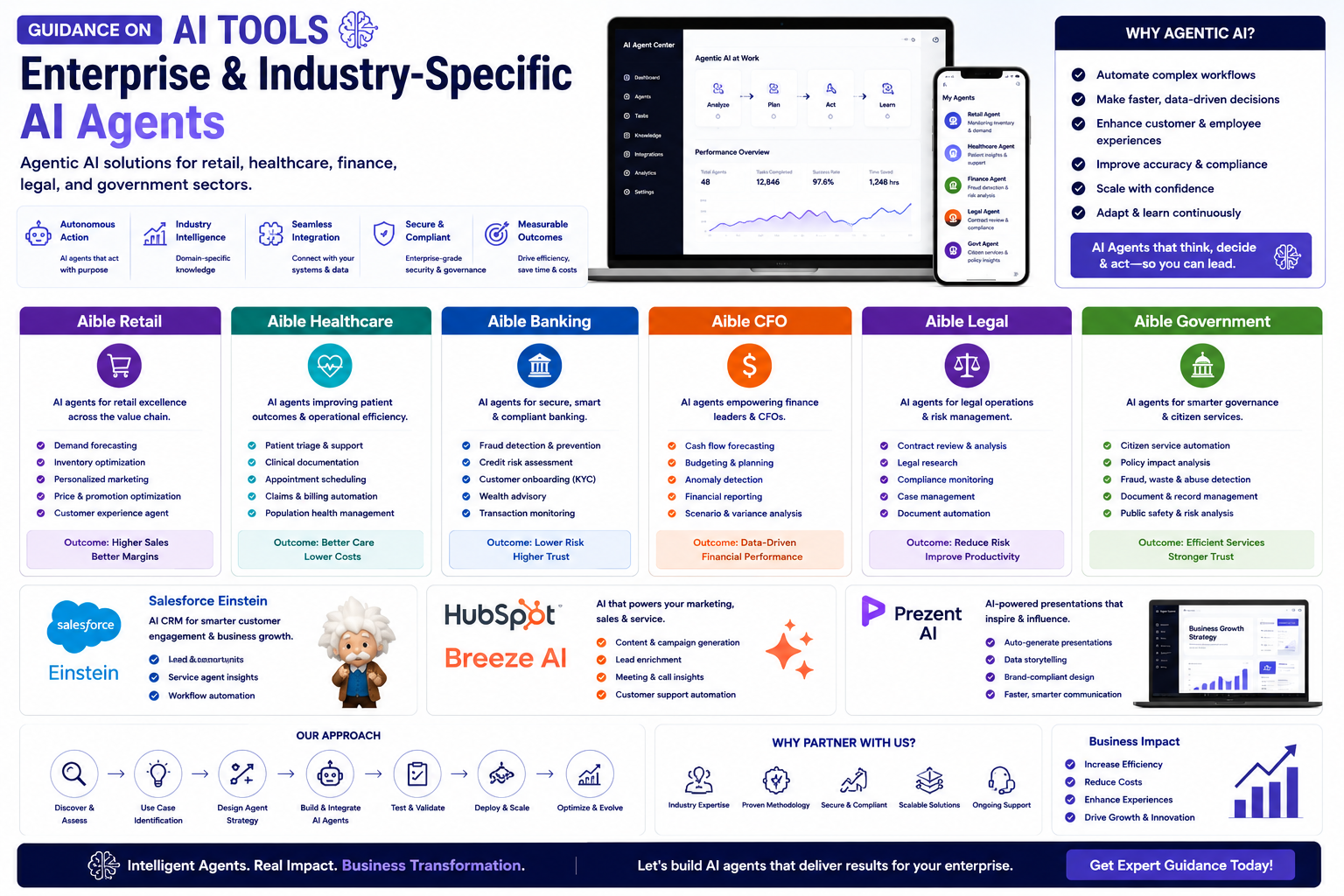
💼 Enterprise & Industry-Specific AI Agents
Agentic AI solutions for retail, healthcare, finance, legal, and government sectors.
- Aible Retail: Enterprise. Detects shifts in customer behavior and population.
- Aible Healthcare: Enterprise. Explains patient demand, visit volume, and facility performance.
- Aible Banking: Enterprise. Manages portfolio performance, risk exposure, and client behavior.
- Aible CFO: Enterprise. Handles spend, budgeting, and contract analysis.
- Aible Legal: Enterprise. Reviews contracts for liability exposure and indemnification risks.
- Aible Government: Enterprise. Monitors contracting and vendor spend.
- Salesforce Einstein: CRM intelligence. Paid ($50+/user/mo). Provides opportunity scoring and predictive forecasting.
- HubSpot Breeze AI: CRM automation. Freemium (credit-based). Offers lead scoring, content agents, and prospecting agents.
- Prezent AI: Enterprise presentations. Custom plan (14-day trial). Features brand alignment metrics and communication fingerprints.
Here is the complete road map to learning Enterprise & Industry-Specific AI Agents, presented without tables.
Phase 1: Foundations – Understanding Agentic AI (Weeks 1–2)
What is Agentic AI?
Unlike generative AI, which creates content based on learned knowledge, agentic AI takes action autonomously. It orchestrates complex workflows, solves problems, and makes decisions without constant human input . Think of it as an AI that doesn't just suggest – it executes.
Key concepts to learn:
- Autonomy vs. Assistance – Understand the spectrum from AI copilots (human-in-the-loop) to fully autonomous agents that operate independently. Most enterprise solutions today sit in the middle, requiring human oversight for high-stakes decisions .
- Multi-agent systems – Learn how multiple AI agents can collaborate, each handling specialized tasks. For example, one agent monitors risk, another handles compliance, and a third manages customer communication.
- Governance and oversight – Agentic AI introduces legal and ethical risks including lack of decision explainability, algorithmic bias, and questions of liability when autonomous decisions cause harm . Every industry deployment must address these.
Free resources:
- Naaia.ai publishes detailed sectoral guides on AI agent risks and governance (free articles)
- Xinhua Net's "How Agents Reconstruct Human Professions" offers insights on emerging roles like AI Behavior Auditor and Agentic AI Architect
- Follow AutoGPT and LangGraph (open-source frameworks) to understand technical foundations
Mini project: Pick an industry (retail, healthcare, or finance). Write a one-page outline identifying three routine processes in that industry that could be automated by an AI agent. For each, note one risk that would require human oversight.
Phase 2: Aible – Industry-Specific Predictive Agents (Weeks 3–4)
Tool overview: Aible delivers enterprise AI agents tailored to retail, healthcare, banking, finance, legal, and government sectors. Its key differentiator is explaining why predictions happen, not just what will happen.
By industry:
- Aible Retail – Detects shifts in customer behavior and population trends. Use case: predicting perishable goods overstock and wastage, reducing point-of-purchase waste by over 10% .
- Aible Healthcare – Explains patient demand, visit volume, and facility performance. Real-world example: A Fortune 500 healthcare provider used Aible to analyze Social Determinants of Health (SDoH) data, achieving a 20x improvement in speed to insight. They identified patterns in emergency room visits and inpatient admissions across five health conditions by region in just 15 days .
- Aible Banking – Manages portfolio performance, risk exposure, and client behavior.
- Aible CFO – Handles spend analysis, budgeting, and contract analysis.
- Aible Legal – Reviews contracts for liability exposure and indemnification risks.
- Aible Government – Monitors contracting and vendor spend to identify inefficiencies or fraud.
Learning actions:
- Request an Aible demo through their website. Focus on understanding how business users (not data scientists) can self-sufficiently analyze datasets in minutes.
- Study their case study on first-time college student retention (17% reduction in attrition in 15 days) to understand the speed-to-insight value proposition .
Free alternative: For predictive analytics fundamentals, explore Google's free "Machine Learning Crash Course" or Kaggle datasets for hands-on practice. These won't have Aible's industry-specific templates but will build transferable skills.
Output: A one-page "AI Opportunity Map" for a chosen industry. List three predictive problems Aible could solve, with estimated business impact and data requirements.
Phase 3: CRM Intelligence – Salesforce Einstein & HubSpot Breeze (Weeks 5–6)
Tool overview: These are the dominant AI layers embedded in leading CRM platforms. Einstein targets large enterprises; Breeze serves small to mid-market businesses .
Salesforce Einstein – Best for large enterprises
Key capabilities include predictive lead scoring that evaluates lead quality using historical data, opportunity insights and risk alerts that monitor deal progression, Einstein bots for automated customer service, and automated data capture using natural language processing .
Pricing starts at $25 per user per month for basic CRM, with AI features available as add-ons or included in premium tiers. Free 30-day trial available, but no permanent free tier .
Learning action: Enable Einstein Lead Scoring in a trial account. Decide which leads you want scored, select which fields matter in scoring, and build a simple workflow routing high scores to fast action and low scores to nurture sequences .
HubSpot Breeze – Best for growing businesses
Breeze offers specialized "agents" that act as team members. The Breeze Prospecting Agent focuses on AI-powered lead generation and personalized outreach. Breeze Copilot helps build workflows, summarize records, write content, and support outreach. Automated data enrichment cleans and completes CRM records. Breeze Customer Agent resolves over 65% of conversations without human intervention according to HubSpot .
Pricing starts free for up to two users. Starter paid plans begin at 20permonthperseat.Professional(
20permonthperseat.Professional(100/seat/month) unlocks full AI features, and Enterprise ($150/seat/month) adds advanced customization .
Learning action: Set up Breeze in a free HubSpot account. Define your ICP (Ideal Customer Profile) and lead stages clearly. Set up tracked buying signals including email engagement, meetings booked, key page visits, and form submissions. Use AI assistance for personalization at scale but keep guardrails – require validation before sending .
Key decision framework:
Choose Salesforce if you have complex go-to-market motions, multiple business units, strict security needs, and existing Salesforce infrastructure. Choose HubSpot if you want faster time-to-value, easier adoption for sales teams, and a single platform for marketing, sales, and service .
Total cost of ownership differs significantly. A mid-sized company (20 sales users, 5 marketing users) over three years: HubSpot totals approximately 123,000includingsoftware,implementation,andadmin.Salesforcetotalsapproximately
123,000includingsoftware,implementation,andadmin.Salesforcetotalsapproximately376,000 – largely due to the need for a dedicated certified administrator (70,000−
70,000−100,000/year) .
Output: A vendor recommendation memo for a hypothetical 50-person company. Include total cost of ownership estimate, AI feature comparison, and implementation timeline.
Phase 4: Enterprise Presentations – Prezent AI (Weeks 7–8)
Tool overview: Prezent is an enterprise business communication platform that uses AI to generate brand-compliant presentations. It's designed for large organizations across insurance, retail, technology, biotech, and pharma .
Key features:
- Communication Fingerprints – This feature allows users to self-identify their communication style, helping teams tailor messages to audience preferences. It promotes self-awareness as a communicator and helps others adapt their messaging to your needs .
- Auto Generator – Creates hyper-personalized, on-brand decks in minutes using prompts.
- Slide Library – Provides 35,000+ brand-approved slides and 1,000+ expert-curated storylines for rapid deck creation .
- Synthesis – Automatically generates concise, brand-aligned executive summaries from longer presentations.
- Template Converter – Converts any slide deck to 100% brand-compliant format.
- Best Practice Library – Thousands of examples from successful presentations.
- Zenith Learning Workshops – Bite-sized, gamified learning modules on business communication.
Learning actions:
- Sign up for Prezent's 14-day free trial
- Create your Communication Fingerprint profile – understand your style and how to adapt to others
- Use Auto Generator to create a deck on a business topic you know well
- Run the Compliance Checker to ensure brand alignment
Career application: Enterprise presentation skills are critical for roles in management consulting (McKinsey, BCG), corporate strategy, investor relations, and executive communications. Prezent's emphasis on "audience fingerprints" aligns with how top consultancies tailor messaging to stakeholder preferences.
Output: A 5-slide deck generated entirely by Prezent AI, plus a one-paragraph reflection on how the Communication Fingerprint changed your approach.
Phase 5: Industry Deep Dives (Weeks 9–10)
How different sectors deploy AI agents:
Finance & Insurance
AI agents in finance perform continuous portfolio risk assessment, anomaly detection, and automated AML/KYC compliance monitoring. Some execute algorithmic trading autonomously based on market conditions and risk constraints .
Critical risks include lack of decision explainability (problematic for regulatory audits), bias in risk assessments that may discriminate against certain customer profiles, and uncertain legal liability for trading losses or undetected fraud .
Healthcare & Life Sciences
Diagnostic support agents analyze medical records, lab results, and imaging to identify clinical signals. Care coordination agents automate appointment scheduling and follow-ups. Clinical research agents explore scientific literature to formulate hypotheses .
Critical risks include protection of highly sensitive health data, potential medical errors from misinterpretation, and excessive reliance on algorithmic recommendations that may weaken clinical judgment .
Human Resources & Talent Management
Candidate pre-screening agents analyze CVs and profiles to match job criteria. Automated onboarding agents support new employees through administrative steps. Skills management agents identify gaps and recommend training .
Critical risks include indirect discrimination from biased historical data, GDPR compliance for sensitive personal data, and reduced human involvement in structuring decisions like recruitment .
Public Sector & Citizen Services
User orientation agents help citizens navigate administrative procedures. Administrative decision-support agents analyze files for social aid or resource allocation. Fraud detection agents cross-reference data to identify inconsistencies .
Critical risks include infringement of fundamental rights, opacity of decision criteria affecting access to benefits, and insufficient contestability of automated decisions .
Learning actions:
- Choose one industry from the list above
- Research and write a one-page "AI Agent Readiness Assessment" for that industry
- Identify which specific processes are most automatable and which require highest human oversight
Free resources:
- Naaia.ai's sectoral guides (detailed breakdowns for each industry)
- European AI Act documentation (free public access)
- Follow industry-specific AI news on LinkedIn or Feedly
Phase 6: Governance, Ethics & Emerging Careers (Weeks 11–12)
Cross-cutting risks (all industries):
Legal and regulatory risks include non-compliance with GDPR Article 22 (which restricts fully automated decisions), exposure to emerging regulations like the EU AI Act, and uncertain legal liability for autonomous decisions that cause harm .
Ethical risks include algorithmic bias reproducing discrimination, weakening of human autonomy through over-reliance on AI recommendations, and lack of transparency in decision-making logic .
Operational and cybersecurity risks include misconfiguration of agents leading to erroneous decisions, excessive access to internal systems increasing attack surface, and difficulty auditing autonomous decision chains after incidents .
Emerging career roles (from expert analysis):
According to industry experts interviewed by Xinhua Net, the following roles will be critical in the agentic AI era :
- Agentic AI Architect / Orchestration Engineer – Designs multi-agent collaboration systems. Projected as one of the most稀缺 (scarce) technical roles in the next five years.
- AI Behavior Auditor – Specializes in assessing whether agent behavior aligns with enterprise values and regulatory requirements.
- Human-AI Collaboration Designer – Designs optimal workflows between humans and AI agents.
- Domain-Specific AI Trainer – Infuses deep industry knowledge (medical, legal, engineering) into agent systems. Extremely high value in specialized fields.
- AI Ethics & Compliance Officer – Ensures responsible AI deployment as agent autonomy increases.
- AI Workflow Designer – Structures how tasks are decomposed and assigned across human and agent teams.
The key insight from experts: "The core of this transformation is not jobs being simply replaced, but humans who can use agents replacing humans who cannot. The real skill is having your intelligence augmented by AI to create your own empire within an organization" .
Phase 7: Career Application Guide
Roles and recommended tool mastery:
- Enterprise AI Strategist – Master Aible (industry-specific), Salesforce Einstein. Sample task: "Identify three processes in a bank's operations that could be automated with agentic AI, including risk assessment and implementation timeline."
- CRM AI Specialist – Master Salesforce Einstein and HubSpot Breeze. Sample task: "Design an AI lead scoring workflow for a B2B SaaS company with 50 sales reps and complex deal cycles."
- Business Communications AI Lead – Master Prezent AI. Sample task: "Create a board-ready presentation using AI-generated content aligned to executive communication preferences."
- AI Governance Analyst – Master industry risk frameworks. Sample task: "Audit an AI agent deployment for GDPR Article 22 compliance and propose mitigation measures for identified risks."
- Industry Solutions Consultant – Master one industry vertical deeply (healthcare, finance, or government). Sample task: "Present a roadmap for deploying diagnostic support agents in a hospital network, including data requirements and human oversight protocols."
Where these skills apply with real titles:
- McKinsey / BCG / Bain – AI Strategy Consultant (agentic AI specialization)
- Deloitte / Accenture – AI Transformation Lead
- Salesforce / HubSpot – Solutions Engineer (Enterprise AI)
- Large banks (JPMorgan, Goldman Sachs) – AI Governance or AI Strategy
- Healthcare systems (Kaiser, HCA) – Clinical AI Specialist
- Tech startups building agentic AI products – Product Manager or Solutions Architect
- Government agencies – AI Policy Advisor or Digital Transformation Lead
The two paths forward:
Path A – Business strategy focus: Learn to identify where agents create value, build business cases, manage risks, and lead organizational change around AI adoption. Master the "what and why" of each tool.
Path B – Technical implementation focus: Learn to configure and deploy these tools. Master prompt engineering for agents, understand API integrations, build workflows connecting multiple agents. Master the "how" of each platform.
Most high-value roles combine both – strategic understanding of where agents fit plus practical ability to configure them.
Phase 8: Next Steps (After 12 Weeks)
A. Build a portfolio – no job required
Create these four deliverables:
- Industry AI Opportunity Assessment (2 pages) – Choose healthcare, finance, or retail. Identify three agentic AI use cases with business impact estimates and risk assessments. Use Aible's case studies as models.
- CRM AI Workflow Design (1 page) – Diagram an AI lead scoring and routing workflow using either Einstein or Breeze. Include trigger conditions, scoring logic, and human handoff points.
- AI-Generated Presentation Deck (5-7 slides) – Create using Prezent's free trial. Include your Communication Fingerprint analysis and a reflection on how AI changed your process.
- AI Governance Checklist (1 page) – For your chosen industry, create a compliance checklist covering GDPR, the EU AI Act, and ethical risk mitigation.
Host these on GitHub, a public Notion page, or a personal website. Link in applications.
B. Certifications and learning resources (free or low-cost)
- Salesforce Einstein AI Certifications – Trailhead (Salesforce's free learning platform) offers modules on Einstein AI. Free.
- HubSpot Academy – Free courses on Breeze AI and CRM automation. Free.
- EU AI Act self-study – Read the full text and summaries. Free.
- Coursera / DeepLearning.ai – "AI for Everyone" and "Generative AI with LLMs" (financial aid available).
- SCIP (Strategic & Competitive Intelligence Professionals) – Webinars on AI in competitive intelligence. Student membership ~$50/year.
C. Networking and practice
Join AI-focused communities on LinkedIn and Reddit (r/artificial, r/LocalLLaMA). Follow the product launches from major vendors – Salesforce, HubSpot, Microsoft, and Google are all rapidly evolving their agent offerings. Practice weekly: pick a real company (a bank, hospital, or retailer) and answer: "Which of their processes could be handed off to an AI agent today, and which should remain fully human – and why?"
D. Land your first role
Job titles to search for: AI Solutions Consultant, Enterprise AI Specialist, CRM AI Analyst, Business Intelligence Analyst (with AI focus), AI Governance Coordinator, Sales Operations Analyst (CRM AI), Digital Transformation Associate.
On your resume (before formal experience): "Analyzed agentic AI applications in healthcare, producing a use case assessment that identified $X in potential operational savings through automated care coordination."
Where to apply: Large enterprises with mature AI teams (you can learn their stack), consulting firms with AI practices (they train junior talent), AI vendors (Salesforce, HubSpot, Prezent, Aible – they need people who understand their products), and startups building agentic solutions (higher risk, faster learning).
The final insight: Agentic AI is not replacing judgment – it's replacing repetition. The most valuable professionals in this new landscape will be those who can set the right objectives for agents, interpret their outputs critically, and take responsibility for outcomes. Your ability to ask the right questions, not just execute tasks, is your ultimate competitive advantage




 Group / 1: 1 Sessions