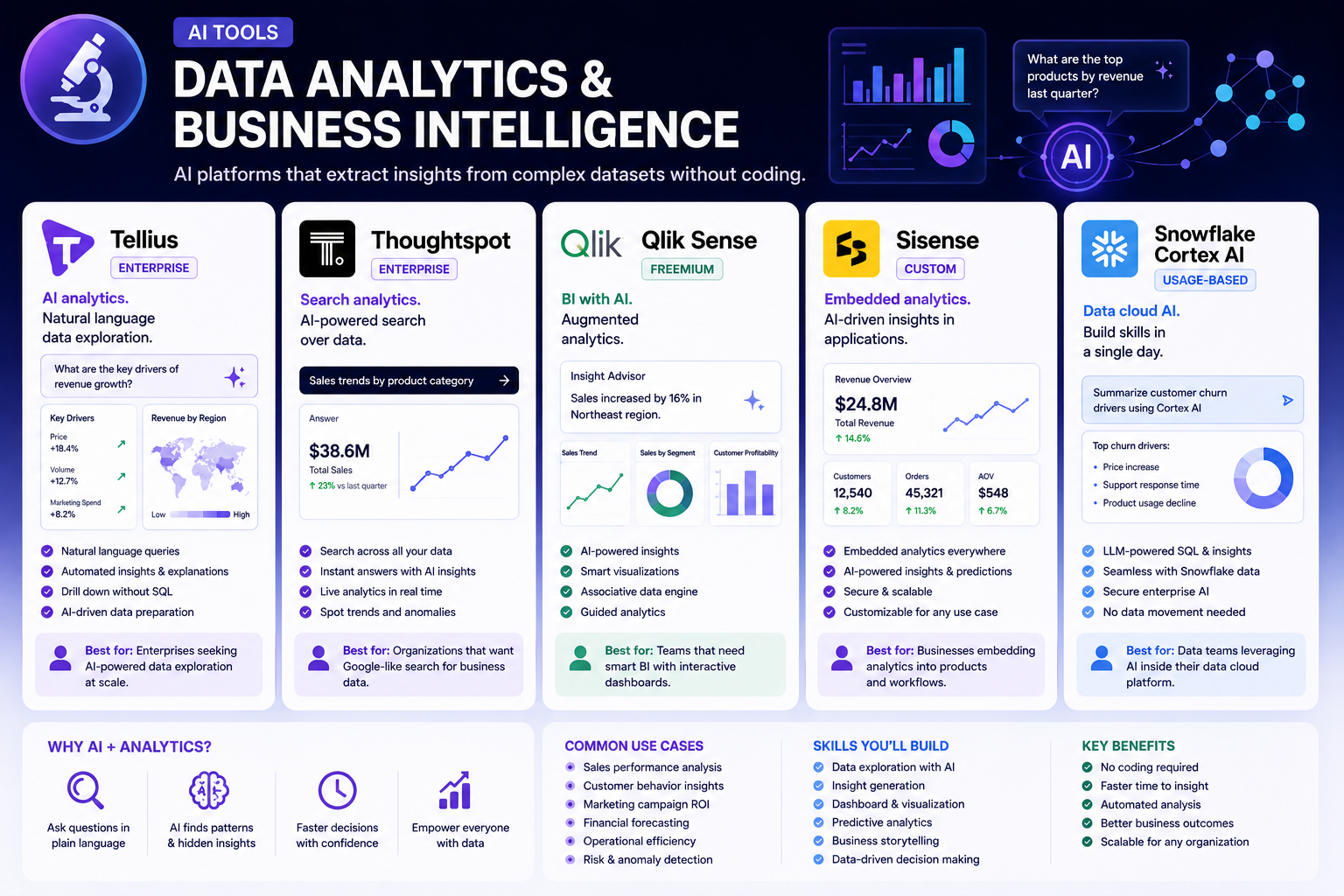
🔬 Data Analytics & Business Intelligence
AI platforms that extract insights from complex datasets without coding.
- Tellius: AI analytics. Enterprise. Natural language data exploration.
- Thoughtspot: Search analytics. Enterprise. AI-powered search over data.
- Qlik Sense: BI with AI. Freemium. Augmented analytics.
- Sisense: Embedded analytics. Custom. AI-driven insights in applications.
- Snowflake Cortex AI: Data cloud AI. Usage-based. Build skills in a single day.
This roadmap transforms you from a spreadsheet user into an AI-augmented data analyst—someone who asks natural language questions and lets AI surface insights, generate forecasts, and explain patterns without writing complex code. You will follow a 4-Phase structure that progresses from foundational AI literacy to enterprise-scale business intelligence.
Phase 1: Foundation (Week 1-2)
Goal: Understand how AI changes analytics and get hands-on with free-tier tools.
Start with AI Analytics Literacy
Before using any tool, understand the paradigm shift. Traditional BI requires you to know what you're looking for—you build dashboards, write SQL, and create visualizations manually. AI analytics flips this: you ask questions in plain English, and the AI explores the data, finds patterns, and surfaces insights you didn't know existed.
The key concepts to master early, drawn from real-world production deployments:
- Natural Language Query (NLQ): Asking "show me sales by region for last quarter" instead of writing SQL
- Augmented Analytics: AI that automatically detects trends, outliers, and correlations in your data
- Semantic Layer: The "translation dictionary" that maps business terms (like "profit") to actual database columns—this is where most AI analytics succeed or fail
- Ambiguity Management: When you ask "show me top customers," the AI must clarify whether "top" means by revenue, order count, or another metric
Practice with Free Qlik Sense
Qlik Sense offers a freemium tier and is an excellent starting point because its "Insight Advisor" feature demonstrates augmented analytics clearly. The tool uses AI to automatically generate insights from your data—trends, outliers, and correlations—without you having to ask specific questions .
Learning path for Week 1:
- Sign up for Qlik Sense free tier
- Upload a simple CSV (sales data, website analytics, anything with dates and numbers)
- Open Insight Advisor and ask "show me trends over time"—watch the AI generate visualizations
- Ask follow-up questions: "what caused the spike in March?"—observe how the AI suggests possible drivers
Free Training Resource: Qlik offers free live instructor webinars through Qlik Continuous Classroom, including a 45-minute session "Transform Your Insights with AI and Augmented Analytics Capabilities in Qlik Sense" delivered monthly. Registering gets you access to the on-demand recording .
Phase 2: Search-Driven Analytics (Week 3-4)
Goal: Master ThoughtSpot's search-first approach and understand how LLMs power natural language queries.
Why Search Changes Everything
ThoughtSpot pioneered "search-driven analytics"—a Google-like search bar over your company's data. Instead of asking a data analyst to build a report, anyone in the company can type "total sales by product category for last month" and get an instant answer .
The technology behind this is sophisticated. ThoughtSpot uses Large Language Models (LLMs) combined with Retrieval-Augmented Generation (RAG), Natural Language Processing (NLP), and Few-Shot Learning to translate your English questions into database queries .
What Makes RAG Important: RAG pulls relevant context from your company's specific data schema before generating the query. This means "profit" maps to your company's definition of profit, not a generic one. Without RAG, the LLM would guess—and often guess wrong .
Learning Path for ThoughtSpot
- Access ThoughtSpot's free training through ThoughtSpot University—specifically the "ThoughtSpot's Use of AI in Modern Analytics" course (37 minutes) covering LLMs, RAG, NLP, and Few-Shot Learning
- Practice with public datasets (ThoughtSpot provides demo environments)
- Master the search syntax: start simple ("sales by month"), then add filters ("sales by month where region = West"), then add comparisons ("sales by month vs previous year")
Paid Training Option: GFU Cyrus AG offers a 2-day ThoughtSpot training course (€1,370 per person) covering search-based analytics, AI-powered insights, pinboards, and enterprise deployment. Available in-person (Cologne) or online .
The "Help Us Learn" Feature
One of the most important concepts in AI analytics is teaching the system your business language. ThoughtSpot (and Tellius) include features where you can correct misinterpretations .
Example: You search "monthly profit." The AI misreads it as "monthlyprofit" (one word) and gets confused. You separate the terms, tell the AI that "monthly" means the time dimension and "profit" means the metric column. The system remembers this for future queries .
This "feedback loop" is what separates enterprise-grade AI analytics from simple demos. The system improves over time as you teach it your terminology .
Phase 3: Augmented & Embedded Analytics (Week 5-6)
Goal: Explore Tellius agentic analytics, Sisense embedded AI, and Snowflake Cortex for cloud-scale insights.
Tellius: Agentic AI Analytics
Tellius represents the cutting edge: agentic AI for analytics. Instead of just translating questions to SQL, Tellius uses AI agents that can plan multi-step analyses, handle ambiguity, and explain their reasoning .
Key lessons from Tellius's real-world deployment:
- Deterministic planning: The AI's plan is validated before any query runs, preventing randomness from affecting business-critical numbers
- Transparency: Every answer includes a "preamble" explaining which data sources, metrics, and filters were used
- Ambiguity handling: If "area" could mean Region or Territory, the AI asks for clarification rather than guessing
Free Learning: Tellius documentation includes detailed guides on the "Help Us Learn" feature, which teaches the system your business terminology. This is the same concept as ThoughtSpot's learning features but worth understanding as a pattern across platforms .
Sisense: Embedded AI Analytics
Sisense specializes in embedded analytics—adding AI-powered analytics directly into other applications. If you're building a Shopify app, a customer portal, or an internal tool, Sisense lets you embed dashboards with AI features like natural language query .
Key Sisense features to understand:
- Sisense Intelligence: A unified suite of AI capabilities including Assistant (natural language workflow builder), Narrative (gen-AI summaries of charts and graphs), and Forecast/Trend/Explanation tools
- Semantic enrichment: AI that automatically generates descriptions for tables and columns, improving how the system understands your data model
Pricing Reality: Sisense starts at $399/month for the Launch plan (usage-based). Implementation can be time-consuming—users report that flexibility comes with significant engineering effort . For learning purposes, focus on understanding the concepts rather than hands-on practice unless you have budget.
Snowflake Cortex: AI Inside Your Data Cloud
If your company uses Snowflake (increasingly common for e-commerce data), Cortex AI lets you run AI analytics directly inside the data warehouse. You don't move data to a separate tool—you ask questions where the data lives .
Key Cortex capabilities:
- Cortex Analyst: Natural language to SQL—ask questions in English, get answers from your Snowflake data
- Cortex Search: AI-powered search over documents and unstructured data
- AI SQL functions: Sentiment analysis, text classification, summarization—all runnable within SQL queries
Free Training Resource: The "Zero to Snowflake" masterclass (offered by ET CIO) covers Cortex in one guided session—spinning up warehouses, loading data, and using Cortex Playground and AI SQL functions . Perfect for a focused learning day.
Phase 4: Enterprise Integration & Career Launch (Week 7-8)
Goal: Build a portfolio project and position yourself for AI analytics roles.
Build Your Portfolio Project
Create a complete AI analytics solution from data to insights using free tiers:
- Source: Download public e-commerce data (Kaggle has excellent datasets—search "e-commerce sales")
- Load: Import into Qlik Sense free tier or Snowflake free trial
- Explore: Use natural language questions to discover insights: "what products have highest returns?", "which customer segment has highest lifetime value?"
- Document: Create a 2-page report showing: the questions you asked, the AI-generated insights, and how you validated them
- Share: Export visualizations and include them in your portfolio
This project proves you can extract business value from data using AI tools—a skill that translates directly to paid roles.
Advanced Training Resources
Free:
- ThoughtSpot University AI Learning Path: 37-minute course covering LLMs, RAG, NLP, and Few-Shot Learning—excellent for understanding how AI analytics actually works
- Qlik Continuous Classroom: 300+ courses including live instructor webinars on AI and augmented analytics
- Tellius Documentation: Detailed guides on semantic layer design, ambiguity management, and the "Help Us Learn" feature
Paid:
- Coursera: Advanced Data Analysis in Qlik Sense: 2-hour course covering set analysis, calculated fields, dynamic filters, and collaboration features. Free option available (certificate may require payment)
- ThoughtSpot Instructor-Led Training: 2-day course (€1,370) covering search analytics, AI insights, and enterprise deployment
Career Applications & Next Steps
AI-Augmented Business Analyst
Your role shifts from "person who writes SQL queries" to "person who asks the right questions." Business users will come to you with vague requests—you translate them into natural language queries, validate the AI's answers, and explain insights to stakeholders. The premium is on business acumen and question-asking, not technical coding .
Embedded Analytics Developer (Sisense Specialist)
SaaS companies need analytics inside their products—usage dashboards for customers, performance metrics for internal teams. Sisense is a leader in this space . Your role: embed AI-powered analytics into applications, configure security for multi-tenant environments, and maintain the semantic layer .
E-commerce Analytics Lead (Shopify, WooCommerce, BigCommerce, Magento)
Each platform generates massive data—orders, customers, inventory, marketing attribution. AI analytics tools let you extract insights without writing complex SQL.
For Shopify, use Qlik Sense to connect directly to Shopify's API via pre-built connectors. Ask natural language questions: "which products have the highest profit margin by region?", "what is the customer lifetime value by acquisition channel?"
For WooCommerce, export data to CSV or connect via REST API to Snowflake. Use Snowflake Cortex to ask questions directly. WooCommerce stores often have more complex, custom data structures—this is where semantic enrichment (automatically generating field descriptions) becomes valuable .
For BigCommerce and Magento (enterprise platforms), focus on performance at scale. ThoughtSpot excels here—its in-memory search architecture handles millions of rows sub-second. Use its AI-powered insights to automatically detect anomalies in order volume, inventory levels, or customer behavior.
Data Analyst (AI-Enhanced)
Traditional data analyst roles are evolving. You still need to understand data modeling, statistics, and business metrics—but AI tools handle the mechanical work of querying and visualizing. Your value is in asking better questions and validating AI outputs . According to real-world job postings, employers want expertise in machine learning frameworks (TensorFlow, PyTorch) and LLMs (OpenAI, LangChain) alongside traditional analytics skills .
AI Analytics Consultant
Small and mid-size businesses want data insights but lack dedicated analytics teams. Package your skills: audit their data sources, set up Qlik Sense or ThoughtSpot (free tiers where possible), train their teams to ask natural language questions, and provide ongoing support. The ROI is immediate—turning data into decisions without hiring SQL experts.
Commerce Data Strategist
The most advanced e-commerce teams are building AI agent systems for merchandising and pricing. Real-world job postings describe roles that design demand forecasting systems, assortment optimization algorithms, and price elasticity models—using techniques like LSTM and Transformer-based models alongside LLMs and agent-based systems .
This represents the frontier: moving from descriptive analytics ("what happened?") to prescriptive analytics ("what should we do?"). You would design systems that automatically adjust pricing based on demand signals, optimize inventory allocation across warehouses, and personalize product recommendations—all powered by AI agents working autonomously .
Your Next Steps for This Week
Day 1: Sign up for Qlik Sense free tier. Upload a simple CSV (sales data or anything with dates/numbers). Ask Insight Advisor three questions.
Day 2: Take the free ThoughtSpot University course "ThoughtSpot's Use of AI in Modern Analytics" (37 minutes). Understand LLMs, RAG, and Few-Shot Learning.
Day 3: Watch the Qlik live webinar recording "Transform Your Insights with AI and Augmented Analytics" (45 minutes, free with registration).
Day 4: Download a public e-commerce dataset from Kaggle. Load into Qlik Sense. Generate five insights using natural language questions.
Day 5: Write down three business questions your current employer (or a company you know) cannot answer easily. Map how AI analytics could answer them.
By the end of 8 weeks, you will have hands-on experience with AI analytics platforms, a portfolio project demonstrating natural language insights, and a clear understanding of how to position yourself for roles in business intelligence, e-commerce analytics, and AI-augmented data strategy across Shopify, WooCommerce, BigCommerce, and Magento.




 Group / 1: 1 Sessions