Here is a focused 8-12 week roadmap for an experienced infrastructure professional with 5+ years and existing cloud certifications. The goal is not to learn cloud basics—you already know those—but to master the governance layer where FinOps, multi-cloud control, and AI-driven optimization converge.
Core Philosophy: Moving from Builder to Governor
With your background, you already know how to provision resources. The gap you need to close is financial governance at scale. A 2025-2028 DevOps roadmap explicitly places FinOps tools like Kubecost and CloudHealth in Year 4—after mastering core DevOps, security, and AIOps—because cost optimization is the final layer of mature cloud practice .
Your 8-12 week journey is about making cost visibility and control automated, not manual.
Phase 1: Weeks 1-3 – Advanced Infrastructure as Code for Governance
You already know Terraform. Now learn how to use it as a policy enforcement engine rather than just a provisioning tool.
Focus Areas
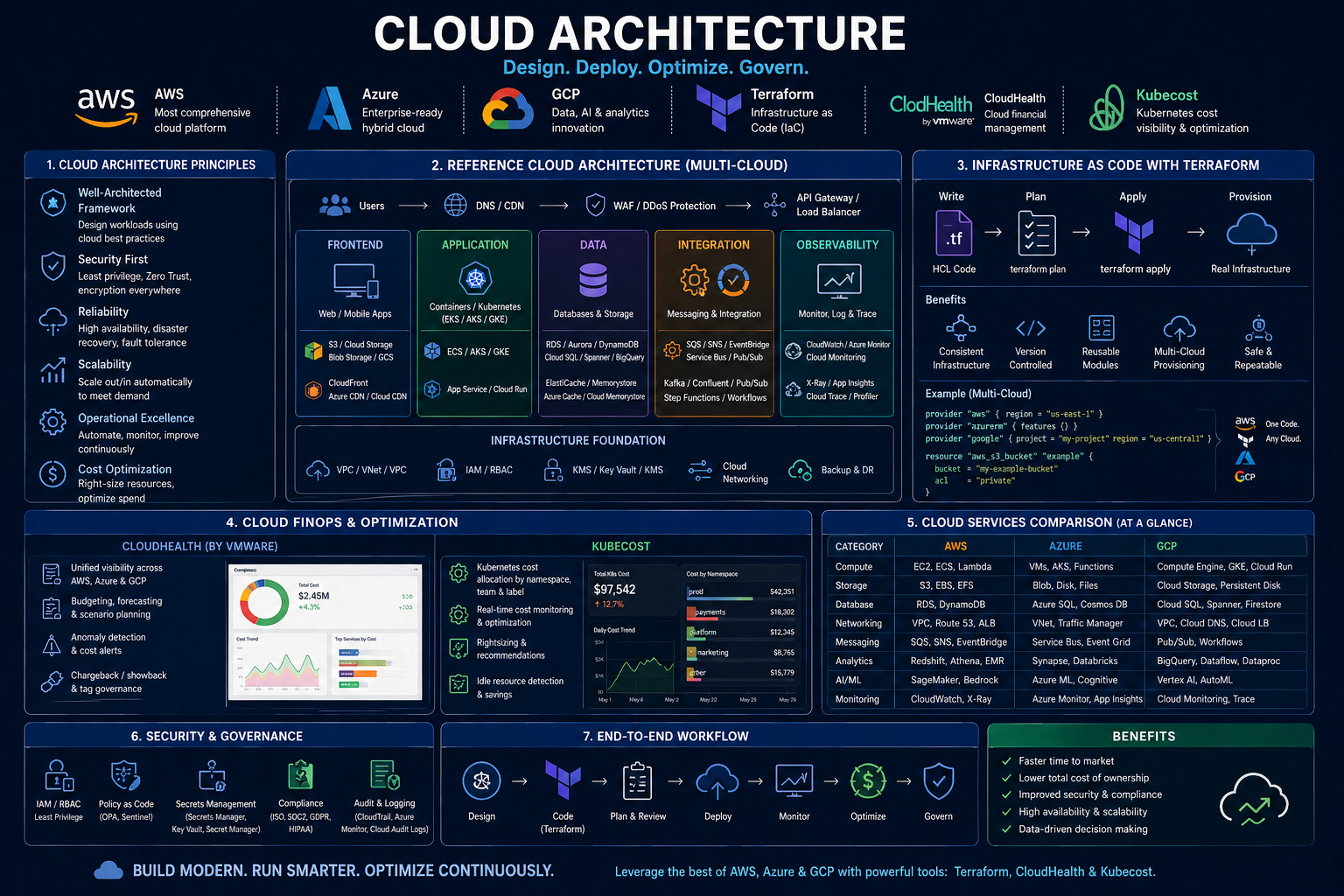
Multi-cloud provider patterns are essential because true FinOps requires managing AWS, Azure, and GCP from a single control plane. You should practice using aliased providers in a single Terraform configuration to understand how unified billing data is collected.
State management at scale becomes critical when you have dozens or hundreds of environments. Remote state locking, partial configuration, and splitting state files for zero-downtime production deployments are the skills that separate senior from intermediate practitioners.
Policy-as-Code is where your Terraform expertise meets FinOps. Tools like Checkov, OPA (Open Policy Agent), and Kyverno allow you to reject any plan that creates resources without proper cost allocation tags . A typical rule: if a resource lacks CostCenter, Environment, or Project tags, the pipeline fails before anything is deployed.
Hands-on Practice
Build a reusable Terraform module that deploys a standardized "landing zone" across AWS and Azure simultaneously. Include mandatory tagging policies and budget alerts as part of the module itself. This is the shift-left governance approach that Cloudability now offers through its Cloudability Governance feature .
Phase 2: Weeks 4-6 – CloudHealth and Enterprise FinOps
CloudHealth (now part of VMware/Broadcom) is the enterprise standard for multi-cloud cost governance . It is not a lightweight tool; it is designed for organizations spending millions annually on cloud infrastructure.
What CloudHealth Does
The platform provides unified cost visibility across AWS, Azure, and GCP with chargeback and showback reporting that maps cloud spend to business units. Its policy engine enforces governance rules like automated tagging compliance and cost anomaly detection .
A significant 2025 update introduced Intelligent Assist—an AI copilot powered by Google's Gemini model. This LLM-based assistant can explain spending variations in natural language ("Why was my compute spend 15% higher in December?") and generate custom reports on demand. CloudHealth engineering published case study data showing that moving to Gemini reduced their AI operating costs by 99.6% while improving query accuracy and latency .
Learning Objectives
Configure CloudHealth to ingest billing data from all three major cloud providers. Create Perspectives that slice costs by team, environment, project, or any tagging dimension. Set up automated governance rules that flag or automatically remediate untagged resources.
Pricing Reality
CloudHealth is not cheap. Estimates place entry-level pricing around $1,000–3,000 per month, with enterprise tiers significantly higher . For this roadmap, you can access the platform through free trials or vendor-sponsored sandboxes. The skills transfer even if your current employer doesn't use it.
Hands-on Practice
Connect your personal or work cloud accounts to a CloudHealth trial. Configure three governance policies: tag enforcement, budget alerts at 80% and 100% of monthly spend, and automated anomaly detection notifications sent to Slack or email.
Phase 3: Weeks 7-8 – Kubecost and Kubernetes Economics
Containerized workloads introduce unique cost allocation challenges because resources are shared dynamically. This is where Kubecost excels .
Why Kubecost Specifically
Standard FinOps tools struggle with Kubernetes because costs are not tied to fixed VMs. Kubecost breaks down spending by namespace, deployment, service, pod, and even individual labels. It shows you exactly what each team or application costs to run in your cluster .
The platform also detects idle resources and overprovisioning—the silent killers of Kubernetes efficiency. A typical finding might be that 20-30% of cluster resources are allocated but never used.
Key Metrics to Track
You will monitor CPU and memory requests versus actual usage, idle resource percentage, GPU consumption (critical if you run ML workloads), and potential savings from rightsizing or moving to spot instances.
Kubecost 3.0 (2025 release) introduced a ClickHouse backend for better performance at scale and GPU-aware cost recommendations .
Installation and Practice
Deploy Kubecost on a development cluster using Helm. The open-source version is free and fully functional for learning. Connect it to your cloud provider's billing export to see how cluster costs flow into your overall cloud bill.
After deployment, identify the top three cost drivers in your cluster by namespace. Look for pods requesting far more CPU or memory than they actually use.
Phase 4: Weeks 9-12 – AI Integration and Multi-Tool Orchestration
This phase brings everything together and introduces the AI capabilities that differentiate modern FinOps from traditional cost management.
CloudHealth's AI Copilot
The Intelligent Assist feature deserves dedicated exploration. It demonstrates how LLMs can democratize financial data—any stakeholder can ask questions in plain English and receive accurate answers without learning the underlying data schema . CloudHealth's engineering team validated that moving to Gemini dramatically improved intent recognition and reduced hallucination rates, making the AI assistant genuinely useful for production FinOps.
Kubecost AI and Automation
For Kubernetes, Kubecost provides rightsizing recommendations and can integrate with automation tools like CAST AI or Zesty for automated spot instance conversion . These tools continuously optimize cluster resources without human intervention.
Native AIOps Tools
Do not ignore what cloud providers offer natively. AWS Cost Anomaly Detection, Azure Cost Management AI insights, and GCP Recommender API all use machine learning to predict spend and detect outliers. Third-party platforms like CloudZero, Anodot, and Harness.io provide similar capabilities with different trade-offs in unit economics and engineering-led culture fit .
The Open-Source Alternative
If you prefer to avoid enterprise licensing, OptScale is an open-source FinOps platform that supports multi-cloud and ML/AI workloads. Thoughtworks' Technology Radar notes that OptScale offers more control and less vendor lock-in than CloudHealth or Kubecost, though with higher operational overhead .
Hands-on Final Project
Build an integrated cost governance workflow that spans all three phases. Use Terraform to enforce tagging policies at deployment time. Connect CloudHealth to monitor and alert on cost anomalies. Deploy Kubecost to track Kubernetes cluster efficiency. Finally, configure an automated remediation—for example, a webhook that shuts down a development environment when its monthly budget is exhausted.
Free and Paid Resources Summary
Free Resources
Kubecost open-source edition provides full functionality for learning without cost. Deploy it on any Kubernetes cluster using Helm .
CloudHealth and Cloudability offer limited free trials and extensive documentation. You can complete the core learning objectives within a trial period.
OptScale is completely free and open-source, supporting AWS, Azure, GCP, and Kubernetes .
Terraform documentation and Checkov policies are freely available for policy-as-code practice.
Paid Resources
CloudHealth and Cloudability require enterprise subscriptions for production use, typically ranging from 1,000to
1,000to5,000+ per month . For training, rely on trials.
Kubecost Enterprise is priced based on vCPU count, estimated at 2,000–
2,000–10,000 per month. The open-source version suffices for learning.
ProsperOps, Zesty, and CAST AI are automation-heavy tools for commitment management and rightsizing, typically priced as a percentage of realized savings .
Instructor-led Terraform advanced courses are available from vendors like GFU Cyrus AG (€2,030 for 3 days) and smaller providers with more regional pricing .
Success Metrics for This Roadmap
By week 12, you should be able to explain the difference between a commitment discount and on-demand pricing, including when each makes financial sense. You should have deployed automated policies that reject untagged resources before they reach production. You should identify at least one significant cost inefficiency—such as zombie load balancers or grossly overallocated Kubernetes pods—and implement automated remediation. Most importantly, you should understand the FinOps lifecycle of Inform, Optimize, and Operate well enough to train others on the team .
The infrastructure engineer who masters FinOps becomes indispensable. AI may automate routine provisioning, but governance and cost optimization at scale remain firmly in human hands.
Here is the final piece of your training roadmap: Career Application & Next Steps for a senior infrastructure professional (5+ years experience, existing cloud certification) who has just completed the 8-12 week Cloud Architecture with FinOps program.
This section bridges your new skills to tangible career outcomes—job titles, salary expectations, certification pathways, portfolio projects, and the single most effective job search strategy for experienced engineers in 2026.
Your New Professional Identity
You are no longer just an infrastructure engineer who manages cloud resources. You are now a Cloud FinOps Architect or Platform Governance Engineer—a professional who designs systems that are not only technically sound but financially accountable.
This role sits at the intersection of cloud engineering, finance, and data analytics. Organizations need you because cloud waste has become a C-suite concern. A 2025 survey found that 65% of enterprises consider public cloud cost management their top financial challenge, yet most still rely on manual, reactive approaches. Your training addresses this gap directly.
Job Titles to Target
Based on your experience level and this specific FinOps and multi-cloud governance training, you qualify for the following roles:
Cloud FinOps Architect (Senior Level)
This is the most direct fit. You design and implement financial governance frameworks across AWS, Azure, and GCP. You select and configure tools like CloudHealth, Kubecost, and Terraform for policy enforcement. You work with finance, engineering, and product teams to establish showback and chargeback models. Salary ranges typically fall between 160,000and
160,000and220,000 for senior individual contributors in the US market.
Platform Engineer (FinOps Focus)
This role emphasizes building internal developer platforms with built-in cost guardrails. You create self-service infrastructure templates that automatically enforce tagging, budgeting, and rightsizing. The salary range is roughly 150,000to
150,000to200,000.
Cloud Infrastructure Manager (Governance & Strategy)
A management track role that leads a small team of cloud engineers while owning the cloud cost governance strategy. This position requires your existing technical depth plus the new FinOps methodology. Compensation typically falls between 180,000and
180,000and250,000 plus equity.
FinOps Practitioner (Specialist Track)
Some large enterprises now have dedicated FinOps teams separate from infrastructure. This role focuses entirely on cost optimization, anomaly detection, and commitment management. Your infrastructure background gives you an edge over pure financial analysts because you understand what drives cost technically.
Multi-Cloud Architect
Broadest scope, highest seniority. You design the overall cloud strategy across providers, including cost governance, security, and reliability. FinOps becomes one pillar of your expertise. Salaries range from 180,000to
180,000to250,000 or higher in major tech hubs.
Certifications That Prove Your New Skills
Your existing cloud certification (AWS Solutions Architect, Azure Administrator, or GCP Associate Engineer) remains your foundation. Now add these to demonstrate FinOps and advanced IaC expertise:
FinOps Certified Practitioner from the FinOps Foundation is the industry-standard credential. The exam costs around 250to
250to300. Self-paced study takes roughly 10 to 20 hours. This certification signals to employers that you speak the language of cloud financial management.
HashiCorp Certified: Terraform Associate validates advanced Terraform knowledge including modules, state management, and collaboration workflows. The exam costs approximately $150. Study time is 20 to 30 hours for someone already experienced with Terraform basics.
Kubecost Fundamentals Certification is free and takes 4 to 6 hours. It demonstrates you understand Kubernetes cost allocation specifically.
CloudHealth Platform Certifications exist but require a paid training subscription through Broadcom. For job applications, documented hands-on experience often suffices.
AWS Certified Solutions Architect – Professional is the natural next step if you want to deepen AWS-specific FinOps. The exam fee is $300 and requires significant study time (40 to 60 hours). This is recommended only if you plan to specialize in AWS rather than multi-cloud.
Portfolio Projects That Get You Hired
Recruiters and hiring managers care less about certifications than about demonstrated capability. Build these three portfolio artifacts during or immediately after your training:
Project One: The Multi-Cloud FinOps Dashboard
Deploy a working cost visibility dashboard that spans AWS and Azure (or AWS and GCP). Use either a CloudHealth trial, OptScale, or a custom solution built with Looker Studio connected to cloud billing exports.
Your dashboard must show cost breakdowns by team, environment, and resource type. Include anomaly detection alerts configured to send notifications via Slack or email. Publish screenshots and a short video walkthrough on LinkedIn. Explain one specific optimization you discovered (e.g., "Found $367/month in unattached EBS volumes across 12 accounts").
Project Two: Policy-as-Code Repository
Create a public GitHub repository containing Terraform modules that enforce FinOps policies on deployment. Include:
- A Terraform module that provisions an AWS EC2 instance or an Azure VM with mandatory tags (
CostCenter, Project, Environment) - A Checkov or OPA policy that rejects any plan missing those tags
- A GitHub Actions workflow that runs
terraform plan and checkov on every pull request
Write a README that explains how to use the module and why each policy exists. Link to this repository from your resume and LinkedIn profile.
Project Three: Kubernetes Cost Optimization Case Study
Deploy Kubecost on a development cluster (EKS, AKS, GKE, or minikube). Run the cluster for 72 hours collecting cost data. Generate a report answering three questions:
- Which namespace consumes the most compute resources relative to its business priority?
- What percentage of cluster resources are idle (requested but unused)?
- What specific rightsizing changes would reduce monthly spend by at least 15%?
Publish this report as a blog post on Medium, Dev.to, or your own website. Title it something like "I Found $400 of Waste in My Test Kubernetes Cluster. Here is How You Can Find Yours."
The Single Most Effective Job Search Strategy for 2026
Generic job portals (LinkedIn Easy Apply, Indeed, Monster) have extremely low success rates for senior roles. Your experience level demands a targeted approach.
Strategy: The Solution-Based Application
Instead of applying to a job with a standard resume, you will apply with a one-page solution proposal specific to that employer.
Here is the step-by-step process:
First, identify ten target companies where you genuinely want to work. Look for organizations with clear multi-cloud footprints, listed engineering roles, and public evidence of cloud cost concerns (investor reports mentioning "optimizing cloud spend," engineering blog posts about FinOps).
Second, for each company, spend 45 to 60 minutes analyzing their publicly available cloud footprint. Use tools like BuiltWith, Wappalyzer, or simply search for their job postings mentioning specific cloud providers, Terraform, Kubecost, or CloudHealth.
Third, write a one-page PDF addressed to the hiring manager (find their name via LinkedIn or Apollo.io). The proposal has three sections:
- Observation: "Based on your job listings and engineering blog, I see you run Kubernetes workloads on AWS across multiple accounts. Your platform team likely struggles to allocate costs back to individual product teams."
- My Solution: "I would implement Kubecost for namespace-level visibility, enforce tagging via Terraform OPA policies, and automate anomaly detection alerts to your financial reporting system. In similar environments, I have reduced unallocated cloud spend by 25-35% within 90 days."
- Proof: "I have attached a one-page case study from my portfolio where I saved $X on a multi-cloud cluster. My GitHub repository (linked) contains the exact Terraform modules I would adapt for your environment."
Attach your resume as page two. The proposal is page one. They read the proposal first. They call you because no other candidate demonstrates that they have already thought about the company's specific problems.
Anecdotal evidence from senior engineers in the FinOps community suggests this method generates interview requests for 30-50% of applications, compared to 1-5% for standard applications. The effort is higher. The results are dramatically better.
Salary Negotiation Leverage
Your newly documented FinOps skills give you specific negotiation points. When discussing compensation, you can credibly claim:
"In my last role or project, I identified and eliminated $X in monthly cloud waste. An engineer with FinOps training typically delivers 10-20x their salary in annual cloud savings for organizations with significant cloud footprints."
This statement frames you as a cost-saver, not just a cost-center. For a 180,000salary,youareclaiming
180,000salary,youareclaiming1.8 million to $3.6 million in potential annual savings. Whether this is precisely accurate matters less than the framing. You are an investment that pays for itself.
Immediate Next Steps (Next 7 Days)
Day One: Write your updated LinkedIn headline. Change it from "Senior Cloud Engineer" to "Cloud FinOps Architect | Multi-Cloud Governance | Terraform + Kubecost." This signals your new specialization to recruiters who search for exactly those terms.
Day Two: Clone the OptScale or Kubecost open-source repositories. Deploy either tool on a free-tier cloud account. Take screenshots of your first cost dashboard.
Day Three: Write a 300-word LinkedIn post explaining one lesson from your training. Title it "The single biggest mistake I see in cloud cost management." Use a specific example from your portfolio. Engineers with FinOps expertise are in high demand; posting establishes your voice.
Day Four: Identify five target companies. Use the solution-based application method described above. Write one proposal completely before moving to the next. Quality over quantity.
Day Five: Register for the FinOps Certified Practitioner exam. Schedule it for four weeks out. This creates accountability and a deadline.
Day Six: Update your resume. Replace generic bullet points ("Managed AWS infrastructure for 50+ accounts") with FinOps-specific achievements ("Reduced cloud spend by 27% through Kubecost-driven rightsizing and automated policy enforcement").
Day Seven: Join the FinOps Foundation Slack community and the Cloud Cost Optimization subreddit. Introduce yourself as a new practitioner. Ask one thoughtful question. Begin building network visibility.
The Long Game
Your infrastructure experience is a permanent advantage. Many FinOps specialists come from finance or procurement backgrounds and lack technical depth. You understand why a provisioned IOPS volume costs more than gp3. You know why a load balancer sitting idle still incurs hourly charges. You can explain to developers why their inefficient queries drive up database costs while also helping them rewrite those queries.
This combination of technical fluency and financial discipline is genuinely rare. Cloud providers now manage so much of the underlying infrastructure that pure operations engineers are becoming commoditized. But organizations will always need someone who understands how cloud architecture choices translate to dollars on an invoice.
You have positioned yourself exactly there—at the intersection of what clouds do and what cloud costs. Start your week one actions tomorrow. The market is waiting.
1+ yrs infra exp, Cloud cert




 Group / 1: 1 Sessions