Serverless architecture security is a high-demand specialization that sits at the intersection of cloud engineering, application security, and operations. Unlike traditional infrastructure security, securing serverless requires shifting left into developer workflows and mastering ephemeral, event-driven environments.
Below is a strategic roadmap broken into phases. Each phase builds on the previous one, starting with foundational cloud knowledge and progressing to advanced AI-driven detection and remediation. Career applications and next steps are integrated at the end.
Phase 1: Foundational Cloud & Shared Security Knowledge
Before touching a single line of Lambda or Cloud Function code, you must internalize the Shared Responsibility Model. In serverless, the cloud provider secures the physical hardware and the runtime environment, but you are responsible for the code, dependencies, permissions, and data handling. A common mistake is assuming "serverless" means "no security work."
Start with vendor-neutral cloud security principles to understand how IAM, data protection, and compliance work across any platform. The Certificate of Cloud Security Knowledge (CCSK) is the ideal starting point here, as it covers serverless functions within its application security modules and introduces zero-trust concepts.
Free / Low-Cost Resources:
- Introduction to Cloud Security (CISA): A self-paced course with no prerequisites covering data protection, IAM, and an introduction to securing serverless architectures.
- CCSK Study Materials: While the exam costs money, the CSA (Cloud Security Alliance) publishes free study guides and the "Cloud Controls Matrix" which are essential for understanding governance.
Practice Lab:
- Elastic Security Agent Skills: Use this open-source tool to spin up a live security project via your AI coding agent. It automatically generates realistic serverless attack data (like AWS privilege escalation) against a live environment.
Phase 2: Specialized Serverless & API Defense
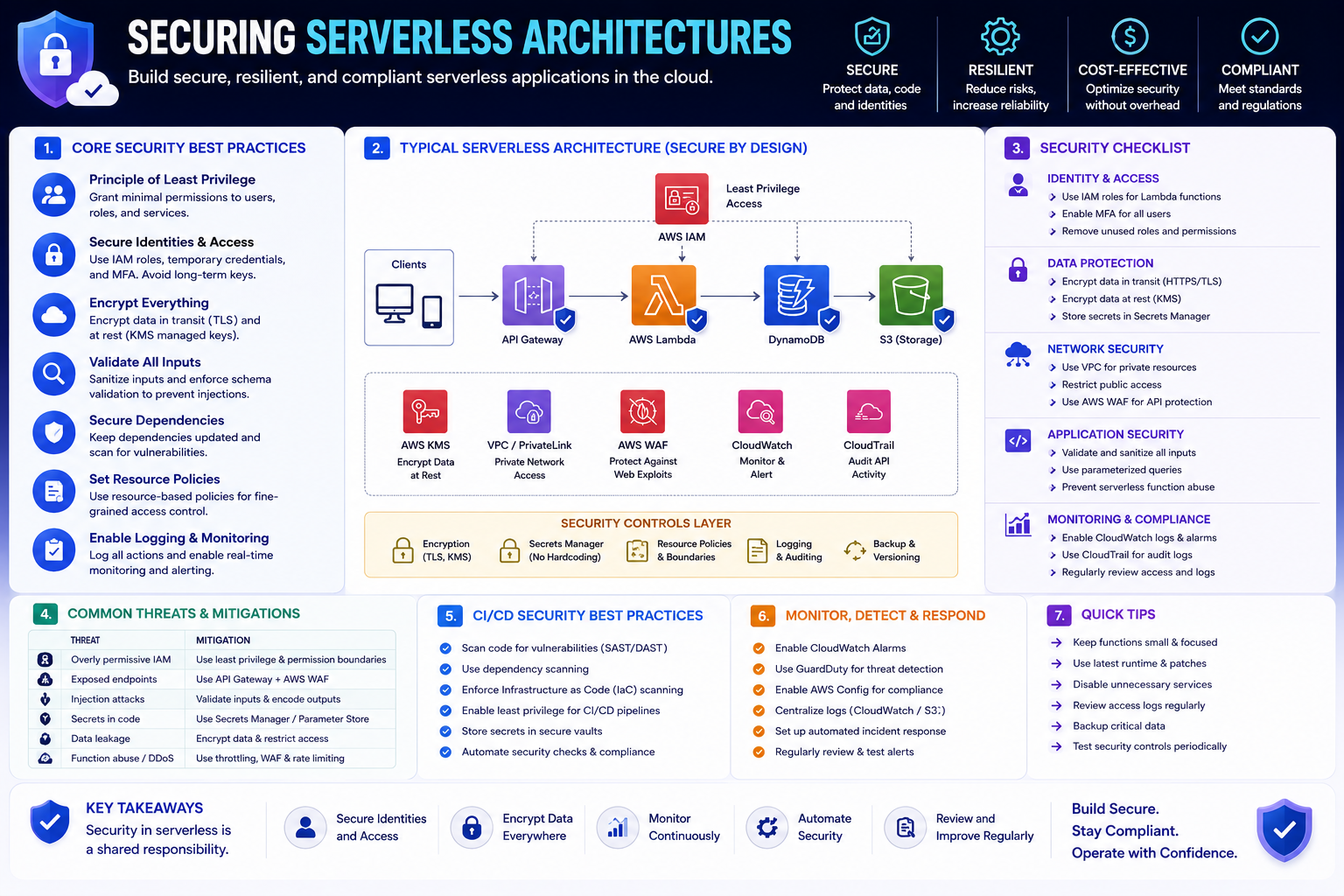
With fundamentals in place, focus specifically on the serverless attack surface. The three biggest risks in serverless are: event injection (malicious data triggering a function), insecure permissions (a function having too much access), and dependency vulnerabilities (using a vulnerable library in your deployment package).
You need to learn how to secure the API gateway (your front door), the runtime environment (the function code), and the data storage (often DynamoDB or Blob storage). The CCSP (Certified Cloud Security Professional) certification is the gold standard here, specifically its domains on Cloud Platform & Infrastructure Security and Cloud Application Security.
Free / Paid Resources:
- Securing Serverless Environments (CISA): A free, intermediate-level course specifically focused on securing entry points, runtimes, and data storage in serverless apps.
- Check Point CloudGuard Jump Start: A completely free course on Cybrary that includes a dedicated week on "Serverless Security" with deployment labs for AWS Lambda.
Practice Labs:
- VRPlayground (F5): A free, self-hosted Docker playground with intentionally vulnerable microservices. It includes Node.js NoSQL injection and Python SSTI (Server-Side Template Injection) labs that mimic real serverless backends.
- Splunk Attack Range: An open-source tool to build cloud labs (AWS/Azure/GCP) and simulate attacks. You can practice detecting serverless threats using generated telemetry without risking live cloud costs.
Phase 3: AI-Enhanced Detection & "Shift-Left" Automation
Once you understand manual defense, augment your capabilities with AI tools. AI is revolutionizing serverless security in two ways: contextual threat detection (identifying malicious intent in logs, not just patterns) and code generation/auditing (using AI to spot security flaws before deployment).
You do not necessarily need a certification for this phase, but you need to demonstrate proficiency in prompt engineering and embedding security checks into CI/CD pipelines. Focus on using AI to interpret unstructured security data (like cloud logs) and to write Infrastructure as Code (IaC) policies.
Free / AI Tools & Resources:
- Adaptive Threat Shadow (GitHub): An open-source project running on Google Cloud that uses Gemini AI to analyze event logs. Study how it simulates attacks and uses Vertex AI to generate risk scores and remediation steps.
- Elastic Security AI Tools: Use the "Agent Skills" to query your security environment using natural language. Practice asking the AI to "find all serverless functions with overly permissive roles".
Practice Strategy:
- Use AI as a Tutor: Ask an LLM (like Claude or ChatGPT) to generate a vulnerable AWS Lambda function in Python. Then, ask it to generate a security scan (using tools like Bandit or Checkov) to find the flaws. Compare the results.
Career Application & Next Steps
Securing serverless architectures primarily leads to roles in DevSecOps, Cloud Security Engineering, and Application Security (AppSec) . According to industry roadmaps, professionals who combine a vendor-neutral certification like CCSP with a provider-specific certification (like AWS Security Specialty) command the highest salaries, as this proves you understand both the "why" (governance) and the "how" (the specific console or CLI command).
Your immediate Next Steps:
- Build a Portfolio Project: Do not just list "knowledge" on your resume. Deploy the free VRPlayground on your local machine, identify a specific vulnerability (e.g., Log Injection), and write a mitigation policy using Terraform or a CloudFormation script. Document this on GitHub.
- Map Learning to Certifications: If you are early-career, aim for the CC or SSCP from ISC2 to establish baseline competence. If you have 2-3 years of experience, skip straight to the CCSP. ISC2 notes that CCSP validates your ability to "design and govern cloud security across environments," which is the exact language recruiters use for senior serverless roles.
- Join the Purple Team: Use Splunk Attack Range to simulate a serverless breach. Practice the "Detection Engineering" workflow: simulate the attack, observe the logs, and write a detection rule. Being able to perform both the attack (red) and defense (blue) makes you a high-value "purple" team candidate




 Group / 1: 1 Sessions