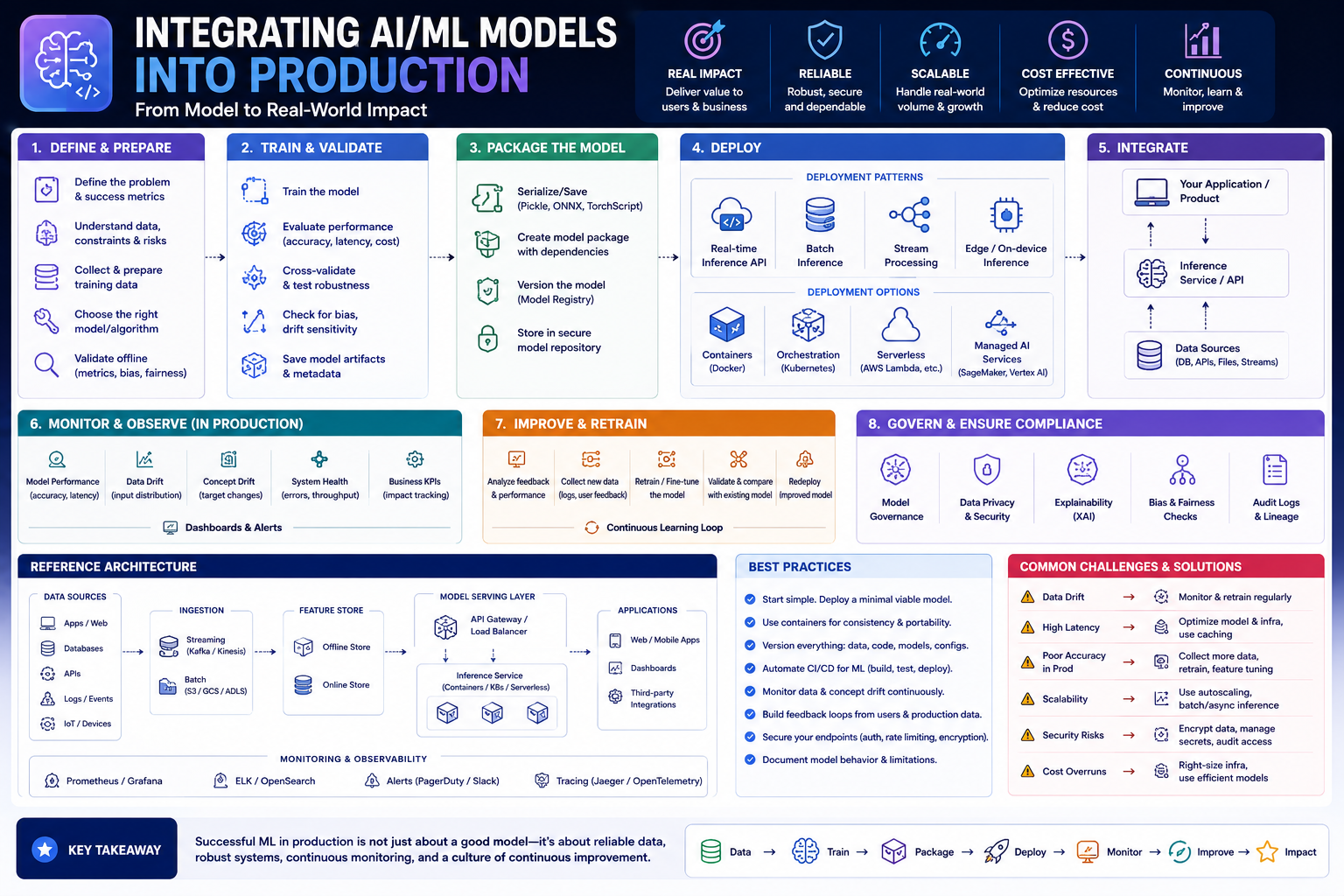
Integrating AI/ML models into production is the critical discipline that separates organizations generating business value from those stuck with experimental prototypes. According to Google Cloud's 2025 ROI of AI Report, more than half of executives now report actively using AI agents in production, yet many struggle to scale beyond the pilot phase . This roadmap will equip you with the skills to bridge that gap, moving from model-in-a-notebook to reliable, monitored, and governable production systems.
Phase 1: Strengthen Foundational MLOps Knowledge & Mindset
Before you can deploy anything, you must internalize a core shift: an ML model in production is not a static artifact but a living system that requires the same rigor as traditional software. This means version control for code AND data, automated testing, reproducible environments, and continuous monitoring.
Start by understanding the complete ML lifecycle and why MLOps is necessary. A critical first concept is the model registry—a centralized system for tracking model versions, metadata (training data fingerprints, hyperparameters, evaluation metrics), and lifecycle stages (staging, production, archived) . Without this, teams face version chaos; 68% of model deployment failures stem from version inconsistency . The registry enables essential operations like tagging a "champion" version or performing a rollback in seconds rather than minutes.
Free Resources to Start:
- Introduction to MLOps (Google Cloud Skills Boost - Free): A 45-minute course with a hands-on lab using Vertex AI. You will build actual ML pipelines and understand the deployment workflow. Upon completion, you earn a Google Cloud badge .
- MLOps Engineering Roadmap (GitHub - Completely Free): A curated collection of the best free video tutorials and official documentation. It covers Phase 1 topics including Python, ML fundamentals (scikit-learn), Git, SQL, and Linux basics, all organized in a logical sequence .
Paid/Structured Resources:
- AI/ML Ops Course (Johns Hopkins University - Spring 2026): A comprehensive graduate-level course covering data strategy, feature stores, production-level ML workflows, and drift detection. This provides academic rigor and a structured syllabus .
- Cloud Machine Learning Engineering & MLOps (Duke University on Coursera): An advanced specialization focusing on TensorFlow, production pipelines, and deployment strategies. Uses a free trial option .
Phase 2: Master Core Production Engineering Skills
With the mindset established, build hands-on competence in the toolchain that makes ML production possible. Focus on containerization, orchestration, and CI/CD specifically adapted for ML workflows.
The Essential Tool Stack:
- Containerization with Docker: Encapsulate your model and its dependencies into a portable unit. This ensures what runs on your laptop runs identically in production. Practice writing Dockerfiles for ML applications and building images .
- Orchestration (Airflow / Kubeflow): ML pipelines involve multiple steps: data extraction, preprocessing, training, evaluation, deployment. Orchestrators schedule these tasks, handle dependencies, and manage retries. Start with Apache Airflow for general workflows; adopt Kubeflow when you need Kubernetes-native ML pipelines .
- CI/CD for ML (GitHub Actions / Jenkins): Automate testing and deployment. A typical ML CI/CD pipeline includes: on pull request, run style checks and unit tests; on merge to main, retrain on new data, evaluate against baselines; on release, deploy to staging, run canary tests, then promote to production with rollback criteria .
- Experiment Tracking & Model Registry (MLflow / Weights & Biases): Systematically log parameters, metrics, and artifacts. The model registry manages versioned, lifecycle-staged models (e.g., "Staging" to "Production") with promotion criteria, enabling safe rollbacks and audit trails .
Practice Strategy:
- Build a complete pipeline project: Use the resources from Phase 1 to create an end-to-end workflow: pull data, preprocess, train a scikit-learn model, log results with MLflow, package the model with Docker, and deploy a FastAPI endpoint. Document each step on GitHub as a portfolio project.
Understanding Model Optimization for Deployment:
Before production, you often need to optimize models for specific environments:
- Cloud API services: Use FP16 mixed precision or TensorRT for GPU acceleration. Optimized models on A100 clusters can achieve 240% higher QPS with 35% lower GPU utilization .
- Edge/mobile devices: Apply quantization, knowledge distillation, and pruning. Convert to TFLite or CoreML. A quantized ResNet50 on iPhone 15's neural engine runs at 120 FPS, 8x faster than the general format .
Phase 3: Production Monitoring, Governance & Responsible AI
Deploying is only half the battle. Models degrade in production due to data drift (changes in input distributions), concept drift (changes in the relationship between inputs and outputs), and performance degradation. You must build observability and governance from day one.
Monitoring Essentials:
- Data Drift Detection: Use tools like Evidently AI or Fiddler to track input data distributions against training baselines. Set up alerts when drift exceeds statistical thresholds .
- Performance Monitoring: Track prediction latency (P50/P95), error rates (e.g., 5XX responses), and resource utilization (GPU/CPU/memory). Establish Service Level Objectives (SLOs) such as 99.9% API availability .
- Automated Rollbacks: Configure your system to automatically revert to a previous model version when anomalies are detected—for example, if error rates exceed 2% or latency spikes beyond acceptable limits for consecutive requests .
Governance & Responsible AI:
- Model Governance Stack: Implement what Google Cloud calls a five-layer governance approach: Agent Identity (cryptographic badges for each model), centralized registry for tool approval, natural language security policies, behavioral anomaly detection, and a unified security dashboard .
- Responsible AI Practices: Version all artifacts, conduct fairness checks, maintain explainability assessments, and schedule routine cross-functional reviews. Regulatory compliance (e.g., FDA's 21 CFR 211.25 in pharma manufacturing) requires auditable training records and validation evidence .
Free Resource for Monitoring:
- Google Cloud's MLOps Course (Part of Phase 1 resources): Includes modules on monitoring and evaluation of deployed models using Vertex AI. The hands-on lab directly applies these concepts .
Phase 4: Augment Your Workflow with AI Tools & Advanced Patterns
AI is now being used to manage AI. At this advanced stage, you will incorporate AI tools to automate data curation, agent orchestration, and deployment optimization.
AI-Powered Data & Context Management:
- Dynamic Data Curation: Use AI models to automatically search, curate, and extract granular pieces of data from across repositories. Rather than relying on static documents, implement automated jobs where Gemini-class models pull the exact context needed for your production models .
- Performance Insight: Smaller, targeted, high-quality datasets consistently outperform massive, unfiltered data dumps. Focus on curating the right data, not the most data .
Multi-Agent Orchestration:
- Agent Development Kit (ADK) & Agent2Agent (A2A) Protocol: Learn patterns for building systems where multiple AI agents collaborate. Implement coordinator-specialist patterns (a central coordinator delegates tasks to specialized agents), hybrid graphs (combine hard-coded business rules with AI reasoning), and cross-language pipelines .
- Long-Running Agents: Design agents that maintain state for up to seven days, implement checkpoint-and-resume mechanisms for failure recovery, and build delegated approval workflows where agents pause for human review .
Tooling to Explore:
- Google Cloud's Agent Garden: Provides atomic agent blueprints and code samples for production-ready multi-agent systems. The "federated data model" pattern allows product teams to expose their data through their own agents, preventing data silos while enabling cross-team collaboration .
Case Study - Industrial Edge Deployment:
Microsoft and Siemens have collaborated on an architecture where Azure AI models are deployed to Siemens Industrial Edge devices. The workflow includes automated training pipelines, model validation, packaging with the Siemens AI SDK, secure delivery via IoT Hub, and continuous monitoring with OpenTelemetry. This closed-loop environment—from cloud training to edge inference to telemetry back to the cloud for retraining—represents the gold standard for industrial AI production .
Phase 5: Adopt a Production Mindset & Iterate Based on Real-World Use
The final phase is not technical but cultural. The biggest organizational barriers to production AI are rarely code-related. Learn to prioritize deployment speed and real-world feedback over perfection.
Key Lessons from Google Cloud's Internal AI Transformation:
- Launch and iterate, don't wait for perfect: Trying to address every edge case slows time-to-market. Reduce initial scope, use manual workarounds, and put tools in users' hands immediately. Use simple feedback loops (1–5 star ratings, focus groups) to identify patterns and refine .
- Design for guided task completion, not open-ended chat: Most employees want to complete a task efficiently. Build experiences with pre-defined prompts, minimal required inputs, and outputs that fit directly into existing workflows (e.g., automatically generated slides using just a company name). When Google Cloud removed the guesswork, user adoption "rocketed" among sellers .
- Measure outcomes, not just activity: Track three dimensions: adoption (which features are used, by whom, for what), sentiment (star ratings, focus group feedback), and impact (tie usage to specific business entities like customer accounts or sales opportunities). Even if direct ROI correlation is difficult, adoption volume and user sentiment serve as effective proxies for value .
- Embrace "atomic" agents for interoperability: Build agents around reusable functions (e.g., "find information") that can be embedded anywhere—Gemini Enterprise, Workspace, custom web apps. Use the A2A protocol and ADK so agents from different teams can discover and collaborate without rebuilding from scratch .
Career Application & Next Steps
Integrating AI/ML models into production is the core competency for MLOps Engineers, AI Platform Engineers, Machine Learning Engineers (Production) , and AI Infrastructure Architects. According to the MLOps Engineer Roadmap 2026, organizations are actively seeking professionals who can bridge data science and software operations, reduce manual toil, and improve model robustness through standard toolchains and governance .
Your immediate Next Steps:
- Earn a Foundational Certification: After completing the Google Cloud free MLOps course, consider the Google Professional ML Engineer certification or AWS Certified Machine Learning - Specialty. These explicitly test production deployment concepts, feature stores, and monitoring. The knowledge from the Coursera MLOps courses directly maps to exam domains .
- Build a Production Portfolio Project: Do not just list "knowledge." Deploy an end-to-end ML system to a cloud platform. A strong example: build a model that predicts something (e.g., taxi trip duration), containerize it with Docker, deploy it as a FastAPI endpoint on Cloud Run or AWS Lambda, set up monitoring with Evidently AI and alerts, and document the CI/CD pipeline on GitHub. This single project demonstrates six roles working together—Data Engineer, ML Engineer, DevOps, Platform Engineer, Monitoring Specialist, and AI Ethicist. This level of cross-functional understanding is what top companies demand.
- Practice System Design Interviews: FAANG and leading AI companies will ask you to design a production ML system for a hypothetical use case (e.g., real-time fraud detection, recommendation system). Practice explaining your choices: how would you handle data drift? How would you serve features with low latency? What is your rollback strategy? Be prepared to sketch architectures on a whiteboard (or digital equivalent), showing the data pipeline, training pipeline, and serving infrastructure as interconnected systems .
- Join the MLOps Community: Engage in forums like the MLOps Community Slack, GitHub discussions on Kubeflow and MLflow, and attend virtual meetups. Real-world problems—like handling version skew between training and serving data or debugging non-deterministic model outputs—are discussed constantly. This is also where you learn about emerging tools like Feast (feature store) and BentoML (model serving) before they become mainstream .
- Specialize Further: After mastering these fundamentals, consider specializations in:
- ML Governance & Responsible AI: Focus on fairness, explainability, and regulatory compliance for regulated industries (finance, healthcare, pharma) .
- Edge & Embedded ML: Master model optimization (quantization, pruning, knowledge distillation) and deployment to resource-constrained devices like mobile phones, IoT sensors, or industrial controllers .
- AI Agent Infrastructure: Focus on multi-agent orchestration, long-running state management, and agent governance—the emerging frontier as organizations move from single models to autonomous agent fleets .
The era of AI experimentation is rapidly shifting to production. Professionals who can reliably ship, monitor, and govern ML systems at scale will define the next generation of enterprise AI. Start building now.




 Group / 1: 1 Sessions