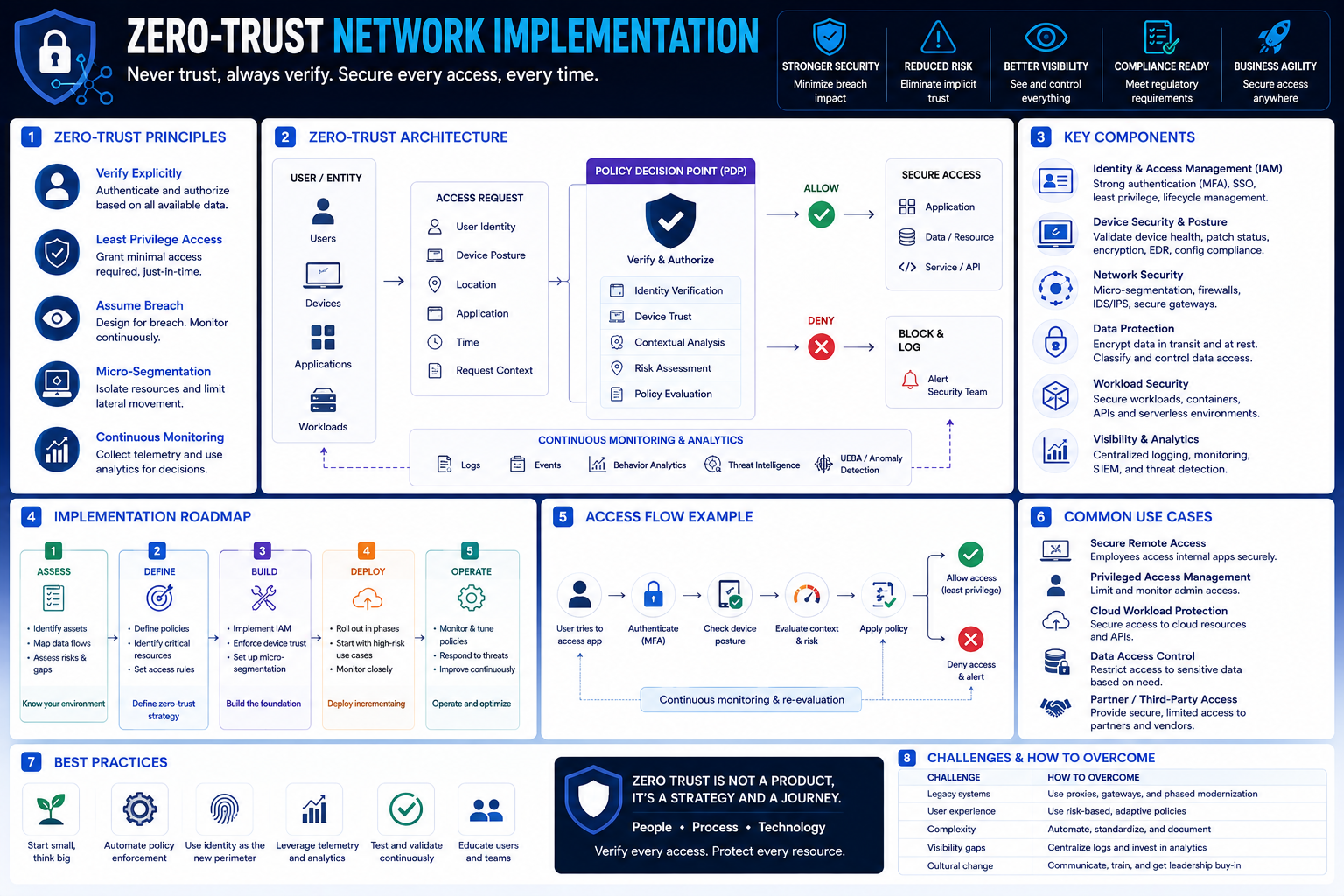
Zero trust network implementation is fundamentally a strategic shift, not a product you can buy and install. According to industry experts, moving from traditional perimeter-based defense to an identity-centric model requires structured workforce development and a phased approach across people, process, and technology. The following roadmap is built around the three-phase framework of Assessment, Architecture, and Enforcement, along with advanced applications involving AI.
Phase 1: Assessment – Establishing Your Zero Trust Baseline
Before implementing any technical controls, you must understand your current security posture. The Assessment phase involves identifying your protect surface (the data, assets, and services that are most critical), mapping transaction flows, and evaluating identity, device, and network maturity. A common mistake is skipping this phase and jumping directly to tool deployment, which often results in disconnected solutions that fail to reduce risk.
Key Skills to Develop:
- Protect surface identification and transaction flow mapping
- Identity, privilege, and endpoint posture analysis
- Visibility, telemetry, and policy governance evaluation
- Aligning zero trust with GRC (Governance, Risk, and Compliance) and the NIST SP 800-207 framework
Free Training Resources:
- ISC2 Zero Trust Strategy Certificate: Designed for leaders and architects, this certificate teaches you how to establish a zero trust maturity baseline, define protect surfaces, and translate principles into actionable policy direction. It is a strong entry point for Phase 1 readiness.
- Microsoft Zero Trust Workshop (Free): This open-source resource (maintained by Microsoft employees) includes a detailed workbook and a PowerShell script to inventory your current security posture across Entra ID and Microsoft 365. The workbook contains over 30 swim lanes across Identity, Devices, Data, Network, and Infrastructure pillars, each with implementation effort ratings, user impact assessments, and direct links to technical documentation. You can track progress from "In planning" to "Third party" for each control.
Paid/Structured Resources:
- ISC2 Workshop: Creating a Zero Trust Roadmap: A two-day instructor-led workshop focusing on applied learning. Participants evaluate zero trust frameworks, map pillars to real-world incidents, and design vendor-neutral architectures aligned to budget constraints. As of May 2026, registering includes access to the ISC2 Zero Trust Strategy Certificate at no additional cost.
Practice Environment:
- Use the free Microsoft Zero Trust Workbook Excel file to conduct a self-assessment of your own organization or a lab environment. Each tile includes a dropdown to track status and notes functionality to document stakeholder decisions. This turns abstract concepts into measurable requirements.
Phase 2: Architecture – Designing the Identity-Centric Framework
Once the assessment is complete, you move to architecture. This is where strategy becomes technical reality. Zero trust architecture replaces network location with identity as the primary control plane. A successful design must cover six pillars: Identity, Devices, Networks, Applications, Workloads, and Data. You will need to understand how to integrate controls across cloud, on-premises, hybrid, SaaS, and remote environments.
Key Skills to Develop:
- Designing cloud-native segmentation and workload isolation
- Architecting access control models aligned to least privilege
- Securing data flows across hybrid environments
- Building a continuous authentication and authorization framework
Free Training Resources:
- NIST SP 800-207 (Free Document): The foundational publication on zero trust architecture. Read this to understand the core principles, logical components, and deployment scenarios. It is the canonical source that most commercial frameworks reference.
Paid/Structured Resources:
- CISSP Certification (ISC2): The Certified Information Systems Security Professional provides broad coverage of security architecture, governance, risk management, and access control strategy. CISSP-certified professionals are positioned to design enterprise security programs aligned to zero trust and translate business risk into architecture requirements.
- CCSP Certification (ISC2): The Certified Cloud Security Professional is critical for zero trust across cloud workloads and SaaS platforms. CCSP covers cloud access control models, cloud-native segmentation, and data flow security across hybrid environments. In modern enterprises, zero trust architecture is incomplete without cloud expertise.
- Pluralsight: Zero Trust Architecture (ZTA) Implementation: A one-day course covering the five pillars of zero trust with hands-on activities. It explains technical components including MFA, micro-segmentation, continuous monitoring, and automation. The course provides a practical roadmap for designing and maintaining a resilient security posture.
Practical Project Resources:
- Firezone (Open Source): An enterprise-ready zero trust access platform built on WireGuard. Firezone offers group-based policies, peer-to-peer encrypted tunnels, and integration with Okta, Entra ID, and Google Workspace. The open-source version is free for self-hosting (educational/hobby use), and the cloud version has a free tier for six users. Use this to practice deploying a zero trust network access (ZTNA) solution and configuring least-privilege policies.
Phase 3: Enforcement – Operationalizing Continuous Verification
The enforcement phase is where many initiatives succeed or fail. Organizations may have an assessment and a high-level architecture but struggle to operationalize policies consistently across teams and systems. Enforcement requires automated policy engines, continuous authentication, real-time telemetry correlation, and identity lifecycle controls. This is not a "set it and forget it" model—it is continuous and iterative.
Key Skills to Develop:
- Implementing risk-based access decisions and step-up authentication
- Configuring micro-segmentation to limit lateral movement
- Deploying privileged access governance
- Managing policy automation and access governance
Free Training Resources:
- ISC2 Security within Zero Trust Course: Helps operational teams understand how to implement access control decisions across environments, use telemetry to validate trust continuously, and manage enforcement without slowing productivity.
Paid/Structured Resources:
- SSCP Certification (ISC2): The Systems Security Certified Practitioner focuses on day-to-day operational execution. SSCP-certified professionals support identity and access provisioning, monitoring and detection workflows, security operations, and policy enforcement adjustments. While CISSP and CCSP support architecture, SSCP supports the daily execution that makes enterprise zero trust sustainable.
Practice with Real Tools:
- Microsoft Global Secure Access (GSA): Available through the free Microsoft Zero Trust Workshop lab, GSA allows you to deploy a client, configure traffic forwarding and DLP integration, and monitor application segments. The lab includes hands-on modules for the Network pillar.
- Microsoft Sentinel & Defender: The same workshop includes a Security Operations pillar where you review a simulated attack and see how Microsoft Security Exposure Management and Sentinel data lake can proactively prevent breaches. This gives you experience with real-time telemetry and alert correlation.
Advanced: AI-Enhanced Zero Trust Implementation
Artificial intelligence and machine learning are increasingly being integrated into zero trust architectures to enable continuous authentication and behavioral threat detection. AI-powered systems can analyze keystroke dynamics, mouse movement patterns, session behavior, and access patterns to calculate dynamic risk scores in real time.
How AI Augments Zero Trust:
- User Behavior Analytics (UBA): ML models (Isolation Forest, LSTM networks, One-Class SVM) detect anomalies in user behavior and trigger step-up authentication or session termination when risk scores exceed thresholds.
- Continuous Authentication: Instead of verifying once at login, AI systems evaluate risk every 30 seconds based on behavioral data, device fingerprinting, location verification, and network context.
- Automated Policy Enforcement: AI can correlate telemetry from multiple sources and automatically adjust access policies based on real-time risk assessments.
Free AI-Focused Resources:
- Zero-Trust Authentication System Design (GitHub): An open-source project implementing a modern zero-trust architecture using AI/ML for continuous authentication. The repository includes code for behavioral model training (scikit-learn, PyTorch, River), a FastAPI authentication service, and anomaly detection systems. You can study the architecture and run the code locally to see how ML models evaluate risk scores (0-100) based on behavioral and contextual features.
- Agent-as-a-Tool Framework (GitHub): A framework that implements zero-trust execution for AI agents using Google ADK. It enforces strict boundaries where non-destructive tasks run autonomously but critical operations require explicit user approval (Human-in-the-Loop). This demonstrates how zero trust principles apply to AI agent orchestration.
Research Perspective:
- IEEE Paper on Zero Trust with AI (2025): This academic paper discusses training algorithms to identify behavior patterns in access logs using SLM and LLM models based on zero trust best practices and CI/CD pipelines (MLops & DevSecOps). This represents the cutting edge of research in this domain.
Career Application & Next Steps
Zero trust expertise is one of the highest-demand specializations in cybersecurity. According to EY job postings, senior zero trust architects need 6+ years of experience with a specialization in zero trust strategy, micro-segmentation solutions (Guardicore, Illumio), and network protection controls (Palo Alto, Checkpoint, Fortinet). Nile Global's Security Solutions Engineer role explicitly requires deep understanding of NAC platforms, firewall platforms, and identity providers, with the ability to translate existing controls into modern zero trust architecture.
Your immediate Next Steps:
- Earn a Foundational Zero Trust Certification: Start with the ISC2 Zero Trust Strategy Certificate to build strategic readiness. If you already have experience, pursue the CISSP or CCSP certifications, which validate broad architectural competency. The SSCP certification is valuable for operational roles. According to industry data, organizations without a zero trust approach incur 1millionto
- 1millionto1.76 million higher costs per breach compared to those with mature deployments, making certified professionals highly valued.
- Build a Hands-On Lab Environment: Deploy Firezone (open source) or follow the Microsoft Zero Trust Workshop lab to get hands-on experience with conditional access policies, Global Secure Access, and Sentinel monitoring. Document your configurations and create a portfolio showing how you implemented least privilege access and continuous verification.
- Practice AI-Enhanced Zero Trust: Run the open-source Zero-Trust Authentication System Design project locally. Experiment with the ML-based user behavior analysis engine and risk scoring model. Understanding how AI augments continuous authentication will differentiate you from candidates who only know static policies.
- Audit Current Skills Against Job Requirements: Use the EY and Nile job descriptions as a skills gap assessment. If you lack experience with NAC platforms (Cisco ISE, Aruba ClearPass), firewall platforms (Palo Alto, Fortinet), or identity providers (Okta, Entra ID), prioritize those through hands-on labs or vendor-specific training.
- Pursue Vendor-Specific Training After Foundational Knowledge: Once you understand the principles, consider vendor-specific training on platforms like Illumio (micro-segmentation), Zscaler (SSE/SASE), or Palo Alto Networks (Prisma Access). These are frequently mentioned in job descriptions and demonstrate practical implementation skills.
- Join the Zero Trust Community: The Microsoft Zero Trust Workshop materials include a delivery guide for partners and internal IT teams. Use these materials to run a workshop internally or with a study group. Teaching others solidifies your own knowledge and demonstrates leadership potential.
The consensus among cybersecurity professionals is that zero trust is the best strategic approach, but the challenge has always been "how do you actually do it?". By following this phased roadmap—from assessment through architecture to enforcement—and supplementing with AI-enhanced tools, you will build the skills to answer that question for any organization. Start with the free Microsoft workbook today, identify one pillar to improve, and document your progress. That single artifact is worth more in an interview than a dozen completed courses.




 Group / 1: 1 Sessions