Ransomware response and forensics is a high-intensity discipline where the speed and quality of your investigation directly determines whether an organization pays millions, loses its reputation, or recovers fully. Unlike general incident response, ransomware forensics requires you to think like an attacker, trace cryptographic operations in memory, and often work against an active timer as encryption spreads.
Below is a roadmap structured to move you from foundational incident response principles to advanced memory forensics and finally to AI-augmented analysis, all tailored to the specific behaviours of modern ransomware families.
Phase 1: Establish Incident Response Foundations & the Ransomware Mindset
Before you touch a memory dump or a PCAP file, you must internalize the structured response lifecycle and understand how ransomware operators think. Many beginners skip straight to tool tutorials, but without a framework, they waste critical time during an actual breach.
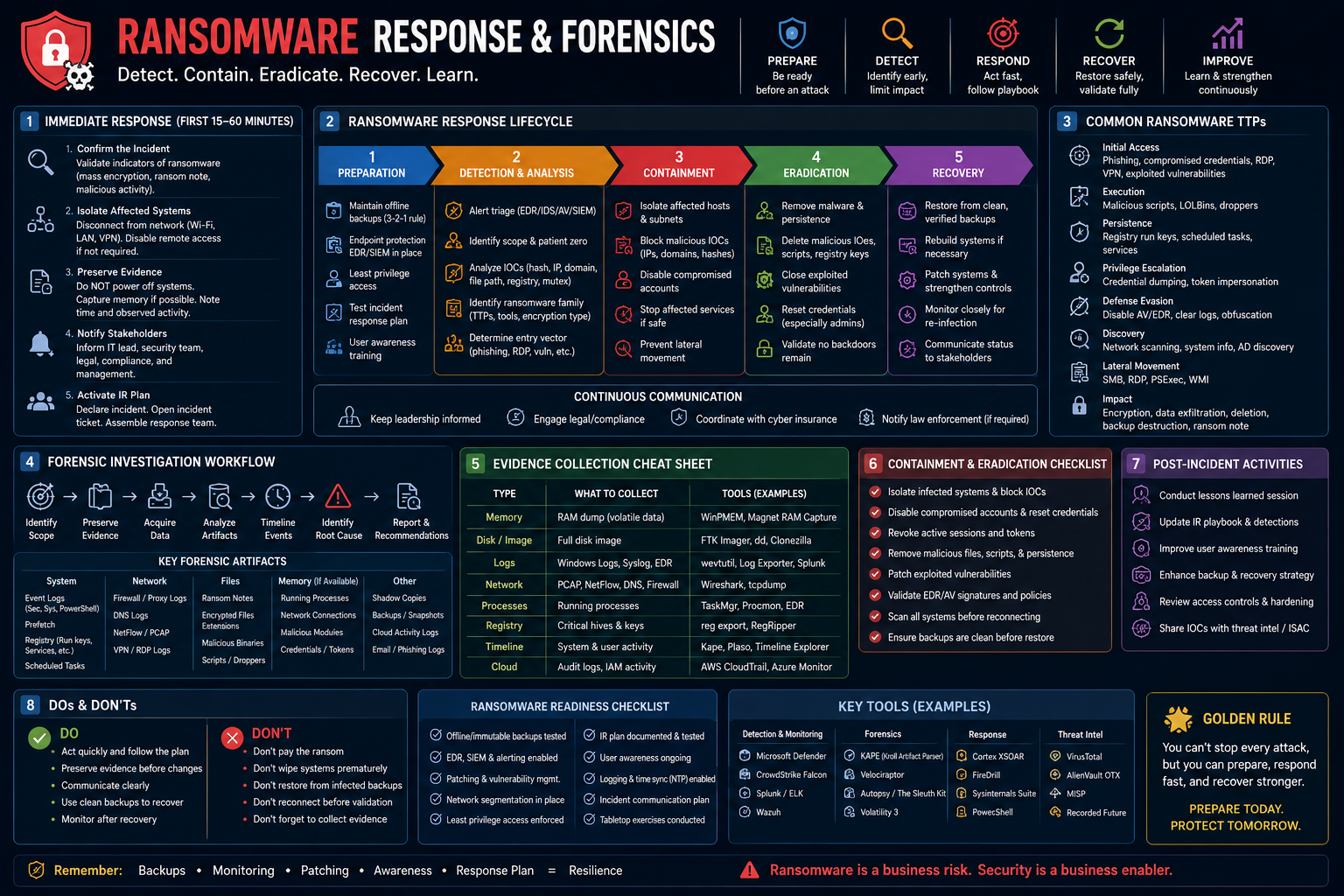
The industry standard is the NIST SP 800-61 incident response lifecycle: Preparation, Detection & Analysis, Containment & Eradication, and Post-Incident Recovery. Ransomware adds specific twists: containment decisions (isolate vs. shut down) have direct implications for forensic evidence preservation. You must also understand the MITRE ATT&CK framework, particularly the tactics of Persistence, Privilege Escalation, Defense Evasion, and Impact (where ransomware encrypts data).
A 2025 industry certification like the Certified Digital Forensics and Incident Response Specialist (CDFIRS) explicitly covers the incident response lifecycle, chain of custody, and alignment with NIST 800-61 and MITRE ATT&CK. This structured knowledge is what separates a coordinator from an investigator.
Free / Low-Cost Resources to Start:
- UK NCSC Exercise in a Box – Ransomware Module: A completely free, government-developed resource from the National Cyber Security Centre. It provides everything you need to run a ransomware tabletop exercise, including realistic scenarios and injects. You can practice your response decisions in a safe, no-risk environment.
- Microsoft Learning – Ransomware Basics Path: Free, self-paced modules that explain how ransomware operates, the threat lifecycle, detection strategies, and prevention best practices. An excellent low-commitment starting point.
- CISA Incident Response & Ransomware Training: Free resources from the U.S. Cybersecurity and Infrastructure Security Agency covering practical IR fundamentals and recovery best practices.
Phase 2: Master Core Forensic Artifacts & Memory Analysis
With the framework in place, you move to hands-on forensics. Ransomware leaves a trail across the file system, registry, memory, and network. Your job is to reconstruct the attack timeline: initial access vector (phishing email, RDP brute force, vulnerable service), lateral movement paths, privilege escalation, and the moment encryption began.
Memory analysis is critical because ransomware lives in RAM. The encryption keys, ransom notes in construction, and network callbacks to C2 servers are often only found in memory dumps. Tools like Volatility and Rekall are your primary weapons here. You must also master file system artifact analysis: NTFS $MFT, prefetch files, Shimcache, Amcache, and browser history all provide timestamps and execution evidence.
Free / Structured Resources:
- Ransomware Forensics Course (eForensics Magazine): An 18-hour, self-paced course with 18 CPE credits. It focuses on analyzing infected hosts, capturing memory dumps (.vmem files), using radare2 for reverse engineering, Volatility for memory analysis, and Bulk_Extractor/Scalpel for system image analysis. The course specifically analyzes real families: Wannacry, Cryptowall, and TOR-based ransomware. Requires assembly knowledge and basic C/C++ programming.
- Certified Ransomware Protection Officer (CRPO): A free training resource focused on ransomware defense and recovery strategies. Practical and expert-backed, available through the ICTTF EU Cyber Academy.
- Pluralsight Incident Response Path: A 14-hour skill path with 8 courses and 4 labs. It includes a full, scenario-based simulation where you respond to a ransomware attack, from initial detection through root cause analysis to remediation. Aligns to NICE Framework roles (PR-CIR-001).
Paid / Advanced Options:
- SANS FOR500: Windows Forensic Analysis (GIAC GCFE Certification): A 6-day, 36 CPE course taught by instructors like Mari DeGrazia. Covers in-depth Windows artifact analysis, file system forensics, registry analysis, and evidence extraction. The gold standard for Windows forensic training, but priced at the enterprise level.
Phase 3: Advanced Threat Hunting & Enterprise Response
Once you can analyze a single compromised host, scale your skills to enterprise networks. Ransomware rarely hits just one machine. You need to hunt for lateral movement using NetFlow, proxy logs, and Windows Event Logs (especially 4624 for logons and 5140 for file shares). You will also integrate with SIEM platforms like Splunk or ELK to correlate events across hundreds of endpoints.
The GIAC Certified Forensic Analyst (GCFA) certification is the industry benchmark for this level. It validates your ability to hunt for advanced persistent threats, conduct memory forensics, and analyze complex incident timelines.
Structured Learning & Practice:
- Rogers Cybersecure Catalyst – Digital Forensics and Threat Hunting Program: A 10-week program (15-20 hours/week) based on SANS FOR508: Advanced Incident Response, Threat Hunting, and Digital Forensics. Includes hands-on labs, two practice exams, and the GCFA certification exam. Also provides access to the Catalyst Cyber Range for realistic ransomware simulations. Designed for professionals with 3+ years of experience. Registration fee is $1,300 + HST.
- CDFIRS Certification (Advanced Track): Includes a capstone DFIR simulation lab where you investigate a simulated APT breach, collect and analyze evidence, contain the threat, and produce a full incident report. Covers network log correlation, YARA and Sigma rules, and MITRE ATT&CK mapping.
Phase 4: Augment Your Workflow with AI & Local LLMs
Artificial intelligence is rapidly transforming DFIR. AI tools do not replace your expertise, but they dramatically accelerate routine analysis: summarizing thousands of log lines, identifying anomalous process trees, generating YARA rules from memory patterns, and even drafting incident reports.
The most important trend in 2026 is the use of local LLMs (Large Language Models) for forensic analysis. Unlike cloud-based AI, local models keep sensitive incident data within your controlled environment. You can run models on your forensic workstation to analyze memory dumps, reconstruct attacker TTPs, and correlate IOCs without risking data leakage.
AI-Focused Training:
- SANS FOR563: Applied AI for Digital Forensics and Incident Response: A 6 CPE course taught by Mari DeGrazia, author of FOR500 and FOR528. This course focuses on leveraging local LLMs to accelerate evidence analysis, automate investigative workflows, and enhance accuracy. It includes practical instruction on using AI to hunt for threats and correlate findings across diverse data sources. Priced at $995 USD for self-paced access.
- ENSEMBLE EU Project – AI-Powered Investigation Toolbox: A European Union-funded research project developing AI-based tools for detecting ransomware, cyber fraud, and data theft. The project specifically focuses on assisting police authorities with AI-driven extraction, processing, and analysis of online information relevant to cybercrime. While not a consumer training course, studying the project outputs gives you insight into cutting-edge forensic AI.
- Learning Lab: AI-Powered Ransomware Response (Educause): A hands-on lab series that transforms you into an AI-powered incident responder. You master ChatGPT for security analysis, decoding complex logs, analyzing network traffic, and hunting threats. The capstone is a realistic ransomware attack simulation where you produce an AI-enhanced IR playbook, detection rules, and forensic findings.
How to Practice with AI:
- Run a local LLM (like Llama 3 or Mistral) on your forensic workstation using Ollama.
- Feed it a sample of Windows Event Logs from a ransomware infection.
- Ask the model to summarize the timeline: "Extract all logon events (4624) with source IPs and timestamps between 02:00 and 04:00."
- Compare the AI's output to manual analysis using tools like Timeline Explorer. This validates the AI's accuracy against your growing knowledge.
Phase 5: Practice with Realistic, Live Simulations
Theory and even recorded labs are insufficient. You need to respond to a live, unfolding ransomware incident with the clock ticking and stakeholders demanding updates. This builds the muscle memory and stress tolerance that separates junior analysts from incident commanders.
Free Simulation Resource:
- UK NCSC Exercise in a Box – Ransomware Module: As mentioned in Phase 1, this is not just a reading exercise. It provides a full simulation kit including injects, discussion questions, and facilitator guidance. Run it with peers to practice your decision-making under pressure.
Paid Simulation Environments:
- Pluralsight Ransomware Simulation Lab: Part of the Incident Response Path, this is a hands-on lab where you respond to a simulated attack on a fictional company (Globomantics). You assess, analyze, and remediate in a controlled environment.
- Catalyst Cyber Range (from the Rogers program): Provides ultra-realistic, 4-hour simulations where you can play both Red Team (attacker) and Blue Team (defender) roles. This dual perspective is invaluable for understanding ransomware TTPs from both sides.
Career Application & Next Steps
Ransomware response and forensics expertise directly leads to roles such as DFIR Analyst, Incident Response Consultant, Cyber Threat Hunter, SOC Lead, and Forensic Investigator. These are among the highest-paid roles in cybersecurity because of the direct business impact: a skilled responder can save an organization millions in ransom payments and recovery costs.
Your immediate Next Steps:
- Earn a Foundational Certification with Practical Weight: Start with the CDFIRS certification. Its 2-day format and focus on real investigation workflows (Volatility, Autopsy, Velociraptor) gives you immediate resume credibility and hands-on skill validation. Alternatively, if you have an IT background, map your existing skills (networking, system admin, scripting) to DFIR domains using the PECB roadmap approach.
- Build a Public Forensics Portfolio: Do not just list "knowledge." Document 5-10 ransomware investigations you performed in your own lab. For each, write a case study: "The infection vector was X, memory analysis revealed Y, the encryption routine used Z, and containment required W." Include screenshots of Volatility output and your YARA rules. Host this on GitHub. Recruiters explicitly look for this evidence of hands-on work.
- Master the Core Tool Stack: Before paying for expensive certifications, become proficient with:
- Volatility (memory analysis)
- Autopsy / The Sleuth Kit (disk forensics)
- Wireshark (network traffic analysis)
- Sysinternals Suite (live Windows analysis)
- YARA (pattern-based malware detection)
- These are used across every course and certification mentioned above.
- Join the DFIR Community: Follow practitioners like Mari DeGrazia on LinkedIn and GitHub. Join DFIR-focused Reddit communities and Discord servers. Real-world incident breakdowns, tool updates, and emerging TTPs are discussed here daily. This is also where you learn about free webinars and beta access to new forensic tools.
- Pursue Advanced Certifications Strategically:
- If you have 0-2 years of experience: Focus on CDFIRS or CRPO first, then build lab experience.
- If you have 3+ years of experience: Target the GIAC GCFA through the Rogers Catalyst program (or directly via SANS). This is the gold standard for senior DFIR roles and is often listed as a preferred or required qualification.
- If you want to specialize in AI-driven forensics: Take SANS FOR563 after you have mastered manual analysis. AI is an accelerator, not a replacement for foundational knowledge.
- Practice the "Purple Team" Mentality: Use the Catalyst Cyber Range or similar platform to play both attacker (Red Team) and defender (Blue Team). Understanding how an attacker deploys ransomware via PsExec or WMI will make you dramatically more effective at hunting for those same behaviours on the Blue Team.
Ransomware is not a theoretical threat. It is a business reality affecting 78% of organizations in some sectors. Professionals who can respond, contain, and forensically analyze these attacks are not optional overhead. They are mission-critical assets. Start with the free NCSC Exercise in a Box today, document your first simulated response, and build from there.




 Group / 1: 1 Sessions