API security and rate limiting design sits at the intersection of software engineering, network architecture, and threat modeling. Unlike traditional network security, API security requires you to think in terms of business logic abuse, token lifecycles, and the delicate balance between availability and protection. A poorly designed rate limiter can break an application just as easily as a malicious attack.
Below is a roadmap structured to move you from foundational threat modeling to advanced implementation patterns, including how AI is transforming API defense and specific resources for every stage.
Phase 1: Master the Threat Landscape & Design-Time Security
Before writing a single rate limiting policy, you must internalize how attackers think about APIs. The API attack surface is unique because every endpoint is a documented, structured interface—a feature for developers but a gift for attackers. The OWASP API Security Top 10 is your canonical starting point. Pay special attention to BOLA (Broken Object Level Authorization) , often listed as API1:2023, which remains the most critical and most misunderstood risk.
The most important shift you can make is moving from reactive patching to design-time security. This means treating your OpenAPI or Swagger specification as an executable security contract, not just documentation. By integrating automated governance into your CI/CD pipeline, you can catch misconfigurations—like accidentally public endpoints or missing rate limits—before a single line of code is deployed. This "shift-left" approach prevents vulnerabilities rather than scrambling to fix them under pressure.
Key Skills to Develop:
- OWASP API Top 10: Understand scenarios for Broken Object Level Authorization, Broken Authentication, Excessive Data Exposure, and Mass Assignment.
- Design-First Security: Define security requirements (TLS enforcement, input validation schemas, rate limit annotations) in your OpenAPI description before coding.
- Automated Governance: Use linting tools to validate that every endpoint has defined security schemes and rate limiting policies, failing builds that violate the contract.
Free / Low-Cost Resources:
- OWASP API Security Project (Official): The definitive guide. Read the Top 10 list and review the cheatsheets for practical mitigation strategies. This is non-negotiable foundational reading.
- Redocly API Security Guide (Free): An excellent resource explaining design-time security, the four pillars of API security, and a maturity model (Level 0 to Level 3). It specifically teaches you how to use OpenAPI as a security contract.
- Linux Foundation LFEL1004 (Free Express Course): A new, self-paced course covering authentication and authorization fundamentals. You will implement OAuth 2.0 and OpenID Connect, secure tokens with JWTs, and add Multi-Factor Authentication (MFA). Perfect for establishing core identity concepts.
Paid / Certification Resources:
- Certified API Security Specialist (C-APISEC) (Tonex): A comprehensive program with a dedicated module on "Rate Limiting and Abuse Prevention." Covers throttling, quotas, adaptive limits, and protection against credential stuffing. Includes OWASP API Top 10 deep dive and zero trust principles for APIs.
Phase 2: Implement Core Rate Limiting Algorithms & Patterns
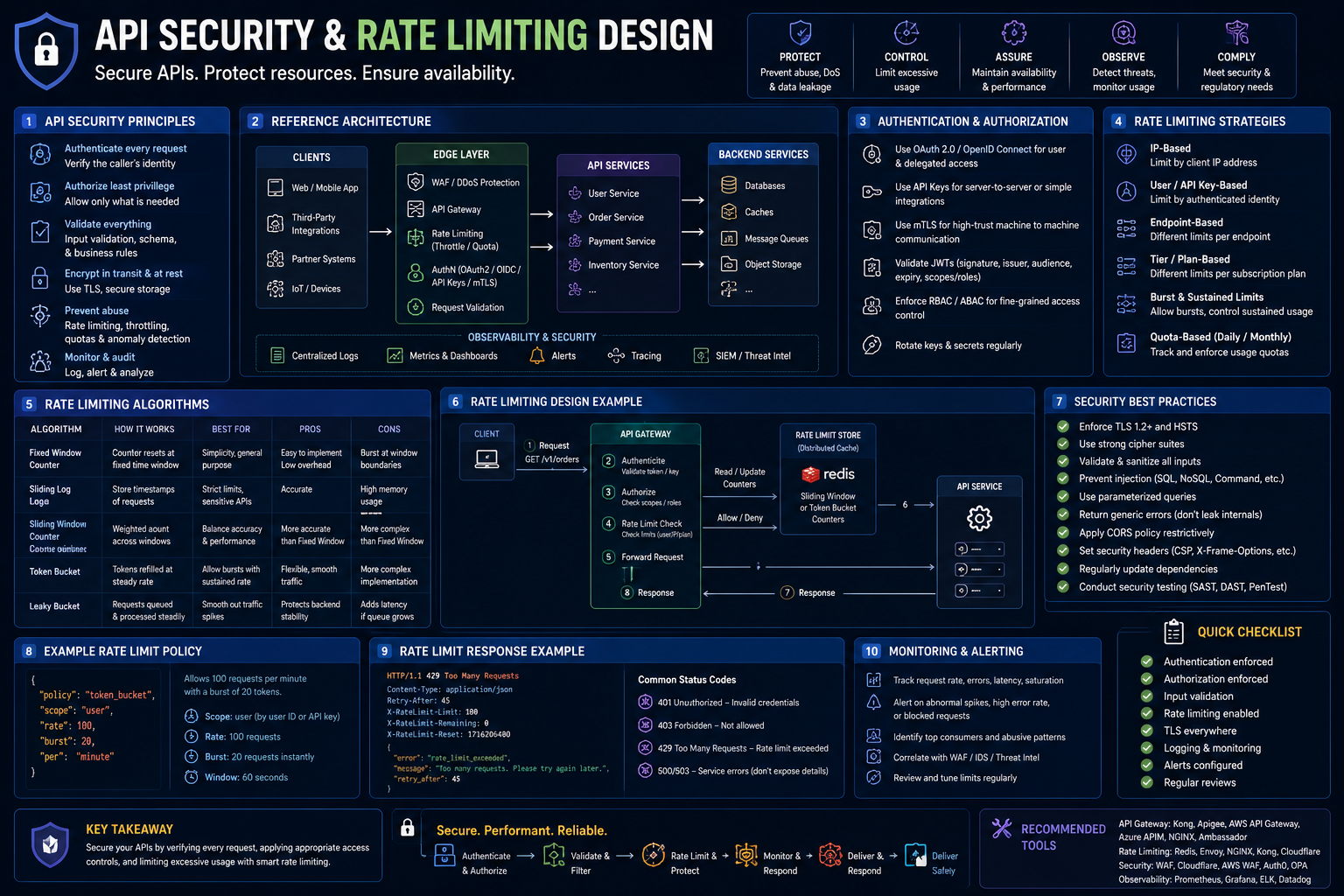
With the threat model understood, dive into the mechanics of rate limiting. This is not a one-size-fits-all control; the algorithm you choose directly impacts user experience and server load. You need to understand the trade-offs between accuracy, memory usage, and performance.
The token bucket algorithm is a common choice for allowing bursts while maintaining an average rate. The leaky bucket smooths traffic but may be less responsive to legitimate spikes. The fixed window counter is simple but suffers from boundary conditions where traffic doubles at the window edge. The sliding window log is most accurate but memory-intensive.
You must also understand where to enforce these limits. API gateways (Apigee, Kong, AWS API Gateway) provide centralized, declarative policies. Application-layer rate limiting (using libraries like golang.org/x/time/rate or Redis-based counters) offers finer control but requires more code and testing. The most resilient architectures use load shedding techniques to gracefully reject traffic when systems are already overloaded, preventing cascading failures.
Key Skills to Develop:
- Algorithm Selection: Match token bucket, leaky bucket, or sliding window to your specific traffic patterns and business requirements.
- Gateway vs. In-App Limiting: Understand the latency, consistency, and flexibility trade-offs.
- Load Shedding & Resilience: Design systems that fail gracefully under extreme load rather than crashing.
Free Resources:
- Conf42 Talk: Making Your Service More Resilient to Traffic Spikes (YouTube): A 45-minute free video by Ivan Lemeshev. It includes visual explanations of the token bucket algorithm, code examples, and a comparison of rate limiter packages. The talk also covers load shedding with AWS Builder's Library references.
Paid / Hands-On Resources:
- Pluralsight: Securing APIs with Apigee X (35-min Lab): An intermediate lab where you modify an API to require OAuth tokens and use SpikeArrest policies to limit call rates. You also learn to mask sensitive data in debug logs. Direct, practical experience with a major gateway.
Phase 3: Authentication, Authorization, & Zero Trust for APIs
Rate limiting is useless if an attacker can simply guess a valid token. You need a robust identity layer. This phase focuses on implementing and validating authentication (OAuth 2.0, OpenID Connect, JWT) and authorization (RBAC, claims-based access).
Zero trust principles applied to APIs mean treating every request as potentially hostile. This involves mutual TLS (mTLS) for service-to-service identity, short-lived tokens, and continuous verification rather than a single login event. The OAuth 2.0 framework is the standard for delegated access, but it is notoriously complex to implement correctly. Misconfigured OAuth flows are a leading cause of API breaches.
Key Skills to Develop:
- OAuth 2.0 & OIDC: Understand authorization code flow, PKCE, client credentials, and common pitfalls.
- JWT Security: Validate signatures, manage key rotation, and avoid algorithm confusion attacks.
- RBAC & Fine-Grained Authorization: Enforce permissions at the API layer, not just in the UI.
Free Resources:
- Linux Foundation LFEL1004 (Authentication & Authorization): As mentioned, this free course covers JWT, OAuth, OIDC, and RBAC with hands-on labs. It is the most direct free resource for core identity skills.
Paid / Advanced Resources:
- C-APISEC Program Modules: The "Authentication and Authorization Flaws" module covers token-based auth, OAuth pitfalls, privilege escalation, and managing machine-to-machine credentials. The "API Gateways and Zero Trust" module covers mTLS and micro-segmentation.
Phase 4: Augment Your Workflow with AI & Automated Scanning
AI is rapidly changing API security. AI-powered gateways can now enforce semantic caching (reducing compute costs for repeated queries), token quotas for LLM endpoints, and content safety policies that detect prompt injection or inappropriate inputs. For defenders, AI tools automate vulnerability detection, generate security tests, and correlate threat signals across thousands of endpoints.
The most important trend is moving from manual testing to continuous, automated security scanning integrated into your CI/CD pipeline. Dynamic Application Security Testing (DAST) tools like OWASP ZAP can be scripted to run against every staging deployment, catching regressions before they reach production.
AI & Automation Tools to Explore:
- APIsec University (Free): A completely free course teaching you to use the APIsec.ai platform to scan APIs for OWASP Top 10 vulnerabilities including BOLA/IDOR, injection, and RBAC testing. It also covers integrations with Slack, Jira, and Postman. A hands-on certification exam is coming soon.
- Wallarm University (Free Certification): Offers free training and certification focused entirely on API security. The promise is hands-on experience running real attacks, investigating signals, and implementing countermeasures—not just watching videos. This is one of the only free, API-specific certifications available.
- Coursera: Secure AI: API and Dependency Risks (Intermediate): A course moving you from developer to defender. You implement JWT auth, input validation, and rate limiting based on OWASP ASVS. Then you adopt an attacker's mindset, using OWASP ZAP (DAST) to verify your defenses. Includes a final project on formulating hotfix and rollback plans for critical dependencies like Log4j.
- Microsoft Reactor: AI Gateway in Azure API Management (Free Event): A recorded session covering how to manage token quotas, semantic caching, safety policies, and authentication for AI workloads. Practical patterns for turning AI capabilities into secure, production-ready APIs.
How to Practice with AI:
- The Automated Scanner Workflow: Set up a vulnerable API target (e.g., OWASP crAPI or a deliberately broken API). Configure OWASP ZAP in headless mode to run a full scan as part of a GitHub Actions workflow. Have the workflow fail if high-severity findings are detected. This simulates a real DevSecOps pipeline.
Phase 5: Build a Production-Ready Threat Detection & Response Framework
The final phase is operational. You have designed secure APIs, implemented rate limiting, and automated scanning. Now you need to detect attacks in real-time and respond effectively. This requires logging forensic-ready API events, establishing behavior baselines, and creating incident response playbooks specific to API abuse.
Key Skills to Develop:
- API Monitoring: Log request/response metadata (not bodies for privacy), user IDs, endpoint paths, response times, and HTTP status codes. Correlate gateway and application logs.
- Anomaly Detection: Establish baselines for normal traffic volume, error rates, and authentication failure rates. Alert on deviations.
- Incident Playbooks: Predefine responses for specific scenarios: credential stuffing (enforce CAPTCHA, rate limit login), scraping (block IP ranges, implement progressive delays), DDoS (activate upstream CDN scrubbing).
Learning Resource:
- C-APISEC Modules (Threat Detection & Incident Response): Covers log design for forensic readiness, behavior baselines, anomaly detection, correlating gateway and application signals, and playbooks for common API incidents.
Practice Strategy:
- The "Break-Glass" Simulation: Deploy a mock API with a known vulnerability (e.g., a login endpoint with no rate limiting). Manually simulate a brute-force attack. Then implement a rate limiting policy (via gateway or middleware) and verify it blocks the attack. Document the entire detection, response, and hardening process.
Career Application & Next Steps
API security and rate limiting expertise directly leads to roles such as API Security Engineer, Application Security (AppSec) Engineer, DevSecOps Engineer, Cloud Security Architect, and Platform Engineer. With APIs now accounting for over 80% of web traffic according to industry reports, specialists who can design, test, and defend APIs are in critical demand.
Your immediate Next Steps:
- Earn a Free, Hands-On Certification First: Start with Wallarm University or APIsec University—both are free and focus on practical attack/defense scenarios, not just multiple-choice questions. These immediately demonstrate hands-on capability to recruiters.
- Build a "Security Contract" Portfolio: Do not just list "knowledge of OWASP Top 10." Take a public OpenAPI specification (e.g., from a weather or crypto service). Use a linter like Spectral or Vacuum to audit it for security issues. Document your findings and write a corrected specification showing rate limit annotations, security schemes, and input validation schemas. Host this on GitHub. This single artifact proves design-time security competency.
- Master the Core Tool Stack: Before paying for certifications, become proficient with:
- OWASP ZAP (automated dynamic scanning)
- Postman (manual API testing and collection scripting)
- A CLI rate limiter (e.g., using Redis + Lua scripts or the
tokenbucket Python library) - A public API gateway (start with Kong in Docker or AWS API Gateway free tier)
- Pursue Strategic Certifications for Career Acceleration:
- If you have 0-2 years of experience: Focus on the C-APISEC certification after completing free courses. It provides structured, vendor-neutral validation explicitly aligned with OWASP.
- If you have 3+ years of experience: Consider the Certified API Security Professional (CASP) or cloud-specific API security certifications (AWS Security Specialty includes API gateway security). The C-APISEC remains valuable for its dedicated rate limiting and zero trust modules.
- Practice the "Red Team / Blue Team" Cycle: Use the Secure AI: API and Dependency Risks course's approach: write a secure API endpoint, then use OWASP ZAP to attack it. Understanding both construction and destruction makes you dramatically more effective.
- Join the API Security Community: Follow OWASP API Security Project updates, join the API Security Slack community, and subscribe to newsletters from vendors like Wallarm. Real-world incident breakdowns and emerging TTPs (like GraphQL introspection abuse) are discussed here first.
API security is no longer a niche specialization. It is a core competency for any modern application engineer. Start with the free OWASP reading and the Linux Foundation authentication course today. Then, deploy a deliberately vulnerable API (OWASP crAPI is excellent) and defend it. That cycle of break and fix is where real expertise is forged.




 Group / 1: 1 Sessions