This roadmap is designed to take you from a solid foundation in databases to a specialist who can make them run fast, reliably, and cost-effectively. The goal is to prepare you for roles like Database Administrator (DBA), Database Reliability Engineer (DBRE), or Performance Tuning Expert. You will learn by doing, using a mix of powerful free resources and strategic real-world projects.
🗺️ Phase 1: Fundamentals & the "Performance Mindset" (Weeks 1-3)
Before you tune anything, you must understand what "slow" means and how databases "think."
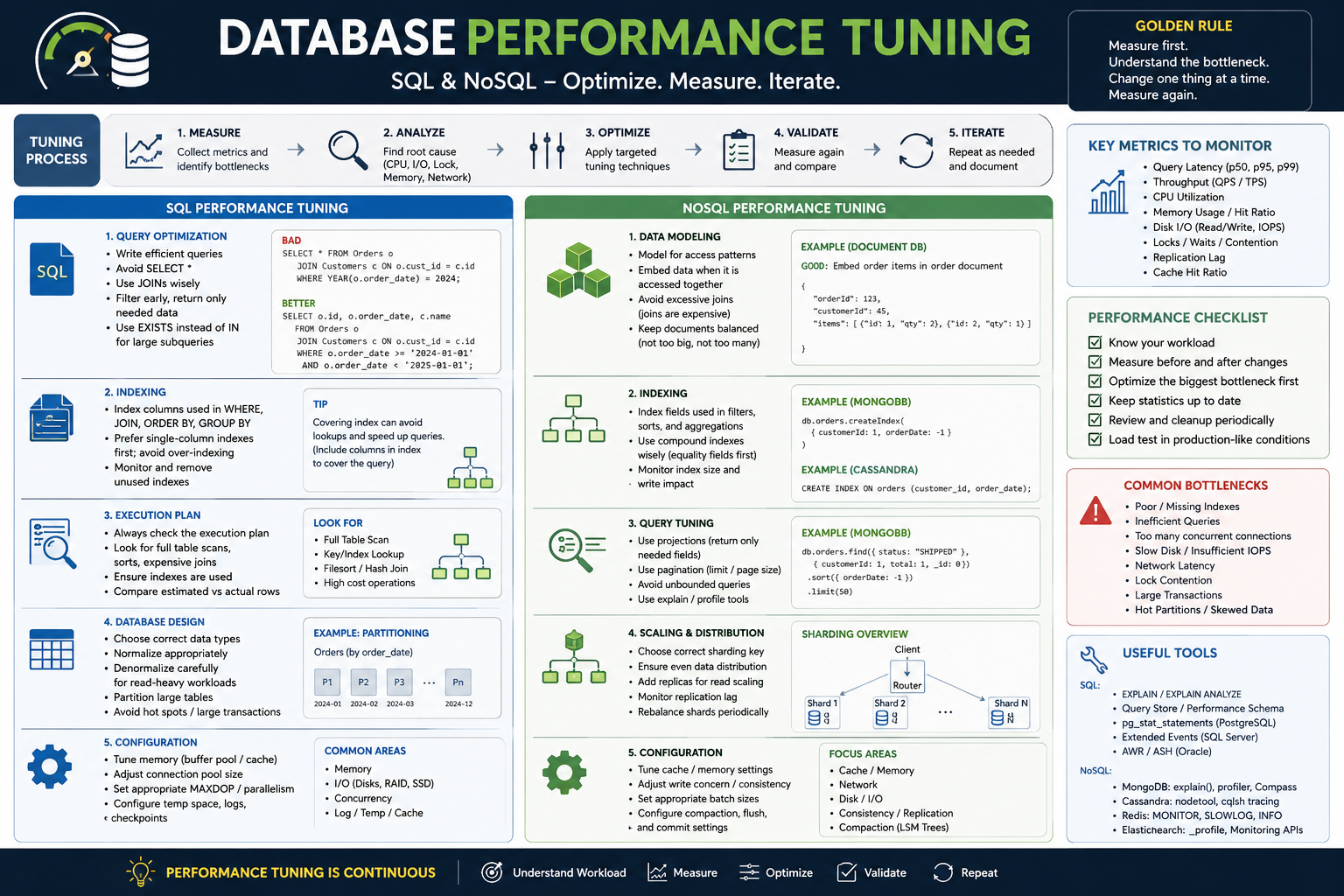
- The Core Concepts: Start with the universal principles of performance. Learn how to read an Execution Plan – this is the single most critical skill. An execution plan shows you exactly how the database is executing your query, whether it is using indexes efficiently or performing a slow full-table scan. Understand the different Join Methods (Nested Loops, Hash Joins, Merge Joins) and why the database chooses one over the other.
- SQL vs. NoSQL Mindset: Grasp that you tune them differently. In SQL (like MySQL, PostgreSQL, Oracle), the focus is on optimizing complex queries, indexing, and normalization/denormalization trade-offs. In NoSQL (like MongoDB, Cassandra), the core principle is that your data model is designed for your query patterns.
- Pro Tip: If you are new to this, start with a relational database like PostgreSQL or MySQL. The concepts you learn (indexing, execution plans) transfer directly to more complex systems.
🛠️ Phase 2: SQL-Specific Tuning & Tooling (Weeks 4-8)
This phase focuses on the workhorses of most businesses. You will learn to identify and fix the most common SQL performance problems.
- Mastering Indexing: Learn to create, manage, and troubleshoot indexes. A poorly designed index can be worse than no index at all. You need to understand the difference between a B-Tree index, a bitmap index, and when a full table scan is actually the faster option.
- Query & Lock Analysis: Learn to use built-in tools to find your slowest queries. For MySQL, learn to enable and interpret the
slow_query_log. For Oracle, learn to generate and read AWR (Automatic Workload Repository) reports and use TKPROF to profile SQL. For PostgreSQL, learn to enable pg_stat_statements. You should also learn to identify and resolve locking and blocking issues, which are common causes of application hangs. - Automation & Scripting: A senior DBA automates everything. Learn to write shell scripts (Bash/PowerShell) to automate routine maintenance tasks like index rebuilds, database health checks, and log rotation.
🚀 Phase 3: NoSQL & Modern Data Architecture (Weeks 9-12)
With a strong SQL foundation, you can now explore the world of NoSQL and modern cloud patterns.
- NoSQL Data Modeling: Practice designing a data model that answers your application's questions in milliseconds. For MongoDB, this means embedding related data inside a single document to avoid expensive "joins" (lookups). For Cassandra, this means designing your table's partition key first, because your query's
WHERE clause must include it. - Scaling & Sharding: Learn how to scale a database out (adding more servers) instead of just up (buying a bigger server). Practice setting up a sharded cluster in MongoDB, where you choose a "shard key" to distribute data evenly across nodes. Avoid the costly mistake of creating a "hotspot" where one shard gets all the traffic.
- Hybrid & Cloud Patterns: Modern applications rarely use just one database. Study the "Strangler Fig" pattern for migrating a legacy SQL database to a new NoSQL system. Learn about caching strategies using Redis, which sits in front of your primary database to serve frequently accessed data at lightning speed.
🤖 Phase 4: Observability, Automation & AI-Assisted Tuning
You must prove your database is healthy. This phase is about building systems to automatically detect and prevent problems.
- Monitoring the "Golden Signals": Set up Prometheus to collect metrics and Grafana to visualize them. Watch the four key signals: Latency (time to respond), Traffic (how many queries), Errors (rate of failing queries), and Saturation (how "full" the server is).
- Alerting & Automation: Configure alerts for critical conditions, like a sudden drop in cache hit ratio for Redis or a spike in replication lag for Cassandra. Automate responses where possible, for example, using a script to automatically kill a runaway query that has been running for over an hour.
- AI-Assisted Tuning: Use AI tools as advanced assistants. You can give ChatGPT an execution plan and ask, "Why is this plan using a hash join instead of a nested loop?" Or give it a slow query and ask it to rewrite it or suggest a better index. AI is currently excellent at pattern recognition and generating boilerplate scripts.
📚 Resource Toolkit: Where to Learn (Free & Paid)
You don't need an expensive degree, but you do need a proven process.
- Best Free, Structured SQL Course:
- Oracle Dev Gym: "Databases for Developers: Performance" (100% Free). This is a hidden gem. It covers execution plans, indexes, and joins through interactive tutorials and comes with a printable certificate. You can even practice on Oracle's free cloud tier or Live SQL browser tool.
- Best Free NoSQL & Architecture Guides:
- CloudThat & Baidu Developer Guides: These resources offer practical, code-heavy case studies on optimizing MongoDB, Cassandra, and Redis. They give you ready-to-use configuration snippets and query examples.
- High-Value Paid Training:
- Pluralsight ("Performance Monitoring, Optimization, and Automation"): Excellent for Microsoft SQL Server professionals. It teaches real-world monitoring and automated maintenance.
- Exasol Performance Management (Free): If you want a taste of high-performance analytical databases, this entire course on Exacademy is free. Certification is optional and paid.
- Your Practice Sandbox:
- Local: Install Docker Desktop. Use it to spin up containers for PostgreSQL, MySQL, MongoDB, and Redis in minutes. This is the safest, fastest way to experiment.
- Cloud: Create free accounts on AWS (Free Tier includes RDS and DynamoDB) or Google Cloud. Learn to spin up a managed database and connect to it from a cloud VM.
💼 Career Application & Next Steps
Database performance tuning is a high-stakes, high-reward career. Companies will trust you with their most valuable asset: their data.
1. The Job Market & Your Path
Look at job postings for Database Administrator (DBA), Database Reliability Engineer (DBRE), or Performance Engineer. They consistently demand skills in:
- SQL Tuning & Query Optimization
- Monitoring & Alerting Tools (Prometheus, Grafana)
- Scripting & Automation (Bash, Python, PowerShell)
- Specific Database Experience (Oracle, MySQL, PostgreSQL, MongoDB)
2. Build Your Portfolio (The "Proof" is in the Performance)
Theory is not enough. You need a story. Document this process in a GitHub repository called "db-tuning-portfolio":
- Find an intentionally slow query (you can generate one by removing indexes).
- Capture its execution plan and measure its latency.
- Create a new index or rewrite the query.
- Capture the new execution plan and show the massive improvement in latency.
- For NoSQL, show a document model you designed and explain why it is fast for a specific query, while a normalized SQL model would be slow.
3. The Certification that Opens Doors
While not mandatory, specific certifications get your resume past HR filters. The most recognized are:
- Oracle Certified Professional (OCP)
- Microsoft Certified: Azure Database Administrator Associate
- MongoDB Certified DBA Associate
- AWS Certified Database - Specialty
4. Get Your First Role
- Inside Your Current Company: If you work in a helpdesk or junior dev role, volunteer to help the DBA team with monitoring or routine maintenance.
- Freelance: On Upwork, search for "MySQL slow query fix" or "PostgreSQL performance audit." These are small, high-value tasks that build a reputation.
- Practice the Interview Question: You will be asked: "A user reports a report is slow. How do you investigate?" Your answer should be: "First, I would check if the execution plan has changed. Then, I would look at the system metrics (CPU, I/O) to see if it's a resource issue. Then, I would use the database's slow query log to find the exact statement and analyze its plan for missing indexes."
Next Step: Do not get overwhelmed by all the databases. Pick one language (SQL) and one free database (PostgreSQL). Go to the Oracle Dev Gym course, complete the first module on "How to Read an Execution Plan," and run your first EXPLAIN command today. The journey of a thousand optimizations begins with a single execution plan.




 Group / 1: 1 Sessions