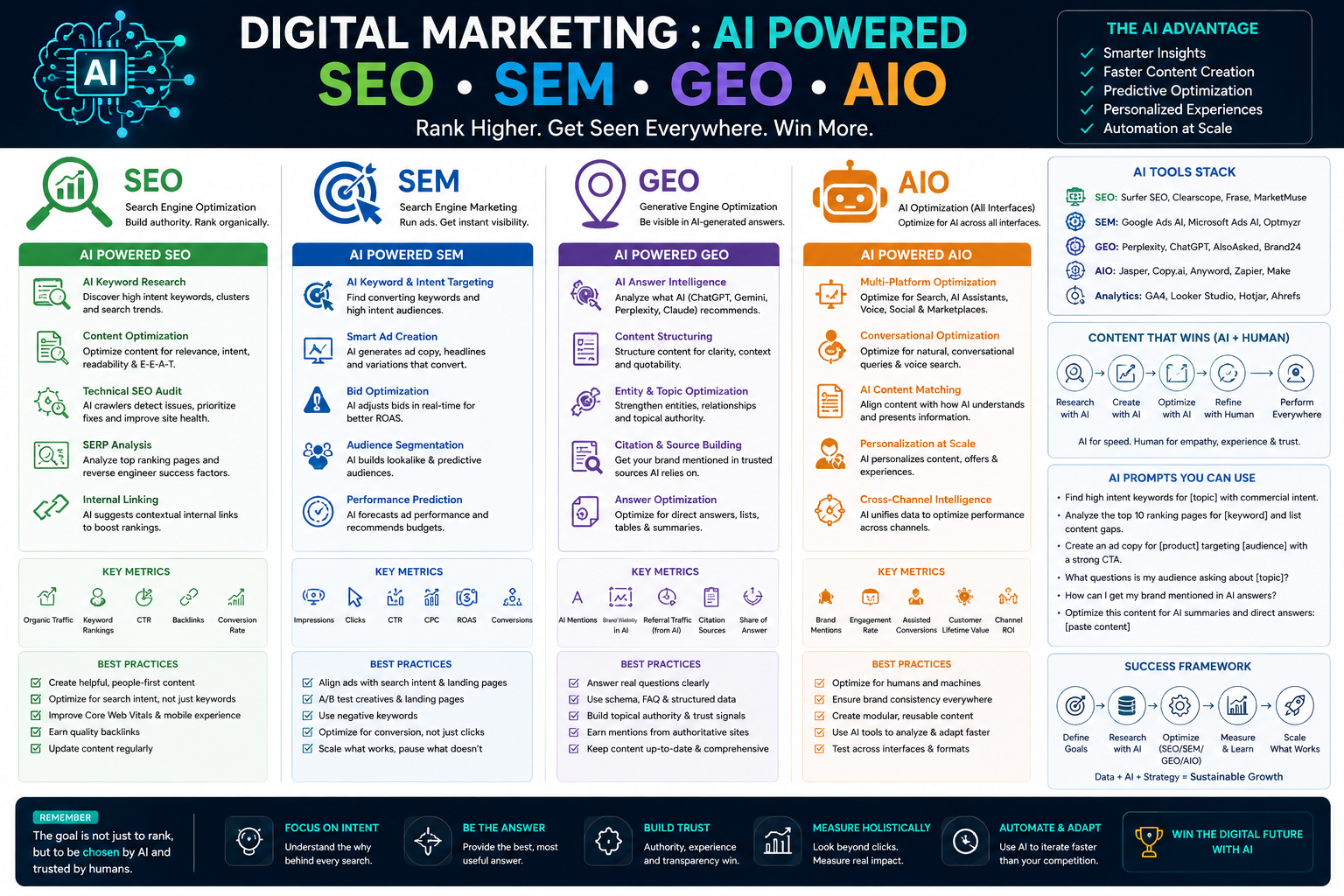
This roadmap is designed to take you from a traditional digital marketing foundation to becoming an AI-native strategist who can optimize for every major channel: AI-powered SEO, Generative Engine Optimization (GEO), AI Overviews (AIO), and traditional Search Engine Marketing (SEM). The search landscape has fundamentally shifted—users no longer click ten blue links; they ask ChatGPT, Perplexity, and Google AIO directly for answers. Your job is to ensure your brand gets cited in those answers.
🗺️ Phase 1: Foundation – Understanding the New Search Paradigm (Weeks 1-3)
Before touching any AI tool, you must grasp why the rules have changed.
- The Shift from SEO to GEO & AIO: Traditional SEO optimized for rankings on a search engine results page. GEO optimizes for citations within an AI-generated answer. If your content is not structured for AI consumption, you risk the "zero-click" phenomenon—where the AI answers the user's question without ever linking to your site.
- Core Concepts to Master:
- RAG Architecture: Understand that Large Language Models (LLMs) like GPT-4 use Retrieval-Augmented Generation—they retrieve relevant information from trusted sources to generate an answer.
- E-E-A-T with an AI Twist: Experience, Expertise, Authoritativeness, and Trustworthiness are still critical, but AI now prioritizes verifiable entities and structured citations over simple backlinks.
- Entity-Based Thinking: Move from keywords to "entities" (people, places, things). You want AI to recognize your brand as an authoritative entity for a given topic.
🤖 Phase 2: Technical SEO & Structured Data for AI Comprehension (Weeks 4-7)
AI cannot guess what your content means; you must explicitly tell it.
- Mastering Schema Markup: This is your single most important technical skill. Learn to implement
Schema.org vocabulary. For GEO, focus on FAQ, HowTo, Product, About, Mentions, and IsPartOf schemas. This structured data acts as a "cheat sheet" for LLMs, ensuring they understand your product details, prices, and specifications. - Technical Health: AI favors fast, secure, and accessible sites. Learn to perform technical audits using free tools. Master robots.txt, sitemap.xml, and core web vitals.
- Pro Tip: Use the free versions of Screaming Frog SEO Spider to crawl websites and find broken links or redirect chains.
📝 Phase 3: AI-Powered Content & Comparison Engineering (Weeks 8-12)
This is where you actively create content that AI models prefer to cite over others.
- Comparison Content is King: Modern AI buyers don't ask for a single product; they ask for comparisons. "HubSpot vs. Salesforce," "Shopify vs. WooCommerce." Structuring 2-way, 3-way, and 'Alternative to' comparison pages is the highest-ROI activity in GEO.
- Prompt Engineering for Content: Use AI (ChatGPT, Claude) as your junior writer, but you are the editor-in-chief. Learn to prompt the AI to write in a specific tone, with citations, and with original data.
- The Experience Layer: AI can synthesize information, but it cannot live an experience. Inject first-person case studies, original screenshots, proprietary data, and unique methodologies into your content. This "experience" signal tells the AI your content has irreplaceable value.
🔍 Phase 4: SEM, Social, and Google Shopping with AI Agents (Weeks 12-14)
While organic is powerful, you must master paid and social channels augmented by AI.
- AI-Powered SEM: Google Ads now uses AI for smart bidding and responsive search ads. Learn how to feed the algorithm高质量 creative assets and let the AI optimize for conversions.
- Social Media & AI Agents: AI agents can now manage content distribution across platforms. Learn to use scheduling tools with AI-powered hashtag recommendations and optimal posting time predictions.
- Google Shopping & Feed Optimization: AI prioritizes product feeds with rich, structured data. Learn to optimize your product titles, descriptions, and images for Google's Shopping AI, ensuring your products appear in the "Shopping" tab and image packs.
📊 Phase 5: Measurement, Attribution & AI Analyst Tools (Week 15+)
If you cannot measure it, you cannot improve it.
- New Metrics for a New Era: Stop obsessing over "impressions" and "clicks." Track Mention Share (how often your brand is cited vs. competitors in AI answers), Semantic Relevance (how closely your brand is tied to a solution in AI logic), and Zero-Click Conversions.
- AI Analytics Platforms: Instead of juggling five different tools, learn to use an AI-powered analytics dashboard that integrates Google Analytics, Search Console, and ad data into one view with an AI analyst surfacing actionable insights.
📚 Resource Toolkit: Where to Learn (Free & Paid)
You don't need an MBA; you need a portfolio of AI-optimized projects.
Best Free & Structured Courses:
- Google's Digital Marketing & E-commerce Certificate (Coursera): An excellent foundation for SEM and basic SEO before you layer on AI.
- GEO Optimization Guides & Courses:
- Look for CXL's Live Course on "Optimize pages for AI Search with GEO" (Paid, but industry-leading for deep research behavior).
- Study the "GEO优化" curriculum from喜传播 for the Asian market perspective on optimizing for DeepSeek and Baidu.
- Oracle Dev Gym: Not just for DBAs. Their advanced technical SEO workshops translate perfectly to understanding how AI crawlers read site architecture.
Essential Free & Freemium AI Tools:
- SEO & Content: Surfer SEO or Rank Math (WordPress plugin) for on-page AI optimization.
- Technical Audits: Screaming Frog (Free for up to 500 URLs) and Detailed SEO Extension (Chrome) for quick on-page analysis.
- Keyword & Topic Discovery: AnswerThePublic (free tier) for long-tail question keywords that fuel comparison content.
- All-in-One Free Platform: MeasureBoard (free tier) offers AI rank tracking, site audits, and an AI analyst without the $500/month price tag of enterprise tools.
- GEO-Specific Monitoring: SearchAttention shows you "heatmaps" of what content an AI model likes or dislikes.
- AI Writing & Assistance: ChatGPT (free tier), Claude, and Perplexity AI itself for researching how AI answers your target questions.
Paid Training (Career Accelerators):
- CXL Institute: The "Mini Degree" in SEO & AI Search is expensive but considered the gold standard for practitioners.
- Pluralsight: Excellent for technical SEO and Python scripting for marketing automation.
💼 Career Application & Next Steps
Your ability to "speak AI" is now a primary hiring qualification. You must prove you can generate results, not just activity.
1. The New Job Titles & Your Target
Update your search terms. The market is looking for:
- AI Marketing Specialist
- GEO Strategist
- SEO & AI Search Manager
- Digital Marketing Analyst (with AI workflow experience)
- Content Strategist (AI-Optimized)
2. Build Your "Anti-AI" Portfolio (What Makes You Uniquely Human)
Recruiters are flooded with generic applications. Stand out by showcasing your AI-resistant skills alongside your technical prowess.
- Document a GEO Case Study: Create a simple website or blog. Pick three related keywords. Publish standard articles for one month, then rewrite them as structured comparison content with schema markup. Use a free tool to check your "Mention Share" in Perplexity AI before and after. The improvement is your case study.
- Show Your Workflow: On your LinkedIn or portfolio, do not just list "ChatGPT." Explain: *"Used Claude to draft 10 product comparisons, manually injected proprietary test data, and used Surfer SEO to score an 85+ optimization grade before publishing."* This shows you treat AI as a tool, not a crutch.
3. Job Search Tactics in the AI Era
- Beat the ATS with Keywords: 70% of large companies use AI-driven Applicant Tracking Systems (ATS). Your resume must mirror the job description's exact keywords (e.g., "GEO," "Schema Markup," "Prompt Engineering," "Looker Studio").
- Use AI as Your Career Coach: Give ChatGPT a job description and your resume. Ask: "Which keywords are missing from my resume for this AI Marketing role?" Use Jobscan.co (free tier) to verify your match rate.
- Prepare for AI Interviews: Many first-round interviews are now AI-assisted, analyzing your eye contact, tone, and clarity. Practice with tools like Huru or simply record yourself answering common questions using the STAR method (Situation, Task, Action, Result).
4. The Interview Question You Will Be Asked
"How do you optimize for a zero-click search where ChatGPT answers the user without linking to your site?"
Your Answer: "You pivot from driving clicks to driving citations. I would first audit our current brand 'Mention Share' across ChatGPT and Perplexity. Then, I would build structured comparison content targeting deep-research queries, implement rigorous Schema markup, and create proprietary data or first-person case studies that provide value the AI cannot synthesize from other sources. Finally, I would track success not by CTR, but by 'Semantic Relevance' and 'Mention Share' over time."
Next Step: Do not try to learn everything at once. Open a free account on Perplexity AI. Ask it a question related to your hobby or industry. Look at the sources it cites. Ask yourself: "Why did it cite that source? Was it structured? Was it a comparison? Was it a .gov or .edu domain?" Reverse-engineer the AI's preferences, and build your first piece of content that mirrors that structure today.




 Group / 1: 1 Sessions