This roadmap is designed to take you from foundational API design principles to a professional who can architect, implement, and scale GraphQL federated systems. You will master schema-first design, resolver implementation, performance optimization, and federation—the enterprise-grade architecture that unifies multiple microservices into a single graph. This knowledge prepares you for high-demand roles where GraphQL expertise commands significant salary premiums, with experienced GraphQL engineers earning between 8 million and 16 million yen annually in specialized roles .
🗺️ Phase 1: Foundations – GraphQL Fundamentals & Schema Design (Weeks 1-4)
Before building federated systems, you must master the core GraphQL paradigm and understand why it solves problems that REST cannot.
Core Concepts to Master:
- GraphQL vs. REST: Understand the fundamental differences. REST exposes multiple endpoints that return fixed data structures, leading to over-fetching (getting too much data) or under-fetching (requiring multiple requests). GraphQL exposes a single endpoint where clients query exactly the fields they need in a single request . This efficiency is why companies like GitHub, Shopify, and Netflix have adopted GraphQL.
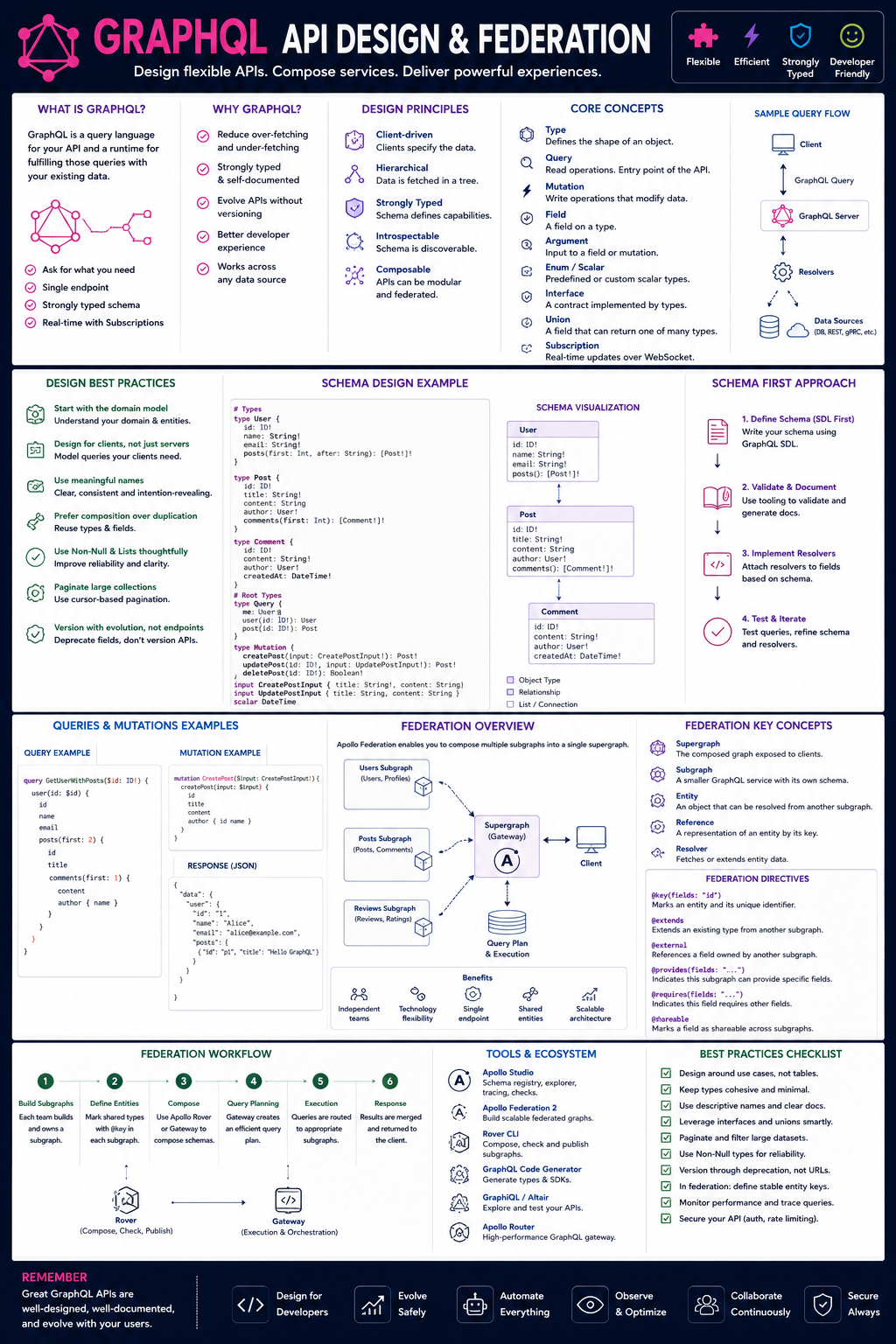
- The Schema Definition Language (SDL): GraphQL is schema-first—you define your API's capabilities in a declarative schema before writing any resolver code. Learn to define:
- Object Types: Representing entities like
User, Product, or Order - Query Type: The entry point for read operations (e.g.,
user(id: ID!)) - Mutation Type: For write operations (create, update, delete)
- Scalar Types:
String, Int, Float, Boolean, ID—and how to create custom scalars like DateTime - Input Types: For passing complex objects as arguments to mutations
- Resolver Functions: Schemas define what data is available; resolvers define how to fetch it. Each field in your schema maps to a resolver function that retrieves data from a database, REST API, or any other source. Learn the resolver signature:
(parent, args, context, info) => data - Query Execution Flow: Understand how a GraphQL operation travels from client to server and back. The server parses the query, validates it against the schema, executes resolvers in parallel where possible, and assembles the response matching the query's shape .
Practice Goal:
- Use Apollo Server (JavaScript/TypeScript) or Hot Chocolate (.NET/C#) to build a simple music catalog or book library API .
- Define a schema with types, queries, and mutations.
- Implement resolvers that return in-memory data.
- Use GraphQL Playground or Apollo Studio Explorer to run queries and explore your schema.
🛠️ Phase 2: Performance Optimization & Production Readiness (Weeks 5-8)
A naive GraphQL implementation can become slow or insecure at scale. This phase teaches you to harden your API for production.
Core Optimization Strategies:
- The N+1 Problem & DataLoader: This is the single most common GraphQL performance pitfall. If you fetch a list of 100 products and each product needs to fetch its author, a naive resolver would make 101 database queries (1 for the list, 100 for each author). Learn to implement DataLoader pattern, which batches requests and caches results, reducing 101 queries to just 2 .
- Pagination Strategies: GraphQL queries can request deep, nested data. Without pagination, a malicious query could request millions of objects. Learn to implement:
- Cursor-based pagination (recommended for real-time data)
- Offset-based pagination (simpler but less performant for large datasets)
- The Connection spec (from Relay) for standardized pagination
- Caching at Multiple Layers: Unlike REST where HTTP caching works automatically, GraphQL requires careful caching strategy :
- Normalized caching on the client (Apollo Client's cache)
- Persisted queries to reduce request size
- Response caching at the gateway level for identical queries
- Error Handling & Observability: GraphQL responses can be partially successful (some fields succeed, others error). Learn structured error handling with custom error types. Implement logging and monitoring using tools like Apollo Studio or GraphQL Inspector to track query performance .
Security Fundamentals:
- Implement query depth limiting to prevent nested queries from exhausting server resources
- Set query complexity limits based on an algorithm that assigns weights to different fields
- Configure rate limiting per user or IP address
- Implement field-level authorization using schema directives
Practice Goal:
- Take your Phase 1 API and introduce an N+1 problem intentionally.
- Fix it using DataLoader.
- Add pagination to a list field.
- Implement a basic query complexity limit and watch it reject an overly complex query.
🔗 Phase 3: Schema Federation – The Enterprise Architecture (Weeks 9-14)
This is the most valuable skill in the roadmap. Federation allows multiple teams to own their own GraphQL services ("subgraphs") that compose into a single, unified "supergraph" accessible through a gateway .
Why Federation Exists:
In a microservices architecture, different teams manage different domains—Products, Users, Orders, Inventory. Federation lets each team expose their domain as an independent GraphQL subgraph. The federation gateway composes these subgraphs into a single endpoint. Clients query the supergraph and don't need to know which service provides which data .
Core Federation Concepts:
- Subgraphs: Individual GraphQL services, each responsible for a bounded context (e.g.,
products subgraph, reviews subgraph) - Supergraph: The composed result of all subgraphs, deployed to the gateway
- Gateway/Router: The entry point that receives client queries and delegates to the appropriate subgraphs
- Entities &
@key Directive: The mechanism for extending types across subgraphs. A User entity might be defined in the users subgraph but extended with reviews in the reviews subgraph using the @key directive @extends & @external: Declare that a field is defined elsewhere
The Four Phases of Federation Maturity :
- Phase: Siloed APIs – Each team has its own GraphQL API. Clients must manually aggregate data. Painful for frontend developers.
- Phase: Experimental Federation – Teams begin composing 2-3 subgraphs through a gateway. Shared naming conventions emerge .
- Phase: Production Federation – The supergraph becomes critical infrastructure. CI/CD pipelines enforce schema checks before deployment. Operational limits (rate limits, complexity controls) are applied .
- Phase: Governed Federation – The graph is a well-defined internal product. SLAs exist per subgraph. Schema proposals, changelogs, and role-based access control are implemented .
Apollo Federation vs. Open Federation vs. Schema Stitching:
- Apollo Federation: The original and most mature implementation. Uses Apollo Gateway and Router. Proprietary but battle-tested .
- Open Federation: A MIT-licensed, open specification backed by WunderGraph, Grafbase, Neo4j, and others. A drop-in replacement that removes vendor lock-in .
- Schema Stitching: An older approach where a single gateway manually merges schemas. Less scalable than federation, not recommended for new projects .
Implementation Steps for a Federated Graph :
- Define your subgraphs: Identify domain boundaries (e.g.,
users, products, inventory, reviews). - Implement subgraphs: Each is a standard GraphQL server annotated with federation directives like
@key. - Set up the gateway: Apollo Gateway or Grafbase Gateway composes subgraphs into a supergraph.
- Publish schemas: Use the Rover CLI (Apollo) or Grafbase CLI to publish subgraph schemas to a schema registry .
- Run schema checks: Before deploying a subgraph change, run automated checks to ensure it doesn't break existing clients .
Practice Goal:
- Create two subgraphs: a
users subgraph and a reviews subgraph. - Define a
User entity in users with an id field annotated with @key. - In the
reviews subgraph, extend the User type with a reviews field. - Run a federated gateway (Apollo Router or Grafbase Gateway) that composes both subgraphs.
- Execute a query that fetches a user's name from the
users subgraph and their reviews from the reviews subgraph in a single request.
🚀 Phase 4: Advanced Federation & The Future Ecosystem (Weeks 15-18)
As you scale to dozens or hundreds of subgraphs, new challenges emerge around governance, observability, and schema evolution.
Federation at Scale:
- Schema Registry & Versioning: When you have 20+ subgraphs, you cannot coordinate every change across teams. A schema registry stores the supergraph schema and enforces compatibility rules. The Rover CLI or Grafbase CLI runs
schema check against the registry before allowing deployment . - Breaking Change Detection: Automated schema checks catch breaking changes like removing a field, changing a field type from non-nullable to nullable, or deleting a type .
- Trusted Documents & Persisted Queries: For security, you can configure the gateway to accept only pre-approved, persisted queries. This prevents malicious queries and reduces request size .
- Field-Level Authorization with Directives: Use custom
@auth directives to enforce permissions. For example, @auth(requires: ADMIN) on a field ensures only admin users can query it .
The Future: GraphQL Fusion & Multi-Protocol Composition
The GraphQL ecosystem is moving beyond pure GraphQL federation. GraphQL Fusion, housed under the GraphQL Foundation, is an emerging specification that enables composing not just GraphQL APIs, but also REST (OpenAPI), gRPC, and AsyncAPI into a unified graph . Backed by AWS AppSync, Hasura, IBM, and Solo.io, Fusion represents the next evolution in API composition.
Observability for Federated Graphs:
- Use OpenTelemetry to trace requests across multiple subgraphs .
- Implement Grafbase's built-in analytics or Apollo Studio Insights to see which fields are most expensive and which clients are making the largest queries.
- Configure access logs to audit who queried what.
Practice Goal:
- Extend your federated graph to three subgraphs.
- Set up a local schema registry and run
rover dev (Apollo) or grafbase dev (Grafbase) to iterate locally. - Introduce a breaking change to one subgraph and run a schema check to see it fail.
- Implement a custom
@auth directive on a field.
📚 Resource Toolkit: Free & Paid Training
Free & Official Learning Platforms:
- Apollo Odyssey: Apollo's official, completely free learning platform. The "Intro to GraphQL" course teaches you to build a music catalog API, implement a GraphQL server, use REST APIs as data sources, and follow best practices for queries and mutations. The "Intro to Apollo Federation" course covers subgraphs, entities, the Rover CLI, and schema delivery . Available in TypeScript, Java (DGS), and .NET/C# (Hot Chocolate) with Python (Strawberry) coming soon .
- Grafbase Academy: A free, in-development resource hub for GraphQL Federation. Built from real production experience handling billions of requests monthly across companies in streaming, e-commerce, and logistics. Practical, no-fluff, paywall-free content .
- WunderGraph Cosmo: An open-source alternative to Apollo Studio for managing federated graphs at scale. The Cosmo GitHub repository (1,074 stars) provides the tooling to build, maintain, and collaborate on GraphQL Federation .
Paid Structured Courses (Highest Value):
- Coursera: Advanced GraphQL for Developers (Board Infinity): A 3-module deep dive into performance tuning, schema federation, and seamless integrations . Covers:
- Module 1: Caching strategies, pagination, rate limiting, error handling, and monitoring with Apollo Studio
- Module 2: Schema federation with Apollo Gateway, subgraphs, migrating from monolith to federation, deployment strategies
- Module 3: Integrating GraphQL with SQL/NoSQL databases using DataLoader, connecting to React/Vue/Next.js, wrapping legacy REST APIs
- YouTube Channels for System Design Context: Channels like Gaurav Sen and Hussein Nasser provide excellent context on where GraphQL and federation fit into broader system design—covering load balancing, database sharding, and microservices patterns .
Open Source Tools & Practice Repositories:
- Apollo Federation Repository: The official TypeScript implementation of Apollo Federation (705 stars) where you can study the source code .
- ultimate-backend (juicycleff): A multi-tenant SaaS starter kit with GraphQL microservice architecture and Apollo Federation (2,862 stars, 432 forks) . An excellent real-world codebase to study.
- federation-subscription-tools: Demonstration utilities for using GraphQL subscriptions alongside a federated graph .
AI-Assisted Learning:
- Use ChatGPT or Claude as a schema design mentor. Ask: "I need to design a schema for an e-commerce system with products, users, carts, and orders. What types and relationships should I define?"
- Paste a resolver with N+1 issues and ask for a DataLoader implementation.
- For federation, ask: "Explain the difference between
@key, @extends, and @external directives" or "Generate a Rover CLI command to publish a subgraph schema."
💼 Career Application & Next Steps
GraphQL API design and federation skills are among the most valued in modern backend engineering. Market data shows GraphQL experience correlates with significantly higher compensation—often 2-4 million yen above standard backend engineering roles .
1. Job Market & Your Target Roles
- Backend Engineer (GraphQL): Specialize in schema design, resolver optimization, and DataLoader implementation. Typical range: 7.5M–11M yen .
- Full Stack Engineer (GraphQL + React/Vue): Combine frontend frameworks with Apollo Client or Relay. The most in-demand combination. Typical range: 8M–12M yen .
- API Architect: Design enterprise-wide API strategies, federation governance, and schema evolution plans. Typical range: 9M–14M yen .
- Platform Engineer (GraphQL Federation): Build and maintain the supergraph infrastructure—gateway, schema registry, observability. Critical for companies with 10+ subgraphs. Can exceed 16M yen for senior roles .
- Lead Engineer (REST to GraphQL Migration): Companies actively seeking engineers who have led migrations from legacy REST architectures to GraphQL. This specific experience commands premium offers .
2. Build Your Portfolio (Three Definitive Projects)
Project 1 (Foundational API):
- What: Build a complete GraphQL API from scratch using Apollo Server (TypeScript) or Hot Chocolate (.NET). Include queries for listing and fetching by ID, mutations for create/update/delete, and DataLoader for batched database access.
- Why: Demonstrates you understand the full request lifecycle and can solve real performance problems.
Project 2 (Federated Graph):
- What: Build a federated supergraph with three subgraphs (e.g.,
users, products, orders). Implement @key directives to share entities across subgraphs. Set up a gateway and execute a query that spans all three subgraphs. - Why: Federation is the enterprise skill that separates junior GraphQL developers from senior architects. This project proves microservice composition ability.
Project 3 (Migration Narrative):
- What: Document a hypothetical REST-to-GraphQL migration for a sample application. Include: why GraphQL was chosen, the schema-first design process, handling of authentication/authorization, pagination strategy, and how federation would handle future scale .
- Why: Companies are actively migrating legacy systems. Your ability to articulate a migration strategy demonstrates product-thinking and architectural judgment.
3. Certifications That Validate Your Skills
- Apollo GraphQL Associate Certification: Validates foundational GraphQL and Apollo Federation knowledge. Recognized across the industry.
- Coursera Advanced GraphQL Specialization Certificate: Project-based certification from Board Infinity covering performance, federation, and integrations .
- System Design Interview Preparation: While not a certification, completing System Design mock interviews (using platforms like Pramp or interviewing.io) with a focus on GraphQL architecture proves your practical communication skills .
4. The Interview Question You Will Be Asked
*"Your company has five backend microservices (Users, Products, Inventory, Reviews, Orders). The frontend team complains they need to call 3-4 different REST endpoints to render a single page. How would you solve this?"*
Your Answer: *"I would recommend implementing a GraphQL federation layer. We would create subgraphs for each microservice. The Users subgraph would define a User entity with a @key on id. The Reviews subgraph would extend User with a reviews field. We would deploy an Apollo Gateway or Grafbase Gateway that composes all five subgraphs into a single endpoint. Now the frontend can fetch a user, their reviews, their recent orders, and product details in one request. We would use DataLoader in each subgraph to prevent N+1 issues to the underlying databases. For existing REST services, we can wrap them with GraphQL resolvers initially, then gradually migrate to native GraphQL subgraphs. This approach gives frontend velocity immediately while allowing backend teams to modernize incrementally."*
Next Step: Do not try to learn everything at once.
- Complete Apollo Odyssey's "Intro to GraphQL" (free, 2-3 hours). Build the music catalog API .
- Spin up Apollo Server locally and create a simple schema with 3 types and 5 fields.
- Run your first query in Apollo Studio Explorer.
- Add DataLoader to batch database calls. Measure the difference.
- Complete the "Intro to Apollo Federation" course and build your first federated graph with two subgraphs .
The moment your federated gateway composes two subgraphs and returns data from both in a single query, you will have crossed the threshold from GraphQL user to GraphQL architect. This is a rare and valuable skill. Start building today.




 Group / 1: 1 Sessions