This roadmap is designed to take you from a foundational understanding of edge computing to a professional who can design, deploy, and manage distributed systems that process data closer to its source—reducing latency, bandwidth costs, and cloud dependency. Edge computing sits between devices (sensors, cameras, industrial equipment) and cloud data centers, enabling real-time decision-making for autonomous vehicles, smart factories, retail analytics, and healthcare systems. This knowledge prepares you for roles in a market where edge computing jobs have grown by 120% in just one year .
🗺️ Phase 1: Foundations – Understanding the Edge Ecosystem (Weeks 1-3)
Before deploying anything to an edge device, you must understand why edge computing exists and how it differs from traditional cloud architecture.
Core Concepts to Master:
- The "Why" of Edge Computing: Traditional cloud computing suffers from latency, bandwidth constraints, and privacy concerns. Moving compute closer to data sources solves these problems. For example, a manufacturing robot cannot wait 300ms for a cloud round-trip to detect a defect—it needs inference in milliseconds.
- The "Cloud-Edge-Device" Continuum: Understand the three layers of modern distributed systems:
- Cloud Layer: Centralized data storage, heavy model training, long-term analytics
- Edge Layer: Gateways, on-premise servers, or local processing units that run inference and filter data
- Device Layer: Sensors, cameras, actuators, and IoT endpoints that generate raw data
- Key Edge Computing Frameworks: Familiarize yourself with the major open-source frameworks that standardize edge deployments:
- EdgeX Foundry: A vendor-neutral, open-source IoT edge framework hosted by the Linux Foundation. It provides plug-and-play components for connecting devices, processing data, and sending to the cloud.
- KubeEdge: Extends Kubernetes to edge environments, enabling container orchestration on resource-constrained devices
- AWS IoT Greengrass, Azure IoT Edge, Google Distributed Cloud: Cloud vendor-specific edge platforms
- Essential Protocols: Learn the lightweight communication protocols that power edge systems:
- MQTT (Message Queuing Telemetry Transport): Publish-subscribe messaging designed for low-bandwidth, high-latency networks
- CoAP (Constrained Application Protocol): RESTful protocol for constrained devices
- OPC-UA: Industrial automation standard for machine-to-machine communication
The Edge Computing Value Proposition:
ChallengeCloud-OnlyEdge-EnabledLatency100-300ms5-20msBandwidth CostAll data uploaded70%+ filtered at sourceOffline OperationImpossibleFull functionalityData PrivacyRaw data leaves premisesSensitive data stays local
This comparison illustrates why industries from manufacturing to healthcare are adopting edge architectures.
🛠️ Phase 2: Containerization & Orchestration for Edge (Weeks 4-8)
Edge deployments are not "install once and forget." You need the same DevOps practices used in cloud, adapted for resource-constrained environments.
Core Technical Skills:
- Lightweight Containerization: Standard Docker works, but edge often requires lighter options. Learn Podman and containerd for environments where Docker's daemon is too heavy. Containers are central to modern edge deployment because they encapsulate dependencies and enable consistent behavior across diverse hardware .
- K3s – Kubernetes for Edge: Standard Kubernetes (K8s) is too resource-intensive for many edge devices. K3s is a certified, lightweight Kubernetes distribution that runs on ARM devices like Raspberry Pi and consumes less than 512MB RAM. Learn to:
- Install K3s on edge gateways
- Deploy pods that run inference models
- Manage device registries and updates
- GitOps for Edge: Use ArgoCD or Flux to manage edge deployments declaratively. Edge devices should pull their configuration from Git repositories, not rely on SSH or manual updates.
- Edge-Specific CICD: Unlike cloud where you deploy to a known endpoint, edge devices are numerous, distributed, and intermittently connected. Learn Azure IoT Edge's DevOps patterns or KubeEdge's device management to handle:
- Blue-green deployments across thousands of devices
- Rollback mechanisms for failed edge updates
- Bandwidth-efficient update distribution (using peer-to-peer or hierarchical strategies)
The AI Edge Engineer learning path from Microsoft provides hands-on modules for deploying containers to edge devices, including a pre-built temperature simulator module and CI/CD implementation for virtual IoT Edge devices on Kubernetes clusters .
🤖 Phase 3: Edge AI – Model Optimization & Deployment (Weeks 9-14)
This is the most valuable skill in the edge computing market. Running AI models on edge devices requires converting cloud-trained models into efficient, low-power versions that run on CPUs, GPUs, or specialized accelerators.
The Challenge: A typical cloud AI model (like YOLOv8 for object detection) might require 5GB RAM and a powerful GPU. The same model needs to run on a $50 device with 2GB RAM and no dedicated GPU.
Your Toolkit for Model Optimization:
- OpenVINO Toolkit (Intel): The industry-standard toolkit for optimizing and deploying AI inference on Intel CPUs, GPUs, and NPUs. It supports model optimization, quantization, and hardware acceleration .
- Learn to convert TensorFlow, PyTorch, or ONNX models to OpenVINO IR format
- Apply 8-bit quantization to reduce model size by 75% with minimal accuracy loss
- Benchmark inference speed on target hardware
- TensorFlow Lite for Microcontrollers: Run TensorFlow models on devices with only kilobytes of memory. Learn to convert, quantize, and deploy models to ARM Cortex-M chips.
- ONNX Runtime: A cross-platform inference engine that works across CPU, GPU, and specialized accelerators like NVIDIA TensorRT and Intel OpenVINO. Learn to:
- Export models from PyTorch or TensorFlow to ONNX format
- Apply graph optimizations and quantization
- Deploy to edge devices with hardware acceleration
- Model Compression Techniques: Master the methods that make edge AI possible:
- Quantization: Convert 32-bit floating-point weights to 8-bit integers (4x size reduction)
- Pruning: Remove neural connections that contribute little to accuracy
- Knowledge Distillation: Train a small "student" model to mimic a large "teacher" model
- Knowledge Distillation: Train a small "student" model to mimic a large "teacher" model
The Eclipse Aidge Framework: A new open-source framework designed specifically for deploying Deep Neural Networks to diverse hardware targets. It provides end-to-end workflow integration, efficient optimization techniques (quantization, pruning, compression), and multi-platform deployment across PyTorch, ONNX, and TensorRT ecosystems .
Harvard's CS249r Course: The Harvard Edge Computing Lab has made their entire "AI and Systems at the Edge" course materials publicly available on GitHub. This resource covers hardware/software co-design, ML systems design, and resource-constrained environments—it's a deep, academic-level treatment of edge AI .
🔗 Phase 4: Orchestration, Observability & Security (Weeks 15-20)
As you scale from one device to thousands, you need sophisticated management, monitoring, and security.
Orchestration at Scale:
- LF Edge Certification Path: The Linux Foundation offers the Certified Edge & Cloud Orchestration Specialist (CECOS) certification through Tonex Training. This 2-day program covers: distributed system architecture, container platforms, service meshes, policy automation, observability, and zero-trust security across edge and cloud environments .
- EdgeX Foundry Deep Dive: The Linux Foundation's free course "EdgeX Foundry (LFD213)" provides 10-15 hours of self-paced learning. You'll learn EdgeX architecture, how to download and run it, configure it, extend it with device services, and use SDKs to create custom services .
Observability for Edge:
You cannot physically visit thousands of edge devices. You need remote observability:
- Use Prometheus with edge-specific exporters for resource monitoring
- Implement Grafana dashboards that aggregate metrics from all edge nodes
- Set up structured logging with log aggregation (Loki or ELK) that handles intermittent connectivity
- Implement distributed tracing (Jaeger or Tempo) to debug requests flowing through device→edge→cloud
Security as First-Class Requirement:
Edge devices introduce unique security challenges:
- Physical Access: Attackers can physically access edge devices. Learn to implement secure boot, encrypted storage, and hardware root of trust (TPM, Azure Sphere)
- Zero-Trust Architecture: Assume the network is compromised. Implement mTLS between devices, rotate certificates automatically, and enforce least-privilege access
- Image Signing & Provenance: Sign all container images and edge module packages. Verify signatures at deployment time
The CECOS certification includes substantial security coverage: threat modeling distributed systems, image signing and provenance, secrets management, runtime hardening, and zero-trust segmentation strategies .
📚 Resource Toolkit: Free & Paid Training
Free & Open-Source Resources:
- Harvard CS249r: AI and Systems at the Edge (Full Course Materials): A complete, publicly available university course covering edge AI, ML systems design, hardware/software co-design, and resource-constrained environments. Available as a public book on GitHub .
- Microsoft AI Edge Engineer Learning Path: A free, modular learning path covering IoT and cloud solutions, deploying containers to edge devices, MLOps for IoT Edge, Azure Functions integrations, and Live Video Analytics with Custom Vision models .
- Linux Foundation EdgeX Foundry (LFD213): A free, self-paced course (10-15 hours) on the EdgeX framework, covering device services, application services, and SDK usage. You'll learn to run EdgeX and its APIs, create simple services, and integrate them .
- Eclipse Aidge Framework: An open-source framework for DNN deployment to edge devices. Includes Quick Start guides, tutorials, model optimization techniques (quantization, pruning, compression), and multi-platform deployment guides .
- Edge AI Libraries (GitHub): A curated collection of performance-optimized libraries from Intel, including OpenVINO Toolkit, Deep Learning Streamer, Anomalib (visual anomaly detection), Geti (CV model training), and SceneScape (digital twins). Each component has documentation and examples .
Paid Certifications & Structured Training:
- Certified Edge & Cloud Orchestration Specialist (CECOS): A 2-day certification program from Tonex Training covering distributed system architecture, container platforms, Kubernetes, service meshes, observability, security, and FinOps optimization. Includes exam and certificate upon passing (70%+ score required) .
- GTC Group's Edge Computing & IoT Integration: A 3-10 day course (prices from £3,450 to £7,300) covering edge architecture design, containerized workload deployment, sensor data stream processing, secure device provisioning, and ML inference at the edge. CPD certified .
- 亿琪软件 (YiQiSoft) Edge Training: Chinese-language training provider offering EdgeX Foundry fundamentals (1 day), edge AI model deployment (1.5 days with登临 KS20实战案例), and国产化 (domestic hardware) edge computing (2 days). Enterprise on-site training available. Includes certification upon completion .
- LF Edge Certification Engineer (CEE): The Linux Foundation's official edge certification. Valued by employers building edge solutions on open-source frameworks .
AI-Assisted Learning Strategies:
- Use ChatGPT or Claude as a "model optimization tutor." Paste your model architecture and ask: "What quantization strategy would work best for this model on an ARM Cortex-A device with 2GB RAM?"
- Generate synthetic training data for edge scenarios: "Create 100 labeled images of manufacturing defects for a custom YOLO model."
- Debug edge deployment issues: "My containerized model crashes on startup with 'CUDA out of memory' on a Jetson Nano. What's wrong and how do I fix it?"
- Simulate edge environments: "Write a docker-compose file that simulates 50 edge devices sending MQTT telemetry to a local broker."
📚 Consolidated Resource Toolkit
Free / No-Cost Training
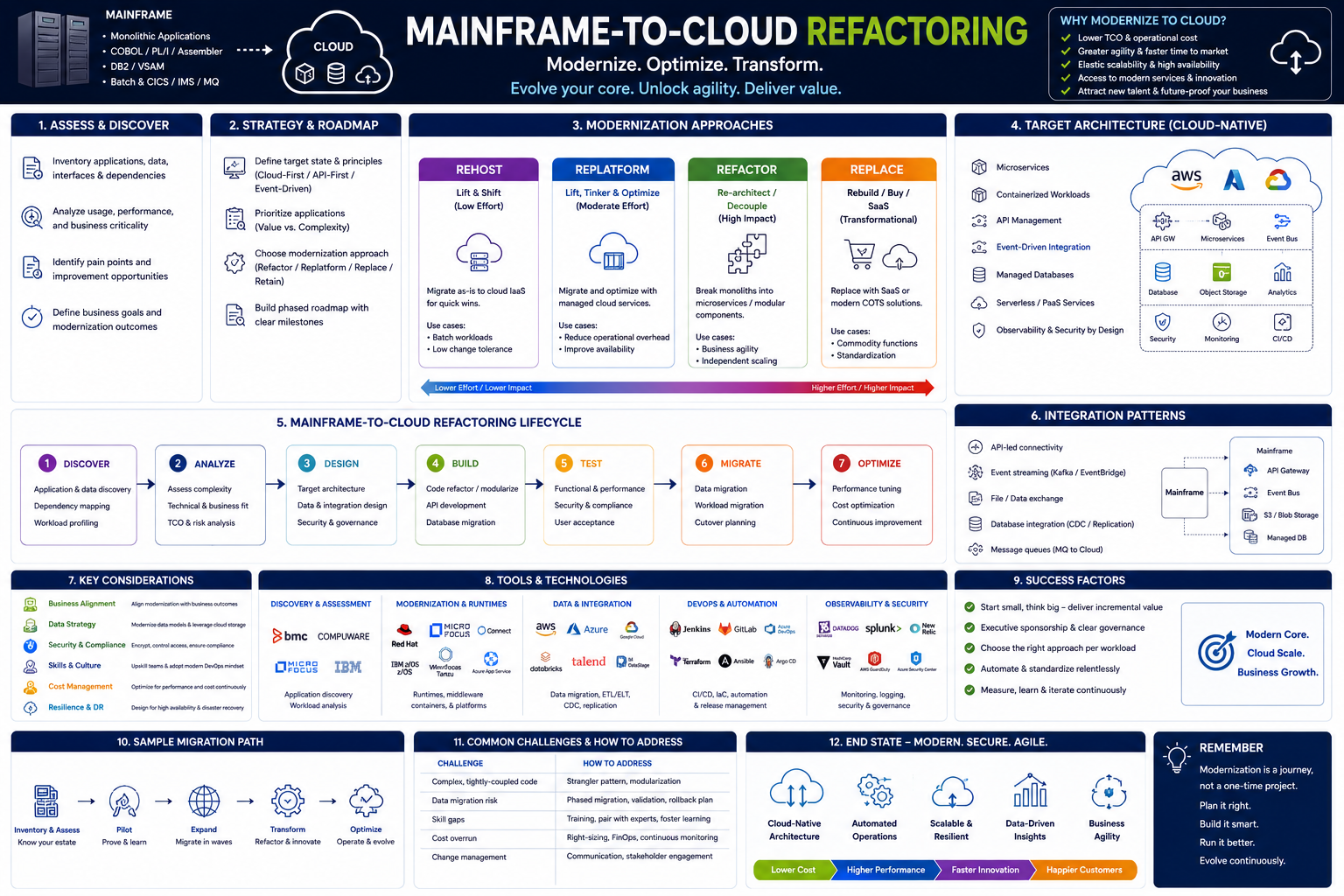
Broadcom Beyond Code Education – Virtual instructor-led training featuring live courses on CA 7, Endevor, Easytrieve, and mainframe fundamentals. This resource is free for Broadcom customers with a Site ID.
IBM Z Wildfire Workshops – Hands-on virtual workshops covering CICS Integration (2.75 days), z/OS Connect REST APIs (7 hours), Ansible for Z (6 hours), and WebSphere Liberty (3 days). Free for qualified IBM customers.
AWS Skill Builder – Self-paced digital training covering mainframe fundamentals, AWS Mainframe Modernization, Blu Age, and AWS Transform.
AWS Transform for mainframe – A hands-on tool for assessment, refactoring, and testing. It is free during early access, though you should check current pricing at the time of your use.
Community Content (YouTube / LinkedIn) – Self-paced resources including roadmaps, skills guides, and career advice from practicing professionals.
Paid Certifications & Structured Training
AWS Blu Age Certification (3 levels) – Focuses on automated COBOL-to-Java refactoring. Provided by AWS via the Partner Network.
IBM z/OS Administrator / Developer – Validates mainframe system skills. Offered by IBM.
AWS Solutions Architect Associate – Covers cloud architecture for modernized applications. Offered by AWS.
Certified Kubernetes Administrator (CKA) – Focuses on container orchestration. Offered by the CNCF / Linux Foundation.
SAFe Agilist – Validates Scaled Agile delivery expertise. Offered by Scaled Agile.
AI-Assisted Learning & Tooling
AWS Transform AI Agent – Automates business logic extraction, code decomposition, and wave planning for mainframe migration.
Kiro (spec-based IDE) – Generates user stories, code, tests, and infrastructure-as-code from AWS Transform outputs.
Claude / ChatGPT – Helps understand COBOL snippets, generate test cases, and explain modernization patterns through conversational learning.
GitHub Copilot / Devin – Accelerates Java development after refactoring with AI-powered code completion and generation.
MCP (Model Context Protocol) – Enables building agent integrations between large language models and enterprise systems.
💼 Career Application & Next Steps
Mainframe modernization expertise addresses a critical market gap: retiring mainframe talent combined with explosive cloud adoption. This skill set commands significant compensation and job security.
1. Job Market & Your Target Roles
Mainframe Modernization Engineer – Requires 3-6 years of experience. Key responsibilities include refactoring COBOL to Java, implementing z/OS Connect APIs, and applying DevOps practices on z/OS. Compensation is competitive with cloud architect roles.
Mainframe Legacy Modernization Engineer – Requires 7-10 years of experience. Responsibilities cover end-to-end transformation, design pattern application, data migration, and AI-assisted code conversion. US base salary ranges from approximately 81,000to
81,000to130,000, varying by location.
Java Engineering Manager (Modernization) – Requires 13-18 years of experience. Leads migration programs, drives AI tooling adoption, provides team leadership, and manages cost reduction initiatives. This role sits at the Senior Vice President level at institutions like Citi.
CICS System Programmer – Requires 3+ years of advanced experience. Responsibilities include region setup, CICSPlex SM configuration, and WLM tuning. Compensation is typically 30-60% higher than standard developer roles.
Industries actively hiring include banking (Citi, JPMorgan Chase, Wells Fargo), insurance, government agencies (tax, benefits systems), retail, and telecommunications.
2. Build Your Portfolio (Three Definitive Projects)
Project 1 – Assessment & Analysis using AWS Transform
Use AWS Transform to analyze a sample mainframe application such as CardDemo. Generate code analysis, data lineage, and activity analysis reports. Document the dependency graph and create a migration wave plan. This demonstrates your ability to perform assessment work, which is the first paid phase of any modernization project.
Project 2 – End-to-End Refactoring
Take a simple COBOL program containing business logic. Run it through AWS Transform's refactor agent to convert it to Java. Transform the generated Java into a Spring Boot microservice with REST endpoints. Deploy it to AWS EC2 or ECS. Document the entire "before and after" process with metrics.
Project 3 – API Exposure of Legacy Functionality
Using IBM z/OS Connect (available in the Wildfire workshop environment), expose a CICS transaction as a REST API. Test it using Postman. Document the OpenAPI specification and the security configuration required. Many modernization projects begin with API exposure before full migration, making this skill immediately valuable.
3. Certifications That Open Doors
AWS Certified Solutions Architect – Associate validates the cloud architecture knowledge needed to deploy modernized applications on AWS.
AWS Mainframe Modernization (Blu Age) Certification (3 levels) is the most directly relevant credential. Level 1 is foundational, Level 2 covers advanced refactoring, and Level 3 validates expert delivery capability.
IBM z/OS Administrator or Developer certifications prove your mainframe system credentials to employers.
Certified Kubernetes Administrator (CKA) matters because modernized applications increasingly run on containers, and this certification proves you can manage them.
SAFe Agilist demonstrates you can lead large-scale transformation programs using scaled agile frameworks.
4. The Interview Question You Will Be Asked
Question: "Our bank has 10 million lines of COBOL code supporting credit card processing. The development team is retiring, and we need to modernize to AWS. How would you approach this?"
Your Answer: "I would follow a phased, six-step approach.
First, Discovery – I would use AWS Transform to analyze the codebase, generating dependency graphs, data lineage, and activity metrics from SMF records. This tells us what is actually used versus dead code.
Second, Wave Planning – Based on dependencies, I would break the monolith into business domains such as credit limit, fraud detection, rewards, and settlement, then sequence migration waves accordingly.
Third, Architecture – For each wave, I would apply the Strangler Fig pattern, building new microservices alongside the mainframe. I would expose initial functionality via z/OS Connect REST APIs before full migration.
Fourth, Refactoring – Using AWS Transform's refactor agent, I would convert COBOL to Java Spring Boot microservices. For high-criticality components, I would add the Reforge step for LLM-enhanced code quality and unit tests.
Fifth, Testing – I would use the automated test generation feature to create functional test cases and data collection scripts, ensuring functional equivalence between old and new systems.
Sixth, Gradual Cutover – I would route traffic incrementally, with human-in-the-loop validation at each stage. Throughout, I would maintain parallel run capability for rollback. I would also train the Java team on the modernized codebase, retiring COBOL skills gradually.
The result would be reduced MIPS costs, the ability to integrate with modern APIs, and no critical talent gap risk."
5. Sample Resume Entry
Mainframe Modernization Engineer | Self-Directed Project (2025-2026)
- Led assessment of a sample mainframe application (CardDemo) using AWS Transform
- Generated code analysis reports identifying 15 business domains and over 200 program dependencies
- Executed refactoring of five COBOL programs to Java Spring Boot microservices
- Deployed modernized application to AWS ECS with a CI/CD pipeline using GitHub Actions
- Exposed CICS transactions as REST APIs using z/OS Connect through IBM Wildfire workshop
- Documented a full migration playbook including wave planning and rollback procedures
Your Next Step
Do not try to learn everything at once. The highest-value starting point is the assessment and analysis phase.
- Set up an AWS account using the free tier, and immediately enable a budget alarm to avoid unexpected charges.
- Navigate to AWS Mainframe Modernization in the console.
- Request access to the CardDemo sample application or download a COBOL sample from GitHub.
- Run a code analysis job in AWS Transform.
- Review the output carefully, focusing on code complexity metrics, dependency graphs, and data lineage.
- Use the AI-powered chat feature to ask questions about the analyzed codebase.
- Document everything you learned in a GitHub repository named "mainframe-modernization-portfolio."
The moment you see a COBOL program analyzed and its business logic extracted in plain English by an AI agent, you will understand the power of modern tooling. This is the future of enterprise IT—preserving decades of business logic while embracing cloud agility. Start your journey today.




 Group / 1: 1 Sessions