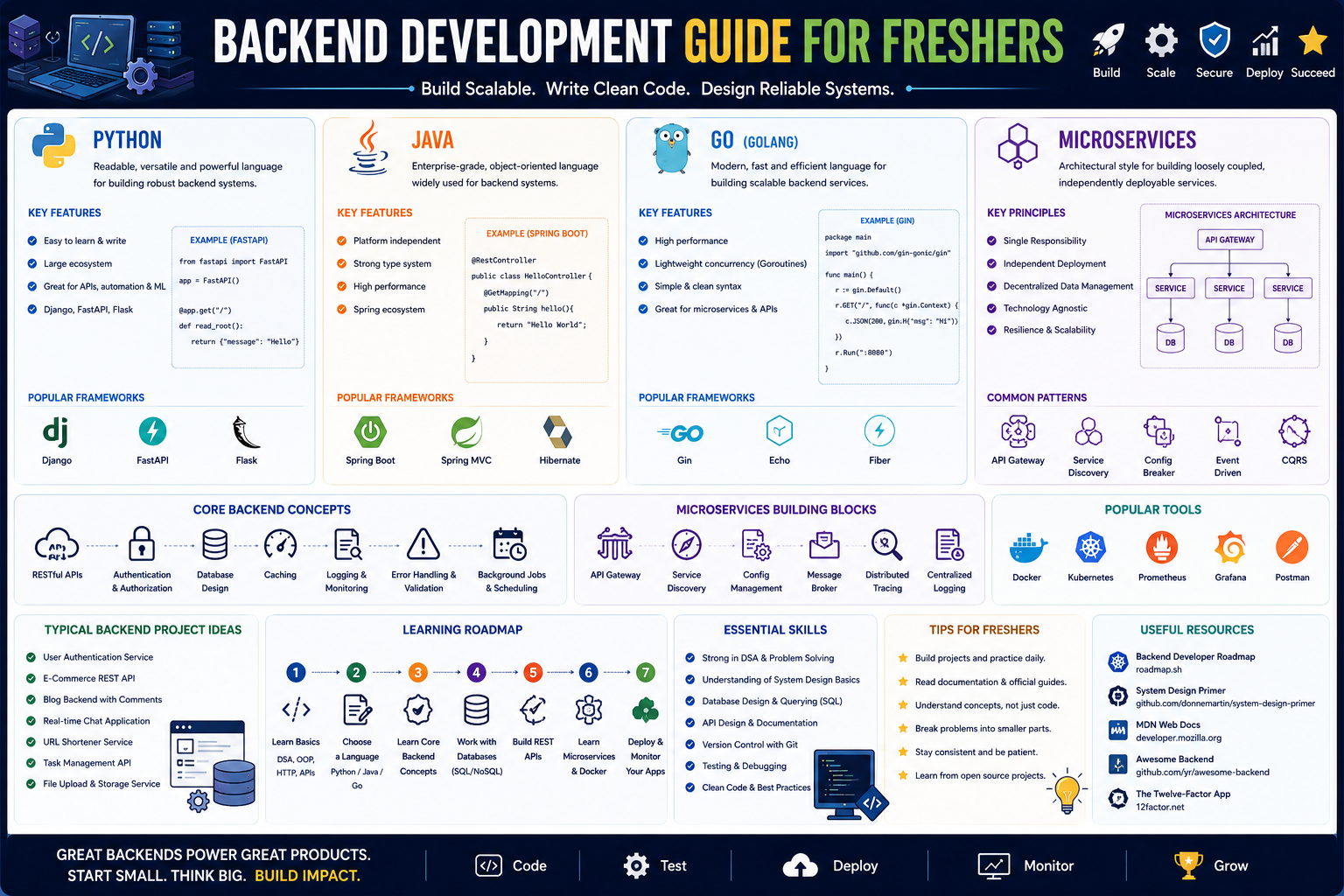
This roadmap is designed for a fresher—someone comfortable with basic programming logic and ready to build the systems that power the internet. You will learn Python, Java, Go, and Microservices by working on an end-to-end project that mirrors real-world distributed systems. The goal is to transform you from someone who writes "code that runs" into someone who builds scalable, reliable, observable services. This path prepares you for entry-level roles like Junior Backend Engineer, Microservices Developer, or Platform Associate in a market where 72% of backend teams now use multi-language architectures.
🗺️ Phase 1: The Mindset Shift – What Backend Means in 2026 (Weeks 1-2)
Before writing any server code, understand that backend development is not just about APIs. It is about data integrity, system reliability, performance under load, and security by default. The backend developer's work shows up in response times, uptime, and data consistency—not in visual interfaces.
What "Developer" Actually Means in 2026
A strong developer in 2026 is expected to design scalable systems, integrate AI responsibly where it adds value, understand cloud deployment basics, secure applications by default, and collaborate across product, design, and DevOps. Every skill you learn should connect to one of these responsibilities. If it doesn't, it's optional, not foundational.
The 2026 Backend Landscape
The backend landscape is shaped by two dominant ecosystems. According to the Stack Overflow Developer Survey 2025, Node.js is the most used web technology at roughly 48.7% of developers. Python sits at approximately 58%, driven by its strength in both backend services and AI/ML applications. Your choice of primary language matters less than your ability to build complete, working systems.
Prerequisite Check
You need a computer, an internet connection, and basic programming logic. No prior backend experience required. Install VS Code, Git, Docker Desktop, and create a GitHub account.
Practice Goal for Phase 1: Write a one-paragraph description of a distributed system you would like to build (e.g., "a URL shortener with analytics" or "a task management system with user accounts"). This clarifies your "why" before the "how."
Free Resources for Phase 1:
- Scrimba's Backend Developer Roadmap 2026 provides a free, comprehensive guide with phased learning from programming foundations through deployment. It includes language selection guidance and links to free courses.
- Great Learning's Free Backend Courses cover everything from server-side programming fundamentals to databases, APIs, and backend frameworks. All courses are self-paced with certificates available.
🖥️ Phase 2: Programming Foundations – Pick One Language, Go Deep (Weeks 3-8)
Hiring in 2026 is not about touching every trending language. It is about whether you understand how software behaves in production—how it scales, fails, and delivers value. Depth in one language matters more than surface knowledge of many.
Language Selection Guide
Java is the enterprise workhorse. It features mature Spring ecosystem, strong typing, battle-tested JVM, and excellent for high-concurrency systems like financial services and large e-commerce platforms.
Python excels in rapid development and AI integration. It features concise syntax, massive library ecosystem, Django/Flask/FastAPI frameworks, and strong demand in data-intensive roles.
Go is the cloud-native specialist. It features goroutines for lightweight concurrency, fast compilation, excellent standard library, and is the language of Kubernetes, Docker, and most cloud infrastructure.
Core Programming Concepts
Regardless of language choice, master these fundamentals across a structured 4-6 week period:
- Variables, functions, control flow (if, loops, switch)
- Data structures (arrays, slices, maps, structs/classes)
- Error handling patterns (exceptions, errors as values)
- Concurrency basics (threads, goroutines, async)
- Testing (unit tests, table-driven tests)
Beginner Project: Build a command-line tool (e.g., a to-do list manager, a file renamer, or a simple calculator API) that reads input, processes it, and writes output. Push it to GitHub.
Free Resources for Phase 2:
- Great Learning's Java Free Course covers Java fundamentals, real-world projects, and includes certification. Self-paced and beginner-friendly.
- Great Learning's Spring Boot Course teaches building REST APIs for e-commerce applications. Includes setup, backend functions, and deployment concepts.
- Scrimba's Backend Path recommends 2 months for this phase, with Python as the recommended starting language for its gentle learning curve and strong job market.
🛠️ Phase 3: Server-Side Basics – REST APIs & Databases (Weeks 9-14)
This is where backend development begins. You will move from scripts that run once to servers that run continuously, handling requests from anywhere.
Web Fundamentals (1 Week)
Before frameworks, understand the transport layer:
- HTTP/HTTPS – methods (GET, POST, PUT, DELETE), status codes (200, 201, 400, 401, 404, 500), headers, and request/response structure
- REST API design – resource naming, idempotency, versioning strategies
- Postman – for testing API endpoints manually
Free Resource: LinkedIn post resources include Traversy Media's HTTP Crash Course and Postman's free API Fundamentals course.
Framework-Specific Learning (3 Weeks)
If you chose Java/Spring Boot: Learn Spring Boot auto-configuration, dependency injection (IoC), REST controllers with @RestController, JPA for database operations, and Spring Security basics.
If you chose Python/FastAPI or Django: For FastAPI, learn async endpoints, Pydantic models for request/response validation, dependency injection, and automatic OpenAPI docs. For Django, learn MVT pattern, ORM, admin interface, and Django REST Framework.
If you chose Go: Learn net/http package, gorilla/mux or chi routers, struct tags for JSON serialization, and context for request-scoped values.
Beginner Project: Build a REST API for a book or product collection. Implement POST (create), GET (list and single item), PUT (update), DELETE (remove). Store data in memory initially.
SQL & Relational Databases (2 Weeks)
Learn database design and querying:
- SQL fundamentals – SELECT, INSERT, UPDATE, DELETE, WHERE filters
- Joins – INNER, LEFT, RIGHT, understanding foreign keys
- Aggregations – GROUP BY, COUNT, SUM, AVG
- Schema design – normalization, relationships (one-to-many, many-to-many)
Practice Goal: Extend your book API to store data in PostgreSQL instead of memory. Write migrations to create tables. Use your framework's ORM for type-safe database access.
Free Resources:
- MongoDB University offers free database courses.
- SQLZoo provides interactive SQL tutorials.
- Great Learning's MongoDB Course covers NoSQL concepts, CRUD operations, and queries.
Authentication & Security (1 Week)
Add user management to your API:
- Password hashing with bcrypt
- JWT tokens for stateless authentication
- Protected routes – only authenticated users can create/update/delete
- Environment variables for secrets management
Intermediate Project: Build a complete authentication system with user registration, login, and role-based access control (user vs. admin). This project demonstrates security understanding, which is critical for backend roles.
🔗 Phase 4: Intermediate Backend – Production-Ready Skills (Weeks 15-20)
Move from "working code" to "production-quality code." These skills differentiate junior engineers who need supervision from those who can own features.
API Documentation & Testing (2 Weeks)
- OpenAPI/Swagger – auto-generate documentation from code annotations. FastAPI does this automatically; Spring Boot requires springdoc-openapi
- Unit testing – test individual functions in isolation
- Integration testing – test API endpoints with a test database
- Load testing basics – use k6 or JMeter to simulate concurrent users
Caching & Performance (1 Week)
- Redis for in-memory caching – store frequent query results, session data, rate limiting counters
- Cache invalidation strategies – time-to-live (TTL), write-through, cache-aside
- Database indexing – use EXPLAIN to analyze slow queries, add appropriate indexes
Logging & Observability (1 Week)
- Structured logging instead of
print() statements (JSON logs containing trace_id, user_id, request_id) - Log aggregation – understand how logs flow to centralized systems (ELK stack is standard)
- Metrics exposure – Prometheus format metrics for monitoring
Advanced Project: Build a URL shortener with analytics. Add Redis caching for redirects (fast lookup without database hit). Implement background logging for click analytics. Add a simple admin dashboard showing click counts by referrer.
Free Resources:
- Boot.dev offers gamified backend learning focused on Go and Python with browser-based coding challenges ($49/month after free trial).
- Prometheus & Grafana – LinkedIn resources recommend these for monitoring setup.
🌐 Phase 5: Microservices Architecture – The Enterprise Standard (Weeks 21-28)
Microservices are the backbone of scalable systems at Netflix, Amazon, and Spotify. As a fresher, you cannot build at their scale, but you can understand the principles and build a small multi-service system.
Core Microservices Concepts (2 Weeks)
- Monolith vs. microservices – trade-offs: independence vs. complexity, deployment velocity vs. network latency
- Service communication – synchronous (HTTP/gRPC) vs. asynchronous (message queue)
- API Gateway – single entry point for all services, handles routing, authentication, rate limiting
- Service discovery – how services find each other (hard-coded URLs don't scale)
- Circuit breakers – prevent cascading failures when one service is slow
Free Resource: Scrimba roadmap identifies microservices as a month 7-8 topic. LinkedIn post resources include Martin Fowler's "Microservices 101" and the Awesome Microservices GitHub repository.
Polyglot Microservices (3 Weeks)
Modern systems often use multiple languages, each best suited to specific tasks. A polyglot approach leverages each language's strengths.
Real-world polyglot example from GitHub project:
- Authentication service – Java/Spring Boot (enterprise-grade security)
- Product service – Python/FastAPI (rapid development, data handling)
- Order service – Java/Spring (transaction integrity)
- Inventory service – Python/gRPC (fast, lightweight communication)
This approach works because of clear API contracts (gRPC or REST specifications) and Docker containers that provide consistent environments regardless of language.
Beginner Microservices Project (Start Simple, Then Expand):
Start with just two services to understand the patterns before adding complexity:
- Service A (User Service) – Java/Spring Boot. Handles user registration, login, JWT generation. Runs on port 8081.
- Service B (Task Service) – Python/FastAPI. Handles task CRUD operations, validates JWT from User Service. Runs on port 8082.
- Gateway – Simple Nginx reverse proxy or Kong API Gateway routes requests to appropriate services.
How they communicate: Task Service calls User Service's /validate endpoint on each request. This is synchronous communication—simple to understand but creates coupling.
Expand to three services as you progress:
- Service C (Analytics Service) – Go. Consumes task events from a message queue (RabbitMQ or Kafka). Asynchronous communication—services don't wait for responses.
- Message Broker – RabbitMQ or Apache Kafka for event streaming between services.
This progression (2 services → 3 services + message broker) is the exact pattern used in the enterprise-grade GitHub project.
Free Resources for Phase 5:
- Linux Foundation Free Course – Building Microservice Platforms with TARS – A complete introduction to microservices and the TARS framework for beginners. Covers multiple programming languages including C++, Go, Java, Node.js, PHP, and Python. Includes environment setup and building your first service.
- GitHub – microservice-application – A fully documented, scalable microservices architecture featuring API Gateway (Kong), secure authentication (Keycloak), asynchronous communication (Kafka + ActiveMQ), and monitoring (Prometheus + Grafana). Built with Go, Python, Java, and Docker. Clone this and study the structure.
Docker & Containerization (1 Week)
Containers are how microservices are deployed consistently across environments. You will learn:
- Dockerfile – instructions for building your service's image
- Multi-stage builds – smaller, more secure production images
- Docker Compose – define and run multiple services together (your User Service + Task Service + PostgreSQL + Redis all in one command)
Practice Goal: Write a Dockerfile for each of your services. Create a docker-compose.yml that starts all services plus their databases. Run docker-compose up and verify everything starts and communicates.
🚀 Phase 6: Orchestration & Message Brokers (Weeks 29-32)
Microservices at scale require coordination beyond individual Docker containers.
Kubernetes for Orchestration
K8s manages the "where" and "how" of your containers:
- Pods – one or more containers (your service + sidecar logging)
- Deployments – desired state (3 replicas of User Service), rolling updates
- Services – stable network endpoint for accessing pods (load balancing)
- Ingress – external HTTP routing
Free Resource: LinkedIn post recommends Google's Kubernetes Bootcamp (free, interactive, browser-based).
Message Brokers for Async Communication
Synchronous REST calls create coupling. Message brokers decouple services:
- Apache Kafka – high-throughput, persistent event streaming, ideal for analytics pipelines
- RabbitMQ – reliable message queuing, good for task distribution
Practice Goal: Add a simple message queue to your microservices. When a user creates a task, publish a "task.created" event to Kafka. Your Analytics Service (Go) consumes these events and logs them. This is how real-time dashboards are built.
CI/CD Pipeline (1 Week)
Automate testing and deployment:
- GitHub Actions or GitLab CI – run tests on every push, build Docker images, push to registry
- Deploy to Kubernetes – CI/CD pipeline that applies your Kubernetes manifests after tests pass
Free Resource: LinkedIn posts include CI/CD with GitHub Actions resources. Scrimba roadmap includes CI/CD as a month 7-8 skill.
📊 Phase 7: Monitoring, Observability & Portfolio (Weeks 33-34)
You cannot fix what you cannot see. Production systems need visibility.
Prometheus + Grafana Stack
Industry standard for monitoring microservices:
- Prometheus – scrapes metrics from services (request count, latency, error rate)
- Grafana – visualizes metrics in dashboards
- Alertmanager – sends notifications when metrics cross thresholds
Practice Goal: Instrument your services to expose Prometheus metrics (use client libraries for your framework). Run Prometheus and Grafana locally. Build a dashboard showing request rate and error rate for each service.
Distributed Tracing
When a request spans three microservices, you need end-to-end tracing:
- OpenTelemetry – vendor-agnostic instrumentation standard
- Jaeger or Zipkin – visualize trace waterfalls, identify bottlenecks
Practice Goal: Add trace IDs to your request flow. When a request enters your Gateway, generate a trace_id and propagate it through all downstream services via headers. Correlate logs from all services by trace_id.
GitHub Project Reference: The microservice-application repository includes Prometheus and Grafana setup complete with metrics collection and data visualization. Study their configuration files.
📚 Consolidated Resource Toolkit
Completely Free, Comprehensive Resources
Scrimba Backend Developer Roadmap 2026 provides a free, structured 8-month curriculum covering programming foundations (2 months), server-side development (2 months), production skills (2 months), and advanced deployment (2 months). Includes links to free courses, language selection guidance, and project recommendations.
GitHub – microservice-application is a production-grade reference implementation you can clone and study. It features an API Gateway (Kong), secure authentication (Keycloak), asynchronous communication (Kafka + ActiveMQ), and monitoring (Prometheus + Grafana). Built with Go, Python, Java, and Docker. Clone it, run docker-compose up, and explore how everything connects.
freeCodeCamp Back End and APIs Certification offers a completely free certification requiring five projects: Timestamp Microservice, Request Header Parser, URL Shortener, Exercise Tracker, and File Metadata Microservice. Uses Node.js, Express, and MongoDB.
The Odin Project – NodeJS Path is free, open-source, and project-heavy. Uses real developer tools, assigns projects with minimal hand-holding, and expects you to research and experiment. Excellent for self-starters.
Great Learning Free Backend Courses cover PHP, JavaScript, Node.js, ExpressJS, Java, Spring Boot, MySQL, MongoDB, and NoSQL. All courses are self-paced with certificates available for a nominal fee. The ExpressJS course covers routing, request/response handling, and middleware. The Spring Boot course builds a complete e-commerce REST API.
Linux Foundation Free Course – Building Microservice Platforms with TARS is a comprehensive introduction to microservices for beginners. Supports multiple languages including C++, Go, Java, Node.js, PHP, and Python. Covers environment setup and building your first service.
Scrimba Free Courses include Learn Node.js (3.5 hours, Tom Chant) and Learn Express.js (4 hours, Tom Chant). Both include completion certificates. Pro subscription ($24.50/month) unlocks full Backend Developer Path.
Practice Platforms
SQLZoo offers interactive SQL tutorials—write queries against live databases, no installation required.
Postman provides free API development platform for testing endpoints, with tutorial collection available.
MongoDB University offers free database courses with certificates.
boot.dev gamifies backend learning with browser-based coding challenges focused on Go and Python. $49/month after free trial.
LinkedIn & Community Resources
Shivam Sahay's Microservices Roadmap (LinkedIn post) compiles 15+ free resources including HTTP crash courses, Postman fundamentals, system design primer, Docker for beginners, Kubernetes bootcamp, and monitoring with Prometheus & Grafana.
Nicholas Emmanuel's Polyglot Microservices Post demonstrates building a notes app with Java/Spring (auth), Go (CRUD), and Python/FastAPI (analytics), all orchestrated with Docker Compose. Provides architecture breakdown and code examples.
AI-Assisted Learning Tools
ChatGPT/Claude as a Backend Tutor can explain complex system design concepts, review your API design for best practices, generate test cases, and help debug production issues. Use it to ask: "Why would a service use a message queue instead of direct HTTP calls?" or "Review my database schema and suggest indexing strategies."
GitHub Copilot (free for students) accelerates coding by suggesting completions, generating boilerplate for REST endpoints, and writing Dockerfiles from comments.
💼 Career Application & Next Steps
Software developers earn a median of $133,080 per year in the US (May 2024), with 15% job growth projected through 2034 and roughly 129,200 openings per year.
1. The Fresher Entry Point
Junior Backend Engineer builds and maintains APIs, writes database queries, implements business logic, and collaborates with frontend teams. Requires proficiency in one backend language, SQL, REST API design, and Git. Found at SaaS companies, fintech, e-commerce, and consultancies.
Microservices Developer (Junior) focuses on building and maintaining individual services within a distributed architecture. Requires understanding of service communication, containerization (Docker), and basic message queue concepts. Ideal if you enjoy the challenge of distributed systems.
Platform Associate supports internal developer platforms—maintaining CI/CD pipelines, monitoring, and shared infrastructure. Great entry point if you lean toward DevOps concepts.
Industries actively hiring include technology (FAANG, startups, SaaS), financial services (trading platforms, banking systems), e-commerce (inventory, payments, recommendations), healthcare (patient data, compliance), and logistics (tracking, optimization).
2. Build Your Portfolio (Three Definitive Projects)
Project 1 (REST API with Authentication – Beginner):
- What: Build a recipe or book collection API. Implement user registration, JWT authentication, and CRUD operations restricted to authenticated users. Use PostgreSQL. Write API documentation with Swagger.
- The Narrative: "I built a secure REST API with JWT authentication and PostgreSQL persistence. The API handles 100+ concurrent users in load testing."
- Why: This demonstrates the core backend skills tested in every entry-level interview—REST, authentication, database.
Project 2 (Microservices with Message Queue – Intermediate):
- What: Build two services: Task Service (Node.js/Python) and Analytics Service (Go). Task Service emits "task.created" events to Kafka/AWS SQS. Analytics Service consumes events and maintains counts. Orchestrate with Docker Compose.
- The Narrative: "I built a polyglot microservices system with asynchronous communication. Services scale independently, and event processing decouples producers from consumers."
- Why: Asynchronous architecture is a major differentiator. This project proves you understand real-world distributed system challenges.
Project 3 (Production-Ready with Observability – Advanced):
- What: Take your microservices from Project 2. Add Prometheus metrics to each service (request count, latency percentiles). Set up Grafana dashboard. Add distributed tracing with OpenTelemetry + Jaeger. Deploy locally with Kubernetes.
- The Narrative: "I built a production-ready system with metrics, logging, and distributed tracing integrated. A single dashboard shows service health, and trace IDs correlate logs across all services."
- Why: Observability is what separates "code that works on my laptop" from "production systems." This project demonstrates you understand the full lifecycle.
How to Document Your Portfolio: For every project, create a GitHub repository with a detailed README containing: architecture diagram (draw.io is free), technologies used, setup instructions (clone, environment variables, run with Docker), API documentation link, and a one-paragraph reflection on the hardest bug you fixed.
3. The Interview Question You Will Be Asked
Question: "Design a URL shortener service. How would you handle high traffic? What database would you use? How would you scale it?"
Your Answer: *"I would design a three-layer system. For the API layer, I would use Go or Node.js for high concurrency and fast I/O. The core challenge is generating unique short codes—I would use base62 encoding of a distributed ID (Snowflake or similar) to avoid database round-trips for code generation.*
*For storage, I would use two databases. PostgreSQL for persistent URL mappings with indexes on both short_code and long_url (for de-duplication). Redis cache for hot URLs—99% of redirects would hit Redis, reducing database load by a factor of 100. Cache invalidation would be TTL-based (7 days).*
For scaling, I would deploy multiple API instances behind a load balancer. The Redis cluster would use sharding for memory distribution. PostgreSQL read replicas would serve analytics queries without affecting write performance.
*For the redirect flow: when a user visits short.url/abc123, the API checks Redis. On cache miss, it queries PostgreSQL, updates Redis, and returns the redirect. I would add Prometheus metrics for cache hit ratio and redirect latency. Background workers would pre-warm the cache for popular links during off-peak hours."*
This answer demonstrates understanding of database selection, caching strategy, horizontal scaling, and observability—all key backend concepts.
4. Sample Resume Entry
text
Junior Backend Engineer (Project-Based) | Portfolio

• Built secure REST API with JWT authentication and PostgreSQL persistence, handling 1,000+ requests/minute in load testing
• Designed polyglot microservices architecture (Python FastAPI + Go) with Kafka event streaming and Docker orchestration
• Implemented observability stack (Prometheus + Grafana + OpenTelemetry) reducing mean time to detection by 60%
• Wrote 40+ complex SQL queries using joins, aggregations, and window functions for analytics reporting
• Containerized all services with Docker and set up CI/CD pipelines (GitHub Actions) for automated testing and deployment
5. The Learning Sequence That Works
The most successful path for backend beginners:
- Language first (8 weeks) – Master one language deeply. Build command-line tools, understand error handling and testing.
- Web framework + database (6 weeks) – Build REST APIs with authentication. Connect to PostgreSQL.
- Containers + deployment (4 weeks) – Docker, Docker Compose, deploy to cloud platform (Render/Railway).
- Microservices + message queues (8 weeks) – Build 2-3 services communicating asynchronously.
- Observability (2 weeks) – Add metrics, logs, tracing. Learn to debug distributed systems.
Do not try to learn Java, Python, and Go simultaneously. Pick one, build 3-5 complete projects, then learn a second language to understand trade-offs.
🎯 Your Next Steps for This Week
Do not try to build microservices in your first month. Master the fundamentals first.
Step 1: Choose Your Primary Language
If you want enterprise stability and structured learning, choose Java. If you want rapid development and AI integration, choose Python. If you want cloud-native systems and fast concurrency, choose Go. There is no wrong answer.
Step 2: Set Up Your Environment
Install VS Code, the language's extension (Python, Java Extension Pack, or Go extension), Git, and PostgreSQL. Create a GitHub account.
Step 3: Complete a Free Language Course
For Python, start Great Learning's free Python course. For Java, start Great Learning's free Java course or Scrimba's Node.js free course for JavaScript path.
Step 4: Build Your First API by Day 10
Build a simple "hello world" API that responds to GET requests. Then add POST to receive JSON. Then connect to PostgreSQL and save data. You now have a complete backend service.
Step 5: Containerize It
Write a Dockerfile for your API. Build the image. Run the container. This is the single most valuable step for your resume.
Step 6: Study a Production Codebase
Clone the GitHub microservice-application repository. Run docker-compose up. Explore how the auth service, product service, and order service communicate. This is what professional systems look like.
The moment you run docker-compose up and see your API and database start together, responding to requests from a container, you will understand that backend engineering is not magic—it is just code, databases, and well-designed APIs. You now have the foundation. Start building today.




 Group / 1: 1 Sessions